Mold on a vinyl record comes off with a damp cloth, 70% isopropyl alcohol and distilled water, and a lot more care than a quick wipe. The work takes 20 minutes per record plus a full day of drying, and the real risk is doing it in a rush: bleach, warm soapy water, and a soaked label do more harm than the mold ever did.
This guide covers the whole job, from spotting the growth to storing the record somewhere it will not come back. The method works on light surface spotting and on a mildly neglected crate. Severely saturated sleeves, records that were actually submerged in water, and anything with a musty smell in an enclosed room are a different job, and I will tell you when to stop and call a conservator.
One thing worth saying up front: the stain will probably still be there afterward. Mold leaves a mark in the vinyl that no cleaning removes, which is why most people assume their clean failed. What you are removing is living growth and the debris it holds, and the signs that it worked are a record that plays quieter and a crate that no longer smells. If you go in expecting a like-new disc, the process feels like a disappointment instead of a success.
Timing works out to roughly 20 minutes of hands-on work per record and at least a day of drying. The drying is not optional and it is not a suggestion, which is the single most common way a careful cleanup gets undone.
Table of Contents
- What You Need
- How Different Cleaning Solutions Compare on Mold
- Step-by-Step: How to Get Rid of Mold on Vinyl Records
- How to Get Rid of Mold on Vinyl Records: Isolate and Identify the Mold
- How to Get Rid of Mold on Vinyl Records: Remove Loose Mold Without Spreading It
- How to Get Rid of Mold on Vinyl Records: Clean the Record Surface Carefully
- How to Get Rid of Mold on Vinyl Records: Dry and Reinspect
- How to Get Rid of Mold on Vinyl Records: Prevent It from Returning
- Common Mistakes
- Frequently Asked Questions
- What kills mold on vinyl records?
- Can moldy records be saved?
- Can WD-40 clean vinyl records?
- Will vinegar and Dawn kill mold on records?
- Does Windex kill mold on vinyl?
- How long should a record dry after wet cleaning?
- Conclusion
What You Need
Set out everything before a single record leaves its sleeve. A missing glove or a missing drying rack is the reason a job half finishes and the discs go back in damp jackets.
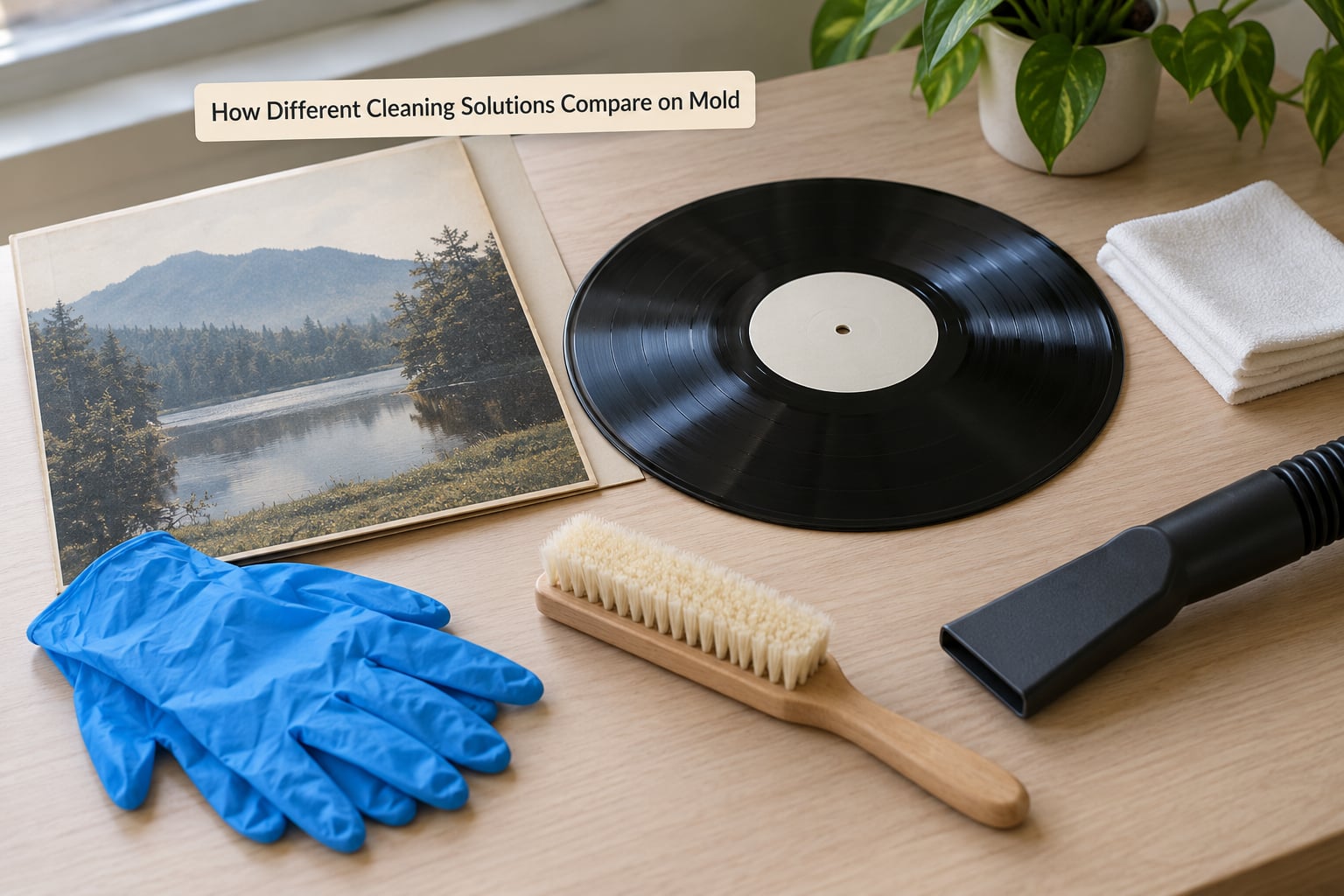
- Nitrile gloves. Disposable nitrile, not cotton. You are touching spores, and you are also touching a record that may have been handled by someone else.
- An N95 respirator or a well-fitting mask. Brushing dry mold pushes spores into the air, and a bedroom or closed office is the worst possible room for that.
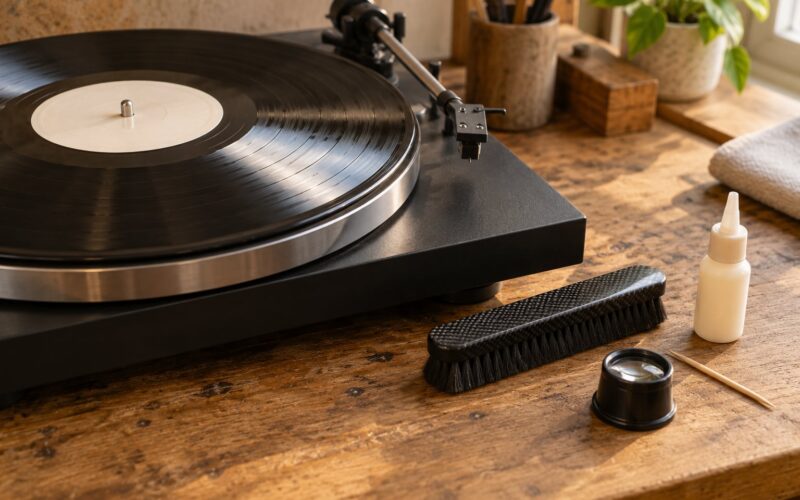
- Soft-bristled brush. A clean, dedicated paintbrush with soft bristles. Do not reuse a brush that has touched a turntable; grit is what scratches grooves.
- Low-suction vacuum with a brush attachment. A handheld with the lowest suction setting works. You want the spores to travel into the bag, not across the room.
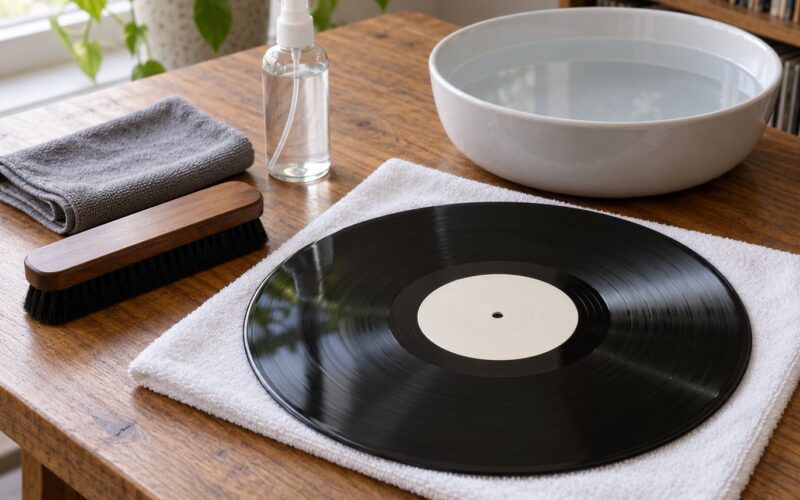
- Cleaning solution appropriate for vinyl. A 50/50 mix of distilled water and isopropyl alcohol at 70% or higher, plus a small amount of plain dish soap if the record is genuinely greasy.
- Lint-free cloths or purpose-made record cleaning pads. Several of them, because you will not use one cloth for more than one record.
- A soft brush and lint-free cloth for jackets. The jacket is a different surface with different rules.
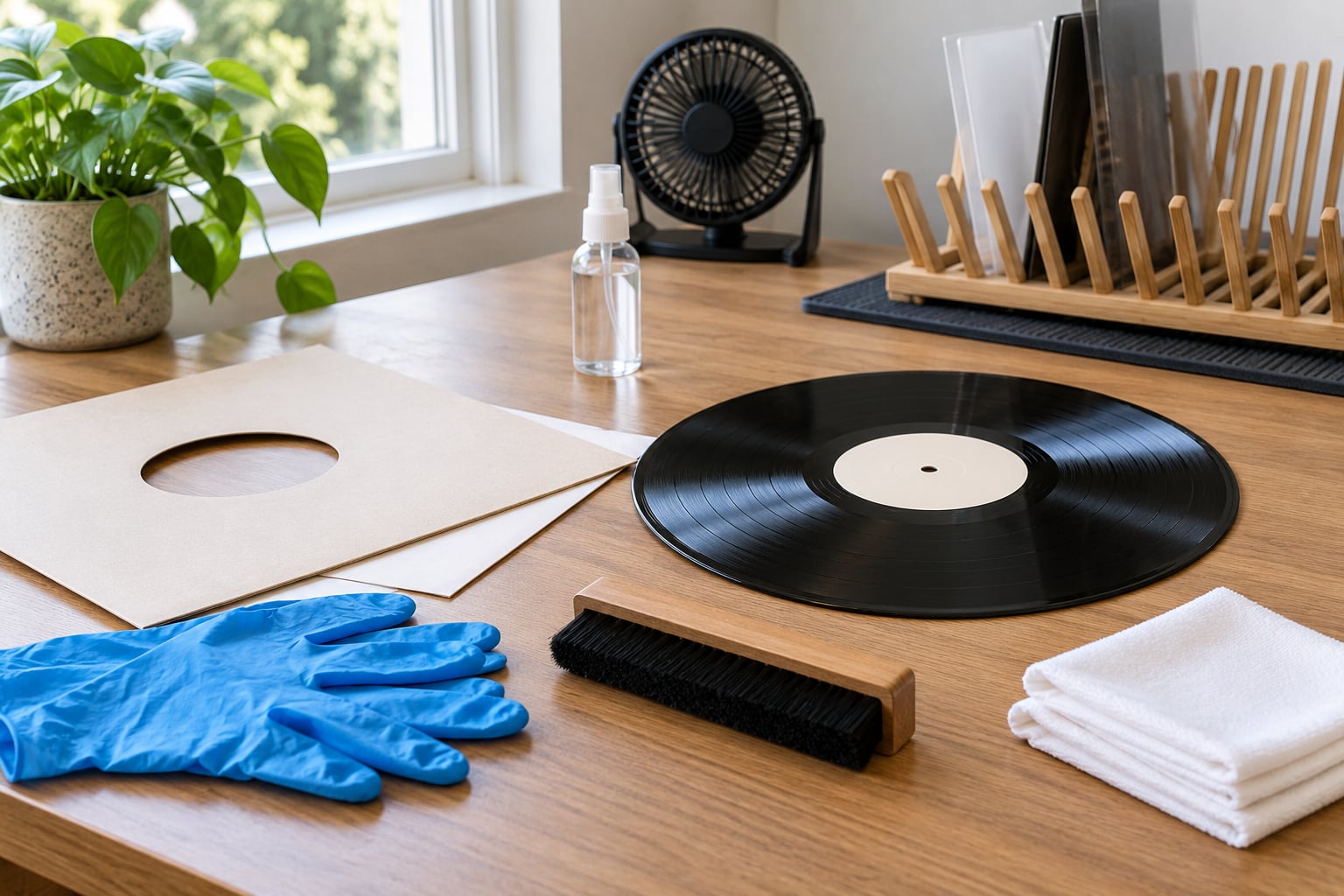
- A clean, ventilated drying area. A dish drying rack, a fan, and an outdoor spot or a bathroom with the door open and a purifier running. Nothing closed, nothing carpeted.
- Fresh inner sleeves. Anti-static poly sleeves, one per affected record. Old sleeves carry spores and go straight in the bin.
Skip the bleach, the steam cleaner, the wood glue, and the Magic Eraser. They show up constantly in forum threads for mold, and every one of them is a bad idea on vinyl.
How Different Cleaning Solutions Compare on Mold
Collectors argue about the right fluid more than almost anything else in record care, so it helps to lay the options out. Each row below is safe or not, and whether it kills mold or merely shifts dirt around.
| Solution | Kills mold | Safe on vinyl | Best used on |
|---|---|---|---|
| Isopropyl alcohol 70% plus distilled water, 50/50 | Yes | Yes, with the label protected | The record surface |
| Enzyme cleaner | Yes, on organic growth | Yes | Pre-treatment on heavy soiling |
| White vinegar | Partly, it damages spores | Careful, it is acidic | Jackets and sleeves |
| Plain dish soap and warm water | Weakly, it loosens dirt | Careful, it means soaking | Jacket surfaces |
| Hydrogen peroxide | Yes, at low dilution | Careful, it bleaches paper | Jackets only, never the label |
| Bleach | Yes | No | Hard surfaces away from records |
| WD-40, Windex, glass cleaner | No | No | Nothing in a record collection |
Two mixes show up repeatedly on enthusiast forums and both work: 50:50 bioethanol and distilled water, and 75% distilled water with 25% alcohol plus a couple of drops of soap. The bioethanol version is widely used because it mixes cleanly and evaporates fast, with the one drawback that it oxidises and turns brown in the bottle over time, so mix it fresh.
A handful of the more expensive machines can replace the wet-cloth step for a large batch. A vacuum record cleaner draws solution through the grooves and pulls it back out, and it handles mold about as well as it handles dust. An ultrasonic cleaner uses cavitation bubbles to dislodge organic material from the groove walls and is the most thorough option for records that have sat wet, provided the machine is rated for records and the disc is not warped. Either way the drying protocol is identical.
Step-by-Step: How to Get Rid of Mold on Vinyl Records
The safe process has four moves: isolate the affected records, take off what is loose without spreading spores, clean the disc surface with the least aggressive method that works, and dry everything completely before it goes back in a sleeve. Rushing the last step is how mold returns within a week.
How to Get Rid of Mold on Vinyl Records: Isolate and Identify the Mold
Take affected records out of the collection and away from clean records before you do anything else. Mold spreads by contact, by damp paper, and by air, so a crate where spotting is visible on three discs is really a crate where you cannot see all of them yet. Bag the flagged records, mark the crate, and work through it in batches rather than sorting and cleaning at the same time.
Then work out what you are actually looking at. Real mold on vinyl is fuzzy, patchy, and grey, black, green or orange. It smells musty or sweet in a warm room, and it transfers to a damp white cloth if you press it. Static dust wipes off in one pass and leaves no mark. Pressing bloom is a faint, even haze across the whole disc that smells like the vinyl itself and does not transfer. A water stain is flat and translucent, often in a ring shape, and sits on the jacket more than the disc.
Get a conservator involved when the disc is warped, when the label is already lifting or peeling, when the sleeve and jacket are stuck together, or when the affected batch is large enough that you would need a ladder. Mold remediation on a bargain bin copy and mold remediation on a first pressing are not the same commitment, and the valuable ones are worth a professional opinion before you start.
How to Get Rid of Mold on Vinyl Records: Remove Loose Mold Without Spreading It
Dry removal first, and it kills two birds: it takes the bulk of the spores off the surface and it lets you see how deep the problem goes before water touches anything.
Work outdoors or in the ventilated room, wearing gloves and the mask, with the vacuum running on low suction through a brush attachment. Hold the disc by the edges, keep it flat on the work surface, and brush in the direction of the grooves. Never across them. Move the brush in long strokes from the outer edge toward the label, and lift it off the record at the end of each stroke rather than dragging it back.
Vacuum from the outside of the disc toward the center, not the reverse, so you are not pulling loose material back over the label. Stop and empty the vacuum canister after every record or two. Spores that sit in a dirty canister come back into the air the moment you reopen it, and that is a common way people clean a crate and end up with a bigger problem.
Collectors on the vinyl forums describe the same order of operations: dry first, then wet. A dedicated brush kept only for mold cleanup is a sensible habit too, since a general cleaning brush carries the debris you just removed straight onto your clean records.
How to Get Rid of Mold on Vinyl Records: Clean the Record Surface Carefully
Wet cleaning is the right call once loose mold is off and spotting or surface noise remains, or when the record has a greasy film that dry methods will not shift.
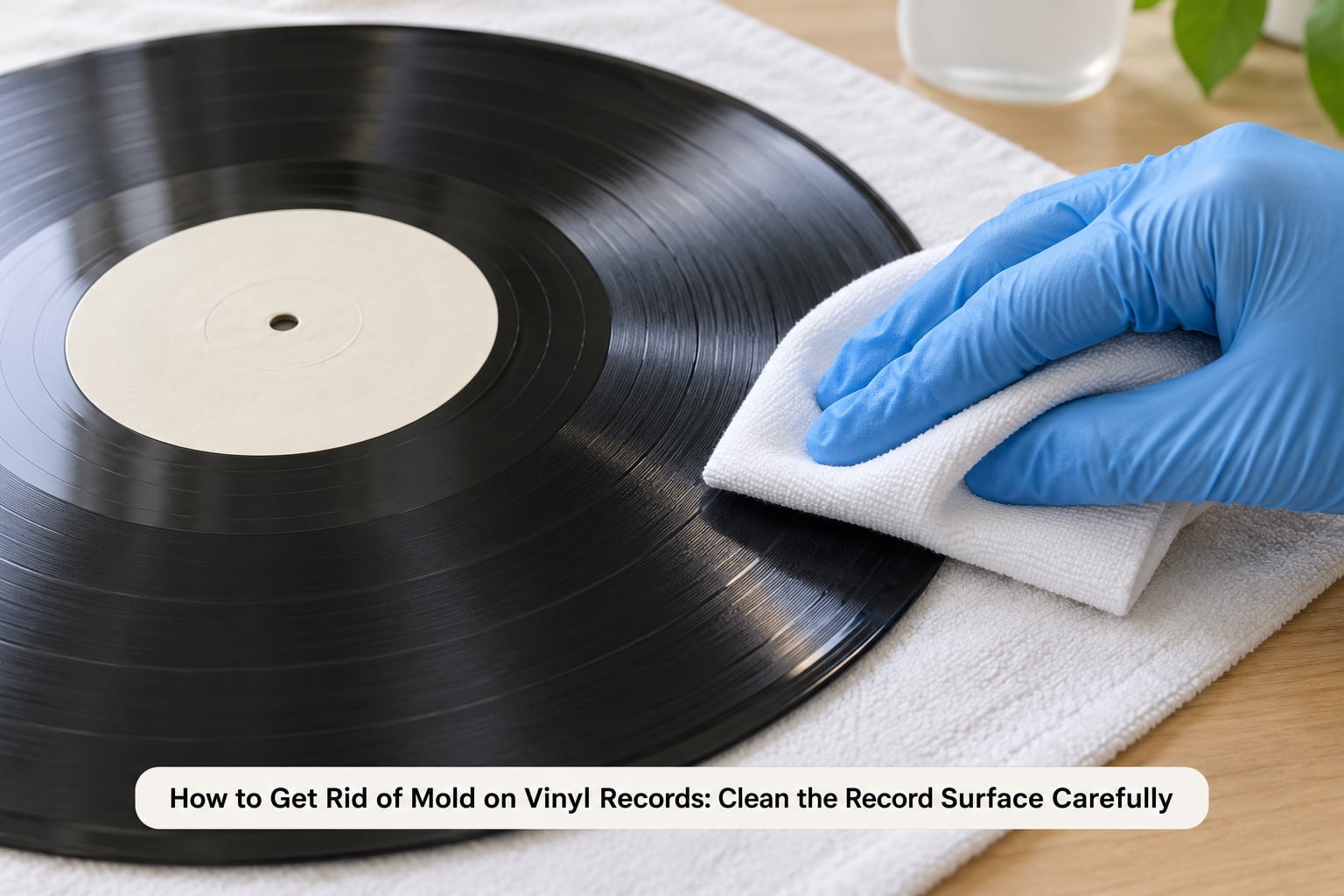
Mix 50/50 distilled water and isopropyl alcohol at 70% concentration or higher in a clean spray bottle. The distilled water matters: tap water leaves mineral deposits in the grooves that show up as crackle. The alcohol dissolves the fungal mass and the grime holding it to the vinyl, and the water carries it away. On a heavily soiled record, enthusiasts add two or three drops of plain dish soap per cup. Soak recipes reported on enthusiast forums, from 75% water and 25% alcohol with a drop of soap to bioethanol at 50:50 with distilled water, all work. The mix is flexible; the technique is not.
Protect the label before any moisture lands on it. A paper label absorbs water, lifts, and then traps the record and the jacket together. Press a label protector film over the center, or slide a square of wax paper under the label area with a clean fingertip smoothing it flat. Skip this on a bare disc with no label, and never use tape directly on the vinyl.
Then wipe along the grooves. Dampen a lint-free cloth so it is wet but not dripping, and run it around the disc in the direction the grooves travel, following the curve from the outer edge to the label. Keep the cloth flat and the pressure light. If the cloth is soaked, you are pushing water into the label and the jacket; if it is dry, you are grinding debris across the grooves.
For a second pass, move the cloth one groove inward rather than re-wiping the same track. Every pass carries material out of the groove, and going back over ground just re-wets what you already lifted. Turn the record over and repeat. For heavy growth, a soft-bristled brush run along the grooves with the solution dripping onto the brush is the traditional approach on forum threads, and it does reach deeper than a cloth alone.
Stop before you overwork it. Cleaning removes the mold and the noise it caused; it does not restore worn grooves. If crackle is still there after a full pass and a dry brush, you are probably hearing groove wear rather than dirt.
How to Get Rid of Mold on Vinyl Records: Dry and Reinspect
Drying is the step that decides whether the job held. A thin film of moisture trapped in a sleeve is exactly the condition mold needs, and records put back into jackets too early are the most common way collectors end up cleaning the same crate twice.
Stand records vertically in a clean dish rack or between two upright boards so air moves on both faces. Not flat in a pile, and not leaning on anything. Put a fan on them, keep the room ventilated, and give each record a minimum of 24 hours before it goes near paper again. Open the jacket and sleeve and let them dry separately, spaced out with air on all sides.
Jackets and sleeves need their own treatment. Sunlight helps on paper sleeves only, and only for a short exposure; put the sleeve in direct sun with the opening propped open, then brush off the residue. Wiping the inside and the outside of the jacket with a cloth lightly dampened with the alcohol solution does more for reinfestation than anything else in this guide. Baking soda sealed with the sleeves in a closed container for a few weeks absorbs residual odor and moisture, which is a popular trick on the record forums and it works well as a follow-up step.
When the records are dry, put each one in a fresh anti-static inner sleeve and a new outer sleeve. Never return a cleaned record to the old jacket. Old paper holds spores in its fibers even when it looks clean, and the smell comes back in a humid week.
Before you resleeve, hold the disc up to a light and check for any remaining fuzz or spotting. Play it once end to end and listen. One collector’s rule of thumb on the forums is to play the record after each clean and use the change in crackle as the measure of whether another pass is needed. If it is still improving, another full pass is worth it. If it has not changed, you have hit the groove wear floor and more cleaning will not help.
How to Get Rid of Mold on Vinyl Records: Prevent It from Returning
Mold needs moisture, warmth, and time, so storage is the whole game after cleaning.
Aim for a relative humidity in the 45% to 50% range in whatever room holds the collection, and get a cheap hygrometer to confirm it rather than trusting the season. If a basement or unheated closet regularly goes past 60%, records stored there will grow mold again within a few months no matter how well you clean them. Moving the collection to a climate-controlled room is cheaper than repeating this process every year.
Keep air moving. A purifier with a true HEPA filter in the storage room does more than most collectors expect, because it catches the spores that escaped during cleaning. Leave space between boxes on the shelf instead of pushing them to the back wall against a cold exterior wall, which is where condensation shows up first.
Shelving matters more than people expect. Wooden shelving and cardboard boxes in a damp room are exactly the organic material mold feeds on. Clean the shelf itself before it goes back into service, and if the smell of damp comes back in a box that is supposed to be empty, clean the box rather than filling it.
On handling, keep records upright in a tight spine, never loose in a horizontal pile where sleeves stick together and trap moisture. Grip the jacket at the edges and handle the disc by the rim, and keep the inner sleeve on whenever the record is not on the platter. For a routine check, look at the front row of every crate a few times a year, since mold shows up on the nearest records first and spreads outward from there.
Common Mistakes
Most mold damage I have seen on records was self-inflicted, and the cause is almost always one of these.
- Using bleach. Bleach is a mold killer on hard surfaces and a record destroyer. It attacks the vinyl, and rinsing PVC hard enough to remove bleach residue is how you etch a groove wall. Use alcohol instead.
- Spraying household glass cleaner on a disc. Ammonia-based sprays leave a residue that keeps attracting dust and can haze the vinyl. Windex is not a cleaning solution for records, and it is not a mold treatment either.
- Soaking the label. Water under a paper label lifts adhesive, and a lifted label traps the jacket to the disc. Protect it or keep the surface work dry.
- Scrubbing across the grooves. Cross-grain scrubbing is what a cloth does when it is dragged straight back and forth. It dulls the surface and wears grooves faster than a few hundred plays would.
- Opening a moldy crate in a bedroom. Spores in bedding and in a bedroom’s air ducts are how a cleaning project becomes a six-month remediation project. Work outdoors or in a hard-surfaced room with the door shut and a fan or purifier running.
- Returning records to damp jackets. A jacket that was part of the problem will re-moisten the record. New inner sleeve, new outer sleeve, jackets air-dried and wiped first.
- Believing the stain means the clean failed. Mold staining is generally permanent even when every living spore is gone. Judge the result by the noise and by the smell, not by the mark.
- Using WD-40 on a record. It will strip a sleeve and leave an oily film that holds dust. It kills nothing that a 50/50 alcohol and distilled water solution does not, and it leaves a mess behind.
Frequently Asked Questions
What kills mold on vinyl records?
A 50/50 mix of distilled water and isopropyl alcohol at 70 percent or higher kills surface mold on vinyl. The alcohol dissolves the fungal mass and the grime holding it to the record, and the water rinses both away. Wipe along the grooves with a lint-free cloth, brush the record dry, and air-dry it for at least 24 hours. Enzyme cleaners also work well as a pre-treatment on heavy organic growth.
Can moldy records be saved?
Most can, and the limit is almost always the sleeve rather than the disc. Vinyl itself is a stable PVC polymer and the record plays fine once the surface is clean. A warped disc, a lifting label, or a jacket stuck to the record means stop and get a conservator opinion. Judge success by the noise and the smell, not by the stain, because mold staining is usually permanent even when the mold is dead.
Can WD-40 clean vinyl records?
No. WD-40 is a petroleum solvent and a penetrating oil, so it strips shellac and lacquer finishes, leaves an oily film on the vinyl, and can migrate into jackets. The film holds dust and makes the record play dirtier than before. It also costs far more than the alcohol and distilled water solution that actually works. Leave it in the garage where it belongs.
Will vinegar and Dawn kill mold on records?
Vinegar and Dawn are a capable first pass on jackets and sleeves, and plenty of collectors use them on the disc for heavy soiling. On vinyl itself, a 50/50 isopropyl alcohol and distilled water mix is more reliable because it kills the mold and lifts it out of the grooves in one step. Use vinegar and Dawn on the paper parts, then finish the record with alcohol solution and distilled water.
Does Windex kill mold on vinyl?
No. Windex is an ammonia-based glass cleaner, so it does not reliably kill mold spores and it leaves a residue on the vinyl that attracts dust. Records cleaned with it often play with more noise afterward, not less. The mix that works is 50:50 isopropyl alcohol at 70 percent or higher and distilled water, applied along the grooves with a lint-free cloth.
How long should a record dry after wet cleaning?
Give it at least 24 hours of air-drying before it goes back into a sleeve. Stand records vertically in a dish rack or between two boards, run a fan on them, and keep the jackets and inner sleeves drying separately with air on all sides. Resleeving a record that is still damp puts moisture right back into the one place that grows mold fastest, and you will be cleaning the same crate again next month.
Conclusion
Start by isolating the affected records and identifying what you are actually dealing with, because that step is what keeps a three-record problem from becoming a whole-crate one. Once you know it is mold, use the least aggressive method that works: a soft brush and low-suction vacuum first, then a 50:50 solution of isopropyl alcohol and distilled water wiped along the grooves, with the label protected.
Then give the drying its full 24 hours, sleeve every cleaned record in fresh anti-static paper, and wipe the jackets on both sides before they go near the collection. The stain may stay; the spores will not, and that is the measure of a job done properly.
Finally, fix the room. Humidity under 50 percent, air movement, clean shelving, and a quick look at the front of every crate a few times a year is what stops the whole process from becoming an annual event.