To know how to tell if a vinyl record is a first pressing, match three things against a pressing database: the catalog number, the matrix or runout etching in the dead wax, and the label and sleeve design. Any one of those can be faked or reused, so the only reliable method combines them.
It takes about ten minutes per record once you have the tools. I’ve been through hundreds of used LPs from crates and marketplace listings, and the same routine settles almost every argument about whether a copy is a genuine first press or a later one wearing the same cover.
Table of Contents
- What You Need
- Step-by-Step: How to Tell If a Vinyl Record Is a First Pressing
- 1. Confirm the exact release and catalog number
- 2. Check the label, sleeve, and packaging for original release details
- 3. Read the runout etchings and matrix numbers
- 4. Compare mastering, pressing, and release credits
- 5. Compare the copy with verified collector references
- 6. Give the copy a confidence rating
- Common Mistakes
- Frequently Asked Questions
- What does A-1 or B-1 mean on a vinyl record matrix?
- Does a barcode on a record mean it is a reissue?
- How do I tell what country a record was pressed in?
- How can I tell if a record is a test or promo pressing?
- Are first pressings always worth more?
- Do first pressings actually sound better than reissues?
- Conclusion
What You Need
You need very little, and most of it is free.
A bright, directional light is the item people skip and regret skipping. A desk lamp held low, a phone flashlight, or daylight through a window will separate etched characters from smooth vinyl. Overhead light alone flattens the groove and hides half the string.
A magnifier or loupe for the last inch between the label and the runout band. A jeweller’s loupe or a cheap 10x reading glass both work. Bring the record to the light rather than crouching over it.
The record’s own release details: the catalog number from the label, the spine, and the back cover. Catalog numbers rarely change on a reissue, which is exactly why they are a starting point and not a verdict.
Access to Discogs, the pressing database collectors actually use, plus the label-specific references for whatever you’re checking. For some labels the community discographies are more detailed than anything the database holds.
A notebook or your phone. Write down the full runout string from both sides. Partial reads are distrusted, and you will not remember what you saw in the runout band five minutes later.
Step-by-Step: How to Tell If a Vinyl Record Is a First Pressing
First pressing status never rests on a single clue. A barcode on a 1980s European repress says nothing about a 1960s stereo mix, and a runout that reads A-1 does not mean first pressing unless the label in question used that convention at all. Work the six checks below in order, because each one narrows what the next one means.
1. Confirm the exact release and catalog number
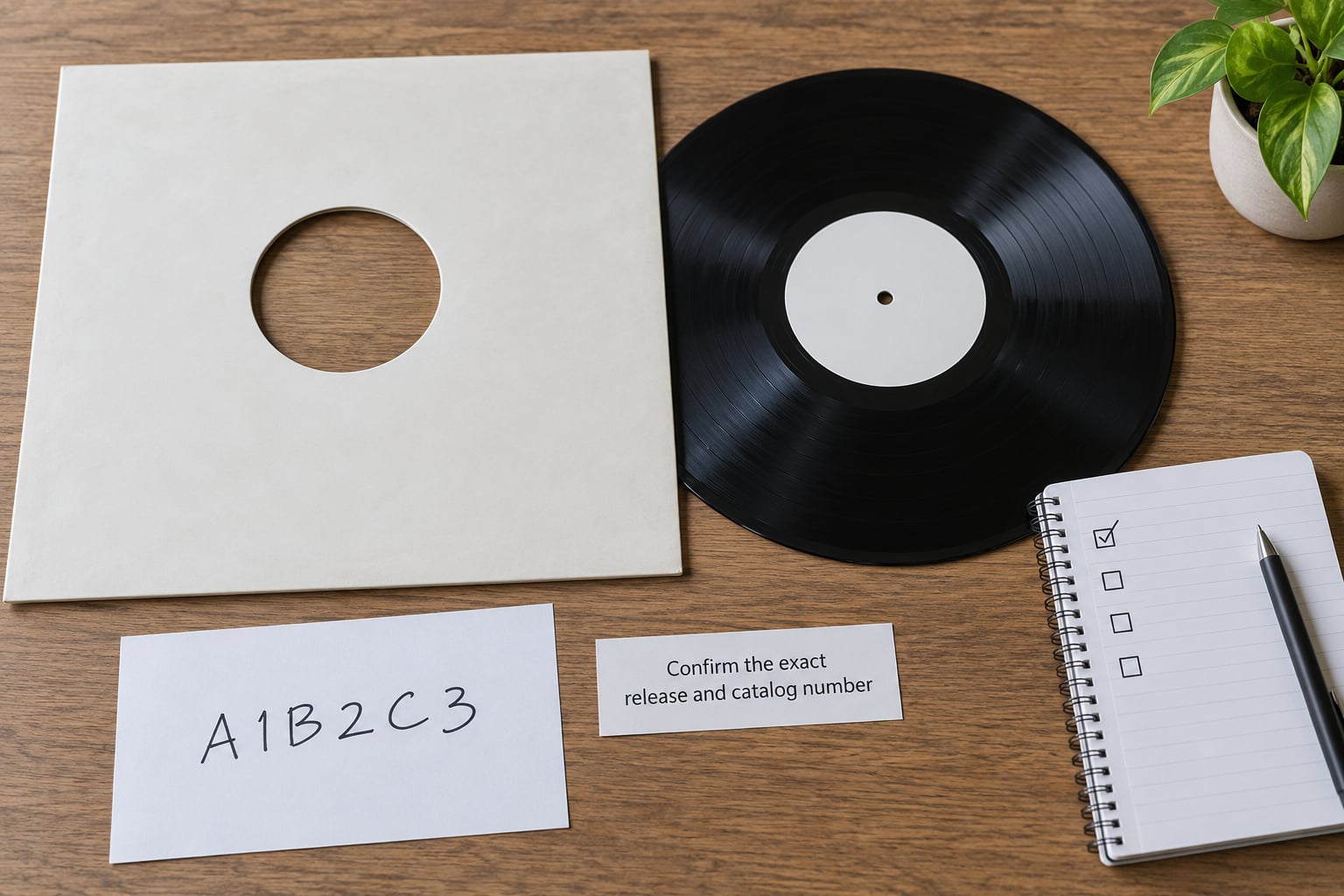
Start by pinning down which edition you are actually holding, because every check after this one depends on it. The catalog number appears on the label, on the spine, and often on the back cover. They should agree, and when they don’t, the disagreement is itself a clue.
Regional issues share catalog numbers constantly. A UK pressing and a European issue of the same album often carry the same number, distinguished by label codes, price codes, and the Depósito Legal deposit number that EU releases print near the rim. US releases from the same period generally carry none of that. If you’re matching a runout string, confirm you’re on the right country’s version first.
Next, confirm the mix. Mono and stereo versions of the same album have different catalog numbers and different matrices, and in some cases they were released weeks apart. A stereo runout compared against a mono discography entry will never match, which sends people down the wrong path for an afternoon.
On Discogs, type the catalog number into the search bar and then open every version listed under the master release, not just the top result. This is the step most people miss, and it’s the single biggest source of confusion in the r/vinyl threads. The album page tells you the record exists; the version list tells you which physical copies exist.
2. Check the label, sleeve, and packaging for original release details
Label design is real evidence, but only within a narrow window. What you are looking for is a change that is documented and verifiable, not a colour you think looks right.
Compare the logo, the typography, the rim text, and the alignment of the printed elements against a photographed reference copy of the same catalog number. On Parlophone Beatles pressings, collectors check whether the rim text begins with The Gramophone Co. or The Parlophone Co., whether a tax code is stamped between the spindle hole and the label ring, and whether the sleeve carries a Garrod & Lofthouse Ltd printer credit. Sleeve printing errors and misspellings are unusually good evidence, because a reissue reuses the original plates and reproduces the error faithfully while a counterfeit does not.
Warning signs of a reissue cluster in the packaging. A barcode on the back or the label means a reissue in almost every case, and barcodes were not in wide use on records until the 1980s. A hype sticker, a remastered sticker, a “now with bonus tracks” strip, or an insert that isn’t in the documented copies of that version all point the same way.
Set the packaging evidence aside rather than counting it. A green apple Beatles sleeve, a psychedelic inner sleeve, a poster, and a specific inner sleeve type are all strong indicators, but each one needs to be matched against a reference copy of that exact release before you lean on it. A design change is not a pressing indicator until somebody documents it as one.
3. Read the runout etchings and matrix numbers
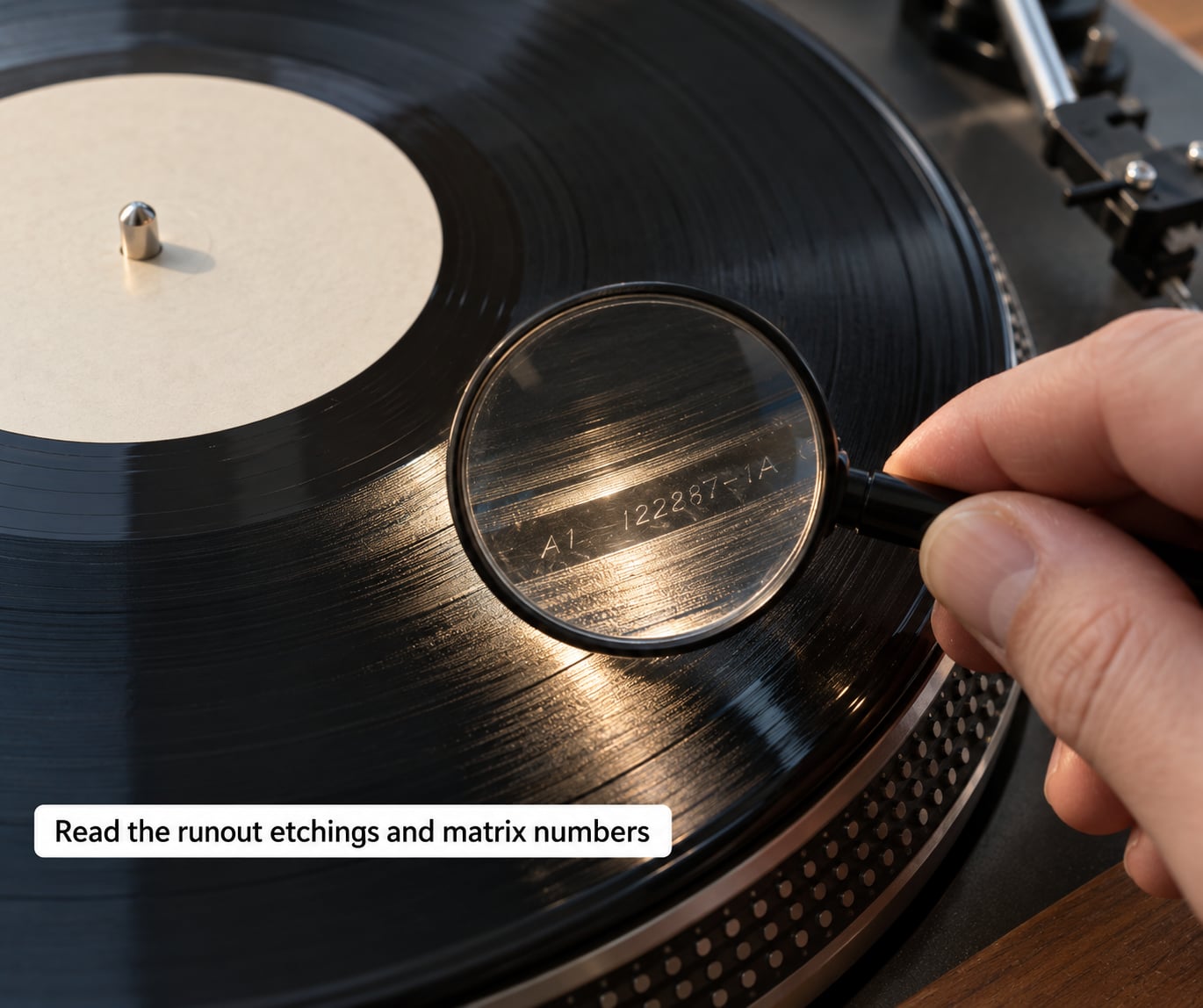
The runout etching, cut into the unplayable band of vinyl between the last track and the label, is the strongest physical evidence you have. Unlike the cover and the catalog number, it is physically impossible to reproduce on a later pressing of the same catalogue entry without someone cutting a new lacquer.
To read it, put the record on a turntable, cue the tonearm past the runout so nothing scratches, and sweep a light across the area at a low angle. Characters that look like faint scratches under overhead light resolve into legible text under raking light. Hold the magnifier over the outer edge first, since the plant code, matrix number, and mastering initials usually sit nearest the rim.
What you transcribe is typically a string like XSMAS-1 or T1-2047-G1: the matrix number identifying the master, then a take or side letter and number, then the mastering engineer’s initials, sometimes with a mastering credit. LPFLOOR2 A-2-1-1 is a good example of a longer plant-prefixed string where the take digit sits in the middle.
Now the caveat that catches nearly everyone. A-1 and B-1 are a convention, not a rule. Some labels and plants used the letter and number to mark the first and second cut, some reversed the logic, and plenty of labels never used it at all. Where collectors have been burned, a copy advertised as a first pressing arrived with a different catalog number, expanded credits, and a runout reading 2-A-1-1 rather than the advertised A-2-1-1. The A-2 there tells you nothing about pressing order on its own.
Transcribe both sides, character for character, including the hand-etched asterisk or symbols. Then search the full string on Discogs, not just the matrix number alone.
4. Compare mastering, pressing, and release credits
Understanding what the numbers mean requires one piece of manufacturing background. A lacquer is cut from the master tape, electroplated into a metal master, and then plated into a mother, which is in turn plated to produce the stampers that actually press the records. The matrix number records the lacquer or master; the stamper number records the tool that pressed the disc.
That chain explains why the same matrix appears on records made years apart. A label with a warehouse full of finished records can keep pressing from existing stampers for a long time, and those copies share the matrix of the original run without being part of it. A stamper change without a new mastering session produces a variant. A new lacquer cut produces a different release with its own entry. Conflating the two is the most common error in both directions, and Discogs’ own guidelines separate them for a reason.
Multi-plant pressings complicate it further. If someone tells you a record is a first pressing, ask which plant pressed it, because many albums were pressed at several plants on the same day. A different plant code on the same matrix is normal and does not make the copy a reissue.
Also read the credits on the sleeve and label. A mastering engineer who only started working in a particular year tells you the mastering is from that year or later. Rights society text, publisher credits, and copyright lines all date a copy within a range.
5. Compare the copy with verified collector references
With the runout string transcribed, go back to the version list and open each candidate release. Read the notes and the runout submitted for that version, and match the full string including the take digit and initials. A partial match is a variant; a mismatch on the mastering initials usually means a different release entirely.
For Beatles and other heavily documented catalogues, the community references go deeper than the database. Collectors point each other to Parlogram’s YouTube breakdowns of the best-sounding UK pressings from 1963 to 1965 when published guides disagree with each other. That disagreement happens: a widely read Beatles guide claimed first UK pressings end in 1N, and a collector corrected it publicly, stating that they end in 3N and that no 1N matrices exist for that album. Cross-check before you buy anything expensive.
When a runout matches nothing, do not force a match. List it under the master release, record the runout in the comments for the next collector, and price it as an unknown pressing.
6. Give the copy a confidence rating
Give the copy one of three labels and hold yourself to the evidence behind it. This is where most people learn how to tell if a vinyl record is a first pressing honestly, instead of guessing from the listing.
Confirmed first pressing means the runout string matches a documented entry for that version, the catalog number and mix are right, and the label and packaging match photographed references. This is the only category worth pricing at the top of the range.
Probable first pressing means the matrix matches the earliest documented version, the packaging is consistent, and something is unverified, usually a faint plant code or a sleeve detail you could not confirm. Price it below confirmed copies and say so in the listing.
Unknown or unverified covers everything else, including the common case of a seller claiming first pressing where the catalog number doesn’t match the database. Describe the physical evidence and nothing more.
Common Mistakes
Treating every numbered copy as a first pressing. Copy numbers, serial numbers, and the A-1 take digit are three different things, and none of them reliably marks pressing order across labels and decades.
Assuming a clean label proves originality. Condition tells you how a record was stored, not when it was pressed. A 1970s repress stored well looks better than a 1966 first pressing stored badly.
Relying on the cover. Artwork gets reused for decades. The sleeve tells you what the marketing department approved, not which plant cut the disc.
Judging by vinyl weight. Heavier pressings exist, but weight is a manufacturing target, not a pressing date, and plenty of later editions were pressed on heavier stock than the original.
Ignoring regional and plant variation. A first pressing in one country is often a reissue in another, and a change of plant code changes nothing about the mastering.
Buying on a seller’s wording alone. If a listing says first pressing and the photos don’t include the dead wax, ask for a raking-light shot of both runouts before you commit. Clear photos of the label, the runout area, and the sleeve get better second opinions than a paragraph of description, and collectors on r/vinyl will read them closely.
When cataloging, store the full runout string for both sides in your own notes, not just the album and year. Six months later, the string is the only thing that will settle the question.
Frequently Asked Questions
What does A-1 or B-1 mean on a vinyl record matrix?
A-1 and B-1 are a take and side notation used by some plants to mark the first cut of each side, but the convention is not universal. Some labels reversed the logic, and many never used it. Only treat A-1 as evidence of a first pressing when the label’s discography documents that convention for that catalog number, and when the full runout string matches a known first-pressing entry.
Does a barcode on a record mean it is a reissue?
Almost always. A barcode printed on the label, the back cover, or the sleeve points to a pressing that came after barcodes were in general commercial use, which began in the 1980s. A handful of exceptions exist, so treat the barcode as a strong signal rather than an absolute, and confirm it against the runout etching before you conclude anything.
How do I tell what country a record was pressed in?
Read the small print around the label rim. EU releases commonly carry a label code, a price code, and a Depósito Legal deposit number, while US releases of the same era usually carry none of them. The runout etching often includes the pressing plant, and plant codes are listed by country in the pressings referenced on Discogs.
How can I tell if a record is a test or promo pressing?
Test pressings are usually plain white labels with hand-written or typed information, and they often carry different runout etchings or none at all. Promo pressings are made for radio or review and normally arrive with a stamped or stickered notation, sometimes on a plain sleeve. Neither is catalogued as a standard commercial run, so the packaging and label have to be read against a reference, not guessed from a rough finish.
Are first pressings always worth more?
No. The value gap comes from supply, not from age alone. Ordinary copies are far more common than collectors assume, and plenty of first pressings sell for a modest premium while rare variants under the same catalog number fetch far more. What moves value is a confirmed match to a scarce version with the runout documented, not the word pressing on a listing.
Do first pressings actually sound better than reissues?
Some do, and the reason is mastering rather than the pressing date. Records cut from a half-inch master or lacquer of a different generation, or remastered from better tape, can sound noticeably different from later digital remasters. Many reissues simply use the same master and are audibly identical, so the honest answer is that pressing date tells you very little on its own.
Conclusion
Start with the catalog number, confirm the country and the mix, then read the runout etching from both sides under raking light and match that full string against the version list on Discogs. Label design, packaging, printer credits, and reissue stickers all support the answer, but none of them carry it alone.
That order is what makes how to tell if a vinyl record is a first pressing a repeatable skill rather than a lucky guess. When two pieces of evidence agree, say confirmed. When one is missing, say probable and price it lower. When the runout matches nothing, call it unknown rather than guessing, and the record will still be worth having.