
What does mastering do to a record? It is the last stage of audio post-production, where a mastering engineer takes your finished stereo mix and puts the finishing touches on it. That means setting overall loudness, evening out the tonal balance between instruments, tightening the dynamics, cleaning up small defects, and preparing the file so it sounds right on a phone speaker, a car stereo, a hi-fi system and a record player.
Most people notice the results long before they know the word for it. A rough mix that was fine on studio monitors suddenly sounds thin, inconsistent or harsh everywhere else. A mastered version fixes that, without changing the song itself. Below I walk through what actually happens to the audio, where the judgment calls sit, and what the mastering engineer simply cannot rescue.
Table of Contents
- What Does Mastering Actually Do to a Record?
- What is the difference between mixing and mastering?
- The six things mastering changes
- How Does the Mastering Process Work?
- What Changes in the Sound After Mastering?
- How Does Mastering Affect Loudness and Dynamics?
- Does Mastering Remove Noise and Distortion?
- Is Mastering the Same as Making a Record Louder?
- How Does Mastering Change When a Song Is Cut to Vinyl?
- Can Mastering Make a Bad Recording Sound Good?
- How Can Vinyl Collectors Recognize a Well-Mastered Record?
- What Does Mastering Do to a Record? Frequently Asked Questions
- Is mastering music necessary?
- What does a mastering engineer actually change?
- How loud should a master be?
- Why do remastered albums sound different from the originals?
- Does mastering make a record sound better on vinyl?
- Can mastering change what a song means?
- Conclusion: Start by Comparing the Versions
What Does Mastering Actually Do to a Record?
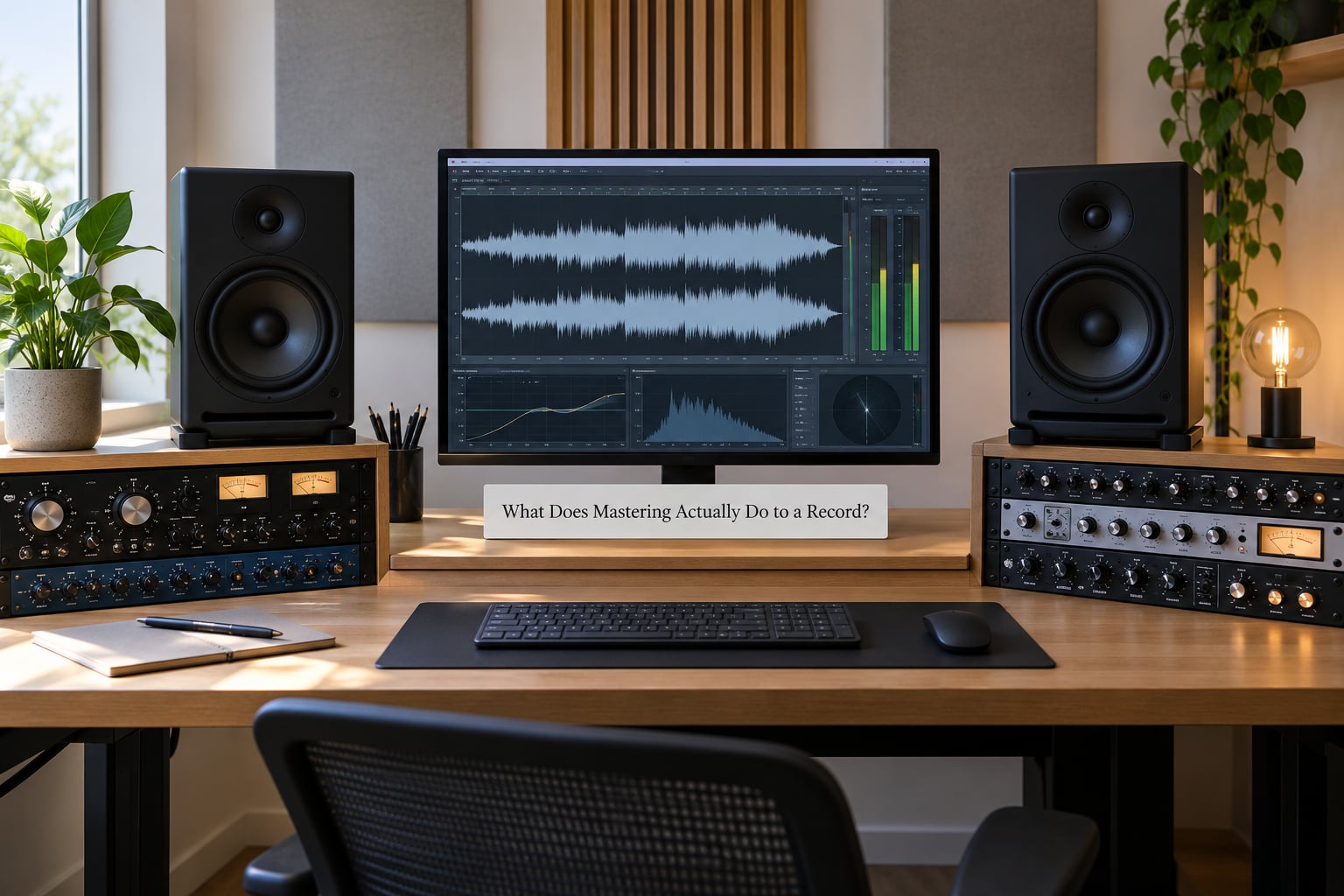
What does mastering do to a record? It is the final quality-control and finishing pass on the stereo mix, where loudness, tonal balance, dynamics, stereo image and small defects are adjusted so the finished track sounds consistent, clean and competitive across playback systems and release formats.
That is the short version. The longer version is that mastering works on one file, the stereo mixdown, rather than on the individual instrument tracks. Once the mix is approved, the engineer listens, measures and adjusts, then delivers a version that meets a technical standard and a creative one.
What is the difference between mixing and mastering?
Mixing builds the song. Mastering refines the finished one. They use some of the same tools, which is exactly why the two get confused.
| Stage | Input | Main focus | Typical tools | Output |
|---|---|---|---|---|
| Mixing | Individual session tracks | Arrangement, performance edits, instrument balance, effects | Channel strips, EQ, compression, reverb, delay, panning | A finished stereo mix |
| Mastering | One stereo mixdown | Tonal balance, dynamics, loudness, translation, delivery | Corrective EQ, multiband compression, limiting, stereo imaging, metering | A release-ready master with metadata |
A mixing engineer decides that the vocal sits in front of the guitar. A mastering engineer decides whether that vocal still sits in front once the track plays on cheap earbuds at low volume.
The six things mastering changes
- Sound translation. The mix is adjusted so it holds up on earphones, phone speakers, a car stereo, a club system and a living-room hi-fi, not just on calibrated studio monitors.
- Loudness. Overall level is set to a measured target, usually expressed in LUFS, and checked against a true-peak ceiling so nothing clips during playback.
- Consistency across an album. Every track is matched so the quiet one is not swallowed and the loud one is not jarring when the sequence plays end to end.
- Tonal balance. Mud in the low mids gets cleaned, harshness in the upper mids gets tamed, and the overall character of the record is shaped to match its genre and its era.
- Minor repairs. Clicks, hum, sibilance, plosives and low-level noise get dealt with where doing so is safe.
- Delivery preparation. The file is formatted, dithered if needed, named correctly and delivered with metadata and an ISRC code attached.
How Does the Mastering Process Work?
The order matters, because each step feeds the next. A mastering engineer who reaches for the limiter first has already made the rest of the work harder.
- Prep and inspection. The file arrives, usually as a 24-bit or 32-bit float WAV. The engineer checks it for clipping, truncation, mono compatibility and obvious mistakes before touching anything.
- Reference listening. A few tracks in the same genre, or a track the artist loves, get queued up. This sets the target rather than any single loudness number.
- Editing and sequencing. Silence is trimmed, fades are placed, clicks and pops are removed, and the track order is checked for flow if this is an album.
- Corrective EQ. Broad tonal problems get addressed first, then narrower resonances. Nothing is added for flavour at this stage unless the artist asks for it.
- Dynamics. Compression, often multiband, evens out the level so the loud parts stop dominating and the quiet parts stop disappearing.
- Stereo imaging. The width of the image is adjusted, sometimes with mid/side processing. Some tracks need to be narrowed so they survive a mono check.
- Loudness and limiting. A limiter raises the overall level and catches the peaks that would otherwise clip, with settings chosen to keep the music alive.
- Metering. Integrated loudness, loudness range, true peak and stereo correlation are read off the meters, and the level is nudged by fractions of a decibel.
- Quality control. The full sequence is played from start to finish, on more than one system, looking for anything that jumps out or disappears.
- Delivery. Bit depth and sample rate are set for the destination, dither is applied if reducing to 16-bit, and metadata plus the ISRC are embedded.
The judgment calls sit mostly in steps four through seven. Tools can measure; they cannot decide whether a record should feel restrained or huge.
What Changes in the Sound After Mastering?
A good master makes a record sound settled rather than processed. The changes are usually small on their own and obvious in aggregate.
Balance and clarity. Frequencies that were fighting each other get sorted, so the bass stops masking the vocals and the cymbals stop cutting through everything. Elements you had to strain to hear become simply present.
Punch. Controlled dynamics give drums and bass a defined attack instead of a smeared one. This is one of the most reliable signs of competent mastering, and it comes from restraint rather than from adding volume.
Cohesion. On an album, the mastering pass is what makes eight tracks recorded over three years feel like one release. Matched levels and a shared tonal signature do most of that work.
Stereo width. The image can be opened up or pulled in, though a record that is too wide tends to collapse when played on a single-speaker phone or in mono.
Contrast between quiet and loud parts. This is the one people miss. Mastering should preserve a sense of a chorus rising and a verse sitting back. When it does not, the track turns into a flat, fatiguing block of sound.
How Does Mastering Affect Loudness and Dynamics?
Loudness and dynamics are the two numbers most people half-understand, and they explain most of what the mastering stage is actually doing.
| Measurement | What it tells you | Why it matters |
|---|---|---|
| Integrated loudness (LUFS) | The average perceived loudness of the whole track | The number streaming platforms use to decide whether to turn your master down |
| True peak (dBTP) | The highest level the waveform reaches once reconstructed as audio | Keeps the file from distorting after lossy encoding |
| Dynamic range / loudness range | How far the level moves between the quietest and loudest moments | Too little and the record sounds flat; too much and it can feel unfocused next to modern releases |
| Crest factor and PLR | The gap between the peak level and the average level | A very low peak-to-loudness ratio usually means heavy limiting and little impact left |
A louder master does tend to feel more immediate at the same volume setting, because loud sounds are perceived as closer. That is the whole basis of the loudness war, and it is also why heavily limited records can sound lifeless: once everything sits near the ceiling, there is no distance between the quiet and the loud.
One thing worth understanding: loudness numbers are not a promise about how loud it will play. Streaming services normalise loudness, turning very loud masters down at playback time so that quiet and loud albums sit closer together. That is why pushing a track to an extreme level can end up producing no audible gain over a moderately loud master. On vinyl, the situation reverses in an interesting way, because there is a limit on average level rather than on peak level.
Does Mastering Remove Noise and Distortion?
Some of it, yes, and mastering is good at the small stuff.
Clicks and pops from edits, a faint mains hum, an unwanted mouth noise, over-bright sibilance, a low rumble under the whole track, and broadband hiss well below the music can often be reduced. A gentle noise gate applied to a recorded noise floor does most of the work, and de-essing handles sibilance cleanly.
What mastering cannot do is separate a sound that was badly recorded from the sound you want to keep. If a guitar was clipped on the way in, the distortion is baked into the waveform, and the most aggressive repair tools will either do nothing or do damage. The same goes for a performance that is out of tune, an arrangement where everything occupies the same frequency range, or a mix that was clipped into a fixed bit depth before it ever reached the mastering engineer.
There is a deliberate side to this too. Tape saturation, transformer colour and a little noise are sometimes part of the record’s character, particularly for older material and vintage-leaning releases. A mastering engineer restoring a historic album will usually keep some of that, because stripping it out can make the record sound like it came from a different decade.
Is Mastering the Same as Making a Record Louder?
No, and yes, and the distinction is the source of most arguments about the topic.
Making a record louder is a single gain change. Mastering is a series of decisions that happen to end with a louder file, and the level is the last thing the engineer sets rather than the first. Gain staging and limiting are two stages inside the process, not the process itself.
Four things tell you whether a record was actually mastered or simply turned up:
- Clarity without harshness. Detail emerges, but the top end does not get sharp or tiring.
- Punch with room. Drums have a defined front, yet the track still breathes instead of sitting pinned.
- Cohesion across a sequence. Every song has a similar tonal signature, and the level does not jump between tracks.
- Translation. It still sounds right on a phone speaker, where a mix that was only ever made louder tends to turn into a muffled blur or a harsh hiss.
A restrained master often sounds more open and more detailed than an over-compressed one, because the quiet parts are still intact. Compare an album mastered with a very low peak-to-loudness ratio against a modest one and the difference in long-session fatigue is easy to hear.
How Does Mastering Change When a Song Is Cut to Vinyl?
Vinyl is the format where the constraints are most visible, and where understanding mastering pays off most directly.
A cutting engineer does not cut from a file. They cut from a lacquer, and the cutting head has to move across the disc at a rate the groove can physically support. Because bass takes up more groove space per cycle than treble does, the usable level is set by the average level across the whole side, not by the peak. The classic result is that a heavily limited master, which has very little dynamic movement, is the hardest kind of material to cut well.
That shapes the source master. Engineers preparing a lacquer usually keep a little more headroom and dynamic range than a streaming master needs, and they avoid pushing the extremes of stereo width, because side-to-side energy uses groove space fast and can crowd the cut. A half-speed master is sometimes used for the same reason: slower cutting translates a higher range of frequencies into the groove.
Vinyl also imposes the RIAA equalisation curve, which reduces treble and raises bass during cutting and reverses it at playback. Records pressed without that step sound dull and bass-heavy, which is one of the most common faults on cheap reissues. The mastering engineer or cutting engineer applies it, and getting it slightly wrong is immediately audible.
Then there is the stereo geometry. The two channels are cut as a single groove whose position wanders from side to side, so any out-of-phase material sums toward the middle and can partly cancel. A mono check on a finished master is standard practice for exactly this reason, and it is why a track that sounds enormous on headphones can lose its bass on a single-speaker turntable setup.
Can Mastering Make a Bad Recording Sound Good?
No. It can make a good recording finished, which is a different job.
An out-of-tune instrument stays out of tune, because pitch is in the waveform. A clipped drum hit keeps its flat, splattered edge. A muddy arrangement where the bass guitar and the bass drum and the low guitar all live in the same 200 Hz region cannot be unpicked by equalisation alone, because the problem is musical rather than tonal. A badly chosen microphone or a noisy room leaves its signature in the recording, and mastering works with what it is given.
Damaged sources are their own category. A file that was clipped in a fixed bit depth has lost information that no algorithm can reconstruct. A transfer with clipped peaks on both the positive and negative side has distortion baked in. If the mix is already 16-bit and has been amplified until it clips, the mastering engineer can only manage the result.
There is one partial exception worth knowing: a well-judged mastering pass can make a competent mix much better, because tonal imbalance and inconsistent dynamics are genuinely mastering problems. What it cannot do is invent a performance or rebuild an arrangement.
How Can Vinyl Collectors Recognize a Well-Mastered Record?
When you are holding a record, the difficult part is separating what the mastering did from what the pressing did. Both affect what you hear, and only one of them was creative.
Check the noise floor first. Surface noise is continuous crackle and hiss that comes and goes as the stylus moves. Mastering problems sound different: hum at a fixed pitch, a rumble tied to motor speed, or broadband hiss that stays perfectly steady even when the groove is silent.
Listen to channel balance. A good master keeps the two channels matched. If one side sounds consistently thinner or the bass pulls to one speaker in a way the arrangement does not explain, suspect the pressing or the cutting rather than the mastering.
Check the frequency balance. Compare a record against its digital counterpart at matched level. A mastering that has lost its top end, or one where the midrange has been scooped out, is easier to hear when the volume is turned down so your ears are not being fooled by level.
Look for dynamics. Play something with a real build, like a ballad that opens into a full arrangement, and notice whether the chorus actually arrives louder. A squashed master flattens that arc, and on a long side it becomes genuinely tiring.
Watch for distortion at high volume. On a well-cut record, raising the volume adds impact. On a badly cut one, the groove runs out of headroom and the bass turns to mud while the treble crackles.
Separate pressing from mastering. The same master can appear on several pressings with very different results, and a reissue may use a different master entirely. If two copies of the same album sound different, check the runout etchings and the credits before blaming the engineer. Reissues are often remastered from the original tapes, occasionally from a noisy copy, and occasionally left alone and simply pressed better than the original.
One practical routine helps more than any equipment: play the same track from two different versions, level-matched on the same system, and switch between them at the moment something changes. A mastering engineer will be doing something close to this all day.
What Does Mastering Do to a Record? Frequently Asked Questions
Is mastering music necessary?
It is necessary if you want the record to sit properly next to professionally released music. Without a mastering pass, a finished mix usually sounds thin, inconsistent between tracks, and unpredictable on systems other than the ones it was made on. The stage is not decoration, but it cannot rescue a weak recording or a poor mix, so fix those first.
What does a mastering engineer actually change?
A mastering engineer works on your finished stereo mix and changes four main things: tonal balance, dynamics, loudness and stereo image. On top of that come small repairs such as clicks, hum and sibilance, plus album-wide matching so every track sits at a similar level. The song’s structure, notes and arrangement are left exactly as they were.
How loud should a master be?
For most streaming releases, an integrated loudness somewhere around -14 LUFS with true peaks kept at or below -1 dBTP is a sensible starting point, and genre matters more than the exact number. Since streaming services normalise loudness, pushing far past that usually gets turned down anyway. For vinyl, average level is the limit rather than peak level.
Why do remastered albums sound different from the originals?
A remaster is a new mastering pass, usually made from the original tapes, a digital archive, or sometimes only a copy. Differences come from fresh equalisation, different loudness targets, improved click and noise repair, and occasionally a different source. Some sound more open and detailed, some sound thinner, and a few that were sourced from poor copies come out worse.
Does mastering make a record sound better on vinyl?
It helps, but the cutting engineer sets the real constraints. Because vinyl is limited by average level, a heavily limited master with little dynamic movement is difficult to cut and loses impact on the record. A master with a little more headroom, controlled width and even channel energy cuts more cleanly and keeps its bass and top end.
Can mastering change what a song means?
It can change how a song feels without changing a single note. A compressed master with no dynamics flattens the build of a track, and heavy limiting can make a restrained arrangement feel aggressive. A careful master preserves the contrast the arrangement depends on, which is why engineers ask what the track is meant to sound like before touching the level.
Conclusion: Start by Comparing the Versions
Mastering is the last balancing and finishing stage: it sets loudness, sorts the tonal balance, shapes the dynamics, matches the tracks, cleans what can be cleaned, and delivers a file ready for streaming, CD or vinyl. What it does not do is make a bad recording into a good one.
So start by comparing versions. Put the original pressing, a reissue and any alternate master of the same track on the same system at a matched level, and switch between them at the moment something changes. Listen for clarity, dynamics, balance and noise, and ignore loudness on its own, because it is the easiest thing to change and the least reliable thing to judge by. Once you can hear that difference, most of the rest of the process becomes obvious.