Organizing a record collection means picking one filing order, applying it to every record you own, giving each one a shelf it lives on, and writing the details down so you can look up an album without physically searching for it. Most people can do the first pass in a weekend, and none of it needs anything you do not already own.
The reason it feels overwhelming is rarely the volume of records. It is that nobody decided the rules, so every new purchase lands wherever there was space. Fix the rules first and the sorting becomes mechanical.
A note on sizing: if your collection is still under about 400 records, almost any method works. Past 2,000 or so, the method that worked fine when you started will have broken down, and that is the point most people learn to reorganize. Where you land between those numbers depends more on how often you want to look something up than on how much you own.
Table of Contents
- What You Need
- Step-by-Step: How to Organize a Record Collection
- 1. Set Goals and Assess Your Collection
- 2. Sort Records into Broad Categories
- 3. Create a Consistent Numbering System
- 4. Choose Storage That Protects the Records
- 5. Arrange Records for Easy Browsing
- 6. Clean, Inspect and Repair Your Records
- 7. Catalog the Collection and Add a Backup
- Common Mistakes
- Frequently Asked Questions
- Should vinyl records be stored alphabetically, chronologically or by genre?
- What is the best way to organize a large record collection?
- Should vinyl records be stored horizontally or vertically?
- How should rare and valuable records be stored?
- Do I need a database to organize vinyl records?
- Where should various artists records and compilations go?
- Conclusion
What You Need
None of this is mandatory. If you have a cardboard box and a pen, you can complete step one today and buy nicer hardware later.
- Record crates or shelving. Crates are portable and stop spines from slumping; shelves hold more and look better in a room. Both work if records stay upright.
- Alphabetized dividers. Cardboard or wood panels that give you a place to write a range of letters. Without them, an alphabetical shelf turns back into a pile within a year.
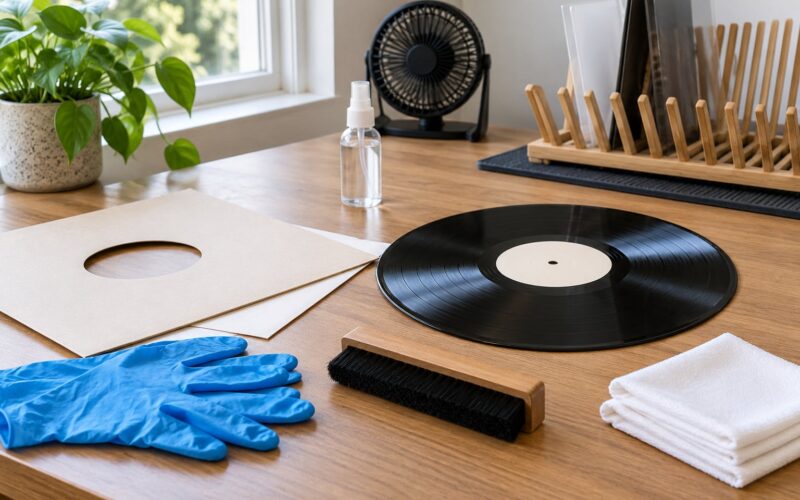
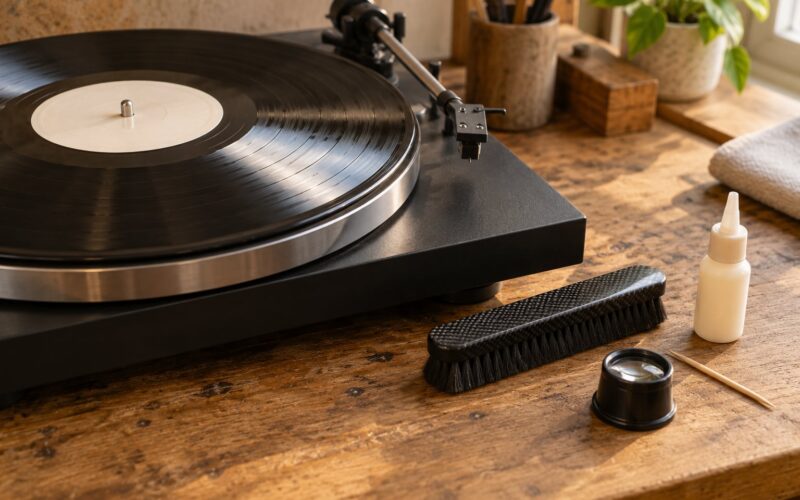
- A dry cleaning brush. A soft-bristle record brush and a microfiber cloth handle dust. Skip the carbon-fiber brushes if you have a lot of static-sensitive electronics nearby.
- An inventory method. A spreadsheet, a notebook, index cards, or a collector database. Pick one before you start rather than halfway through.
- Labels. Masking tape and a marker work fine. Printed labels are nicer but not better.
- Backup storage. A USB drive or cloud folder for whatever file you end up keeping.
If you are starting from almost nothing, the single most useful purchase is a set of dividers and a marker. Storage you can always rearrange; labels you have to retrofit across two hundred records are miserable.
Step-by-Step: How to Organize a Record Collection
Seven steps, in this order. Each one produces something the next step depends on, so skipping ahead tends to mean doing the work twice.
1. Set Goals and Assess Your Collection
Decide what the collection is for before deciding where anything goes. If the goal is listening, favor the album you reach for most and keep it close to the turntable. If the goal is displaying, the front cover is the priority and crates go behind glass. If you trade or sell, catalogue number and pressing information matter more than anything else.
Then get an honest count. Crate by crate, count them; do not estimate, because the estimate is what got you here. Write the number down. It tells you how much sorting time to book and whether your furniture can even hold the collection.
While you are counting, flag anything physically wrong: a seam split on the jacket, a record that looks wavy sitting flat on a table, a sleeve with tape residue. Those get dealt with in step six, not now. Sorting around them is faster.
2. Sort Records into Broad Categories
Start with categories broad enough that you can apply them without hesitating. Genre first is the usual answer, because it also tells you how you want the shelves arranged. Format is the other strong option, and serious collectors often run both: a wall of 12-inch LPs by genre, and a separate shelf of 7-inch singles and 45s.
On this site the categories tend to be punk and hardcore, garage and rockabilly, and general rock, with soundtracks as their own run. That split is a personal one. What matters is that each category is big enough to fill a crate or a shelf section and small enough that you do not argue with yourself about where a record goes.
Do not over-split on the first pass. Three categories you actually use beats eight you meant to refine later. You can always carve a sub-section out once a pile grows into a crate of its own.
3. Create a Consistent Numbering System
Alphabetical filing has a specific failure mode: inserting a new album from an early-alphabet artist means shuffling every record to its right. Collectors complain about this constantly and it is why strict A-to-Z tends to collapse somewhere around the two-thousand record mark.
A location code avoids it. Write a short code on the back of each jacket or on a small card in the sleeve: category, format, and a sequence number. So a record might read G12-0043, meaning garage category, 12-inch format, item forty-three.
Fill each category in batches and number them in the order you file them, so the physical order matches the code order. When a new record arrives you append the next number in its category instead of re-shuffling the shelf. When the collection moves to a new room, the numbers still tell you what belongs together.
Alphabetical ordering still has a place inside each category. Keep it as a within-category sort, not as the primary index.
4. Choose Storage That Protects the Records
Records go upright or not at all. Stacked flat, the weight of the pile puts a long, slow curve into every disc, and a warped record that skips is a record you will resent every time you play it. Vertical storage is not a preference, it is the requirement.
On the hardware:
- Record crates keep sleeves upright with support from both sides, and they move from room to room in one trip. A standard milk crate holds roughly fifty LPs, which makes them the classic crate for a new batch of finds.
- Dedicated shelving holds more per metre than crates and displays the spines. It costs more and it is harder to move.
- Cube shelving like a Kallax unit is easy to start with, but check the shelf depth and the weight rating before filling one fully with vinyl. A full cube is heavier than people expect.
One caution worth taking seriously. A dense collection has real weight, and residential floors have limits. Collectors have reported upstairs rooms sagging under several thousand records, and estimates for domestic upstairs floor loads run around a tonne and a half. Spread the load along a wall rather than concentrating it in one spot, and put the heaviest rows on the lowest shelf. Basements, attics and exterior walls are poor choices for records, for reasons in the next section.
5. Arrange Records for Easy Browsing
Inside each category there are three patterns worth knowing.
Alphabetical by artist is the most common and the most legible to anyone else in the house. File by the name people actually use. Drop a leading “The” so The Clash sits under C, and file stage names the way the artist is billed, which puts Captain Beefheart under B and Muddy Waters under W. Compilations with many artists go after Z, sorted by album title, and soundtracks usually get their own shelf. Classical collections often do better filed by composer with the performer noted in your catalog.
Chronological by release year shows how a label or an artist developed over time. It is a poor way to find one specific record and a good way to browse.
Genre within category is the middle ground most collectors end up at, especially when one label or one scene dominates a shelf.
Whatever you choose, label the front edge of every crate or shelf section with its range, and use partial-alphabet tabs when a run gets too long to eyeball. Also keep one crate that is not part of the system at all: the records you are actually playing right now. A separate in-rotation crate stops listening from constantly disturbing the filing, which is the single biggest reason organized shelves fall apart.
6. Clean, Inspect and Repair Your Records
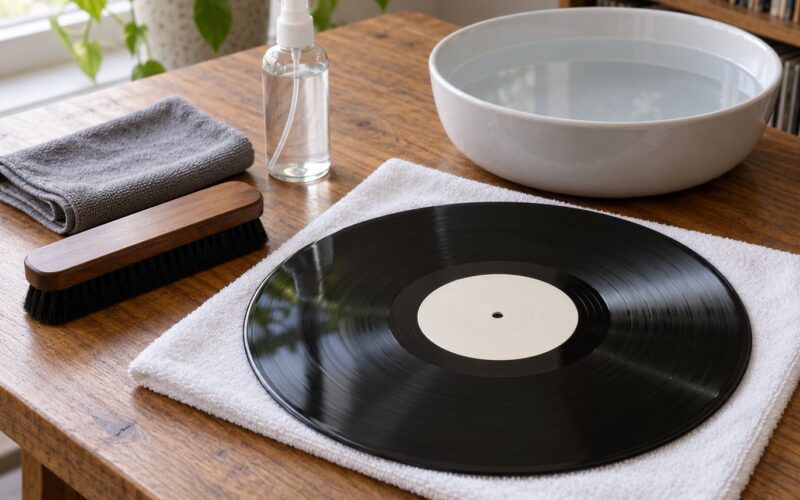
Cleaning is dry cleaning. A soft brush and a microfiber cloth, worked in the direction of the grooves, takes off surface dust and does nothing else. Wetting a record risks mould, and household cleaners strip the jacket finish.
Look for four things while you handle each one:
- Dust on the playing surface. Audible as a tick, and the easiest thing to fix.
- Scratches running across the groove rather than around it. Radial scratches matter, circular ones mostly do not.
- Warping, seen as a record that will not sit flat or wobbles on the turntable platter. Mild warp is often workable; a cup-shaped disc is not.
- Sleeve damage, especially split seams and brittle card. Paper degrades with heat and humidity faster than vinyl does, so old jackets in a hot room can be the first thing to go.
Know when to stop. A record with mold should be isolated rather than brushed, since spores spread. A sleeve that is already flaking is not going to be improved by aggressive tape or glue, and a professional conservator is the right call for anything genuinely rare.
One point of confusion worth clearing up: organizing records means deciding where albums live, not the order of tracks within an album. Those are separate decisions, and the track order is already fixed on the record.
7. Catalog the Collection and Add a Backup

Physical order tells you where something is. A catalog tells you whether you own it at all, which is how collectors end up with three copies of the same pressing in different genre sections.
Record these fields, and nothing more unless you have a reason:
- Artist
- Album title
- Release year
- Label
- Format, meaning 12-inch LP, 7-inch single, 10-inch or 45 rpm
- Catalogue number, which is what identifies a specific pressing
- Location code, matching the number from step three
- Date and place of purchase, and what you paid, if you care about future value or duplicate avoidance
A spreadsheet handles this fine for most collections, and a free collector database gives you release-level detail, pressing data and a way to flag what you are missing on an artist. Use whichever you will actually keep up. A catalog you abandon in a month is worth nothing, and five minutes per record beats an hour of data entry you never finish.
Then save a copy somewhere else. A single file on the computer that holds your catalog is one failed drive away from gone. Email the spreadsheet to yourself or put it in cloud storage, and re-save it after any big session. Your records are the physical backup for the catalog, and the catalog should be the backup for the records.
Common Mistakes
Stacking records flat. The single most common storage mistake, and the only one that permanently damages discs. Fix: anything that does not hold records upright gets emptied today.
Overloading shelves. A sagging shelf dumps a hundred records onto the floor and usually bends some in the process. Fix: check the rating before you fill it, and keep the heaviest rows low.
Unstable DIY furniture. Record crates stacked three high on a chair is a waiting-to-happen collapse. Fix: nothing stacked where it can be kicked, leaned on, or walked into.
Inconsistent labels. A shelf marked “Punk” next to one marked “punk/HC 1990s” means every lookup starts with a guess. Fix: decide your label vocabulary once and write it down on the inside cover of a binder.
Overcomplicated databases. Trackers with fifteen fields, cover art uploads and marketplace sync, set up on a Sunday and abandoned by Thursday. Fix: start with the eight fields above and only add one when a real need shows up.
No separate home for actively played records. If your current rotation lives in the main alphabetical run, something is always out of place. Fix: one crate, clearly labelled, that is allowed to be a mess because it is temporary.
Doing it all at once. A two-thousand record reorg that stalls in week two leaves the collection worse than before. Fix: one crate per session, and a small number you will actually finish.
Frequently Asked Questions
Should vinyl records be stored alphabetically, chronologically or by genre?
It depends on how you use the collection. Alphabetical by artist is the most common and the easiest for guests to understand. Chronological order by release year suits collectors who like to see how a label or artist developed, but it makes finding one album harder. Genre grouping suits a collection built around scenes and eras. Most collectors end up hybrid: genre as the outer layer, alphabetical within it, and chronological inside each artist.
What is the best way to organize a large record collection?
Start with broad, stable categories, then give every record a location code of category, format and sequence number. That stops new arrivals from forcing a reshuffle of the whole shelf. Add a labelled crate for what you are currently playing, and keep one catalog file recording artist, title, year, label, format and catalogue number. Once a collection passes roughly two thousand records, a spreadsheet or collector database becomes worth the effort.
Should vinyl records be stored horizontally or vertically?
Vertically, always. Stacked flat, the weight of the pile puts a slow curve into every disc, and a warped record skips. Upright storage in a crate or on a shelf with full-height support keeps discs flat. Records may sit in a crate with the lids closed; what matters is that nothing is bearing weight across the face of another record.
How should rare and valuable records be stored?
Store them upright in a sturdy crate, supported on both sides so nothing leans, and keep them away from direct sun, heat, damp and flood risk. Put each in a clean inner sleeve with the album inside it, rather than loose in the jacket, and use an archival outer sleeve if the jacket is valuable or fragile. Basements, attics and exterior walls are the worst rooms in a house for them.
Do I need a database to organize vinyl records?
Not if the collection is small. Labels, dividers and a handwritten file are enough for a few hundred records, and physical order alone will serve you well. A spreadsheet or a free collector database earns its keep once you start buying duplicates of the same pressing, tracking catalogue numbers, or trying to work out what a pressing is worth. Pick the simplest version you will keep using.
Where should various artists records and compilations go?
The usual convention is to file compilations after Z under V for various artists, sorted by album title rather than by any one performer. Soundtracks are often better off on their own shelf, since they span genres and are usually looked up by film. Whichever rule you choose, write it down somewhere, because the inconsistency is what makes a collection feel disorganized.
Conclusion
How to organize a record collection comes down to three decisions: the categories, the location code, and a home for whatever is currently on the turntable. Get those right and the rest is repetitive work you can do in short sessions.
Do not plan the whole collection this weekend. Pick one crate, sort it, label it, assign the code range, and put a spreadsheet copy somewhere safe. Then repeat the next time you have a free Saturday. A finished crate you can maintain is worth more than an ambitious scheme you abandon halfway.