Audiophiles prefer belt drive turntables for one main reason: the belt is a compliant coupling that soaks up motor vibration before it ever reaches the platter, the spindle and the stylus. On top of that, a small offset motor costs far less than a high-spec direct drive motor, so more of the budget goes into the tonearm and cartridge you actually hear. The trade-off is speed accuracy, and it is a real one.
That last sentence is where most of the arguing online comes from. Belt drive enthusiasts treat speed stability as a solved problem handled by a fresh, correctly tensioned belt. Direct drive owners point at phase-locked loop circuitry that corrects speed electronically, and they are not wrong either. Both sides usually end up changing the tonearm, the cartridge and the plinth at the same time, which is why the argument never really settles.
What follows is the mechanical version of the argument, what actually changes once a belt is involved, and where direct drive is the better tool for the job.
Table of Contents
- What Is a Belt Drive Turntable?
- Why Do Audiophiles Prefer Belt Drive Turntables?
- Does a Belt Drive Reduce Noise and Vibration?
- Why do audiophiles prefer belt drive turntables for critical listening?
- How Does a Belt Drive Affect Speed and Torque?
- Are Belt Drive Turntables Better for Vinyl Records?
- Belt Drive vs. Direct Drive Turntables
- Which Belt Drive Turntable Features Should Collectors Look For?
- What Are the Drawbacks of Belt Drive Turntables?
- Frequently Asked Questions
- Do belt drive turntables sound better than direct-drive turntables?
- Are belt-drive turntables quieter than direct-drive turntables?
- How often should a turntable belt be replaced?
- Does a belt-drive turntable wear out vinyl records faster?
- Are belt-drive turntables better for beginners?
- What is the disadvantage of a belt-drive turntable?
- Conclusion
What Is a Belt Drive Turntable?
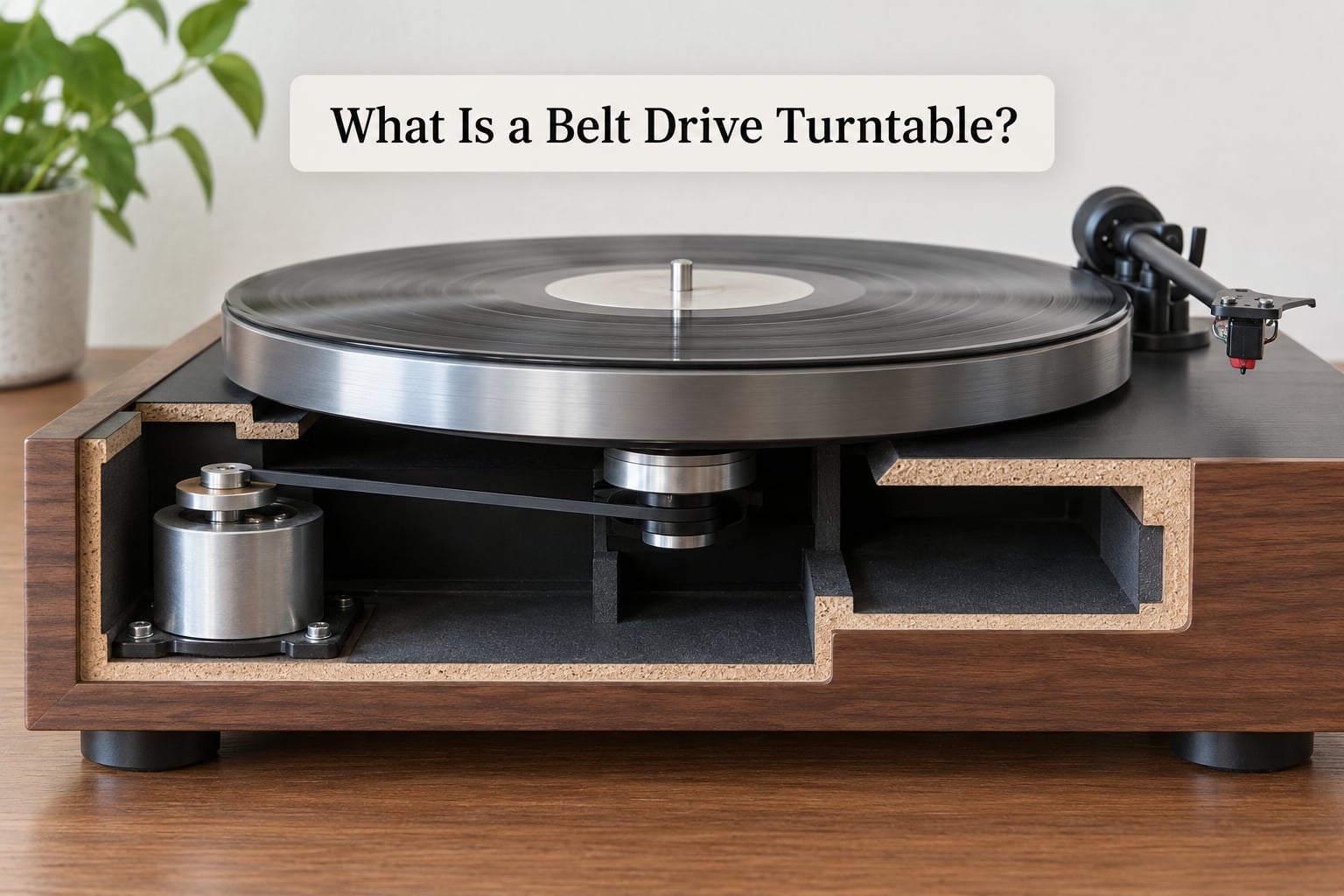
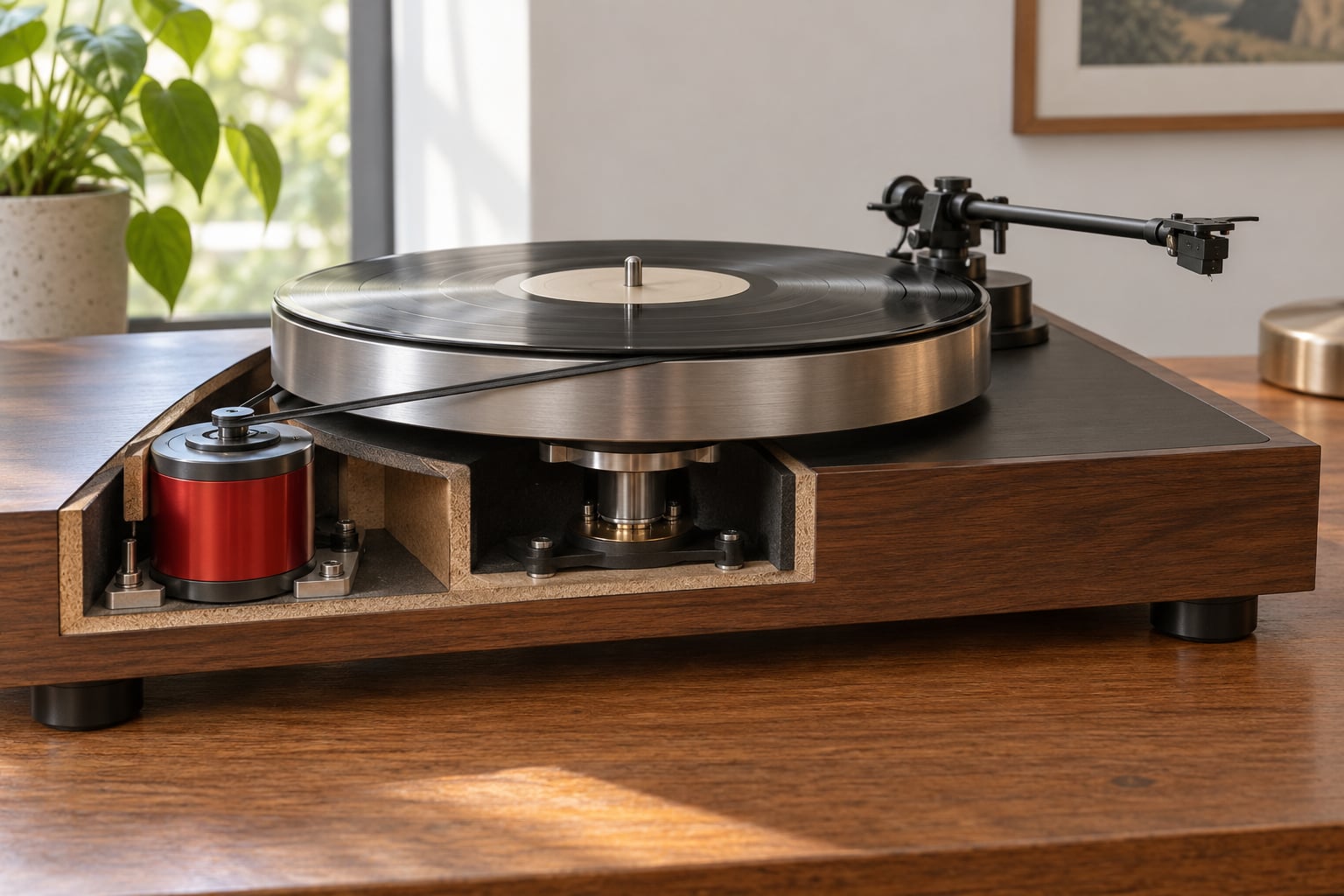
A belt drive turntable spins its platter with a loop of rubber or silicone that runs from a small motor pulley to the platter rim. The motor usually sits behind or beside the platter, often on its own little suspension, rather than underneath it. A direct drive deck does the opposite: it mounts the motor under the platter and uses magnetic force to turn the platter itself, with no moving belt in the path.
That single mechanical difference is what everything else follows from. The belt is a soft, slightly springy part sitting between motor and record, so it can absorb vibration and it can also stretch, slip and change tension over years of use.
Five things on a belt drive deck matter more than the drive label once you have one in front of you. How gently the platter spins up tells you how much torque the motor has and how the bearing is loaded. Where the motor is mounted and whether it touches the plinth at all decides how much structure-borne noise can travel into the chassis. Speed control matters too, whether it is regulated electronically or set by a reference pitch. Then there is the bearing and how much platter mass it carries, and finally the condition of the belt itself, which is a consumable part like a drive belt on a car.
Why Do Audiophiles Prefer Belt Drive Turntables?
Five reasons come up over and over on enthusiast forums, and they are worth separating because they carry different weight. The first two are engineering. The last three are practical.
1. The motor sits away from the stylus. This is the core one. On a belt drive deck the motor is offset, so the physical distance between the motor and the tonearm is large, and the belt interrupts any rigid connection between them. Motor noise has to survive a compliant coupling before it can reach the platter. On many direct drive designs the motor sits directly under the spindle, so vibration has a much shorter, more direct path to the tonearm mounting.
2. A heavy platter becomes affordable. This is the argument enthusiasts tend to underrate. A high-quality direct drive motor has to be powerful and precise enough to spin a heavy platter accurately, and that motor is expensive. A belt drive deck can get away with a smaller, cheaper motor because the belt multiplies torque and the compliance takes up the rest. The money saved can go into a heavier, better-damped platter and a better tonearm instead, and those two changes are usually worth more audibly than the motor upgrade would have been.
3. The drive is decoupled from the plinth. On many belt drive designs the motor is not attached to the main plinth at all. It hangs off the frame or sits on a separate sub-chassis, so its mounting resonances never enter the structure the tonearm is bolted to. That is a bigger structural decision than the belt itself.
4. It can be serviced by an owner. A stretched, glazed or cracked belt is a ten-minute fix with a hand tool and a cheap part. Direct drive electronics are a different problem: a phase-locked loop circuit or a faulty motor board usually means a repair shop. For a deck you plan to keep for twenty years, that difference in ownership anxiety is real.
5. Value at a given price point. This is the practical version of reason two. At a fixed budget, a belt drive design tends to give you a better tonearm, a better cartridge or a better plinth than a direct drive design that spent its money on the motor. It is the reason so many first serious turntables, from established names like Thorens, Pro-Ject, Rega and U-Turn Audio, are belt drive. It is also why the enthusiasts who grew up with those decks never saw a reason to move.
Does a Belt Drive Reduce Noise and Vibration?
Why do audiophiles prefer belt drive turntables for critical listening?
It genuinely reduces one specific kind of noise: the low-frequency rumble a motor can transmit straight through a rigid structure into the plinth. The belt and the offset motor break that path, and on a quiet system at low volume you can hear the difference. On classical, solo piano and acoustic jazz at low level, that reduction is worth real money.
But the belt is a two-sided mechanism, and this is the part the sales copy leaves out. A more compliant belt transmits less noise and also grips the pulley less precisely, so it slips a little more under load. Turntable designers describe that trade-off as the choice between belt compliance and belt creep. Making the belt softer lowers the noise floor and raises the speed wobble. That is the deal, and it is a real engineering constraint, not a marketing story.
The bigger point is that drive type is only one input to the noise you hear. Motor design and whether the motor is coreless matters. So does the tonearm’s own resonance frequency, which can sit right where rumble lives. The plinth material and mass, the isolation feet, the floor underneath all of it, and the building if you are in a shared wall. Cartridge matching and stylus compliance set the low-frequency extension. Speed matters too, because a heavy platter at the wrong speed can develop its own noise. And the room does the rest.
Here is the part that is rarely said out loud: a better phono stage makes this decision louder, not quieter. A cheap stage clips or filters deep bass, which masks rumble entirely. A high-gain, low-noise stage reproduces the bottom of the spectrum faithfully, so the motor’s contribution becomes audible and motor isolation starts to matter much more. Upgrade the preamp first and the drive question will suddenly seem urgent.
How Does a Belt Drive Affect Speed and Torque?
Belt drive motors are small and low-torque by design. The belt does the multiplication: a small motor pulley driving a large platter rim gives a big mechanical advantage, so a modest motor can still spin a heavy platter at 33 and a third RPM.
The signature of that arrangement is the startup. A belt drive platter eases up to speed over a second or so, and during that second the speed is genuinely wrong. On a direct drive deck the platter snaps to speed in a fraction of a second. If you have ever dropped the needle while the belt deck was still spinning up, you have heard why people care about this. It is also why the tonearm cueing lever exists, and why a manual arm with proper cueing matters more on a belt deck than on a direct drive one.
Once it is up to speed, the two systems are closer than the folklore suggests. Two terms matter here. Wow is slow speed variation, the kind you hear as a warble on a sustained piano note. Flutter is fast variation, a faint roughness on sustained strings or cymbals. A fresh, correctly tensioned quality belt holds speed very well, and a good electronic regulator on a direct drive deck holds it very well too. The gap between them is much smaller than the loudness of the argument.
Where direct drive does have a genuine advantage is measurement and holding speed over decades. A phase-locked loop circuit measures the actual rotation of a sensor and corrects the drive to hold the target speed, so it self-corrects for temperature and mains variation without a mechanical reference. Cogging, the magnetic detent you feel as a stalling or stepping feel in a direct drive platter at low speed, is also a direct drive artefact. Coreless motor designs largely solved it, which is why the current generation of high-end direct drive decks are much quieter than the ones people remember from the 1970s and 80s.
Belts fail predictably. They stretch, they glaze, they crack from heat and sunlight, and a belt that has been sitting in a hot non-climate-controlled room can seize onto the platter rim. Once that happens the deck will not play properly until the belt comes off. A stretched belt also changes tension and therefore changes the speed. Classically-minded listeners distrust belt drive for exactly this reason, and on piano and orchestral records sustained pitch wobble is the first thing they hear.
Are Belt Drive Turntables Better for Vinyl Records?
No, not on their own. Drive type has almost no direct effect on how much a record wears out. What wears records is a mistracked tonearm, too much tracking force, a dirty or dry stylus, a worn bearing letting the platter wobble, and handling a disc by its edges. A correctly set up belt drive deck that spins at a steady 33 and a third RPM is gentler on your records than a badly set up direct drive deck with instant torque and a heavy platter.
Constant speed does help, because the stylus stays in the groove on the same part of the waveform instead of drifting back and forth. That is worth taking seriously. But it is an argument for a healthy belt, not for a particular drive type.
Belt Drive vs. Direct Drive Turntables
Here is how the two actually line up, with idler and rim drive included because they are the middle ground most collectors run into when restoring a vintage deck.
| Attribute | Belt drive | Direct drive | Idler or rim drive |
|---|---|---|---|
| Motor position | Offset, often off the plinth | Under the platter | Offset, driving the platter rim |
| Startup time | Slow, roughly one second | Instant | Slow to medium |
| Torque at the platter | High for the motor size | Very high | High |
| Motor noise into the chassis | Low, isolated by the belt | Varies widely by motor design | Moderate, wheel and rim contact |
| Speed accuracy over time | Depends on belt condition | High, self-correcting on PLL models | Moderate, depends on wheel wear |
| Consumable parts | Belt, replaceable by owner | None | Idler wheel or rim strip |
| Setup sensitivity | High, belt tension and alignment | Low, plug and play | Moderate to high |
| Pitch fader for beat matching | Rarely | Usually | Sometimes |
| Best suited to | Home listening, low-volume critical listening | DJing, scratching, ripping, instant start | Vintage restoration, budget decks |
Idler drive is worth a sentence of its own because it is misunderstood. In an idler drive, a motor spins a small wheel that rubs against the inside of the platter rim, and the friction is what turns the platter. It is cheap, it is heavy on torque, and it is noisy, because two surfaces are grinding against each other at a constant rate. Rim drive is the same idea with the wheel replaced by a smooth ring. Some collectors convert idler decks to belt drive specifically to cut that noise, though it changes the feel of the machine and is not for everyone.
Which Belt Drive Turntable Features Should Collectors Look For?
Since the drive type is often settled already, these are the features that actually decide whether a belt drive deck is good.
Platter mass and damping. A heavy platter resists speed variation and adds inertia, but an undamped heavy platter rings and can amplify motor noise. Look for a platter that is both heavy and damped, and check the manufacturer’s figure for whether the mass sits on a compliant interface or is bonded directly to the motor or bearing housing.
Bearing quality. This is the single most important part of a turntable and the hardest to judge from a spec sheet. A well-made bearing spins freely, has minimal play in the vertical axis and stays quiet over years. An inverted bearing and a thrust bearing design are worth a premium; ask about serviceability and whether the bearing is user-replaceable.
Motor isolation. Find out where the motor actually sits and whether it shares structure with the plinth. A motor mounted on a separate suspension, or not attached to the plinth at all, is doing more for your noise floor than any spec-sheet vibration figure.
Speed regulation. A good belt drive deck still has electronic speed control, usually with a quartz-locked reference. A deck that lets you trim speed in fine increments is more useful than one with a coarse pitch slider.
Tonearm adjustability. Effective tracking force, adjustable anti-skate, and a removable headshell or standard arm tube. On a belt drive deck the slow startup makes good cueing essential, so a damped vertical arm lift matters more than on a direct drive machine.
Also worth checking: a hinged dust cover that actually seals, isolation feet that are adjustable or good enough to not need a separate platform, a spindle that fits standard 7 inch records, and whether the manufacturer supplies replacement belts and parts rather than only servicing through an authorised centre.
What Are the Drawbacks of Belt Drive Turntables?
Stated plainly, because the preference is only worth anything if you know the other side.
The belt is a consumable that stretches and ages, and speed stability degrades with it. It has to be tensioned correctly, and a belt fitted inside out or routed wrongly will not drive properly. The motor pulley bearing can develop noise over decades, and on some designs it is awkward to reach. Belt drive is also more sensitive to setup than direct drive, which suits people who enjoy setting up a turntable and frustrates people who want to plug it in.
Startup is slow, and there is no instant stop. That rules out DJ work, scratching and beat matching entirely, and makes the deck a poor choice if you want one machine that does everything. And the subjective argument runs both ways. Owners of the classic 1970s direct drive decks, and of the current high-end ones, regularly report that they are satisfied with the accuracy and the pace. One poster on an Audiogon thread described a direct drive deck as satisfying his brain without moving his heart, which is a fair summary of the gap the enthusiasts are chasing.
The honest version of the whole argument is this: speed stability is a turntable’s main job, direct drive is very good at it, and a well-made belt drive deck keeps up with it as long as the belt is fresh and the deck is set up properly. The preference for belt drive is really a preference for isolation, mass and serviceability, and it only becomes audible on a quiet, well-matched system.
Frequently Asked Questions
Do belt drive turntables sound better than direct-drive turntables?
On a well-set-up system the difference is small, and it is not a difference in accuracy. Belt drive listeners usually describe fuller, softer bass and a more relaxed presentation, while direct drive owners describe a tighter, more forward sound. Much of that is preference rather than measurement. The one measurable gap, low-frequency motor noise, only appears with a quiet high-gain phono stage and low listening levels.
Are belt-drive turntables quieter than direct-drive turntables?
Usually yes, and the reason is layout rather than the belt alone. The motor is offset and the belt interrupts any rigid path to the plinth, so less motor vibration reaches the tonearm. But motor design, tonearm resonance, plinth mass, isolation, cartridge matching and the room all affect the noise floor just as much. A poor belt drive deck can be noisier than a good direct drive one.
How often should a turntable belt be replaced?
Judge it by condition rather than by calendar. Replace it when the speed is persistently off and trimming will not hold, when you can see glazing, flat spots, cracks or a chalky surface, or when the deck has been stored somewhere hot or damp. Stored carefully indoors, a quality belt commonly lasts five to ten years. A fresh correct belt is a genuine upgrade, not a compromise.
Does a belt-drive turntable wear out vinyl records faster?
No, not because of the belt. Drive type has almost no effect on record wear. What wears records is too much tracking force, a badly aligned tonearm, a dirty or worn stylus, a dry bearing that lets the platter wobble, and rough handling. Steady speed does help the stylus stay in the right part of the groove, so a stretched belt is worth replacing, but the drive style itself is not the risk.
Are belt-drive turntables better for beginners?
They are a reasonable first serious turntable, mainly because there is nothing fragile to break and service is straightforward. They are also more involved to set up, so a plug-and-play direct drive deck is easier for a total beginner. On an entry-level machine the tonearm, cartridge and plinth matter far more than the drive, so check those specs first and treat the drive as a secondary consideration.
What is the disadvantage of a belt-drive turntable?
The main disadvantages are slow startup, no instant stop, a belt that stretches and eventually needs replacing, and sensitivity to correct belt tension and alignment. The belt also introduces a compliance versus creep trade-off, since a softer belt isolates better but grips the pulley less precisely. It also means no pitch fader, so it will not work for DJing or beat matching.
Conclusion
Why do audiophiles prefer belt drive turntables? Because the offset motor and the compliant belt lower the noise floor, and because the money a maker saves on the motor can go into the platter, the tonearm and the cartridge, which you hear far more clearly than the motor itself. The trade is speed accuracy over a long life, and a well-looked-after belt drive deck keeps up with a direct drive one.
When you are in front of a specific machine, ignore the drive label first and check five things. Listen for motor noise between tracks with the volume low. Spin the platter by hand and notice how freely it runs. Time the speed and trim it. Check how precisely the tonearm is set up. Then look at the plinth, the isolation and the general build. Those five things decide how a deck sounds far more reliably than which system turns the platter.