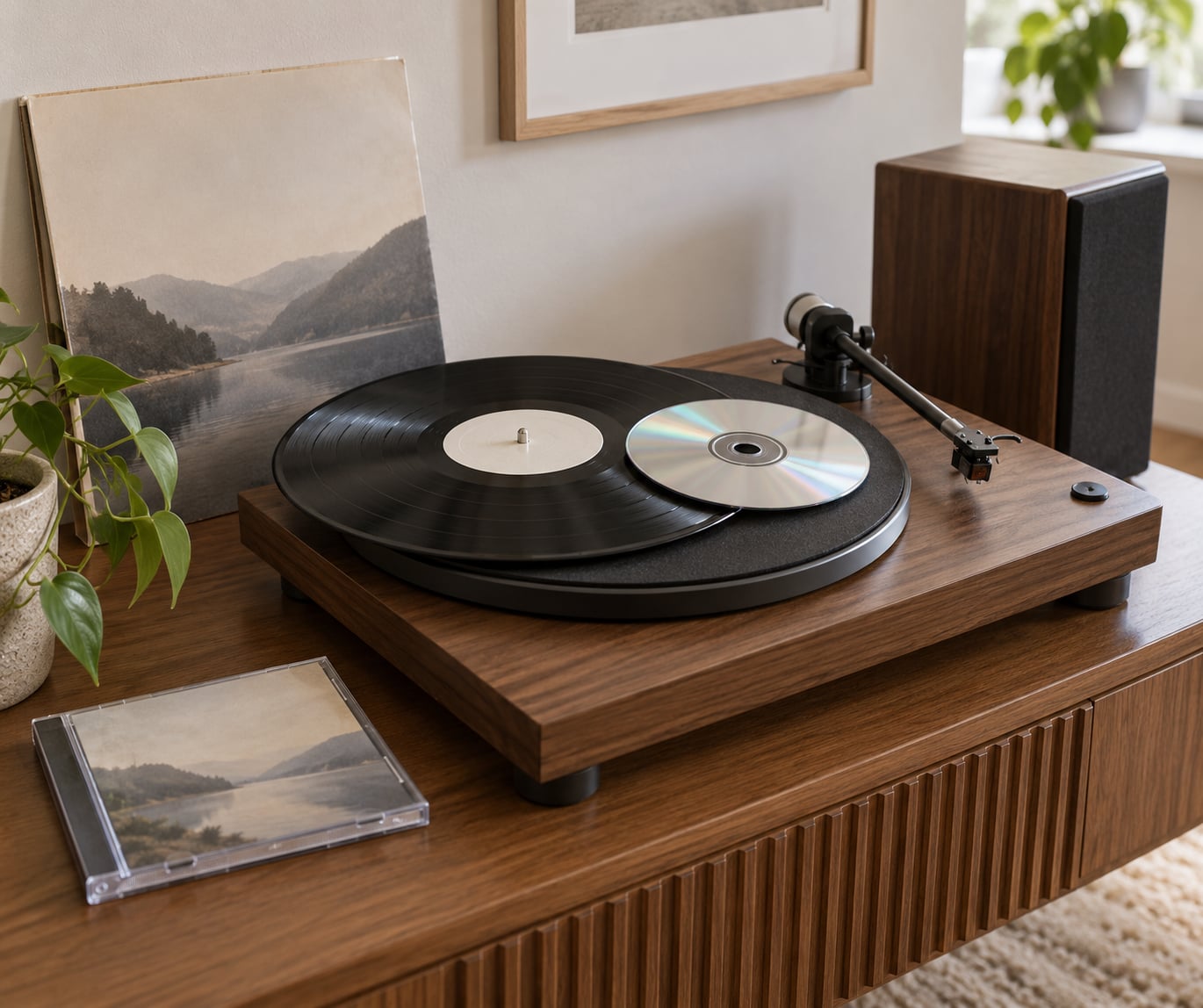
Vinyl vs CD sound quality explained in one line: a CD is measurably cleaner and holds more dynamic range, while vinyl sounds different rather than better. Most of what collectors notice comes from mastering, the playback chain and expectation, not from the format itself.
That distinction matters more than the argument usually gets credit for. Vinyl is not more faithful, and a CD is not perfect. One is a physical groove carrying everything a cutting lathe managed to put there, and the other is a set of numbers that come back out exactly as they went in.
So how do you tell which one suits the way you listen? Here is what actually differs, what is marketing, and where each format earns its place.
Table of Contents
- Vinyl vs CD Sound Quality at a Glance
- What Actually Makes Vinyl and CD Sound Different?
- Warmth, Detail, and Frequency Response
- Dynamics, Noise, and Soundstage
- Why Vinyl and CD Can Sound Different From the Same Master
- Which Format Sounds Better in Real Listening Situations?
- Vinyl vs CD Sound Quality Explained by the Numbers
- Which Should You Choose?
- Frequently Asked Questions
- Is vinyl always warmer and more detailed than a CD?
- Does a CD really have more dynamic range than vinyl?
- Why can two vinyl records with the same mastering sound different?
- Is vinyl surface noise a sign that the record is defective?
- Should collectors buy vinyl or a CD for the best sound quality?
- Does a better turntable or CD player make the format more accurate?
- A Practical Verdict for Collectors
Vinyl vs CD Sound Quality at a Glance
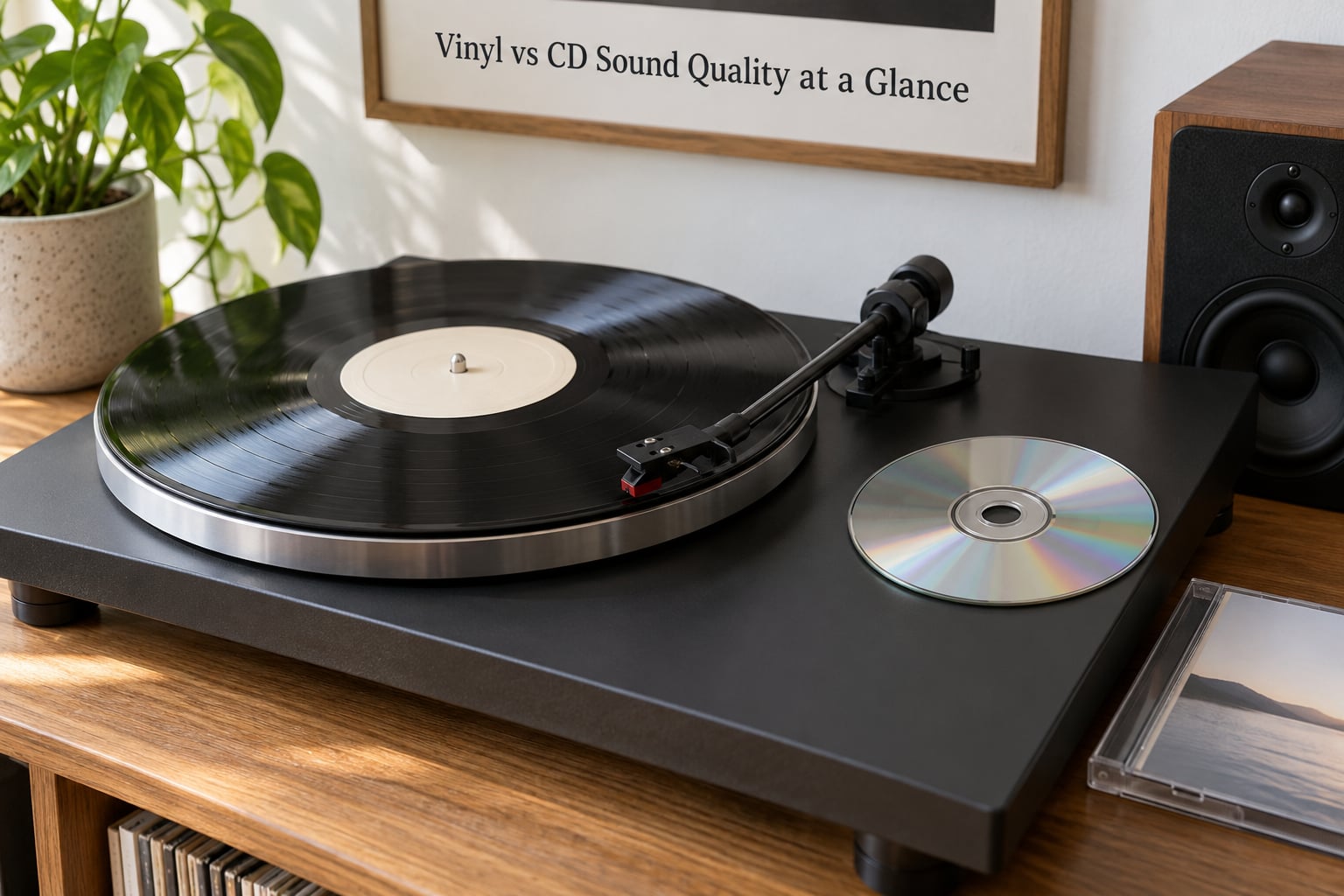
The table below is the honest summary. Each row names a criterion, what each format does, and who the criterion favours.
| Criterion | Vinyl | CD | Favours |
|---|---|---|---|
| Frequency response | Rolled off above roughly 15 to 16 kHz; emphasis curve applied on playback | Flat to about 20 kHz, then a sharp digital filter | CD |
| Dynamic range | About 55 to 70 dB on a good pressing | About 90 to 96 dB by format specification | CD |
| Noise floor | Hiss, crackle and thump audible in a quiet room | Effectively silent between tracks | CD |
| Surface feel | Weight, sleeve, artwork, ritual | A case on a shelf, click and play | Vinyl |
| Convenience | Flip sides, clean the stylus, cue the next track | Random access, skipping, no handling | CD |
| Longevity | Plays indefinitely if undamaged; degrades with use | Immune to handling, but the disc can oxidize if stored badly | Either, for different reasons |
| Edition quality | Varies widely between pressings of the same album | Usually one mastering, though remasters exist | CD |
| Collector appeal | High, and the reason many people buy it | Low, though bargain copies are satisfying | Vinyl |
Read that last two rows carefully. Nothing on this page argues with them.
What Actually Makes Vinyl and CD Sound Different?
Vinyl stores music as a physical shape. A cutting lathe vibrates a stylus, and that vibration cuts a groove into a lacquer disc; a diamond stylus then follows the groove on playback and reproduces every wiggle, wobble and irregularity in it.
Because the groove carries everything, it also carries the noise floor. Dust, pressing imperfections and stylus wear are not filtered out. They are simply part of the signal, sitting underneath the music.
A CD stores music as numbers: 16-bit samples taken 44,100 times a second. A laser reads the pits, the player converts the samples into an electrical signal, and the result is a reconstruction with almost nothing added of its own.
That last point catches people out. Nearly all vinyl pressed since the early 1980s is an analog pressing of a digital master, so the audio reaching the cutting lathe is usually the same PCM file that ended up on the CD. The format difference is real, but it is applied to an identical source.
Playback conditions then widen the gap. A record depends on stylus force, tracking, tonearm alignment and motor quality, and small pitch variations called wow and flutter show up in the sound. A disc plays the same way every time, or it does not play at all.
Warmth, Detail, and Frequency Response
The warmth people describe is mostly a consequence of equalisation, not of a warmer tape. Records are cut with the bass boosted and the treble cut, because high frequencies eat groove space that bass needs. The playback chain applies the inverse curve, the RIAA equalisation curve, to put the balance back.
Do it accurately and you get a flat response to roughly 15 to 16 kHz. Do it sloppily and the record sounds dull. Much of the perceived warmth people praise is simply a chain that has not fully undone the cutting curve.
Because groove space is finite, engineers also roll the top end off before cutting, and bass on a dense 1960s style mix can crowd everything else out. The result is a band-limited source with smooth transients and rounded cymbals. Compare that with a bright modern master on CD, and the CD wins the detail fight easily.
Vinyl’s detractors sometimes say it smears detail. That happens when the cartridge is under-tracked or the inner grooves are worn thin, not because of the format. A well-cut, well-set-up record resolves plenty of detail. It simply resolves a slightly narrower slice of the spectrum.
Room acoustics and system matching matter more than either format. A turntable in an untreated living room, playing into small desktop speakers, will lose more fidelity than the medium ever took away. Cartridge alignment, stylus force and phono stage gain are where that loss usually comes from.
Dynamics, Noise, and Soundstage
Decibels are logarithmic, so the gap between the two formats is larger than the raw numbers suggest. Vinyl’s usable range sits around 55 to 70 dB depending on the pressing; the CD specification allows 90 to 96 dB.
In practice a pressed record holds quiet passages well, and its limited range is part of why dense mixes feel dense. A CD has the headroom to keep a whisper above a cymbal crash, and mastering engineers use it.
Noise works the opposite way. A disc sitting in silence is genuinely silent, apart from the very faint dither added to smooth the 16-bit steps, which is designed to be inaudible. A record in silence produces continuous hiss, random pops, and crackle concentrated where the pressing is worn.
Is that crackle a defect? Some of it is. A new record should be quiet, and repeated pops in the same spot usually mean damage. But light, even noise is normal, and a small amount of it masks the very thin spots in an otherwise quiet recording.
On imaging, records tend to sit slightly forward and compact, while digital sources can place instruments more precisely. Very few listeners can reliably identify this in a blind test, and moving a speaker changes it more than the format does.
Why Vinyl and CD Can Sound Different From the Same Master
When two versions of the same album disagree, the master is usually the reason, not the medium. Four things account for most of it.
- The cutting engineer. Cutting is a live performance of a sort. The engineer sets levels, equalisation and where each track sits, and two good engineers cutting the same lacquer will not match.
- The master route. A record cut straight from the digital master inherits its loudness. Many famous records were cut from a version mixed slightly differently for vinyl, before anyone produced a CD from that same mix.
- The pressing plant. Weight, platicity and quality control vary between plants and between eras. Cheaper pressings are often crowded, noisier and clipped at the top.
- The run-out groove. The space near the label carries the etched matrix number and, on many copies, audible noise. It is not damage, but it is real.
Blind listening makes the point better than any argument online. Play the vinyl-specific mix against the one that went straight to disc, label neither, and plenty of listeners pick the vinyl cut as the better recording. Same label, same band, same format probably included. Whatever the format contributes, the mix is what they heard.
Playback equipment closes the loop. An under-gained phono stage, a misaligned cartridge, or a CD player with a poor DAC can each flatten a recording far more than the format gap ever does.
Which Format Sounds Better in Real Listening Situations?
Casual background listening favours the CD. You skip the track you do not want, you do not cue anything, and the room stays quiet. For focused listening at a desk with good speakers, a well-set-up turntable is a genuinely rewarding way to hear an album, because the format asks you to stay with the record.
Portable use is not a close contest. Vinyl does not travel; a CD in a player with a headphone jack does, and so does the same album in lossless files.
Large collections favour the CD. Nobody flips through four hundred discs and cleans a stylus every Saturday. Expensive equipment favours neither format in particular: past a certain point you are hearing the room and the speakers, not the medium.
Vinyl vs CD Sound Quality Explained by the Numbers
The CD stores 16-bit samples at 44.1 kHz. Sixteen bits gives roughly 96 dB of theoretical dynamic range, and 44.1 kHz sampling puts the usable bandwidth at 20 kHz, just above human hearing. Vinyl reproduces a continuous analog waveform with no sampling steps, but a practical pressing tops out around 55 to 70 dB with noise included, and its bandwidth runs to roughly 20 kHz at best with a slow roll-off on the way there.
Those figures are real and they do not cancel out. They also fail to predict enjoyment, because enjoyment is built from mastering, playback, familiarity and the physical object in your hands.
Which Should You Choose?
Choose vinyl for collecting, for the artwork, for the ceremony, and for the specific analogue character you like. Choose CD for convenience, lower cost per album, instant playback and consistent silence.
If you are still weighing it after this comparison, the deciding factor is rarely something you can measure. It is how much of your listening happens on a sofa, and how much you enjoy the handling.
Buy both when you can. Many of the best arguments online come from collectors who own the same album in two formats and know exactly which mastering they prefer.
Before buying anything, check which edition you are about to get. A recent reissue pressed thin will lose to an older, heavier copy of the same album, whatever the format.
Frequently Asked Questions
Is vinyl always warmer and more detailed than a CD?
No, and the two halves of that claim pull in opposite directions. Vinyl is often warmer and less detailed: the warmth comes largely from the RIAA equalisation curve not being perfectly reversed, and the missing detail comes from the band-limited top end a cutting lathe can hold. A bright, well-mastered CD through a good chain still sounds more detailed than almost any record.
Does a CD really have more dynamic range than vinyl?
Yes, by a wide margin. A good pressing manages roughly 55 to 70 dB, while the CD specification allows about 90 to 96 dB. Because decibels are logarithmic, that gap is larger than the raw numbers suggest. In practice most listeners never hear it, because mastering loudness has narrowed the range on both formats.
Why can two vinyl records with the same mastering sound different?
Same master, different hands. The cutting engineer, the pressing plant, the record weight, the matrix and the run-out noise all change the result. Some records were also cut from a mix made specifically for vinyl, while the CD came from the digital master of a slightly different session. Check the matrix and mastering credits before blaming your turntable.
Is vinyl surface noise a sign that the record is defective?
Not usually. A faint, even hiss is normal on any pressing, and light crackle is common even on new records. Repeated pops in the same spot, heavy crackle that varies track to track, or distortion that fades in and out usually point to a scratch, a worn groove or a misaligned cartridge rather than the pressing being faulty.
Should collectors buy vinyl or a CD for the best sound quality?
Buy the best-mastered copy of the album you care about, in whichever format that mastering exists on. Collectors who prefer the physical object and the ritual tend to choose vinyl; anyone who wants quiet, convenience and cheaper replacements tends to choose CD. For pure measurement, the CD wins on noise and dynamic range.
Does a better turntable or CD player make the format more accurate?
Yes, and it matters more than the format does. A cartridge with the wrong stylus force, a phono stage with too little gain, or a CD player with a poor DAC will each flatten a recording. Spend on matching the cartridge to the phono stage and the speakers to the room before chasing format differences you cannot measure.
A Practical Verdict for Collectors
Start with the specific copy, not the format. Look at the run-out, check the weight, listen for crackle that repeats in one place, and compare the same album on CD if you can find it.
When the copies are matched, vinyl gives you the object, the ritual and an analogue character that many people find more engaging. A CD gives you silence, convenience and a straight path from master to speaker.
Neither one is a shortcut to good sound. That comes down to the mastering, the chain and the room, in that order.