Lacquer cutting in record pressing is the step where a mastering engineer transfers finished audio onto a lacquer-coated aluminium disc on a record cutting lathe. A heated sapphire or ruby stylus shaves one continuous spiral groove into the soft coating, and that groove becomes the master every copy of the record is pressed from.
It sounds technical, and it is, but the idea is simple: someone cuts the music physically into a disc, the cut is fixed forever, and every record your friend buys is a duplicate of it. Understanding that one distinction clears up most of the confusion collectors have about mastering credits, runout etchings and why a bad cut can never be fixed downstream.
Table of Contents
- What Is Lacquer Cutting in Record Pressing?
- Why Record Factories Traditionally Used Lacquer?
- How Does Lacquer Cutting Work?
- What Is Lacquer Cutting in Record Pressing on a Lathe?
- Lacquer Cutting vs. Metal Mastering: What Changes?
- Does Lacquer Cutting Affect the Sound or Playability of a Record?
- Why Do Collectors Care About Lacquer Masters?
- Frequently Asked Questions
- Can you play a lacquer record used for record pressing?
- Is lacquer cutting better than metal mastering?
- Why are lacquer masters used to make vinyl records?
- How can I tell if a record was mastered from lacquer?
- Is a lacquer record the same as a vinyl record?
- Conclusion
What Is Lacquer Cutting in Record Pressing?
Lacquer cutting is the transfer of a finished audio master onto a soft recording disc. The engineer mounts a blank lacquer disc on a lathe, plays the master audio through the lathe’s playback head, and lets a cutting head follow that signal by physically engraving it into the coating as the disc turns.
What comes out the other side is not a record. It is a master disc that will never be played commercially and will never be handled casually. A metal negative called a father is grown on it electroplating-wise, the father makes a mother, the mother makes a stamper, and the stamper presses PVC to make the actual records. The lacquer itself is destroyed during plating, which is where most people get the mental model wrong.
Collectors often assume a record is pressed from a lacquer. It is not. The lacquer never touches vinyl. It holds the audio for long enough to be copied into metal, and then it is scrap.
So where does lacquer cutting sit in the order of operations? Four stages, and the words get used loosely, so it helps to keep them apart:
- Mastering is preparing the audio: EQ, compression, level, stereo decisions, mono bass below a certain frequency, treble ceiling, groove width and playing time. The output is usually a digital file these days.
- Lacquer cutting is the physical engraving of that file or tape onto the lacquer disc.
- Plating is the electroforming of the metal father, mother and stamper from that cut.
- Pressing is the forming of PVC biscuits in a press against the stamper.
One more thing makes lacquer cutting the odd one out: it is the point of no return. Mastering choices can be revised, plating can be redone from a backup, and a bad pressing run can be scrapped. Once the stylus has finished a groove, that decision is carved into the master and every copy inherits it.
Why Record Factories Traditionally Used Lacquer?
Lacquer won the mastering world for practical reasons, not aesthetic ones. In the late 1940s and 1950s, record cutting lathes were built to cut soft materials. A disc of aluminium coated in nitrocellulose lacquer was the natural input, because that was what the machines were designed around.
Engineers already knew how to run them. A mastering engineer in 1958 had spent years with the same lathe design, the same cutting heads, the same feed rates. Switching media meant relearning the trade at exactly the moment record production was scaling up fast.
Handling mattered too. A lacquer disc is light, flat and reasonably forgiving in a mail envelope or a mastering room drawer. Metal masters are heavier and more rigid, which is a benefit once you reach the plating stage and a nuisance before it.
And the output slotted straight into existing pressing. A lacquer takes a silver solution and a nickel bath without any change to the plant. Vinyl duplication is a separate industry, and lacquer cutting sits upstream of it rather than tangled up with it.
Direct metal mastering, or DMM, came along as an alternative where the audio is engraved straight onto a copper-plated metal disc and skips the lacquer step. It came from the Teldec and Neumann lineage and has been used for high-profile pressings since the 1980s. The two methods still coexist, which is where most of the loud argument comes from.
How Does Lacquer Cutting Work?
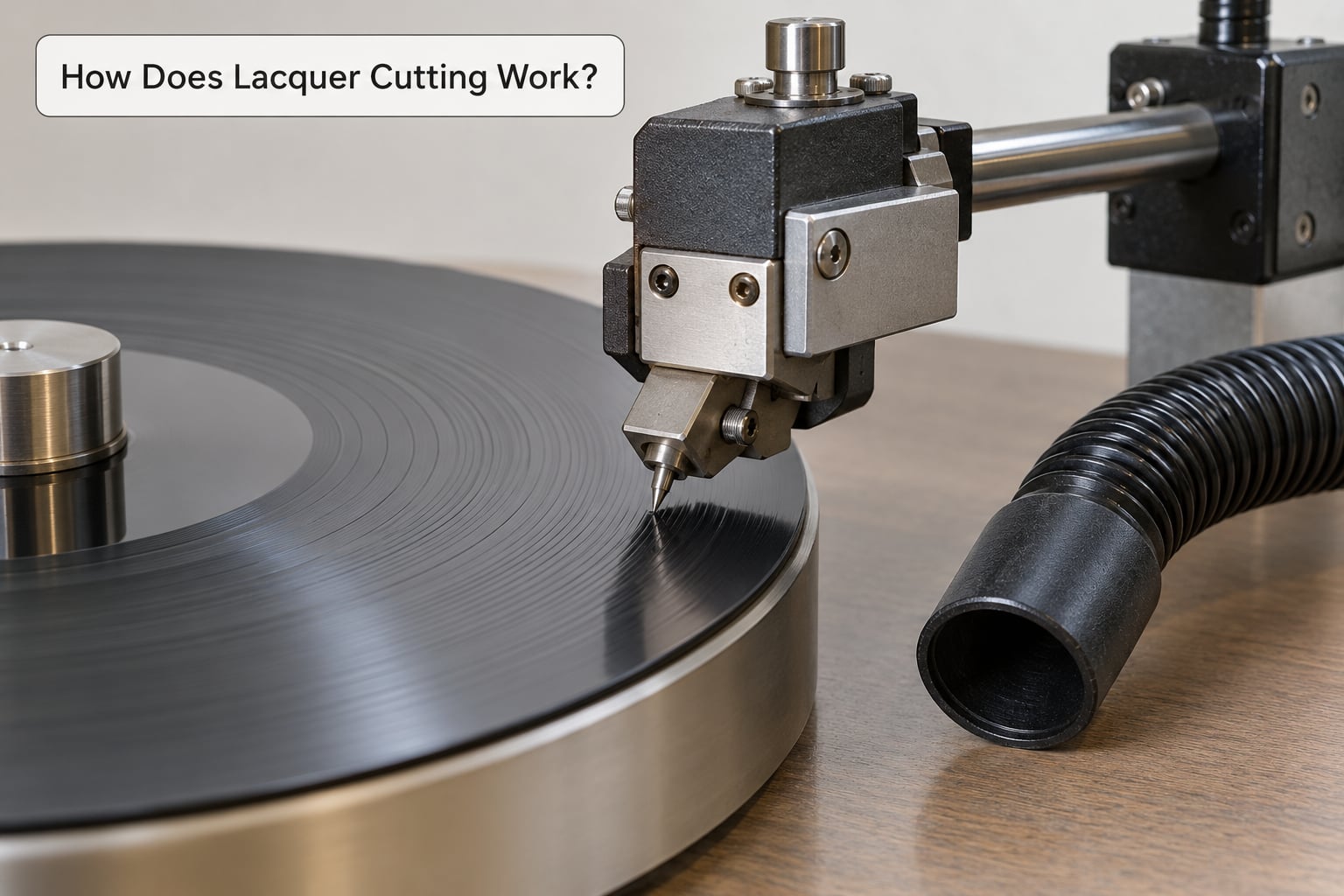
The full chain has eight steps, and each one hands off to the next. Here is the order of operations as an engineer or plant would describe it.
- Source material and mastering. The label delivers finished audio, usually a high-resolution digital file. It gets EQ, level, compression and the decisions that only matter once you have a groove width in mind.
- Lacquer preparation. A blank aluminium disc coated with lacquer is cleaned and mounted on the lathe. The coating is soft enough to cut cold, though the stylus runs warm to help it.
- The cut. The master audio drives the lathe’s cutting head, which engraves one continuous spiral groove from the outer edge to the runout. Each side is cut separately.
- Inspection and test play. The lacquer is played back on a turntable before anything irreversible happens. Cutting engineers do this on every side, because the next step destroys it.
- Silvering. The cut surface is made electrically conductive with a fine silver solution, which is what the current needs to attach to.
- Electroplating for the father. The disc goes into a nickel bath and grows a metal layer. Because plating deposits onto a surface, the result is a negative: a raised ridge where the groove was cut.
- Mother and stamper. The father is parted and used to plate a positive, the mother. The mother then produces the stamper, the actual metal mould the press uses. A safety copy of the father is made in parallel.
- Pressing. PVC biscuits are heated, formed in a hydraulic press against the stamper, cooled and trimmed. The audio you hear is a pressed copy of a plated copy of a cut.
The metal parts have names worth learning, because they show up in collectors’ conversations:
| Part | What it is | Playable? |
|---|---|---|
| Lacquer master | Aluminium disc with lacquer, holding the audio | Technically yes, but it is a single-use master |
| Father | Metal negative grown on the lacquer, groove becomes a ridge | No |
| Mother | Positive stripped from the father, groove is a valley | No |
| Stamper | Working mould used in the press | No |
Plating is what makes the lacquer single-use. You cannot peel silvered metal off soft lacquer and reuse the disc, so once plating starts, that master is finished. That is why the test play in step four is not optional, and why a rejected cut is a scrapped cut.
What Is Lacquer Cutting in Record Pressing on a Lathe?
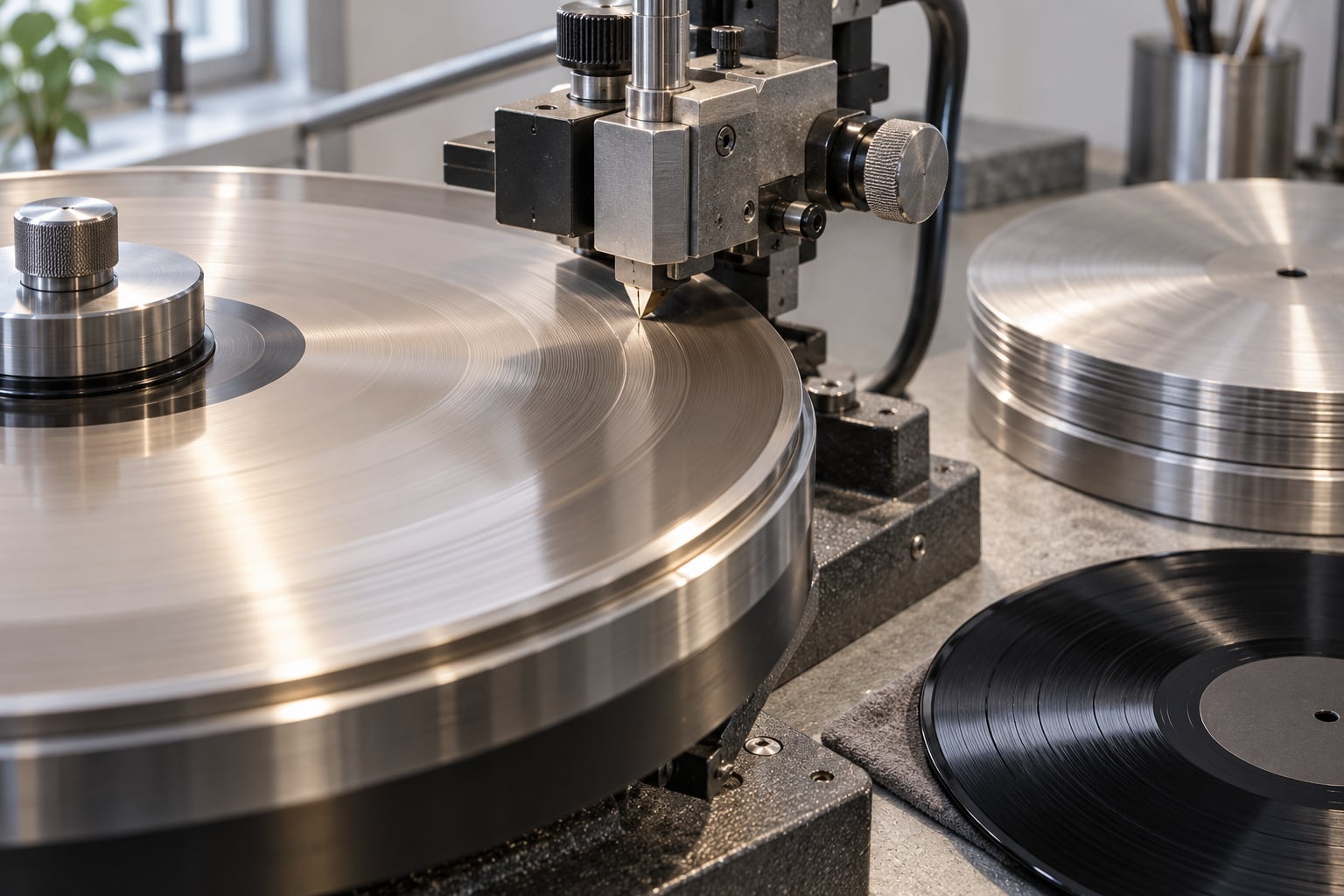
Here is the part people find satisfying when it finally clicks. The lathe has two separate heads. The playback head reads the incoming master audio. The cutting head, driven by that audio, does the engraving.
Inside the cutting head are electromagnetic coils. One pair moves the stylus up and down, and that vertical movement is the waveform: the shape of the wave is the shape of the groove wall. Another pair moves it sideways, and that lateral swing carries the difference between the two stereo channels. Because the left and right information is stored as a sideways movement of a single groove, a mono turntable plays back both channels summed, which is a genuine design feature rather than a compromise.
The stylus itself is usually sapphire or ruby, tipped and shaped to cut a clean V. It sits in a heated mount, and as the disc spins beneath it, it displaces a microscopic ribbon of lacquer. The removed material is called swarf, and it is vacuumed away through a line near the head so it cannot settle back into the groove.
Groove pitch, the distance between neighbouring passes of the spiral, is where playing time gets decided. A wider pitch fits fewer rotations per inch, which fits more music per side. Cutting engineers balance that against the loudness and low-frequency content the groove has to hold, because a groove packed too tightly can wander or distort on playback.
The whole thing runs in one pass, in real time, at a controlled feed rate. A twenty-minute side is twenty minutes of cutting. There is no second pass to correct it and no undo.
Lacquer Cutting vs. Metal Mastering: What Changes?
The practical differences are real, but they are smaller than the marketing suggests. This table covers what actually changes between cutting lacquer and cutting direct metal mastering.
| Factor | Lacquer cutting | Direct metal mastering |
|---|---|---|
| Cutting surface | Lacquer on aluminium, very soft | Copper-plated metal |
| Typical tooling | Heated sapphire or ruby stylus | Diamond or cold metal stylus |
| Plating steps | Silver, then father, mother, stamper | Skips the lacquer, still plates the father |
| Surface artifacts | Can develop a small horn at the groove edge | No horn; no dehorning needed |
| Pre-echo tendency | Soft coating can ring slightly ahead of the transient | Harder surface, minimal pre-echo |
| Master handling | Light, mail-friendly, but single-use | Rigid, longer-lived tooling |
| Availability today | Small supplier base, cut styli and discs are niche | Broader, and the fallback the industry relies on |
| Collector relevance | You cannot tell from a finished record alone | Same: the finished copy does not reveal the method |
The last row matters more than most people expect. A pressed record does not announce how its master was made. The vinyl carries the groove, not the story of what the groove was cut into three weeks earlier, so the method is something you learn from credits and plant lore rather than from inspecting the disc.
Does Lacquer Cutting Affect the Sound or Playability of a Record?
Not on its own. Lacquer cutting is a transfer step, and a good transfer faithfully carries a good master. The variable that decides how a record sounds is almost never the choice between lacquer and metal.
What actually shapes the result, in rough order of influence:
- The master. A brickwalled, over-compressed master sounds flat however carefully it is cut. The forum consensus among collectors and engineers is blunt about this: the cut carries decisions, not quality.
- Mastering decisions. Mono bass, treble limiting, groove width and level all happen before the lathe turns.
- Cut quality. Feed rate, groove geometry, lateral and vertical modulation accuracy, and cleanliness of the room. A speck of dust in the lacquer becomes a tick in every copy.
- Plating and pressing. Poor plating gives a fuzzy or thin groove wall. Thin or badly cooled pressings distort, and a misaligned press gives you a record that skips.
- Vinyl formulation and weight. Softer compounds grip the stylus and reduce surface noise; thicker records play louder and hold their shape.
- Your playback chain. A worn stylus makes a magnificent cut sound terrible.
One artifact is worth naming because it shows up on new records and worries buyers: the horn. As the stylus displaces soft lacquer, a tiny ridge can form along the groove edge. It is a real consequence of cutting a soft material, it is cosmetic in almost every case, and pressing plants dehorn the groove afterwards. The faint hairline marks you sometimes see on a fresh record are usually traces of horn or of dehorning itself, not a fault that damages the audio.
Pre-echo is the other one collectors ask about. On a soft coating, the stylus can generate a very small ring in the lacquer just ahead of a sharp transient, so you hear a ghost of the drum hit a fraction before the drum hit. It is subtle, it is a material property rather than an error, and cutting engineers manage it with stylus choice and geometry rather than by hoping.
Why Do Collectors Care About Lacquer Masters?
Because the cut is permanent, the collector’s interest is mostly about tracing decisions rather than judging sound. Three things make that possible.
The credit line. A release may say Mastered By, Lacquer Cut By, or Lacquer Cut At, and the distinction is a genuine source of argument. Conventional usage treats mastering as preparing the audio and cutting as the physical transfer, so a studio that does both is usually credited for both. Very often the same human appears under both lines, and collectors assume the roles are always separate people. They usually are not.
The dead wax and runout. The unrecorded area at the end of a side carries etched information, and each part traces back to a stage of this process:
- The matrix number, side letter and take number, such as an A-1, tell you the side and which take of that side the cut came from.
- Mastering marks and the mastering engineer’s initials identify the facility and the person, which is the closest thing to a signature on the cut.
- Stamper codes tell you the plant, the matrix run and how far into that run your copy sits, which matters if you are hunting early pressings.
Reissues and lathe cuts. A reissue that returns to the original master is a lacquer cut being made again, in 2026, from the same source, and the second cut is not the first cut. Lathe-cut dubplates and one-off records are the exception: they are cut direct to the record in real time, never plated, never duplicated, and every copy is genuinely one of a kind.
The supply chain is also worth a sentence, because it is thinner than most listeners assume. A fire at Apollo/Transco in 2020 removed a major supplier of lacquer discs, and the industry now leans on a very small number of disc makers and cutting styli producers. DMM exists partly because it is the backup plan when lacquer supply is tight.
Start with the credit, the matrix and the stamper code. Those three tell you who cut it, which side and take, and how early your copy is.
Frequently Asked Questions
Can you play a lacquer record used for record pressing?
A lacquer master can be played on a turntable, and cutting engineers do exactly that to check a cut before plating. It is a delicate disc and the stylus wears faster on it than on vinyl, so it is played once or twice at most. After plating it is destroyed, which is why it cannot be checked a second time.
Is lacquer cutting better than metal mastering?
Neither is reliably better. Both transfer the same master, and the sound you end up with is decided mostly by the master, the mastering decisions and the pressing. Lacquer cutting is the traditional method and handles bass and level decisions the way engineers learned; DMM avoids pre-echo and the horn. Audiences who prefer one usually react to the mastering, not the metal.
Why are lacquer masters used to make vinyl records?
Lacquer is soft enough to be engraved by a heated sapphire or ruby stylus on lathes that were built for exactly that job, and it takes plating cleanly, which is what lets a metal mould be grown from the cut. It is light to ship and easy for engineers to inspect before plating. The reason is equipment history and supply chain practicality, not a claim about sound quality.
How can I tell if a record was mastered from lacquer?
You usually cannot, from the finished record alone. The vinyl carries the groove, not the record of what the groove was cut into, so nothing in the runout distinguishes a lacquer cut from a direct metal master. Credits, the mastering engineer involved and the plant’s practice are your evidence. A collector can read the matrix, take number and stamper code with confidence; the cutting method is not in the etching.
Is a lacquer record the same as a vinyl record?
No, and this is the most common mix-up among newcomers. A lacquer record is a soft nitrocellulose coating on aluminium that carries the master audio for plating. A vinyl record is PVC pressed against a metal stamper made from that lacquer. The lacquer never becomes the record; it is broken down during plating, and every copy you own descends from a metal copy of it.
Conclusion
Lacquer cutting in record pressing is the engraving step between mastering and plating, and nothing more mysterious than that: an audio master becomes a physical spiral groove in a lacquer-coated disc, that disc grows a set of metal moulds, and the moulds press the records. The lacquer master is temporary and single-use; the vinyl you own is a pressed copy of a plated copy of a cut.
So look at the credit line, the matrix and take number, the mastering mark and the stamper code. Those tell you who cut it, which side and take, and where your copy sits in the run, which is more than the record itself will ever tell you.