What does a phono preamp do? It takes the tiny electrical signal your record’s cartridge produces, boosts it to normal line level, and applies the RIAA equalization curve that puts the bass and treble back where they belong. Without it, records play quiet, thin and tinny. With it, they sound full and balanced.
Most people first meet this box the day they try to plug a turntable into something that isn’t a turntable. The cable fits, the needle drops, and something is obviously wrong. That something is usually the missing link in the chain, and it is a small one.
Table of Contents
- What Does a Phono Preamp Actually Do?
- Why Vinyl Signals Need a Phono Preamp
- What Are Phono Preamp Gain and RIAA Equalization?
- Gain
- RIAA equalization
- How Does a Phono Preamp Work in a Turntable Setup?
- Do You Need a Phono Preamp for Your Turntable?
- How Do You Choose a Phono Preamp?
- Cartridge support
- Gain range
- Loading
- Noise and construction
- Placement and features
- Phono Preamps for Moving-Coil and Moving-Magnet Cartridges
- What does a phono preamp do differently for a moving coil?
- How to Set Up a Phono Preamp for the Best Sound
- What Causes Hum, Distortion, or a Thin Sound?
- Frequently Asked Questions
- Is a phono preamp necessary?
- What happens if you do not have a phono preamp?
- Should I use the PHONO input or AUX for a turntable?
- Is a phono stage the same thing as a phono preamp?
- How do I get rid of turntable hum?
- How much gain should a phono preamp have?
- Conclusion
What Does a Phono Preamp Actually Do?
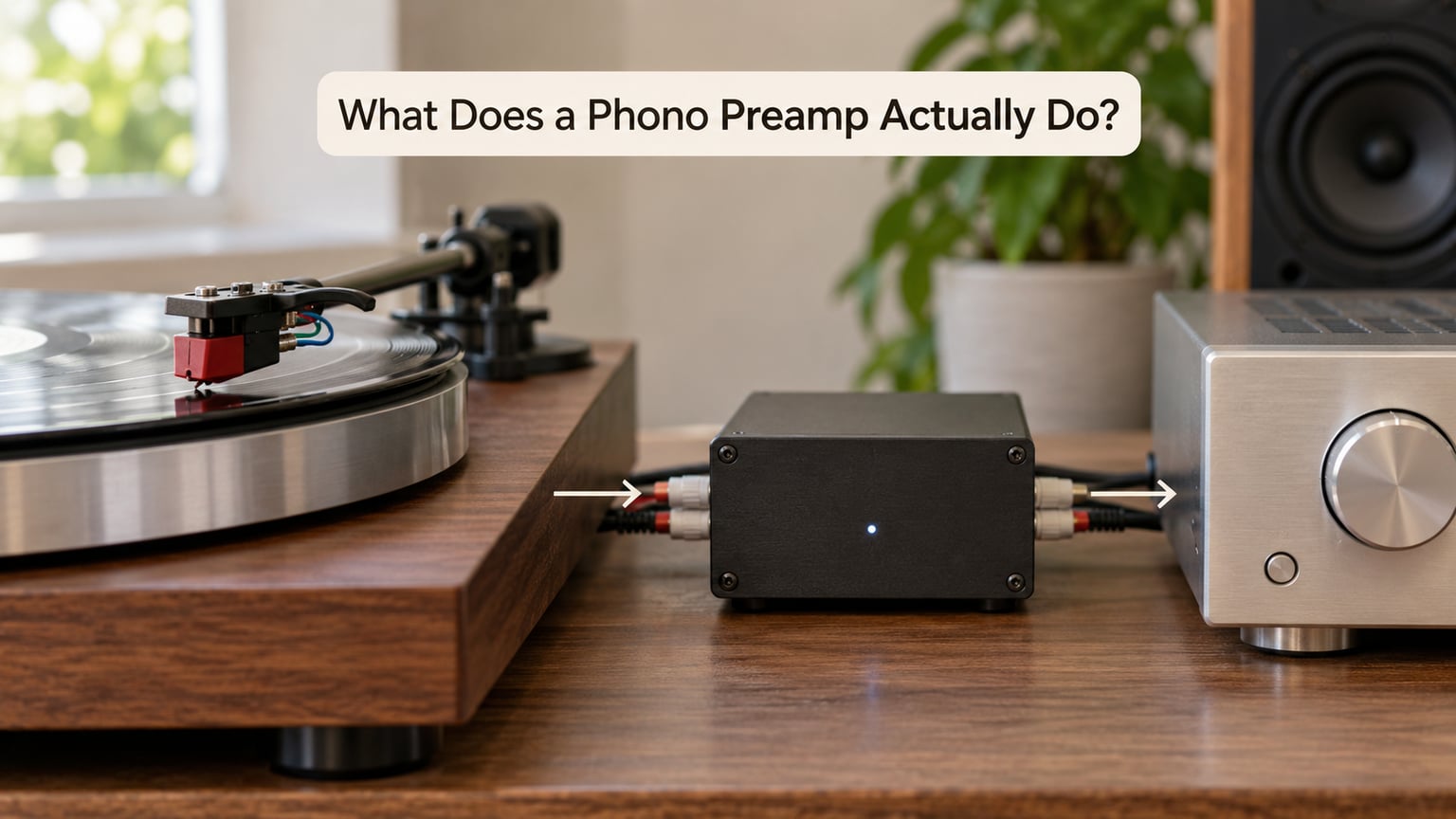
A phono preamp, also called a phono stage, does four jobs in one small box. It lifts a millivolt-level signal up roughly 1,000 times, corrects the tone of the cut, sets the loading the cartridge needs, and usually tames rumble on the way.
- Amplifies the cartridge signal to line level. The signal coming out of a moving magnet cartridge is measured in millivolts. Everything downstream expects line level, so the preamp adds the gain to close the gap.
- Applies RIAA equalization. Records are cut with bass reduced and treble lifted so the groove can hold more music. The preamp reverses that so the balance is restored.
- Sets cartridge loading. The input impedance and capacitance the cartridge sees affect treble extension and resonance. A good preamp lets you match them.
- Filters rumble. A low-cut filter, usually around 20 Hz, removes the subsonic warp energy that would otherwise make a woofer work very hard for no audible benefit.
The RIAA curve is the part people find surprising. Records are not flat recordings. The inverse curve is built into the preamp, and every record player since the late 1950s assumes it is applied exactly once.
Why Vinyl Signals Need a Phono Preamp
Compare the numbers and the reason becomes obvious. A moving magnet cartridge puts out somewhere around 3 to 6 millivolts at 1 kHz. An AUX or TAPE input on a typical amplifier is calibrated for something in the range of 100 to 500 millivolts. A CD player or phone puts out a volt or two.
That is a gap of roughly 40 to 50 decibels of gain. Push a millivolt signal into an AUX input and the amplifier plays it exactly as it received it, which means you turn the volume up as far as it goes and still have almost nothing.
You also lose the bottom. The RIAA curve lifts the bass by around 30 dB at the low end relative to the midrange. Skip it and the result is that familiar thin, tinny, honky sound people describe as a record played through the wrong input. It is not a damaged record and it is not a bad cartridge. It is a missing circuit.
There is a second failure mode in the opposite direction. Feed that same raw cartridge signal into an amplifier’s PHONO input and the built-in stage amplifies it once. That is correct. Now put a turntable that already has its own preamp into that same PHONO input, and the signal gets amplified twice, with the RIAA curve applied twice. It comes out harsh, compressed and distorted.
What Are Phono Preamp Gain and RIAA Equalization?
These get bundled together, but they are two different jobs and it helps to keep them apart.
Gain
Gain is simply how much bigger the signal gets, usually expressed in decibels. A moving magnet cartridge needs roughly 35 to 42 dB to reach line level with a little headroom left. A low-output moving coil cartridge can need 60 dB or more, which is why some preamps have two gain settings and some have a gain knob.
RIAA equalization
Equalization is the shape of the frequency response, not the level. Cutting a record uses an inverse RIAA curve: deep bass is turned down so large, slow vibrations need less groove space, and high frequencies are lifted because high frequencies carry small, fast detail that would otherwise be buried.
Playing it back requires the exact opposite shape. That is what the RIAA stage does. A preamp that boosts everything uniformly is a line amplifier, and it will not sound right with a record. This is also why preamps made for record players are not sold as general line preamps, and why a headphone preamp is not a substitute. Headphone preamps raise volume. They do not apply the record curve.
How Does a Phono Preamp Work in a Turntable Setup?
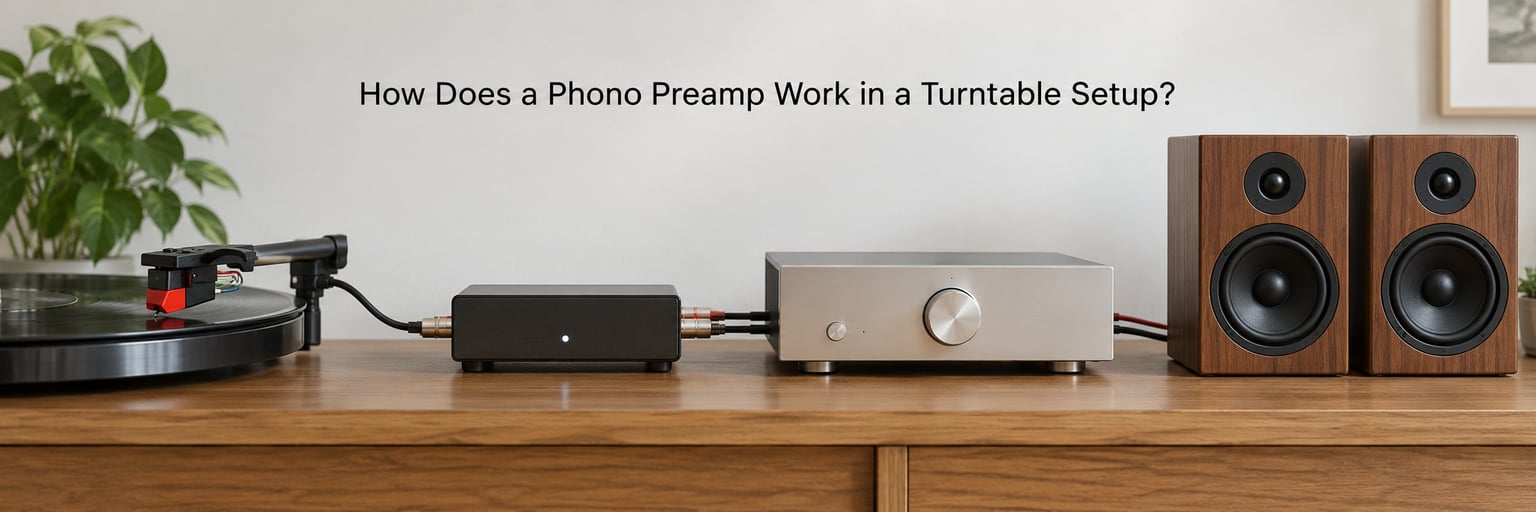
The signal travels through four stages, and each one hands off to the next in a different voltage range.
- Stylus in groove. The needle follows the microscopic modulations cut into both sides of the groove.
- Cartridge. That mechanical movement becomes a small electrical signal, and one side is usually grounded so the stereo channels share a common reference.
- Phono preamp. Gain, RIAA equalization and loading happen here. The output is now line level and ready for a normal input.
- Amplifier or powered speakers. Line level goes in, speaker-level power comes out, and the speakers move air.
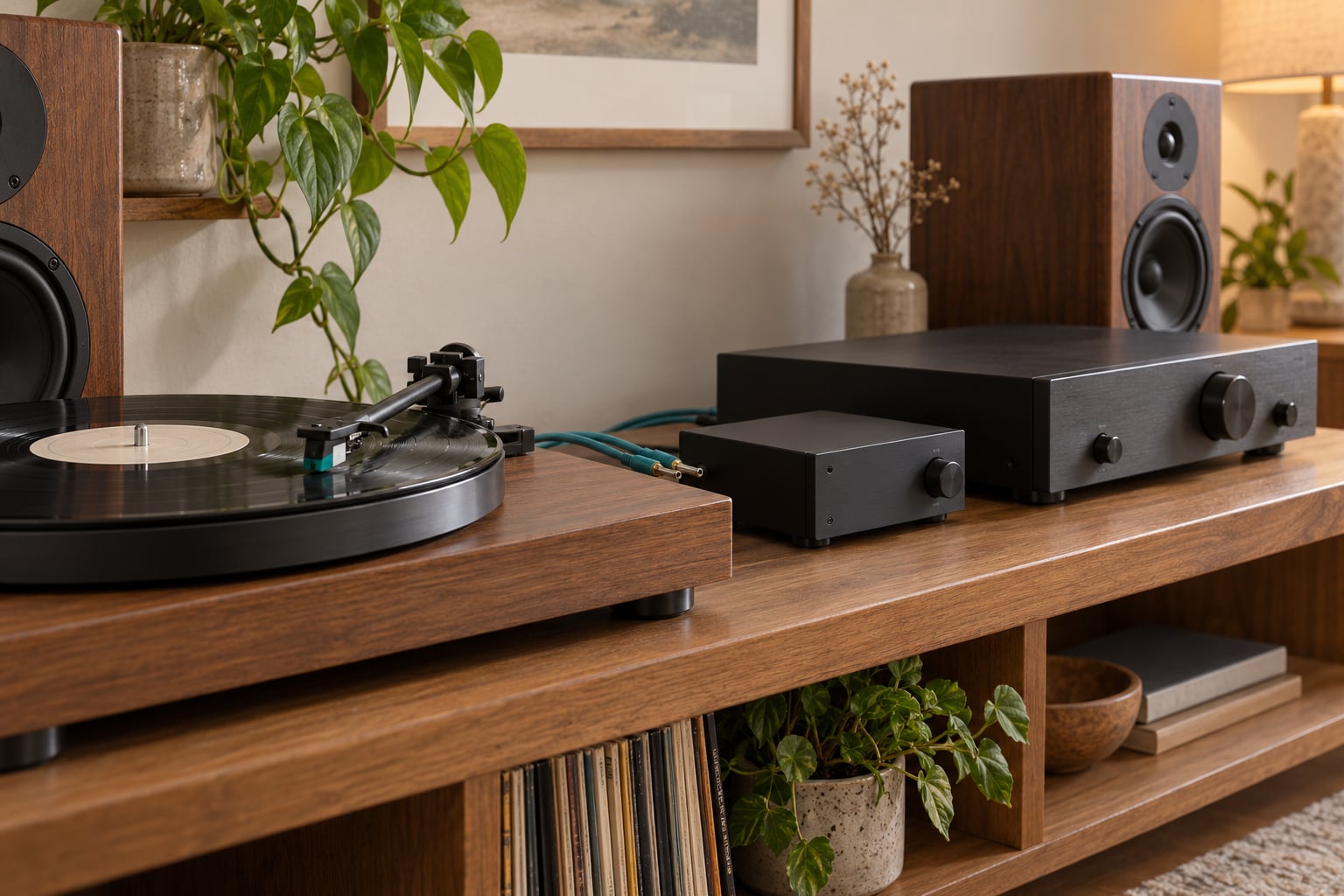
A phono preamp can live in two places. Many turntables have one built in, usually with a switch on the back marked PHONO or LINE. Receivers and amplifiers often have one too, at an input labelled PHONO with a ground screw beside it. You use exactly one of them, never two.
Do You Need a Phono Preamp for Your Turntable?
Before shopping for anything, check these three things. Most people who think they need a preamp already own one.
- Does your turntable have a PHONO or LINE switch on the back? If yes, it has a built-in phono stage. You can switch between feeding a receiver’s PHONO input and feeding an external preamp’s RCA input.
- Does your amplifier or receiver have an input labelled PHONO? Look for a pair of RCA jacks with a metal ground post next to them. That is a phono stage in the box.
- Do your powered speakers or active monitors have a PHONO input? Many desktop and bookshelf speakers do. Computer speakers and Bluetooth speakers do not.
You need an external phono preamp when the answer to all three is no. That is common with USB turntables, budget belt drives, active speakers and any amp whose inputs are all line level.
You might also want an external one even when your system has a built-in stage, if you plan to add a low-output moving coil cartridge later. Built-in stages are usually designed around moving magnets, and a moving coil into an MM-only stage sounds quiet and thin no matter how you turn it up.
One more case: headphones. Most phono stages have no headphone output, so listening to records with headphones usually means buying a small headphone amplifier and plugging it into the phono preamp’s line output. Users on the Steve Hoffman and AVForums boards broadly agree that an outboard stage improves an already decent built-in one, but that it is an upgrade rather than a necessity.
How Do You Choose a Phono Preamp?
Start with the cartridge, then work backwards. The manual tells you what came fitted, and cartridge type is not something to guess at.
Cartridge support
A unit labelled MM only will not accept a moving coil cartridge properly. A unit labelled MM/MC handles both, usually with a front-panel switch. Some very low-output cartridges want an MC position plus extra gain from an outboard stage or a step-up transformer.
Gain range
Roughly 35 to 42 dB covers moving magnets well. If you ever plan a moving coil, look for at least 60 dB available, whether through a second gain setting or an adjustable knob. Published input sensitivity and maximum input figures tell you where the gain tops out before distortion.
Loading
Fixed impedance suits most people and costs less. Selectable loading capacitance helps when a cartridge has unusually low output impedance or the cable run is long, and some high-end models offer switchable impedance for tonearms with high effective mass. Loading is one of those settings where the default is right for most systems.
Noise and construction
Signal-to-noise and THD figures are only meaningful if the measurement conditions match, so treat them as a rough screen rather than a ranking. A metal case, a real ground post and a separate power supply matter more in practice than a headline noise number.
Placement and features
Keep the interconnect run between turntable and preamp short; forum advice repeats this constantly, and long runs pick up hum. Put the preamp near the amplifier if the chain allows it. A headphone output is worth having if you listen with headphones. A 12V trigger wakes an amplifier from standby, which is a small luxury. A USB output turns the preamp into the front end for digitizing records.
Phono Preamps for Moving-Coil and Moving-Magnet Cartridges
| Cartridge type | Typical output | Gain needed | Preamp setting |
|---|---|---|---|
| Moving magnet | 3 to 6 mV | 35 to 42 dB | MM position |
| High-output moving coil | 0.5 to 1.2 mV | 42 to 50 dB | MC position, low gain |
| Low-output moving coil | 0.1 to 0.5 mV | 60 to 70 dB | MC position plus extra gain or a step-up transformer |
What does a phono preamp do differently for a moving coil?
Nothing conceptually. The circuit still amplifies and still applies the same RIAA curve, but it needs a lot more gain and tighter tolerance in the input stage to keep noise and distortion low at high amplification. In practice it means an MC-capable gain setting, and sometimes a bigger box than the one in your receiver.
The trade-off is fragility. A moving magnet tolerates a mistracking stylus better, and moving coils cost more, so the usual path is to get a good moving magnet working well before stepping up.
How to Set Up a Phono Preamp for the Best Sound
Ten minutes of care here saves an afternoon of chasing hum later.
- Turn everything off and unplug it. Cables go in and out far more safely with the system powered down.
- Connect the ground wire first. The bare spade or pin on the turntable’s ground post goes under the terminal on the preamp or amplifier, and that terminal must be loosened with a screwdriver rather than guessed at.
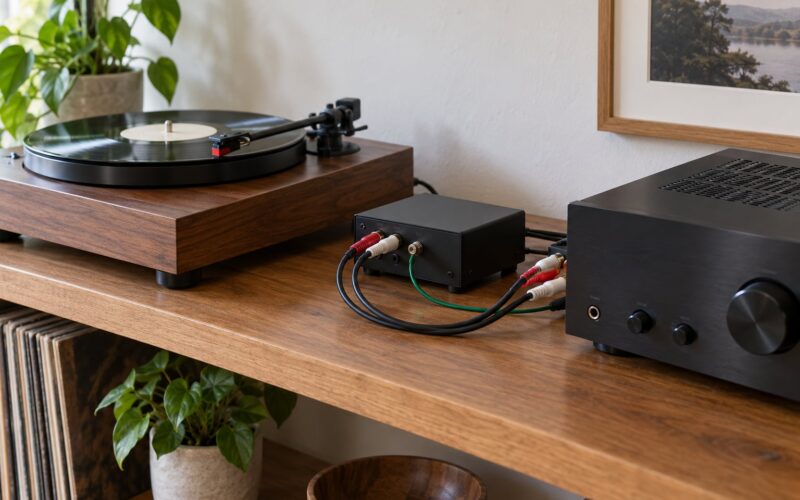
- Plug the turntable RCA outputs into the preamp inputs. Left to left, right to right, which is the usual colour arrangement.
- Set the preamp for your cartridge type before you power up, since a moving coil on an MM setting sounds wrong immediately.
- Run the preamp output into a line-level input on the amplifier, such as AUX, CD or LINE. Never into PHONO if the preamp is external.
- Set the PHONO or LINE switch on the turntable correctly. Built-in stage in use means LINE. External preamp in use means PHONO, which bypasses the internal one.
- Start with the amplifier volume low, then raise it. Listening for a few seconds at a modest level catches distortion far more easily than blasting it.
- Set loading to the default unless you have a reason and a measurement to change it.
What Causes Hum, Distortion, or a Thin Sound?
| Symptom | Likely cause | Fix |
|---|---|---|
| Constant low hum or buzz | Ground wire loose or missing, or a ground loop between two mains-powered boxes | Seat the ground wire properly, then try one box on a different wall outlet |
| Hum that changes when you move closer to the speakers | Magnetic field from speaker magnets reaching the cartridge | Increase spacing, turn the speakers off together, or move the turntable |
| Quiet and thin, with no bass | Cartridge signal going into a line-level input with no RIAA stage in the path | Use a PHONO input or place an external preamp in the chain |
| Harsh, compressed, distorted on loud passages | Double preamp, or too much gain for the cartridge | Switch the turntable to LINE when using the receiver’s PHONO input, or drop the gain setting |
| Intermittent crackle when touched | Loose RCA plug or adapter | Reseat both ends and replace any wobbly adapter |
| Boomy, exaggerated bass | Rumble filter off with a warped record, or a mechanical resonance | Engage the low-cut filter and check the tonearm anti-skate |
Hum is almost always grounding or interference rather than a broken component, which is why checking the ground wire first is the most common advice in the forums. One question worth asking yourself before buying anything: does the hum get worse when you touch the ground post, and stop when you let go? If so, you are hearing the noise the system is meant to reject.
Frequently Asked Questions
Is a phono preamp necessary?
Only if nothing else in your system already does the job. A turntable with a PHONO or LINE switch has one built in, and an amplifier or powered speakers with an input labelled PHONO has one too. You need an external unit when your turntable has no built-in stage and your amplifier has no PHONO input, which is common with USB turntables and computer speakers.
What happens if you do not have a phono preamp?
Plenty, and none of it is dangerous. Plugged into an AUX or TAPE input, the record plays very quietly with almost no bass and a thin, tinny character, because the signal is far below line level and the RIAA curve was never applied. Turn the amplifier up to maximum and you will still have a quiet record.
Should I use the PHONO input or AUX for a turntable?
Use the PHONO input when your turntable has no built-in preamp, or when its switch is set to PHONO. Use AUX, CD or another line input when the turntable has its own preamp and the switch is set to LINE. Choosing the wrong one gives you either a quiet, thin sound or a harsh, doubled one.
Is a phono stage the same thing as a phono preamp?
Yes. Phono stage, phono preamp, phono preamplifier and phono equalizer all describe the same job, though phono preamp is the most common on retail listings. What it is not is a general line preamp or a headphone preamp, which raise volume without applying the record equalization curve.
How do I get rid of turntable hum?
Start at the ground. Turn everything off, loosen the ground terminal on the preamp or amplifier, reseat the turntable ground wire and tighten it properly, then reconnect the RCA cables. If hum persists, try plugging the amplifier into a different wall outlet. A hum that changes when you move nearer the speakers points to magnetic interference instead.
How much gain should a phono preamp have?
Around 35 to 42 dB for a moving magnet cartridge, which typically outputs 3 to 6 mV. A high-output moving coil usually wants 42 to 50 dB, and a low-output moving coil can need 60 to 70 dB. If you only have a moving magnet now, a model with an MM and MC switch gives you room to grow later.
Conclusion
The phono preamp is the box that makes a record playable at all: it raises a millivolt signal to line level and restores the tone curve the record was cut with. Nearly every thin, quiet or harshly distorted record problem traces back to skipping that step, or applying it twice.
Before you buy anything, turn your turntable over and look for a PHONO or LINE switch, then check whether your amplifier has an input labelled PHONO. If either one exists, you already have a phono stage and only need a separate unit if you plan to move to a moving coil cartridge or listen with headphones.