Do I need a phono preamp for my turntable? Only if nothing else in your chain already has one. A phono stage turns the tiny signal from your cartridge into a normal line-level signal, and every single system needs exactly one of them, somewhere. The good news is most turntables and amplifiers already hide one, so the check takes about a minute.
That minute matters. A lot of first-time owners wire a turntable into the wrong input, get music that is quiet and thin, and assume their deck is faulty. It usually isn’t. It is sitting in the wrong hole in the back of the amplifier.
Here is the short version, then the detail: look at the back of the turntable for a PHONO/LINE switch, look at the back of the amplifier for a PHONO input sitting next to a small grounding screw, and look at your powered speakers for a phono input and ground post. Find one anywhere in that list and you do not need to buy anything.
Table of Contents
- Do I Need a Phono Preamp for My Turntable? Quick Answer
- What Does a Phono Preamp Do?
- Does Your Turntable Have a Built-In Phono Preamp?
- How to Tell If Your Turntable Needs One
- Which Type of Phono Preamp Do You Need?
- What Cartridge Does Your Turntable Use?
- How to Choose a Phono Preamp for Your Setup
- How to Connect and Set Up the Preamp
- Do You Need a Separate Preamp with Bluetooth or Powered Speakers?
- Frequently Asked Questions
- Can I connect a turntable directly to an amplifier?
- Is a PHONO input on my amplifier the same as a turntable preamp?
- Do all record players have a built-in preamp?
- Do I need a separate preamp for a Bluetooth turntable?
- Can I use a moving-magnet preamp with a moving-coil cartridge?
- What Should You Do First?
Do I Need a Phono Preamp for My Turntable? Quick Answer
You need exactly one phono preamp in the chain. Where it lives depends on your gear.
There are only two valid arrangements. Either your turntable has a built-in, switchable phono stage and you run a line-level cable into any line input on the amplifier, or your turntable outputs raw phono level and you plug straight into the amplifier’s PHONO input. When the amplifier has no phono input at all, an external phono preamp goes between the two.
Two arrangements do not work, and they produce two very different complaints. Plugging a phono-level turntable into a line input gives you music that is far too quiet with almost no bass. Plugging a preamp’s line output into an amplifier’s PHONO input gives you thin, harsh, scooped-out sound that gets worse as you turn it up.
One catch worth knowing early: a PHONO input on your amplifier is not evidence that your turntable has a preamp. It usually means the opposite. Amplifiers with phono inputs are designed for decks that output raw cartridge signal, and most of those decks are sold without a built-in stage.
If your turntable has a PHONO/LINE switch on the back panel, that switch is the whole answer in one control. Set it to LINE and use a line input. Set it to PHONO and use the amplifier’s phono input. Getting this backwards is the single most common wiring mistake on the vinyl forums, and the two mistakes sound nothing alike, which is actually useful for diagnosing it later.
What Does a Phono Preamp Do?
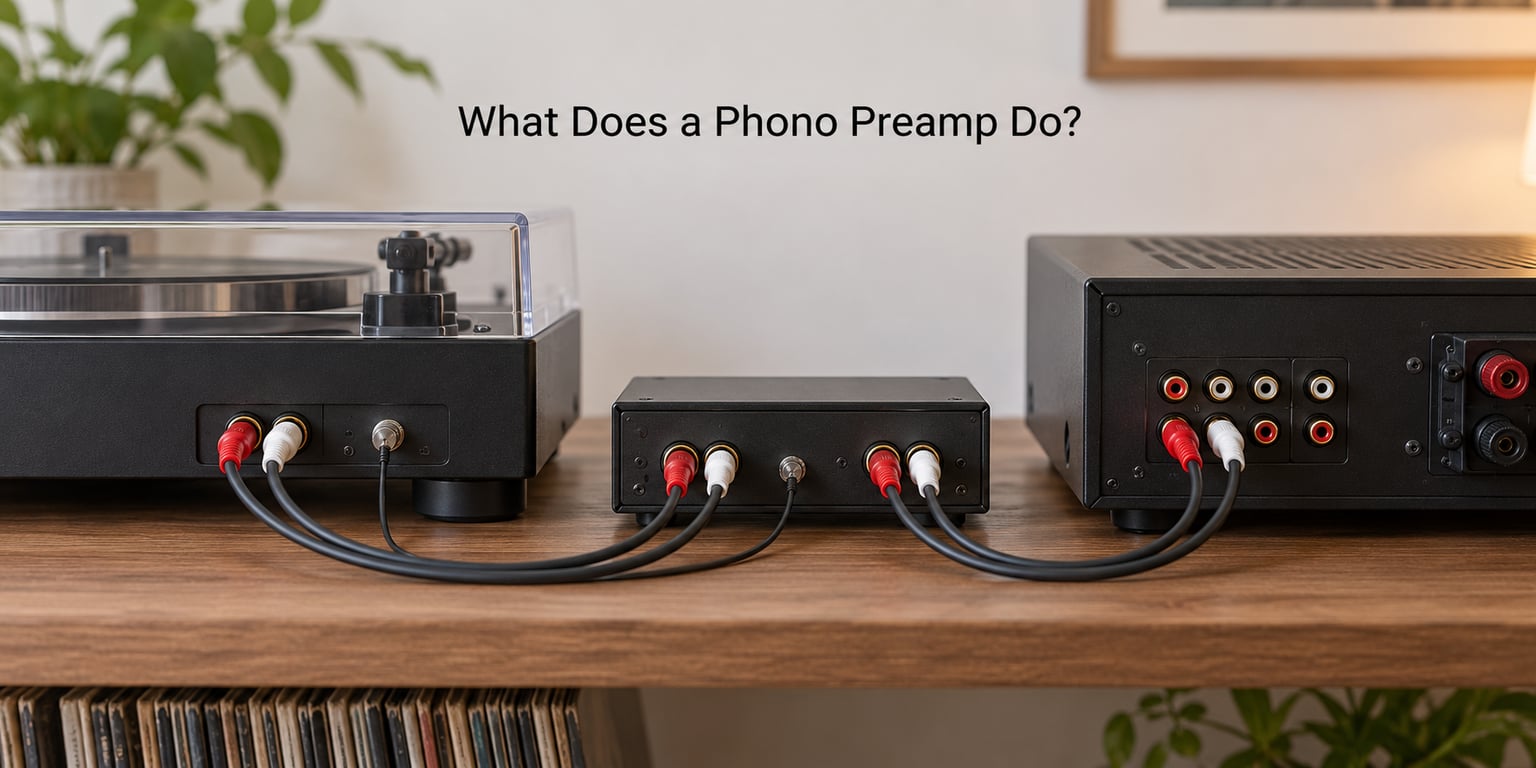
A phono preamp, also called a phono stage, does two jobs at the same time. It boosts the signal, and it applies RIAA equalization.
The boost is needed because a cartridge is a delicate little generator. An average moving-magnet cartridge puts out roughly 0.005V, and a low-output moving-coil cartridge can sit well below that. Amplifiers expect to work with a signal around 0.3V. Somewhere in between those two numbers, about 60 times of gain, has to happen before the music will play at a normal level.
The equalization matters just as much. Record cutting is a compromise: bass takes up enormous space at low frequencies, so engineers cut bass way down and shave the treble to keep the level under control. The RIAA curve is the agreed reversal of that. A phono stage applies it, restoring the bass and taming the sibilance. Play a record without it and the bass is missing by design, not by fault.
Three signal levels matter when you are wiring anything, and mixing them up causes every common problem in this hobby.
| Signal level | Typical voltage | What accepts it |
|---|---|---|
| Phono level | about 0.005V | A PHONO input on an amp, or a preamp’s phono input |
| Line level | about 0.3V | CD, TAPE, AUX, PC, DVD, streamer and digital inputs |
| Speaker level | much higher, amps only | Nothing but loudspeakers, via speaker cable |
That middle row is the one beginners misread. If your turntable has a built-in preamp switched on, the RCA outputs are carrying line-level signal, and any of those inputs is correct. The input names differ on every brand but the meaning does not.
So why can a turntable not just plug into an amplifier directly? Because the signal is 60 times too quiet and shaped wrong. The amplifier would play it, technically, but it would be quiet, thin and piercing, and the tone controls would not fix it because the problem is not tone. It is level and equalization.
Does Your Turntable Have a Built-In Phono Preamp?
Turn the deck around and look at the back panel. Four things give it away.
A switch labelled PHONO/LINE, or PREAMP ON/OFF, is the clearest signal. It is usually a small slider or a push button near the RCA outputs. Some decks put it underneath the platter next to the speed selector, which is genuinely confusing the first time.
A second, separate pair of line outputs also proves a stage exists, because the deck is giving you two usable signals from one cartridge. If you have one pair of outputs labelled PHONO and a second pair labelled LINE, that is the same story told differently.
Button-operated gain stages show up on mid-range decks. A small button or dip switch sets the gain for a moving-magnet or moving-coil cartridge. That is a phono stage with two settings, not a line output.
Finally, the manual. Search the PDF for built-in preamp or switchable preamp. Every deck that has one says so on page two, usually in a diagram of the back panel.
Labels vary enough to trip people up. PHONO, PREAMP, LINE, DIRECT and BYPASS all appear, and they do not always mean the same thing. DIRECT and BYPASS usually mean the internal stage is switched out, so the deck outputs raw phono signal. LINE usually means the internal stage is active and the output is line level.
One warning worth repeating: a PHONO input on an amplifier tells you nothing about the turntable. People see the label on the receiver and assume their deck is covered. It is not. The switch on the turntable is the only reliable answer.
Named examples help because the naming conventions are so loose. The Audio-Technica AT-LP60X has a switchable built-in stage with a PHONO/LINE selector, the kind of detail forum users point each other to when someone is stuck.
How to Tell If Your Turntable Needs One
Work through this in order and the answer falls out.
First, read the manual’s specifications page. Look for the word output and check whether it says phono level or line level. This takes thirty seconds and settles the question more reliably than any guess.
Second, identify your cartridge. A moving-magnet cartridge, the type fitted to almost every beginner turntable, works fine with a modest phono stage. A moving-coil cartridge outputs far less and needs real gain.
Third, trace the signal path you are actually using. Follow the cable from the turntable to wherever it lands, then from there to the speakers. Ask what that input expects.
Fourth, listen. Set the turntable’s switch to LINE, plug into a line input, and put the volume at about a third. Play something you know well. If it sounds thin and quiet, switch the deck to PHONO, move the cable to the phono input, and listen again. One of those two will be obviously right.
If neither is right, the honest answer is that you are hearing something else: a worn stylus, a stretched belt, or a tracking problem all mimic a bad level. Rule the wiring out before you blame the cartridge.
Some turntables deliberately ship with no preamp and are designed around an external stage. That is a legitimate design choice, not a missing feature, and it is why the hi-fi advice pages lean toward buying a separate unit when in doubt.
Symptoms map to causes cleanly, which is why the table below settles most arguments.
| Symptom | Likely cause | Fix |
|---|---|---|
| Very quiet, almost no bass | Phono-level signal into a line input | Use the PHONO input, or switch the deck to LINE and stay on a line input |
| Thin, harsh, scooped-out, worse as volume rises | Line signal into a PHONO input, so RIAA is applied twice | Match the turntable switch to the input you are using |
| Distorted or crackly at higher volume | Too much gain, often a moving-coil cartridge into an MM stage | Use the lower-gain setting or an MC-capable preamp |
| Constant hum or buzz | Ground wire loose or missing, or a ground loop | Reseat the ground post, try a different input, check for LED lights or computers on the same circuit |
| Music fades in and out | Anti-skate set wrong, or a worn cartridge | Reset anti-skate to zero with the tonearm at rest, then check the stylus |
Which Type of Phono Preamp Do You Need?
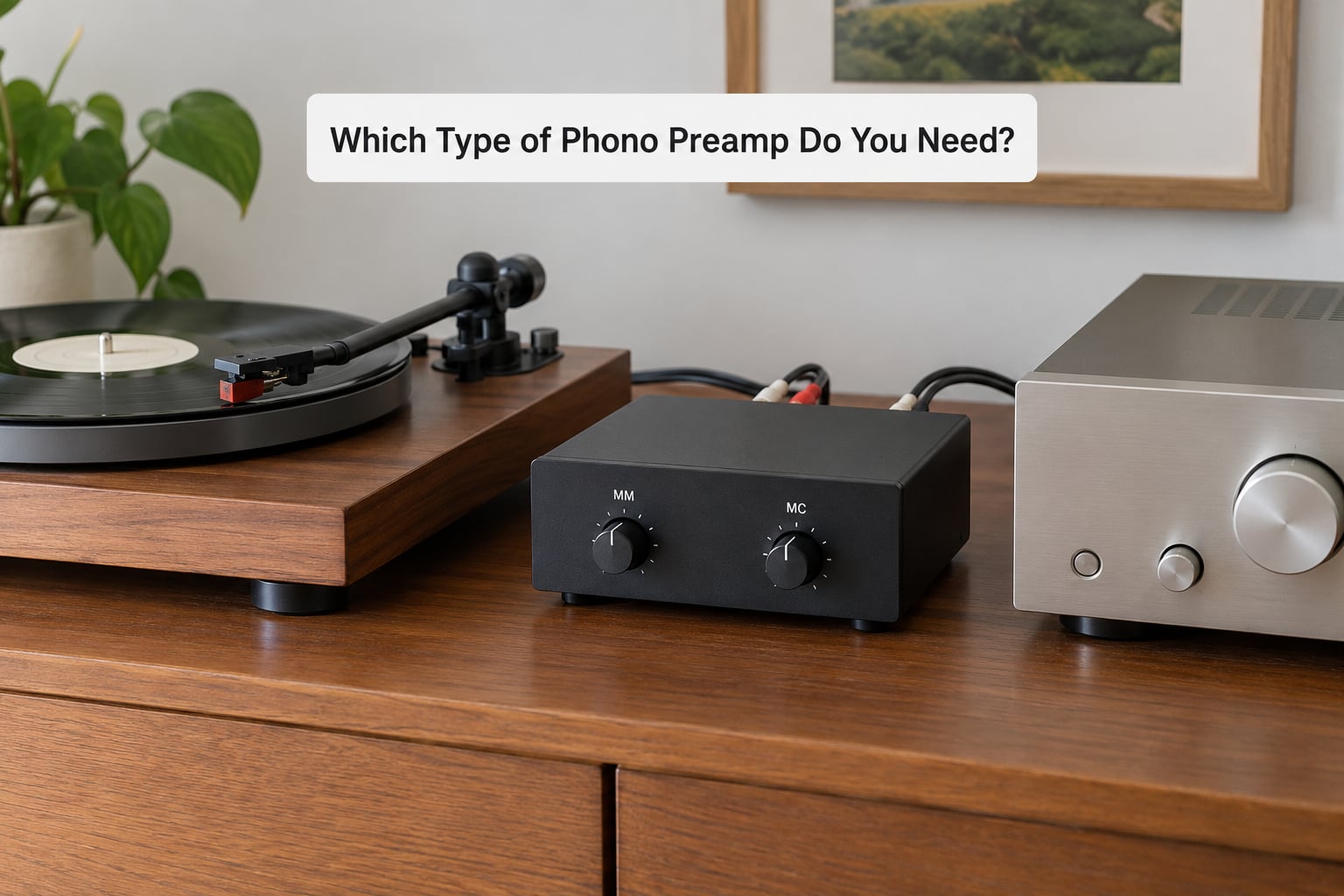
Four kinds turn up in practice, and which one you need comes down to your cartridge and your amplifier.
A built-in switchable preamp covers most people completely. It ships with the turntable, costs nothing extra, and the only decision is the position of the switch. It is the right answer for a moving-magnet cartridge on a budget system, and most forums reach the same conclusion: most built-in stages are fine, plug the turntable in and enjoy.
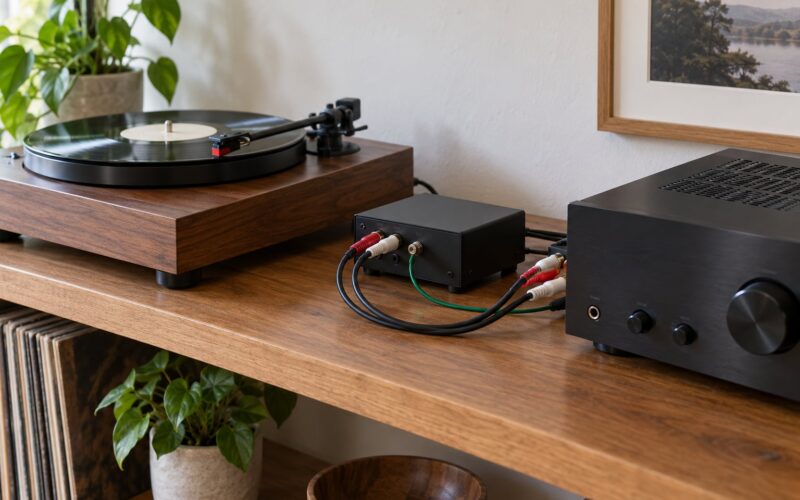
An external moving-magnet stage is the useful next step. It goes between a preampless turntable and any line input, and it is what you buy when the amplifier simply has no phono input. Moving-magnet preamps are small, inexpensive and impossible to get wrong.
An external moving-coil stage adds substantial gain and usually selectable loading. You need one when the cartridge is a low-output moving-coil, or when a moving-coil into a moving-magnet stage leaves the music audible but lacking weight. Loading matters more here than gain does, because a mismatched impedance dulls the treble.
A preamp with a headphone output is a niche choice. It makes sense if you listen on headphones, because you get a usable level and a volume control in one box. Otherwise it adds nothing you need.
The honest summary is that cartridge compatibility decides the category, and everything after that is a preference about size, flexibility and how much of your system you want to be able to change later.
What Cartridge Does Your Turntable Use?
The cartridge is the part that turns the groove into an electrical signal, and it comes in two main flavours you need to tell apart.
Moving magnet, or MM, is the common one. A magnet sits near the coil and the stylus movement changes the field, producing a few millivolts. Cheap, durable, forgiving of a slightly imperfect preamp, and fitted to almost every turntable sold for beginners.
Moving coil, or MC, generates its signal directly in the coil. The output is much lower, sometimes a fraction of a millivolt, and the coils are delicate and expensive. MC cartridges reward a good phono stage and punish a bad one.
How to identify yours without taking anything apart. Check the manual for cartridge type, or read the specification sheet. A maker that fits an MC cartridge almost always says so loudly, because it changes what you can pair the deck with.
Many moving-coil cartridges work acceptably with a universal moving-magnet preamp, especially mid-output models. Low-output ones will not, and instead of silence you get music that is still a bit too quiet and thin. That is the frustrating failure mode forum users hit, because nothing warns you.
Impedance is the quieter variable. It describes how hard the cartridge works to push signal into the preamp, and getting it roughly right keeps the treble from sounding dull. Preamps with a loading switch let you dial it in; a fixed one is tuned for moving magnets and is fine for most setups.
How to Choose a Phono Preamp for Your Setup
Work down this list in order and the right preamp falls out of it before you start reading specifications.
1. Cartridge type. Moving magnet or moving coil. Nothing else on the list matters if this is wrong.
2. Turntable output. If the deck has a working built-in stage and you like how it sounds, you do not need another one. If it outputs raw phono level, something must supply the stage.
3. Amplifier inputs. If there is a PHONO input, use it and spend nothing. If the only inputs are CD, TAPE, AUX or a streamer input, an external stage is required.
4. Gain. MM needs modest gain. MC needs more, and a switchable MM/MC preamp covers both without you having to know in advance.
5. Loading. Adjustable impedance suits people who will change cartridges later. Fixed loading suits people who will not.
6. Power supply. A preamp with its own power supply adds hum if cheap. Wall-powered units and good linear supplies stay quiet, and that matters more than any feature list.
7. Enclosure. A small box near the amplifier is fine. Chasing a fashionable chassis is not a technical upgrade.
8. Budget, honestly. If your amplifier’s phono stage is decent, spending more here is the least productive upgrade in the whole chain. Fix placement, tracking weight and a clean record first.
The pattern across all eight is the same: match the interface to the thing you already own. Specifications that do not change how your system actually sounds are not worth paying for.
How to Connect and Set Up the Preamp
Unplug everything before you move a single cable. Mains hum and pops aside, the order keeps you from chasing a fault that was never there.
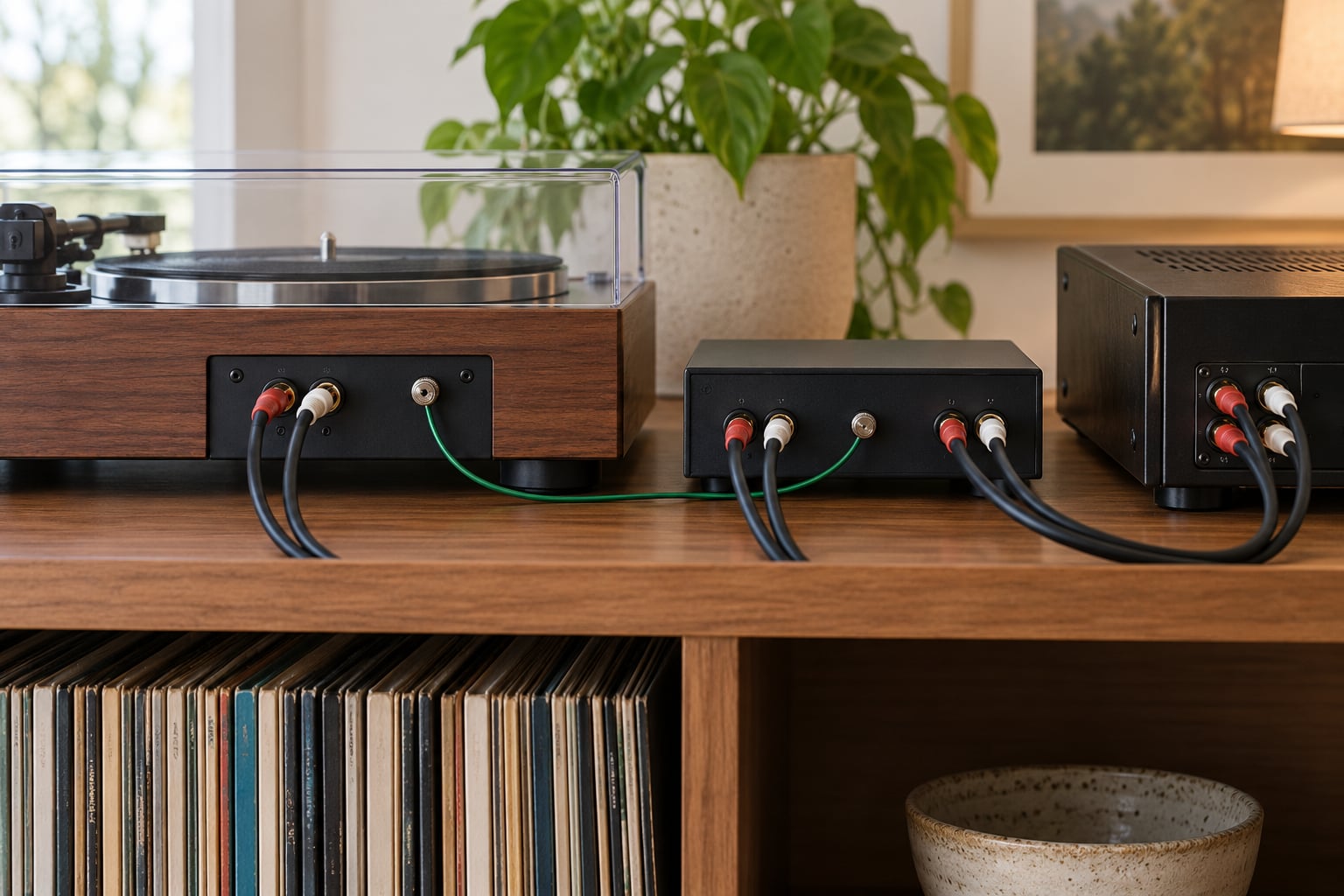
1. Turn the turntable’s switch to PHONO so it outputs raw cartridge signal. If you leave it on LINE, the preamp receives an already-equalised line signal and amplifies the mistake.
2. Connect the turntable’s RCA outputs to the preamp’s input, left to left and right to right.
3. Attach the ground wire. The thin bare lead from the turntable clips to a metal screw terminal, usually at the back of the preamp, and it is there to give the signal a return path. Without it you will hear hum. A phono input is usually right next to a small grounding screw terminal, which makes them easy to confuse with a speaker binding post. It is not one.
4. Run the preamp’s output into a line input on the amplifier. Any line input works now. This is the step people get wrong by reaching for the phono input again, which applies RIAA a second time.
5. Set the cartridge mode to match your cartridge, and set loading if the preamp offers it. Gain and capacitance requirements differ enough between models that the preamp’s manual is the authority, not a forum post.
6. Start the volume low, then bring it up. A preamp with a lot of gain on an MM cartridge will clip before your amplifier does, and the distortion sounds like a bad record.
One more word on hum, because the standard advice online is wrong. Do not fix hum by lifting the ground wire. That masks a ground loop rather than removing it, and you lose your only defence against interference. Check the connection is tight, try a different input, and look for computer, LED lighting or dimmer switches sharing the circuit. A ground loop isolator is the honest fix if the loop is in another component.
Do You Need a Separate Preamp with Bluetooth or Powered Speakers?
Usually yes, and this is where a lot of modern setups go wrong. Powered speakers are not a preamp.
An active or powered speaker takes a line-level signal and drives its own drivers. Most of them have no phono input, no RIAA curve and no grounding post, so a preampless turntable plugged into them produces near-silence with a trace of treble. A small number of powered and all-in-one systems do include a phono stage, and the giveaway is a PHONO/LINE switch on the back panel, often next to a ground post. Check before you buy anything.
Bluetooth turntables are the same problem in a different shape. The switch still matters: set to LINE and the deck sends a usable line-level signal to the transmitter, which is what a Bluetooth receiver or speaker expects. Set to PHONO and you transmit raw cartridge signal, which arrives thin and quiet, and no receiver will fix it. Owners of Bluetooth decks such as the AT-LP60XBT hit this one regularly.
Your options, in order of preference. Use a powered or active speaker system that has a phono stage built in, put a phono preamp earlier in the chain so everything downstream sees line level, or use an amplifier with a phono input. The first is tidiest, the second is most flexible, and the third is the traditional route.
If you run one turntable into two systems, most decks with a built-in stage make this easy: PHONO position into one amplifier’s phono input, LINE position into the other. The stage is bypassed in one case and used in the other, and both play correctly.
Frequently Asked Questions
Can I connect a turntable directly to an amplifier?
Yes, as long as the amplifier has a PHONO input and your turntable’s switch is set to PHONO. That input contains a phono stage, so it does the boost and the RIAA equalization for you. If your amplifier only has CD, TAPE, AUX or streamer inputs, a turntable cannot go straight in. You then need a phono preamp, either external or inside the turntable.
Is a PHONO input on my amplifier the same as a turntable preamp?
No, and this is the most common mix-up. They do the same job in different places. A phono input on an amplifier is a phono stage waiting for raw cartridge signal, which is why it expects a turntable set to PHONO. A turntable preamp does the same work inside the deck and outputs line-level signal for any line input. Having one does not mean you have the other.
Do all record players have a built-in preamp?
No. Plenty of turntables, particularly higher-end models and anything sold to pair with a separate amplifier, output raw phono level and expect an external stage. Look for a PHONO/LINE switch on the back panel or under the platter, a second pair of line outputs, or a switchable MM/MC gain button. If none of those are there and the specification says phono level output, you need an external preamp.
Do I need a separate preamp for a Bluetooth turntable?
It depends on what the Bluetooth device expects. Set the turntable to LINE and its transmitter receives a normal line-level signal, which is what Bluetooth receivers and wireless speakers want. Set it to PHONO and you transmit a raw cartridge signal, which arrives thin and quiet with no bass. So the switch position matters more than an extra box, unless the receiving speaker has no phono input of its own.
Can I use a moving-magnet preamp with a moving-coil cartridge?
Often, yes, with caveats. Mid-output moving-coil cartridges usually work acceptably on a universal MM preamp, though a low-output coil will sound quiet and thin because there is not enough gain. Preamps labelled MM/MC have the extra gain built in. A step-up transformer is another route and costs nothing in signal quality terms, so it is worth trying before buying a different preamp.
What Should You Do First?
Check the back of the turntable for a PHONO/LINE switch and check the back of the amplifier for a PHONO input beside a grounding screw. Then check whether your powered speakers have a phono input and ground post of their own.
If any of those three exists, you do not need a phono preamp. Use what you have, match the switch position to the input you chose, and spend your money somewhere that changes the sound more.
If none of them exists, buy an external phono stage matched to your cartridge, and do it before you judge the rest of the system. Every chain needs exactly one phono stage. Two is worse than one, because the second applies RIAA again and leaves you with the thin, harsh, scooped-out sound that sends people hunting for a fault that is not there.