How to choose speakers for a vinyl setup: pick a cabinet size that suits the room, check the impedance and sensitivity against what your amplifier can actually drive, and work out where the phono preamp sits in the chain before you spend anything on speakers. Those four checks decide more about how a record sounds than the badge on the front baffle.
Get them wrong and no amount of spending elsewhere fixes it. A pair of modest bookshelf speakers driven by a matched amplifier will beat expensive floorstanders that the amp cannot push, and they will beat them by a distance most buyers can hear immediately.
This guide walks through the whole decision in six steps, from working out your budget split to nudging the speakers into position. It takes maybe an hour of reading and an afternoon of moving boxes.
Table of Contents
- What You Need
- Step-by-Step: How to Choose Speakers for a Vinyl Setup
- 1. Set a Speaker and System Budget
- 2. Measure the Room and Choose a Practical Size
- 3. Match the Speakers to Your Amplifier
- 4. Check Frequency Response, Drivers and Sonic Character
- 5. Audition Speakers for Vinyl With the Music You Actually Play
- 6. Position and Fine-Tune the Speakers
- Common Mistakes
- Frequently Asked Questions
- Do I need an amplifier with a vinyl setup?
- What size speakers are best for a small listening room?
- Are floorstanding speakers better than bookshelf speakers for records?
- How do I match speakers to a turntable or amplifier?
- Should I add a subwoofer to a vinyl system?
- Conclusion
What You Need
Four pieces of information, and you can get all of them before opening a single product page.
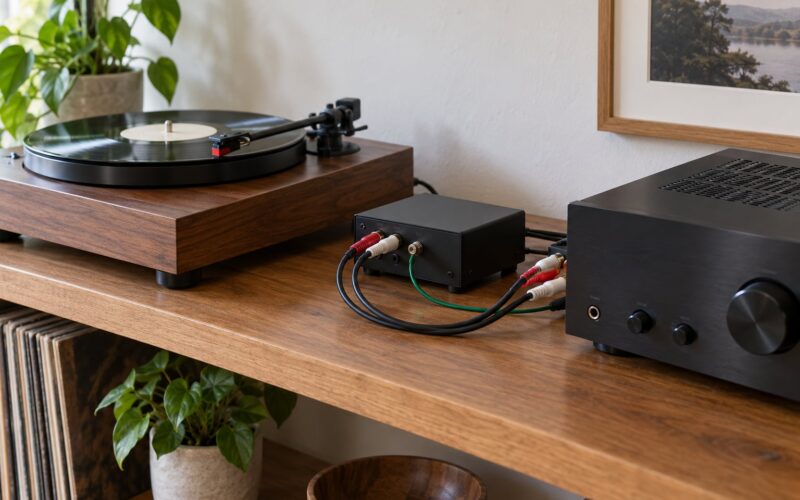
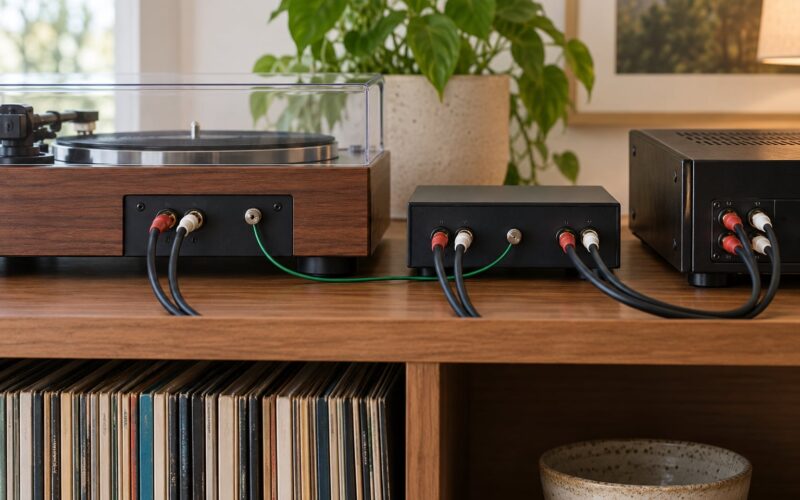
Your turntable’s output. Look at the back panel and the manual. A turntable with a built-in phono stage usually has a PHONO/LINE switch on the back or under the plinth, and you leave it on LINE when feeding an amplifier with its own phono input. Some models ship with a phono stage you can bypass entirely. Know which one you own, because it decides whether you need an external preamp at all.
Your amplifier, or your plan for one. Passive speakers need an amplifier with speaker-level outputs. If you own one, write down its minimum impedance rating and its power output per channel. If you do not own one yet, the speaker choice and the amplifier choice happen together, and the smart move is to pick the pair you like first and then find an amp that suits them.
Your room’s real dimensions. Measure length, width and ceiling height, then note the floor surface, where the sofa sits and which walls are shared with neighbours. A hard floor and bare walls will sound brighter than carpet and curtains, and that changes which speaker you will enjoy at 11pm.
What you actually play. Acoustic records cut at low volume behave very differently from early Sixties rock pressed loud. A mix of both is the common case, and it is worth knowing which side dominates.
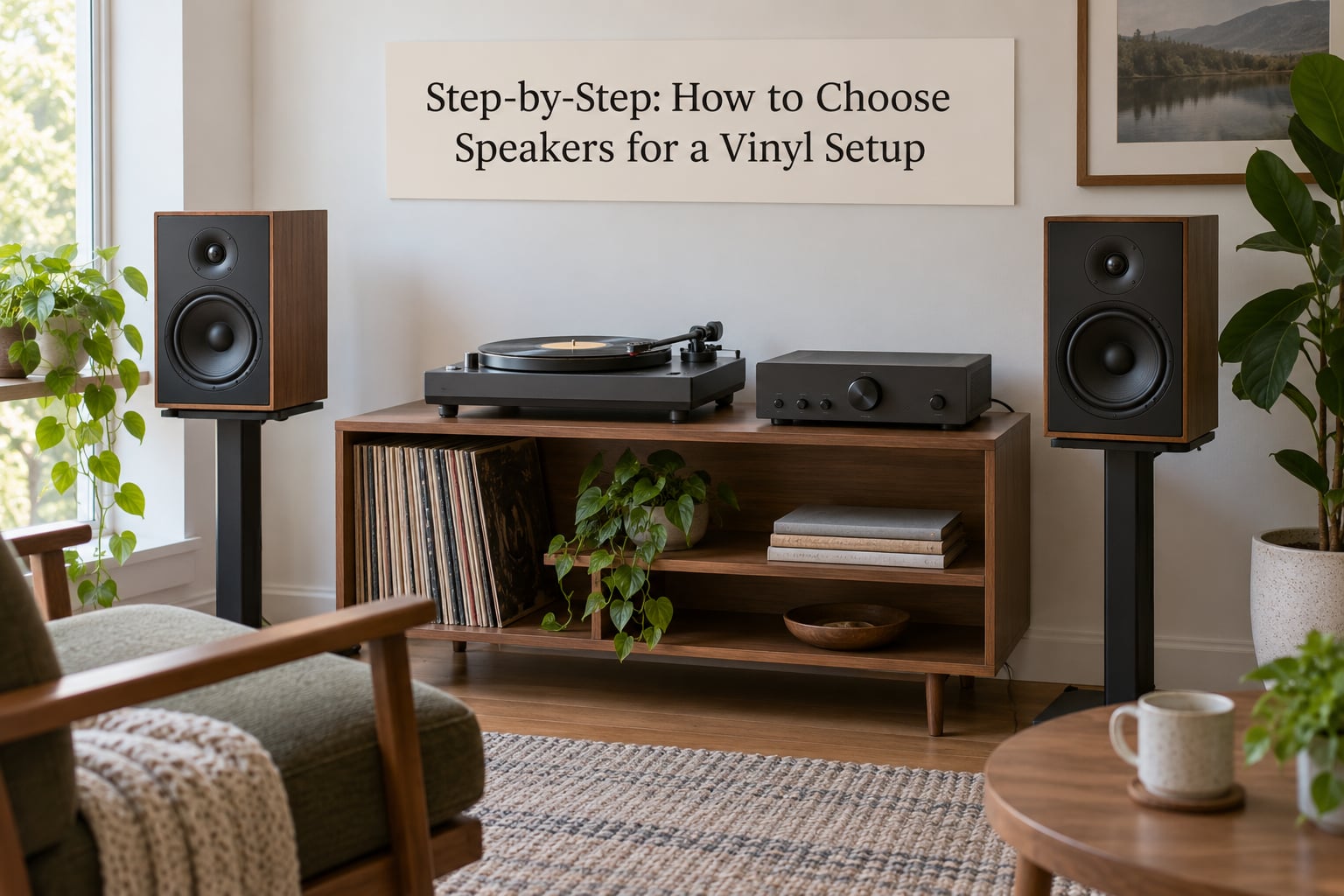
Step-by-Step: How to Choose Speakers for a Vinyl Setup
1. Set a Speaker and System Budget
Decide the total first, then split it. Speakers are usually the largest single share, but a system built in the wrong order ends up with a bottleneck in the middle of the chain.
A workable division of a total budget: 40 to 50 percent for the speakers, 20 to 30 percent for the amplifier, and the remainder spread across a phono preamp if the amplifier lacks one, stands or isolation pads, cables, and basic record cleaning kit. Add a subwoofer only after the basics are right, because it is the easiest component to add later and the least likely to fix a problem you actually have.
On the passive route, a turntable with a switchable built-in preamp means you are shopping for two big items: speakers and an amplifier. On the active route, the amplification lives inside the speakers, so the same money buys a better turntable and a finished sound. Active speakers are the common first setup for a reason: two boxes instead of four, no amp to match, no phono stage to hunt down.
2. Measure the Room and Choose a Practical Size
Match the cabinet to the room, not the other way round. Speakers too large for a space run out of amplifier headroom at normal listening levels, and that is where the thin, lifeless sound people complain about in forums actually comes from.
| Room area | What usually works | Watch out for |
|---|---|---|
| Under 12 square metres (a bedroom or small study) | 5 to 5.5 inch bookshelf speakers on stands | A subwoofer becomes a liability rather than a help |
| 12 to 25 square metres (a typical living room) | 6.5 to 7 inch bookshelf, or a slim floorstander | Floorstanders need 20 to 30 cm from the back wall or they boom |
| Over 25 square metres (loft or open-plan) | Floorstanding speakers, or bookshelf plus a subwoofer | Placement discipline matters more as the volume goes up |
Bookshelf speakers on good stands win in small and medium rooms more often than the size argument suggests. A stand-mounted 6.5 inch pair driven by a modest amp has the bandwidth to play rock properly, and it gives you flexibility: move them apart, pull them off the wall, change your mind next year without a tower in the way.
Floorstanders earn their place when the room is genuinely large or the low end matters more than tidiness. The most common advice on audio forums follows that same logic: a fairly high power amplifier with warm, moderately efficient tower speakers, because towers tend to be more efficient than standmounters and fill a big room with less strain. That is a room-size answer, not a quality ranking.
Decide the listening distance too. Near-field listening at 1.5 to 2 metres in a small room changes what you need, and near-field is where a lot of careful vinyl listening actually happens.
3. Match the Speakers to Your Amplifier
Impedance is the electrical load a speaker presents to the amplifier, written on the spec sheet as 4, 6 or 8 ohms. The lower the number, the harder the amplifier works to push the speaker, and the more current it has to supply. Impedance also dips below the nominal figure in the bass, so a nominal 8 ohm speaker that dips to 4.5 ohms at 40 Hz is asking more of the amplifier than the label suggests.
| Nominal impedance | What it means | What to check on the amplifier |
|---|---|---|
| 4 ohms | Heavier electrical load, easier to go quiet on a small amp | Rated for 4 ohms, or has a 4 ohm setting. Never below the speaker’s stated minimum |
| 6 ohms | The usual middle ground for integrated amplifiers | Almost all modern amplifiers are comfortable here |
| 8 ohms | The easiest load, the most forgiving pairing | The standard reference. Safe with nearly any amplifier |
Read two numbers on the back of the amplifier rather than guessing. One is the minimum speaker impedance it supports. Two is the continuous or RMS power per channel into 8 ohms. A rough guide is that 10 watts per channel will drive a sensitive bookshelf speaker in a small room, while 40 to 50 watts per channel gives a larger room or less efficient floorstanders real headroom. Check the manufacturer’s spec sheet rather than a badge on the front panel, and remember the figure is quoted into 8 ohms, not into 4.
Sensitivity is the second number that matters and the one almost nobody explains. Measured in decibels at 1 watt and 1 metre, it tells you how loud a speaker gets for a given amount of power. A speaker at 87 dB and one at 84 dB sound very different on the same small amplifier even though the wattages look identical, and three decibels is roughly a doubling of perceived loudness in one direction. Entry-level amplifiers with small power supplies run out of voltage well before they run out of watts, which is why a quiet-sounding system is usually a sensitivity mismatch, not a broken amplifier.
On the powered route none of this applies. The amplifier is matched to the driver inside the cabinet, so check the inputs instead: a line-level input, a phono input with a switch, or a USB or Bluetooth input. What you give up is the ability to change amplifiers later, and the choice of speaker on offer is narrower.
Higher wattage does not mean better sound. It means more headroom, and headroom is only useful if the speaker is hard to drive.
4. Check Frequency Response, Drivers and Sonic Character
Frequency response tells you the range the speaker reproduces, usually written as 45 Hz to 25 kHz with a plus or minus 3 dB. The tolerance is the honest part. A claimed range with a wide tolerance describes a speaker that will roll off early, and a tight tolerance describes one that will not.
Driver size mostly decides how much air a speaker moves, which is why a 6.5 inch woofer can sound more substantial than a 5 inch one with better marketing. It does not decide clarity. A two-way design with one woofer and one dome tweeter crossed over around 2 kHz is simple, fast and easy to place. A three-way design adds a dedicated midrange driver and can play loud rock with less intermodulation distortion, at the cost of a bigger cabinet and usually a higher price.
Coaxial designs put the tweeter in the centre of the woofer cone. They are a sensible choice if you intend to mount the speakers vertically on stands or brackets rather than on proper speaker stands.
Note the port position. A rear-firing port needs 20 to 30 cm of clear space behind the cabinet, and pushing a floorstander flat against a wall will give you a boomy, one-note bass that no amount of tone control fixes properly. Front-firing ports give you more placement freedom at the cost of a little cabinet width.
Cabinet rigidity and internal bracing matter more than most spec sheets admit. A thin, lightly braced box buzzes and colours the midrange, which is exactly where vocals live on most of the records collectors play.
5. Audition Speakers for Vinyl With the Music You Actually Play
Specifications narrow the field; listening decides it. Take a shortlist of two or three pairs and hear them on music you know by heart, because you will recognise a smeared cymbal or a hollow snare that you would never notice on unfamiliar material.
For punk, garage and rockabilly, listen for the click of a guitar pick, the rattle of a snare and how the bass guitar sits under the kick. These records are compressed hard, so any speaker that adds its own bass bloom will sound muddier than the mastering intended. For surf and vintage rock and roll, the test is the vocal: it should sit forward and be easy to follow, with guitars clearly separated from drums.
Compare dynamics on a track that goes from quiet to loud within a minute. If the speaker compresses at the loud part, it lacks headroom at your normal volume, which is the real reason a system feels tiring after an album. Imaging matters too: instruments should sit in stable positions, not wander between tracks.
Account for mastering differences. A late Fifties mono pressing and a modern reissue are not a fair comparison of the speakers, they are a comparison of two different records. Switch between the same track on several albums before you decide.
Listen for unwanted colour rather than for a signature you admire. Slight edge on cymbals, a chesty upper bass, or a midrange that makes a guitar sound nasal are the flaws worth rejecting. You are looking for a speaker that stays out of the way.
6. Position and Fine-Tune the Speakers
Two starting points do most of the work, and neither is written in the manuals.
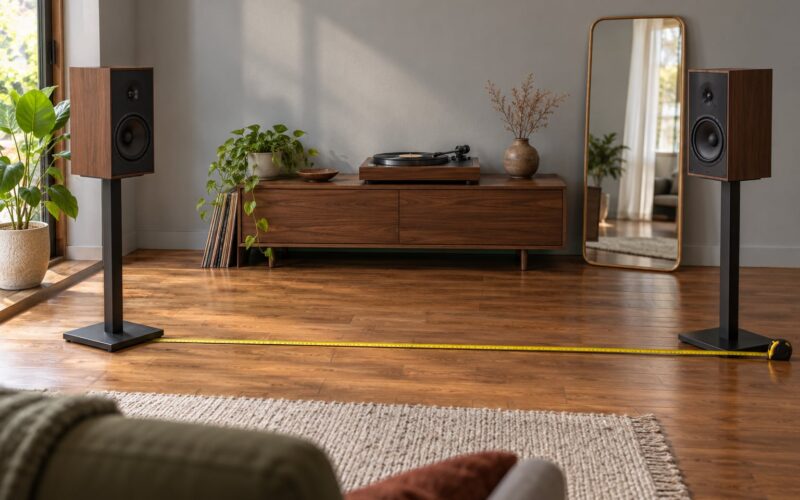
The 38 percent guideline: start about 38 percent of the room’s width back from the front wall. In a four metre room, that puts the speakers about 1.5 metres in. It is a starting point, not a law.
The second is simply to leave the listening position at the far end of the room with space behind it, and only then adjust. Combined with the 38 percent guideline, that gives you speakers clear of the front wall and a seat with breathing room, which is the arrangement most of the well-regarded setup guides arrive at after a lot of trial and error.
From there, form a triangle. The speakers and your head should make an approximate equilateral triangle, with the speakers spaced roughly as far apart as the distance from each speaker to your ears. Around two metres apart with a little toe-in toward the seat is a good starting point in a medium room. Toe-in of a few degrees narrows the image and centres the vocal; pulling them parallel widens it.
Set the tweeters at ear height when seated. Angle the rear ports away from the corner if you can, and keep the turntable on a separate piece of furniture from the speakers whenever the room allows it, because bass energy at low volume travels further than most people expect and can push a suspended stylus around.
Tune in small increments rather than with heroic tone control. Cut the bass if it is boomy, cut the treble by a decibel or two if it is sharp, correct balance before anything else, and leave the rest alone. If you need three or more units of correction, the placement is wrong, not the settings.
Common Mistakes
- Buying speakers that are too big for the room. The amp runs out of clean power at normal volume and the bass turns into one-note boom. Fix: drop to a 5 or 6.5 inch bookshelf on stands and add a subwoofer later if you need the low end.
- Ignoring amplifier compatibility. A nominal 8 ohm speaker with a 3.5 ohm dip in the bass region is harder to drive than the label suggests. Fix: read the minimum impedance spec on the amplifier and the depth of the dip in the speaker’s frequency and impedance graphs, and err on the side of more power rather than less.
- Placing floorstanders flat against a wall. Rear ports then reinforce the low end and the speakers lose all sense of space. Fix: pull them 20 to 30 cm out and angle them away from the nearest corner.
- Judging the sound from one seat. Sitting close to one speaker tells you nothing about imaging or balance. Fix: check the setup from the middle of the room and from the far wall as well.
- Turning the treble up to fake detail. A dull speaker with boosted treble sounds worse than the dull speaker. Fix: correct the placement or the speaker choice instead, and use no more than a decibel or two of boost.
- Buying floorstanders when stands were available. A stand costs a fraction of a pair of towers and gives you the same drivers at ear height. Fix: a pair of decent stands with isolation pads beats buying tall cabinets for a small room.
- Buying used speakers without inspecting them. Foam surrounds go brittle, terminals corrode and drivers unbolt unevenly, all of which are fixable if you know before you buy. Fix: play something with steady bass at moderate volume, listen for rattles or a buzz, check the terminals, and ask whether the drivers have been re-sealed or replaced.
- Running the phono stage twice. A turntable’s LINE output into an amplifier’s PHONO input applies RIAA equalisation twice and sounds thin and wrong in a way that is hard to describe. Fix: turntable PHONO/LINE switch on LINE whenever the amplifier has a phono input, and only switch it to PHONO if you are feeding a line-level input.
- Using a guitar amplifier. It handles music, but it colours everything and has no phono stage, no tone controls worth the name and no room to grow. Fix: spend the same money on a used integrated amplifier with a phono input.
Frequently Asked Questions
Do I need an amplifier with a vinyl setup?
It depends on whether your speakers are passive or powered. Passive speakers have no electronics inside, so an integrated amplifier with a phono input is required to boost the record’s signal to drive them. Powered or active speakers have amplification built in, so a turntable with a switchable phono stage can connect straight to them and you can skip the amplifier entirely.
What size speakers are best for a small listening room?
In a room under about 12 square metres, a pair of 5 to 5.5 inch bookshelf speakers on stands is usually the right answer. They stay clear of the amplifier’s power limits at normal volume, sit well clear of the walls, and leave floor space free. Adding a subwoofer in a room that size tends to do more harm than good.
Are floorstanding speakers better than bookshelf speakers for records?
Neither is better in the abstract. Floorstanders make sense in a larger room or when low-frequency extension matters more than the price of the cabinets, and they often reach lower with the same amplifier power. Bookshelf speakers on stands are easier to place, cheaper and more flexible, and in most living rooms they are the safer first choice.
How do I match speakers to a turntable or amplifier?
The turntable barely enters into it. Check the amplifier’s minimum speaker impedance rating and its power per channel into 8 ohms, then check the speaker’s nominal impedance and its sensitivity in decibels. A high-sensitivity speaker works well with a small amplifier, while a low-sensitivity floorstander needs a stronger one to reach a comfortable volume without strain.
Should I add a subwoofer to a vinyl system?
Only after the main speakers and amplifier are right. A subwoofer fixes deep bass, not muddiness, so it will not rescue a system that sounds unbalanced through the midrange. Once the rest of the chain is working, it gives you low-frequency extension the bookshelf speakers cannot reach and it is the easiest component to add later.
Conclusion
How to choose speakers for a vinyl setup, in order: work out whether you are going passive or powered, measure the room, set the budget split, match the impedance and sensitivity to the amplifier you own or plan to buy, audition a shortlist on records you know well, and only then start moving speakers around the room.
Do the first three things today. Write down your turntable’s PHONO/LINE switch position, measure the room, and note your amplifier’s minimum impedance. That information turns a wall of product pages into a shortlist of three pairs you can actually listen to.