Positioning speakers for better sound comes down to three distances: how far each speaker sits from its wall, how far apart the pair is, and how far you sit from them. Get those roughly right and a modest system on ordinary furniture starts to throw a centred, deep stereo image, and you spend nothing to find out. The whole job takes an afternoon and every change is reversible, which is why it comes before any shopping.
This is how to position speakers for better sound in a room that is not a studio, with a turntable, a small integrated amplifier and a pair of bookshelf speakers that most people already own. The method is measurement first, one change at a time, and it assumes you will be re-listening to records you know well rather than watching a video.
Start here: measure the room, set both speakers the same distance from their side walls, pull them a few inches off the front wall, form an approximate equilateral triangle with your chair, and put the tweeters at ear height. Do nothing else that week. Sound changes a lot at that point, and the rest of this guide is about what to adjust after the basics are in place.
Table of Contents
- What You Need
- Step-by-Step: How to Position Speakers for Better Sound
- How to Choose the Right Listening Triangle
- How to Position Speakers and Adjust Their Angle
- Test the Setup With Familiar Music
- Common Mistakes
- Frequently Asked Questions
- What is the 38% rule for speaker placement?
- What is the 83% rule for speaker placement?
- What does the equilateral triangle setup mean?
- How far apart should speakers be in a small room?
- Where should I put a subwoofer?
- Do Bluetooth and wireless speakers follow the same placement rules?
- Conclusion
What You Need
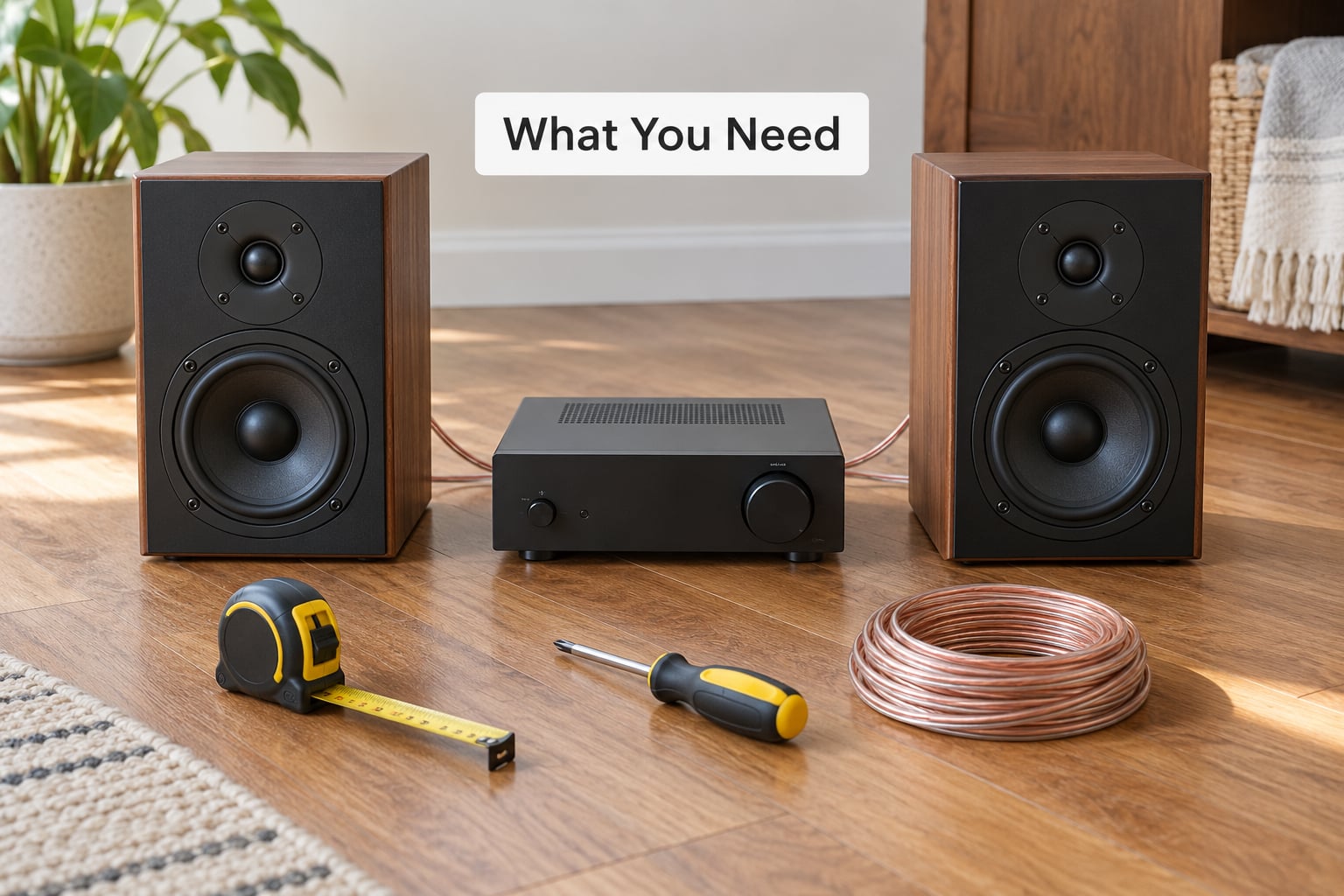
None of this is expensive, and two of the four items cost nothing. Gather them before you touch a speaker, because half of bad placement is measuring badly.
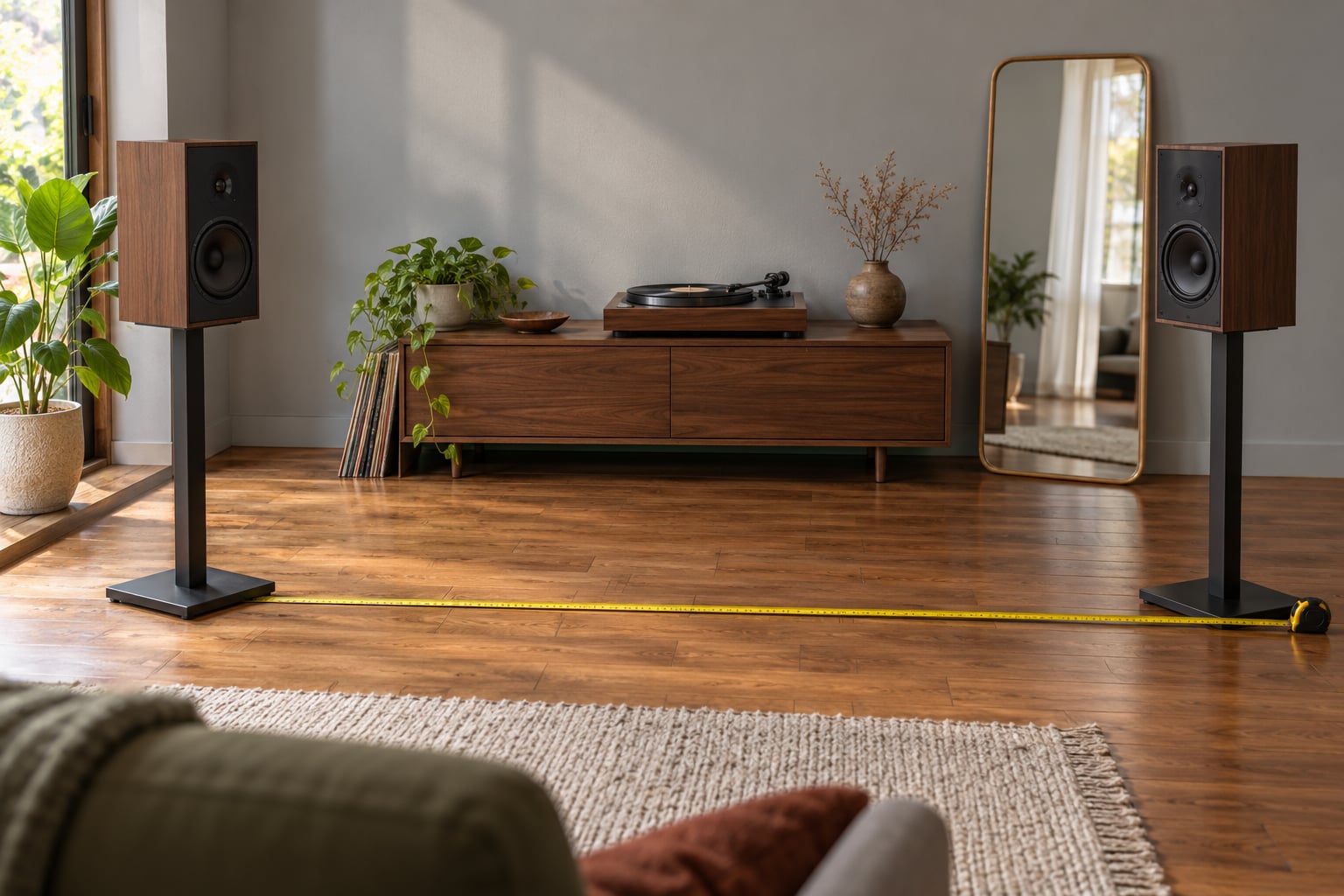
- A tape measure. A 6 foot one is awkward in tight rooms. Any tape measure beats eyeballing, and a phone measuring app is fine if you have nothing else.
- A pair of speakers of the same model. Mixing two different pairs makes imaging impossible to judge, because each channel colours differently.
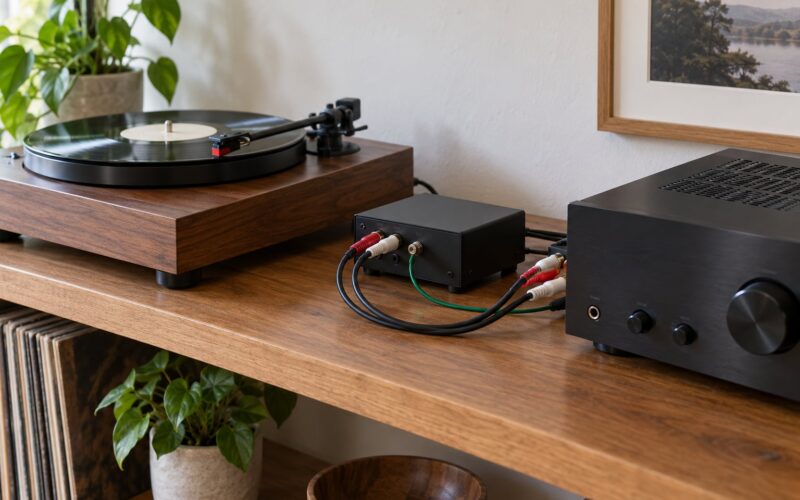
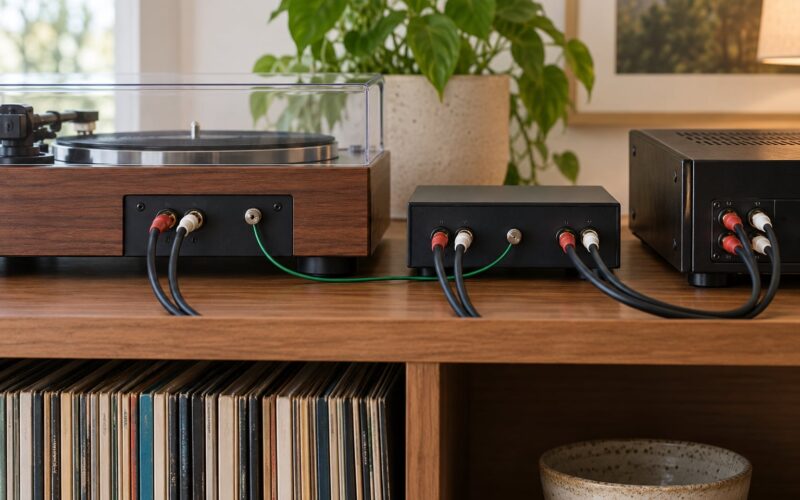
- A source and an amplifier. A turntable with a phono stage works well, and so does any other source. The placement rules do not change.
- Speaker wire and a screwdriver or hex key for loosening the binding posts so the stands or furniture can be moved properly.
- Two reference tracks you know by heart. Pick something with a clear vocal in the centre, steady low end, and cymbals. You need familiarity more than hi-res.
- Optional but useful: a phone measurement app for room dimensions, and a cheap mirror for locating reflection points later.
- Optional: a second chair. Having somewhere to sit other than your normal listening spot makes it obvious whether the problem is the speakers or the seat.
Before anything else, confirm the system is working correctly. Check that the binding post jumpers are seated, that the amplifier is in stereo rather than mono, and that channel polarity matches on both speakers. Placement cannot fix a reversed channel, and a reversed channel will make the centre image collapse to one side no matter where you stand.
Step-by-Step: How to Position Speakers for Better Sound
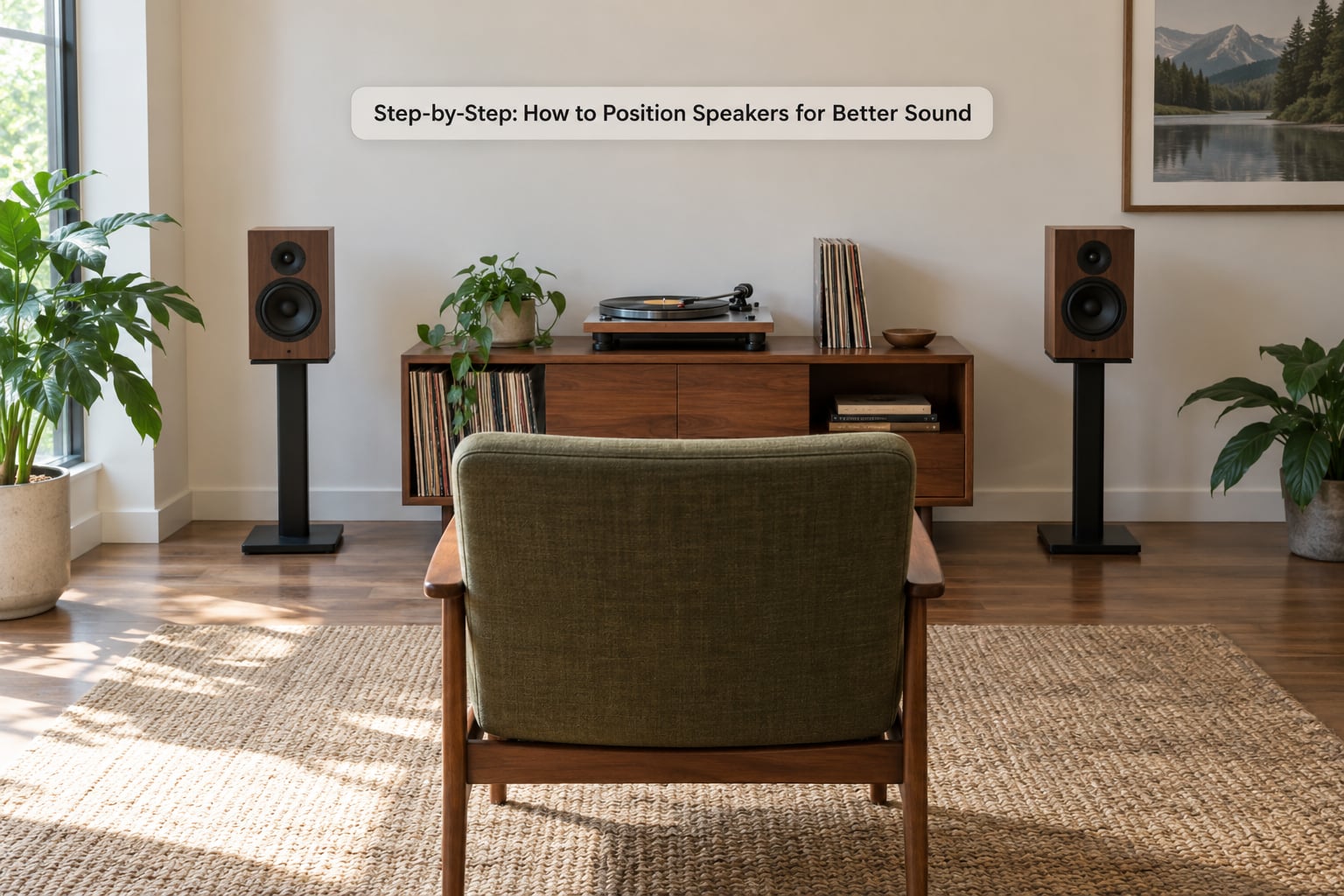
Work in the order below, and change one variable at a time. If you move the speakers, the toe-in and the chair position in the same afternoon, you will not know which change did what, and the temptation will be to move them back and lose both improvements.
How to Choose the Right Listening Triangle
Two rules get quoted more than any other, and they describe the same seat. The 38% rule says your listening position should sit about 38% of the room length back from the wall your speakers face. The 83% rule is that same seat measured from the other end: 83% of the way from the front wall, leaving a 17% gap to the back wall. In a 16 foot room the listening position lands about 6 feet from the front wall and 10 feet from the wall behind you.
Experienced users often work it the other way round, taking the gap between the two speakers and dividing it by 0.83 to get your ear distance. That is the same maths done from the speaker side, and it is handy because most rooms are more awkward in width than in depth.
The equilateral triangle is the third anchor. Make the gap between the two speakers roughly equal to the distance from each speaker to your head, and the triangle has three equal sides. That produces an included angle of about 60 degrees at your ears, which is where stereo imaging and soundstage usually lock together.
The three methods rarely agree in a rectangular room, and that is fine. Pull out a tape measure and run the numbers for a typical 8 foot by 16 foot living room:
| Measurement | Formula | In an 8 by 16 foot room |
|---|---|---|
| Minimum gap behind each speaker | Width x 0.2 | 1.6 ft (about 50 cm) |
| Maximum gap behind each speaker | Width x 0.33 | 2.6 ft (about 80 cm) |
| Speakers off the front wall | Length x 0.2 | 3.2 ft (about 1 m) |
| Speakers off the front wall, generous | Length x 0.33 | 5.3 ft (about 1.6 m) |
| Listening position from front wall | Length x 0.38 | 6.1 ft |
| Ear distance at 5.3 ft separation | Separation / 0.83 | 6.4 ft |
Now the part that matters more than the numbers: the textbook seat can sound worse than a worse seat. Rooms have modes, which are standing waves at specific frequencies set by the room’s dimensions. Sitting in a pressure null at 60 Hz means bass simply vanishes when you settle into your chair, and no amount of formula will fix that. Measure, listen from the suggested position, then move 20 cm in either direction and listen again. Pick what you hear.
One rule people consistently get wrong is placing the back of your head against the rear wall. Forum regulars on Gearspace describe that seat as generally always problematic, and it is: the back wall reinforces the front wall’s reflection, which lifts the mid-bass and smears the centre image. If you cannot get more than 40 cm between your head and the wall, that is the single most valuable move available to you.
How to Position Speakers and Adjust Their Angle
Start with both speakers facing straight ahead, parallel to the front wall, with matching side gaps measured at the cabinet, not at the front edge. Symmetry is the golden rule here. When one speaker sits a metre from a side wall and the other sits 10 cm away, the two channels are coloured differently and the stereo image drifts toward the loud one.
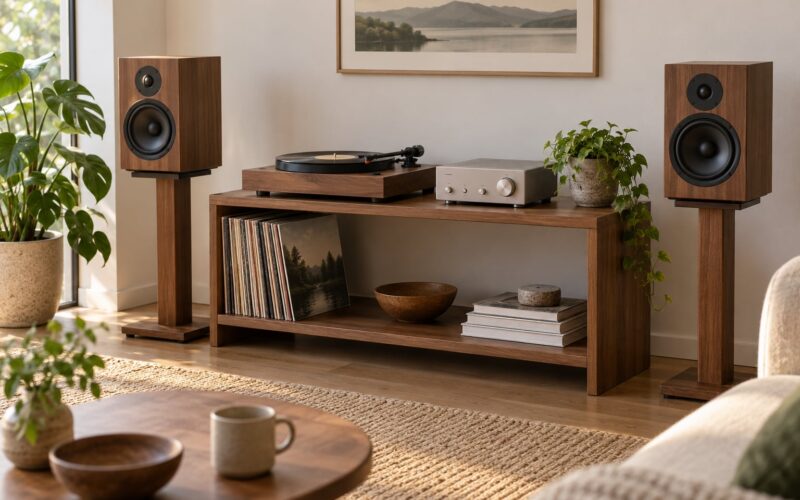
Next, set the height. The tweeter should end up roughly at ear level when you are seated in your normal listening position, which for most people sitting forward on a sofa is somewhere between 34 and 40 inches off the floor. A low stand with the tweeter at chest height aims the treble at your lap. A tall bookshelf pushed onto a sideboard cannot be fixed by anything except moving it to a proper stand, and stands with filler in them are the cheapest upgrade in this whole guide.
Toe-in is the free tone control, and the amount is a matter of taste plus room size. Try three settings with the same track:
- Zero degrees, both speakers square to the front wall. Widest soundstage and the softest centre image. Best in a small room where a narrow stage would otherwise be a real problem.
- About 5 to 10 degrees inward. A good starting point in most living rooms. Vocals sit more firmly in the middle without the soundstage closing up.
- About 15 to 20 degrees inward, each speaker aimed at your shoulder or slightly behind the ear. The tightest centre focus and the most obvious speaker separation. In a large room this is where imaging usually looks its best.
A useful trick from the audiophile forums is to change the target rather than the angle: start each speaker pointing at your shoulder, move it to your ear, then to your nose, then a foot in front of your nose. Four settings, two minutes, and the one that sounds right is the right answer for your room.
Angle speakers by sliding them, not by rotating them in place, unless they are on proper stands. Sliding changes the front wall distance and the reflection geometry at the same time, which is usually the change you actually wanted. If you do rotate them, keep both at the same angle; unequal toe-in is worse than no toe-in.
Finally, do the housekeeping while the speakers are in hand. Check polarity again. Make sure rear port plugs or foam bungs are in the ports if the manufacturer supplies them, or out if you have pulled the speakers into the room. Lift speakers off furniture with isolation pads so the cabinet is not coupled to a hollow shelf, and route the cable loosely rather than pinned tight against the wall.
Test the Setup With Familiar Music
Verification matters more than adjustment. Choose two tracks you have played hundreds of times, ideally a well-recorded rock, punk, garage or rockabilly cut with a hard panned snare and a solid bass line. Vinyl makes this easy, because a familiar album is the most honest reference material most of us own.
Judge four things separately, and give each one a sentence out loud before you move anything:
- Centre focus. Do vocals sit between the two speakers, locked in the middle, or do they wander off to one side?
- Bass balance. Is the bass even across the room, or does it swell and vanish as you shift your weight?
- Treble and sibilance. Do cymbals and hi-hats sit behind the vocal in depth, or do they stick out in front of everything?
- Stereo separation. Can you point at each instrument when it plays alone?
Change one thing, put the same record on, listen to a full track, and write down what changed. Notes with two or three words are enough. Over a couple of evenings you will build a record of what your room likes, and that is worth more than any formula.
Do not chase bass by moving things closer to a corner unless the rest is already right. A corner adds several decibels at the lowest frequencies and will give you an impressive bottom end that smears everything above it, and if you add a subwoofer to an already boomy corner you will spend months blaming the subwoofer.
Once the basics are stable, layer in the soft furnishings. A rug between the speakers and the chair, curtains on a bare side wall, and a bookshelf that does not vibrate when a bass note hits are all free or cheap, and they cut the early reflections that blur the centre image.
Finally, put a mirror on each side wall. Move it along the wall until you can see a speaker reflected at roughly ear height from your seat, and the spot where the reflection is visible is your first reflection point. Heavy absorption at that point is worth more than panels placed by ear at random. If you go further, the Gearspace advice on corner traps is to go deeper rather than wider: 15 to 20 cm of dense material in the corners and behind the listening position, not a thin sheet.
Common Mistakes
Almost every disappointing hi-fi setup on a forum is one of the following, and all of them are free to fix. Match the symptom in the left column to your system and apply the fix on the right.
| Symptom | Likely cause | Fix |
|---|---|---|
| Bass booms when seated, drops away when you lean forward | Chair sits in a room mode null | Move the chair 20 to 30 cm forward or back, then re-check |
| Low end is thin and midrange sounds hollow | Speakers too close to the front wall | Pull both speakers out by 30 to 60 cm |
| Bass changes noticeably when you shift your head 20 cm | Direct path and wall reflection cancelling at a specific frequency | Step forward first, then fine-tune toe-in a few degrees |
| Vocals sit flat between the speakers with no depth | Pair too close together, or not toed in | Set separation to roughly the ear distance, then add 5 to 10 degrees of toe-in |
| Sibilance and cymbals get harsh when you move off-centre | Strong first reflection off a bare side wall | Add a rug or curtains, or toe in so the reflection lands behind your head |
| One speaker sounds brighter or thinner than the other | Asymmetric side gaps | Match both side gaps to within a couple of centimetres |
| Centre image drifts to one side of the room | Reversed polarity, or one channel louder | Check binding posts and balance, then re-check placement |
| Everything sounds worse in the corner than at the recommended spot | Speakers in a corner before geometry was sorted | Return to the equilateral triangle, then treat the corner rather than sit in it |
The specific mistakes I would name, worst first:
- Pushing speakers into corners. Corner loading gives you level at 40 Hz and mud everywhere above it. Pull the pair out into the room and give it a proper triangle first.
- Judging the sound from the wrong seat. Evaluate from your normal listening position, not standing in the middle of the room or sitting against the back wall. Centre-channel pickup means the middle of the room flatters the sound and hides the problem.
- Ignoring the walls entirely. Bare side and back walls reflect the midrange straight at you. Soft furnishings beat panels here on cost.
- Mismatched stands or furniture. One speaker on a proper stand and one on a wobbly sideboard gives you different height, different tilt and different vibration. Match them.
- Aiming at the wrong place. Both speakers should cross at or just behind the listener, not at the middle of the sofa or at the turntable.
- Assuming the speakers are too close together. Many listeners pull a narrow pair apart and lose the centre focus entirely. Widen only if the image is genuinely loose.
- Spending money in the wrong order. Cables, then panels, then a subwoofer, then new speakers, all while the speakers are still 5 cm from the wall. Position is free and it changes more than any of them.
There is a legitimate argument that rules are only starting points. Long-running threads on the Gearspace forums put it plainly: there are no rules for your placement, and if you get better bass definition sitting in the corner, go for it. That is the right attitude as long as you have measured and tested the textbook position first. Formulas tell you where to start; your ears decide where to stay.
If you want an afternoon plan, work through it in this order: measure the room and mark the front wall, then clear a path and pull both speakers out to at least 50 cm from the front wall, match the side gaps, set the separation, place the chair for an equilateral triangle, raise the tweeters to ear level, square the speakers, then work through the three toe-in angles. Check polarity while the cables are loose. Finish by moving the chair 20 cm in each direction and choosing the seat by ear, not by percentage.
For a vinyl setup specifically, remember where the gear lives. A turntable and amplifier stacked on a sideboard restrict the speakers to furniture height and furniture width, which is why so many systems end up in a corner. If the amp is in a furniture stack, put the speakers on stands on the floor, run the speaker cable loosely along the wall, and keep the phono stage and its power cable as far from the speaker cable run as the furniture allows.
Two special cases. With a subwoofer, start by placing it in a corner for the most output, then pull it out and reposition until the low end is even across the listening area, and set the crossover above the sub’s own resonance rather than low enough to overlap your speakers. For home theatre, the centre channel carries the majority of a surround mix, so anchor the centre to the screen and pull the front pair out to match the tweeter height, then re-run the triangle from the centre seat rather than the sofa arm.
Frequently Asked Questions
What is the 38% rule for speaker placement?
The 38% rule says your main listening position should sit about 38% of the room length back from the wall your speakers face. In a 16 foot room that is roughly 6 feet from the front wall. The same distance is called the 83% rule when you measure from the listening position to the far wall instead, which is why the two numbers describe one position, not two.
What is the 83% rule for speaker placement?
The 83% rule is the 38% rule measured from the other end of the room: put your listening position 83% of the room length from the front wall your speakers face, which leaves the same 17% gap to the back wall. Experienced users often compute it as speaker separation divided by 0.83 to get the ear distance.
What does the equilateral triangle setup mean?
The equilateral triangle setup means the gap between your two speakers should be roughly equal to the distance from each speaker to your head, forming a triangle with three equal sides. That gives about a 60 degree included angle at your ears, which is the point where stereo imaging and soundstage usually lock together best.
How far apart should speakers be in a small room?
In a small room, ignore the equilateral triangle and use the width of the room as your guide. Set the side gaps to about 20 to 33% of the room width on each side, which leaves a pair that is not jammed against the walls. Keep the speakers on stands, expect a narrower soundstage, and if bass still will not settle, a smaller sealed speaker may suit the room better than any placement trick.
Where should I put a subwoofer?
Start in a corner, where a subwoofer produces the most output for the least effort, then treat the low end like anything else: move it, listen, and move it again. Aim for even bass across the listening area rather than maximum output at one seat. Set the crossover above the subwoofer’s own resonance so it does not overlap the range your bookshelf speakers already handle well.
Do Bluetooth and wireless speakers follow the same placement rules?
The geometry rules are the same, because the acoustics of the room do not care how the signal arrives. What changes is your control: many Bluetooth and wireless speakers apply their own EQ or automatic room correction that quietly moves the effective balance, so comparing settings while moving the speaker can be confusing. Where possible, disable any automatic correction before you start judging placement by ear.
Conclusion
Do one thing this week: measure your room, pull both speakers out from the wall, match the side gaps, and sit at the equilateral triangle. Then put on a record you have played a hundred times and listen from two or three positions before deciding anything.
Most people who learn how to position speakers for better sound find that small changes to listening position matter more to the sound than any purchase they were planning. The changes are free and they are reversible, so record what you tried and recheck the setup whenever you rearrange the furniture or move the chair.