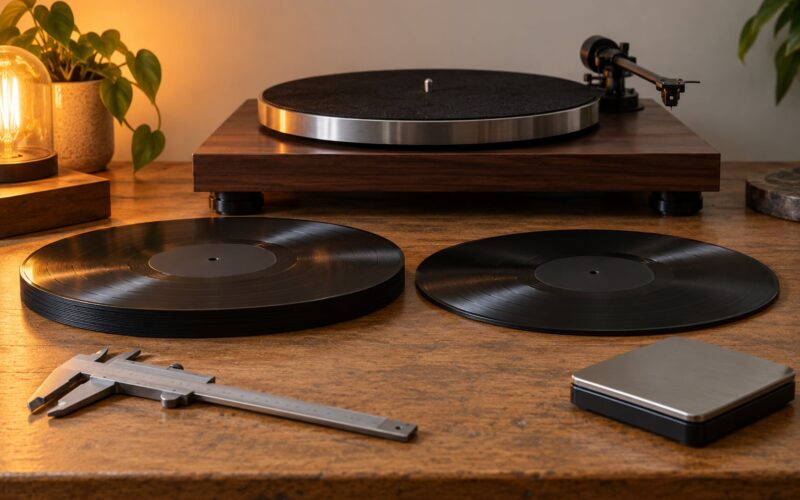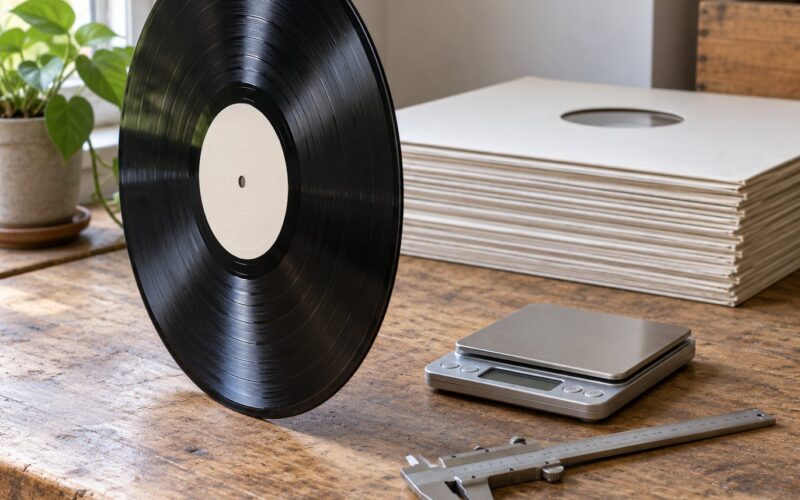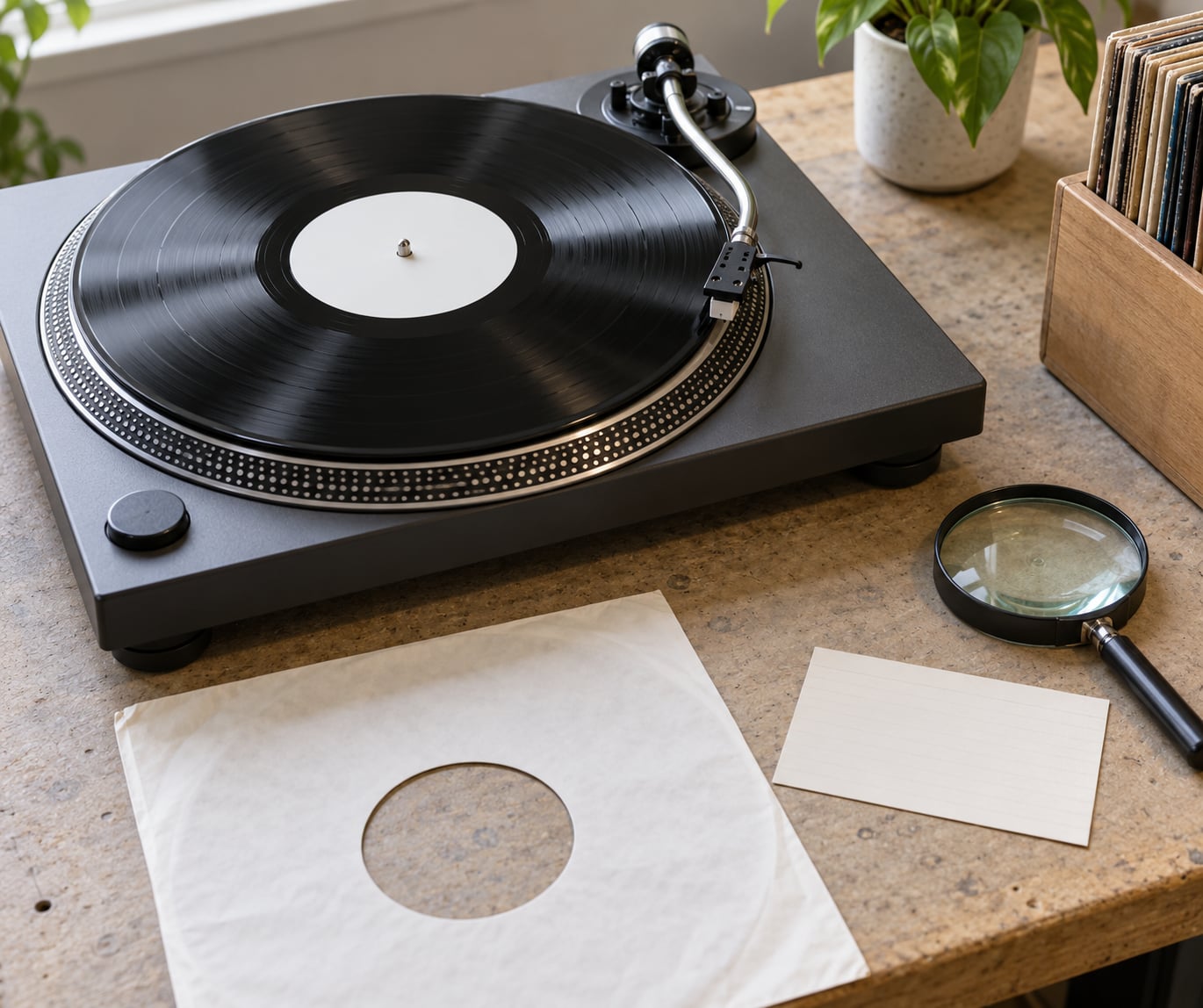
What is a test pressing? It is a small batch of vinyl records, usually somewhere between three and ten copies, pressed from the first metal stampers cut from a record’s lacquer master and sent to the artist, label and mastering engineer to approve before the full production run is made.
- How many: usually three to ten copies, depending on order size and what the plant is asked for.
- Who gets them: the artist, the label’s quality control staff, and the mastering engineer who cut the lacquer.
- What they look like: a plain unlabelled disc, a hand-etched or stamped catalogue number, and a run-out groove carrying the matrix.
Most people meet the term for the first time on a listing and assume it means an expensive treasure. It usually does not. Understanding what a test pressing actually is saves you from paying a premium for what is, in many cases, a quality control copy that was never meant to leave the building.
Table of Contents
- What Is a Test Pressing?
- How Are Test Pressings Different From Promos and Limited Editions?
- Why Do Record Collectors Value Test Pressings?
- What Is a Test Pressing on a Vinyl Record?
- Are All Test Pressings Rare?
- How Much Is a Test Pressing Worth?
- How to Tell Whether a Test Pressing Is Authentic
- Frequently Asked Questions
- Do test pressings sound better than regular pressings?
- Are all first pressings test pressings?
- Are test pressings worth anything?
- Why is my test pressing noisy, warped or skipping?
- Do reissues and later pressings count as test pressings?
- Can you buy or sell a test pressing?
- Conclusion
What Is a Test Pressing?
The term sounds far rarer than the reality behind it. A test pressing is the small approval run made from a fresh stamper, so the label and artist can confirm the record is right before committing to thousands of copies. The copies themselves are often called TPs once you have said the full name a few times, which is how the trade talks about them.
The production chain explains everything. A mastering engineer cuts a lacquer disc, called the lacquer master or reference lacquer. A plating plant coats that lacquer with metal and creates negative and positive metal stampers. The pressing plant takes those stampers, heats PVC vinyl compound, and presses a disc. The first handful of discs off that stamper are the test pressings.
Nobody has paid to market them. They are the last checkpoint before the label spends serious money on a full run, so the copies get inspected for the wrong things a finished record would never be blamed for: surface noise, distortion, pre-echo, sibilance, an off-centre hole, a side split in the wrong place, an ID groove in the wrong spot, or a stamper defect showing up at the identical point on every copy.
If everything passes, the run goes ahead on the same stampers. If something fails, the plant can scrap the stamper, plate a fresh one and start over. That is why a test pressing is evidence that a record was checked, not that a record is rare.
How Are Test Pressings Different From Promos and Limited Editions?
Terminology is the single biggest source of confusion here. Sellers use white label, promo and test pressing interchangeably, and collectors on the Discogs forum and the Steve Hoffman board spend years untangling the same listings. This table sorts the categories by what they are actually for.
| Format | Purpose | Typical quantity | Label and packaging | Who receives it |
|---|---|---|---|---|
| Test pressing | Quality control and approval before the production run | 3 to 10 copies | Plain or blank label, no sleeve or artwork | Artist, label, mastering engineer |
| White label | Generic proof copy, sometimes used as a promo | Varies, often a handful | Blank white label, hand-etched or stamped catalogue number | Plant, label, sometimes radio |
| White label promo | Sent to reviewers, radio and DJs to promote a release | A few hundred to a few thousand | Blank label, often in a plain jacket marked not for sale | Media, reviewers, retail |
| Promo | Marketing before the commercial release | Several hundred to several thousand | Labelled or stamped promo, marked not for sale | Radio, press, reviewers |
| Coloured vinyl | Retail or promotional variation | Whatever the run was | Normal label and jacket in a coloured pressing | Buyers, sometimes reviewers |
| Numbered limited edition | Marketing scarcity and higher margin | 50 to 5,000, numbered on the sleeve | Full artwork, edition number printed or hand-written | Buyers |
| First pressing | The earliest commercial run | Full production run | Normal label and sleeve | Buyers |
| Acetate | One-off lacquer cut for review, not a pressed record | One or two per approval round | Handwritten, often marked with the cutting speed | Artist, label, mastering engineer |
Two points from collectors do more to fix this than any table. On the Hoffman board, someone notes that the first pressings off a stamper are the test pressings, normally with white labels, and that white labels are the most common promo format for 12-inch records. On the Discogs forum, another points out that test pressing is effectively the same as the white label proof, and plants commonly run ten of them unless asked for more.
An acetate is a different animal entirely. It is a lacquer disc, not vinyl, it is cut per approval round, and it never had a stamper. If you can flex it slightly or see a warm sheen instead of a black surface, it is an acetate.
Why Do Record Collectors Value Test Pressings?
Collectors value them for a short list of honest reasons, and every one of them is conditional.
The first is position. A test pressing is physically the earliest object off a given stamper, which makes it part of the production history of an album. An owner on r/vinyl described signed numbered test pressings as exactly that, part of the album’s real history rather than a marketing wrapper.
The second is scarcity in the strict sense. Only a few copies were made, and most stayed inside the label. The third is the rarest case of all: a test pressing for a record that was never issued. A poster on r/Vinyl_Jazz put it cleanly, the real value in test pressings is when it is a test pressing for something that was never actually pressed.
Here is the part sellers skip. None of those reasons apply automatically. A test pressing of an album that sold two million copies is not scarce in any way a buyer would notice. Ten copies exist, eight were distributed to staff, and the record is worth the same as the regular version.
What Is a Test Pressing on a Vinyl Record?
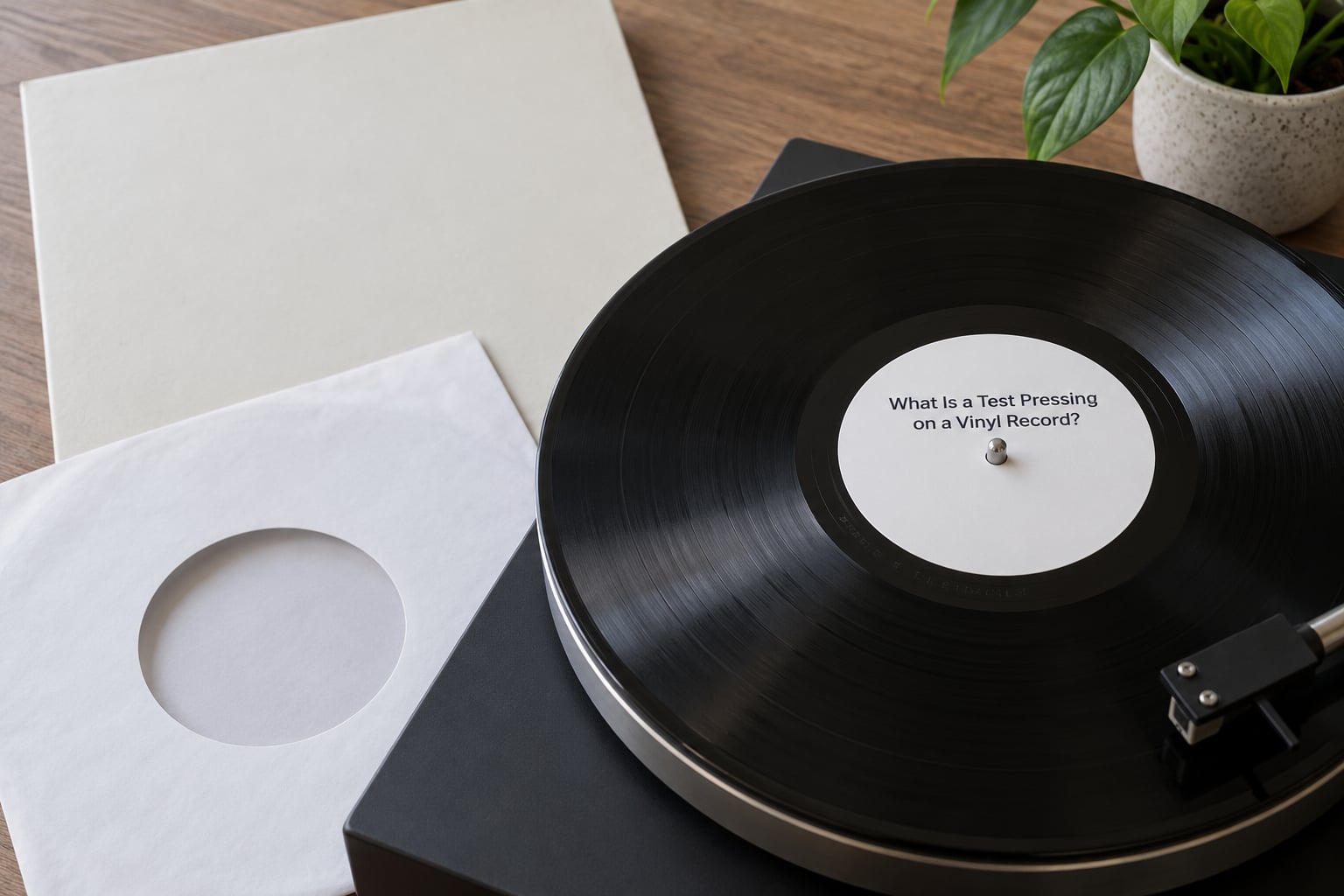
A genuine test pressing gives you several identifiers at once, and you need more than one to be confident.
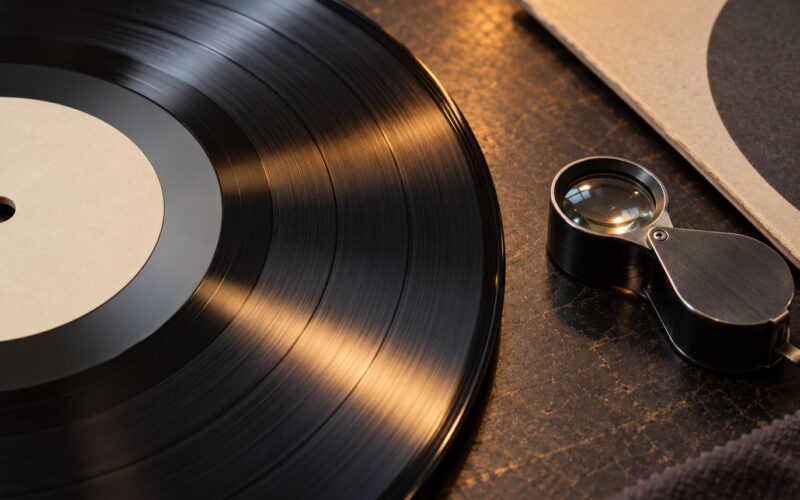
Look at the run-out groove, the area between the last track and the label, often called the dead wax. A test pressing typically carries a matrix or etch code there, sometimes with letters indicating the master or lacquer stage. Then check the label itself: plain white or completely blank, never a printed commercial design. Look at the jacket: there is usually none, or at most a generic inner sleeve.
Finally, look for a catalogue number written or stamped by hand on the label or the run-out. That handwritten number is the plant operator’s mark, and it is the detail that separates a real test pressing from a later plain repress. Some copies carry an edition note such as 1 of 1, and one oddity shows up on certain one-of-one copies where one side is blank because it was never cut.
A collector should document all of it before anything else. Photograph the full disc, the label, and the run-out area under even light, note the matrix and any hand-written markings, then record the catalogue number, the country and the label. That five-item record is what lets you compare your copy against documented releases later instead of relying on somebody else’s listing description.
Are All Test Pressings Rare?
No, and this is where most disappointment comes from. Rarity depends on how many were pressed, how many survived, who wanted them and whether the record itself was ever commercially issued.
A test pressing from a widely released album is not meaningfully rarer than the record you can buy in any shop. It exists in a handful of copies, but those copies sit in collections rather than in circulation, so the visible supply in a marketplace is the same as for any common record.
What moves a test pressing into genuinely scarce territory is a combination of factors: an independent or small label where nobody documented the run, an album with a committed following, an aborted or unissued release, and a copy that arrives with provenance, meaning someone can say where it came from and why it survived. Remove the artist demand and even a perfect copy is a shelf ornament.
How Much Is a Test Pressing Worth?
There is no reliable price guide for test pressings, and anyone quoting you a fixed figure for one is guessing. Value moves with a handful of variables you can actually check.
Artist popularity is the biggest one. Then label history and the era of the pressing, since collectors pay more for well-documented plants and well-known labels. Pressing quantity matters, though only in combination with demand, and condition is decided by the same rules as any other record: sleeve integrity, ring wear, seam splits, and the play grade of the vinyl itself.
Completeness and provenance do more work than most sellers expect. A test pressing with its original inner sleeve, any paperwork and a documented chain of custody outranks an identical disc in a generic sleeve every time.
The practical method is to stop guessing and start comparing. Look at recent completed sales for the same artist, the same catalogue number and the same format, not current asking prices. Ask yourself whether this copy is genuinely a test pressing, or a plain repress that got described as one. And run the seller description against your own photographs, because the description is the easiest thing in the whole transaction to fake.
How to Tell Whether a Test Pressing Is Authentic
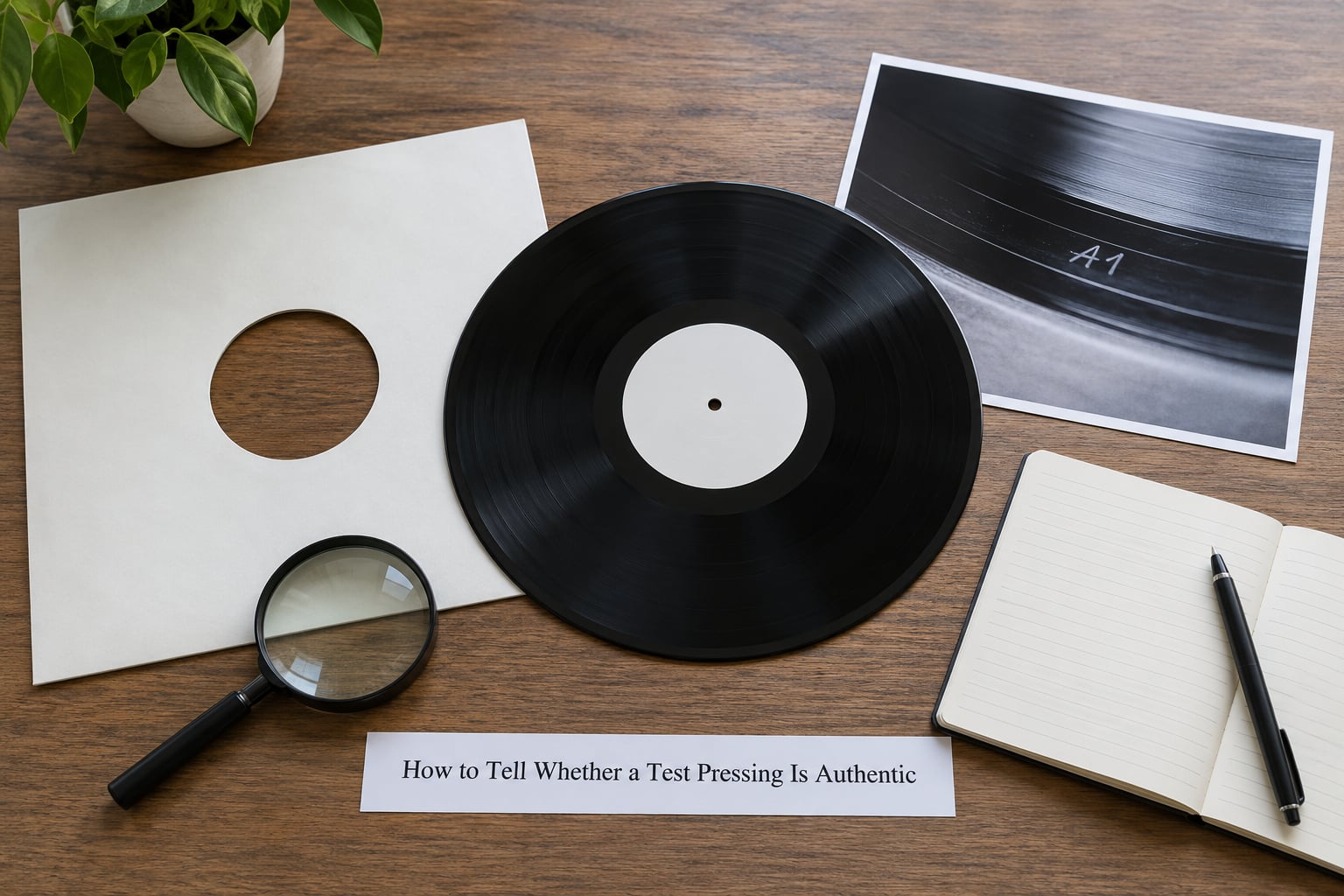
Work in this order, because each step either supports the next or rules the copy out.
- Read the run-out. Photograph the dead wax under even light with a magnifier if you have one. Note the full etching exactly, including letters, numbers and symbols.
- Check the label. A test pressing has a blank or plain white label. Any printed commercial artwork on the label is disqualifying.
- Look for the hand-marked catalogue number. A number written or stamped by the plant operator on the label or in the run-out is the strongest single signal.
- Inspect the sleeve. Test pressings rarely have jackets. A full commercial sleeve suggests you are holding a repress.
- Count the evidence. Matrix etching alone is weak, because it also appears on commercial pressings. Etching plus plain label plus hand-marked number plus missing sleeve is a different situation entirely.
- Compare against documented releases. Check the matrix and catalogue number against documented entries for that artist and label, and check whether the album was ever commercially issued.
- Play it once, carefully. A test pressing can be noisy and can skip, and that is expected of an uncooled proof. Warping is common because these copies often skip the plant’s cooling period, so judge condition with that in mind.
A generic test-pressing label on a seller listing is not proof of anything. On the Discogs forum, collectors repeatedly raise listings described as test pressings that turn out to be plain represses in an unmarked sleeve.
Frequently Asked Questions
Do test pressings sound better than regular pressings?
Not reliably. Because they come from the very first discs off a stamper, some collectors on vinyl jazz boards argue a test pressing sounds better, and a slightly cleaner groove is possible. In practice a proof copy is often noisier, since it may skip the plant cooling period and warp. Judge each copy on its own condition rather than assuming an advantage.
Are all first pressings test pressings?
No. A test pressing is the small approval run before production, and a first pressing is the earliest commercial run a label sells. The two overlap at the plant level, since the first records off a stamper are the test pressings, but they are different things: one is a quality control copy, the other is the record the public buys.
Are test pressings worth anything?
Most are worth very little. A test pressing from a widely issued album can be functionally interchangeable with the regular pressing, because copies stayed with the label and staff instead of circulating. Value climbs when the run was tiny, the album was aborted or unissued, the artist is in demand, and the copy is complete with provenance. Compare recent sold listings before paying a premium.
Why is my test pressing noisy, warped or skipping?
That is fairly typical. Test copies are often pressed straight off the stamper without the cooling period commercial runs get, so a little warping is normal and can push the stylus through a damaged or dirty groove. Expect some surface noise too, since these discs were never destined for retail. Clean it properly, keep the sleeve, and play it gently rather than assuming the copy is ruined.
Do reissues and later pressings count as test pressings?
No. A reissue or a later pressing has its own approval copies, but the records themselves are commercial product and are catalogued as reissues or later pressings. What matters is the specific edition you own, not the fact that the master has been through a stamper more than once. Check the matrix and catalogue number against documented releases for that title.
Can you buy or sell a test pressing?
They turn up for sale because artists and labels often keep a few or give them away, so you can own one without any problem. Reselling is a different matter in practice: many copies stay in the label’s archive, and a listing that leans hard on the test pressing label is often a plain repress. Verify first, then decide, and be honest in the description about what you actually have.
Conclusion
Before you pay anything for what is described as a test pressing, verify the marks yourself. Read the run-out etching, check that the label is plain, look for the hand-marked catalogue number, and compare all of it against documented pressing data for that release.
Rarity and value depend on the specific record, the label, the run size and the condition of the copy in front of you. The word test pressing on a listing tells you where to start looking, not what you are holding.