No. Heavier vinyl is tougher and harder to warp, but gram weight alone does not make a record sound better, because the groove geometry, cutting standard and mastering are identical across weights. What you actually hear comes from the master, the lacquer cut and the pressing plant.
That answer tends to annoy people who have paid a premium for a 180g reissue, and understandably so. The weight figure got stuck to a record as a quality badge somewhere along the way, and now it sits on nearly every mainstream release as decoration. Meanwhile 180 gram vinyl has quietly become the cheapest common grade on the market.
So is heavier vinyl better quality? Sometimes, for reasons the sticker never mentions. There is a real argument for a heavier disc, just not the one the badge on the sleeve implies. Here is what the number does and does not tell you.
Table of Contents
- What Does Vinyl Record Weight Tell You?
- How heavy is a vinyl record?
- Is Heavier Vinyl Better Quality?
- How Does Heavier Vinyl Affect Sound?
- How Does Heavier Vinyl Affect Durability?
- Does Record Thickness Matter on a Turntable?
- Is Heavier Vinyl Better Quality on a Budget Turntable?
- Do record weight stabilizers and clamps work?
- Is Vinyl Weight the Same as Quality?
- Why Do Gen Z Listeners Love Vinyl?
- How Do Mastering and Pressing Quality Affect the Record?
- What Record Weight Should Collectors Choose?
- Are 200g and 220g records worth the step up from 180g?
- How to check a record’s weight at home
- Frequently Asked Questions
- Does 240g vinyl sound better than 180g vinyl?
- Are thicker records more durable?
- Does heavier vinyl warp less?
- Can you tell the weight of a vinyl record without weighing it?
- Why do some heavyweight records cost more?
- Do heavier records skip more often?
- Conclusion
What Does Vinyl Record Weight Tell You?
Vinyl record weight is the mass of the disc itself, in grams, usually printed on the back sleeve or etched near the runout. It is a rough proxy for one thing: how much vinyl went into the biscuit before it was pressed.
Three measurements get mixed up constantly, so it is worth separating them. Gauge is the physical thickness of the disc, usually quoted in millimetres. Weight is what the disc weighs on a scale. Grade is the marketing band a plant has assigned to a product, and grades are set by the label, not by any physical standard.
Thickness and weight track each other closely, but not perfectly. Transparent and coloured compounds, recycled content, fillers and normal production tolerance all shift the final figure. A 180g press and a 180g press from two different plants can differ by several grams. That is why a label can legitimately print “180g” and the record in your hand is 172g or 190g.
How heavy is a vinyl record?
If you have ever wondered what a vinyl record weighs in pounds, the answer is less than you would expect. A 12-inch LP runs roughly 100g to 220g, which is about 3.5 to 7.8 ounces. A 180g record comes out around 6.3 ounces. A 240g heavyweight gets close to 8.5 ounces but is still under half a pound.
Format is the biggest factor, and it is the one people forget when comparing weights across catalogues. A 7-inch 45 is a small disc, so it lands near 40g no matter what. Comparing that to a 12-inch LP tells you nothing about quality.
| Format | Typical weight | What that weight tells you |
|---|---|---|
| 7-inch 45 RPM single | Around 40g | Size limits the weight, so it is never a quality signal |
| 10-inch 78 RPM | 100g and up | Format-determined, not a premium grade |
| 12-inch LP, standard | 100g to 140g | The traditional mass-market pressing |
| 12-inch LP, mid-weight | 150g to 180g | The current default for new mainstream releases |
| 12-inch LP, heavyweight | 200g to 240g | Costs more to press, mostly for feel and durability |
Notice what is missing from that table. No weight grade can tell you who cut the lacquer, what the master was made from, or whether the stamper was fresh. Those are the things that change what you hear.
Is Heavier Vinyl Better Quality?
Straight answer: heavier vinyl gives you a sturdier object, and a sturdier object is a better record to own. It is not a better master, a better cut or a better recording. Treat weight as a durability rating with a marketing sticker on it, not an audio specification.
Disc Makers, one of the largest record pressing plants in the world, puts it plainly: 180g records do not sound any better, they just feel heavier in the hand, which creates an impression of higher quality. The same stampers, the same groove depth, the same cut. The mass changes the feel and it changes how the disc tolerates abuse. The sound does not change.
| Factor | 140g standard | 180g mid-weight | 240g heavyweight |
|---|---|---|---|
| Approximate thickness | About 0.4 mm | About 0.5 mm | About 0.6 mm |
| Weight in ounces | About 4.9 oz | About 6.3 oz | About 8.5 oz |
| Perceived sound quality | Identical if the cut is identical | Identical if the cut is identical | Identical if the cut is identical |
| Scratch resistance | Low, grooves sit close to the surface | Moderate | Good |
| Warping resistance | Warp easily, easy to flatten | Good | Very good when flat |
| Behaviour if it warps | Can be pressed flat between albums | Hard to flatten | Very hard to flatten |
| Fit on budget turntables | Fine | Fine, slightly more stable | Fine, adds a little tracking stability |
| Value for the money | High on originals and half-speed cuts | Reasonable, but no longer special | Only worth it with a strong cut |
How Does Heavier Vinyl Affect Sound?
The honest answer is: barely, and not in a way most people can identify in a blind test. A heavier disc has more mass, so it damps micro-vibration between the platter and the stylus a little better. There is a physics argument for that, and several turntable and cartridge makers accept it in principle.
What that vibration is worth is another matter. It sits far below the level of other noise sources in a typical system, including the surface noise inherent to vinyl itself, the preamp, the motor and the room. Swap a 140g record for a 240g record cut from the same lacquer and the measurable difference, if there is one, is negligible.
The rest of the claim is perception, and perception is a real thing. A record that feels substantial in the hand reads as expensive, and expensive-sounding gear usually measures better. That expectation colours what you hear next. It is not a scam so much as a placebo with a price tag.
Two things you may have read about heavy pressings are worth clearing up here. Groove depth and the modulation standard are set by the lathe and the master, not by how much compound sits under them, so a heavier disc does not read deeper or hold more information per revolution. And the surface noise floor of vinyl comes from the compound and the groove itself, which are the same at every weight. A 240g record will hiss exactly as much as a 140g one cut from the same lacquer.
There is one genuine audio argument, and it is not about the vinyl at all. Half-speed mastering at 45 RPM, or a 45 RPM double LP, changes the engineering. More space between groove walls, wider grooves, less information crammed into each revolution. That improves the sound far more than doubling the disc weight ever will. Supertramp’s Crime of the Century, a 120g half-speed original, comes up again and again when collectors list their best-sounding records.
How Does Heavier Vinyl Affect Durability?
This is where the heavier disc genuinely wins. More vinyl under the stylus means the groove walls sit further from the surface, so a scratch has to travel further before it reaches the music. A record you drop on a hard floor at 140g is a coin flip. The same drop at 180g usually leaves a scuff on the sleeve instead of a cut through the groove walls.
Thicker records also resist the slow warp that comes from heat, pressure and bad storage. That matters if you live somewhere with real seasonal swings, or if your records live in a box under a stack of magazines.
There is a catch, and collectors hit it constantly. A heavy disc is more rigid while it is hot off the press, and rigid plus hot means a cooling failure leaves a permanent curl. A 140g record that warps can be pressed flat between two other albums. A 180g one usually cannot. Once a thick pressing bows, your options get expensive fast.
Weight also shifts the static picture. Dense, dry vinyl holds a charge more readily, so a heavyweight can attract more dust onto a record you were about to brush clean. Not a huge deal, but it is a small argument against maxing out the gauge for no audio benefit.
Does Record Thickness Matter on a Turntable?
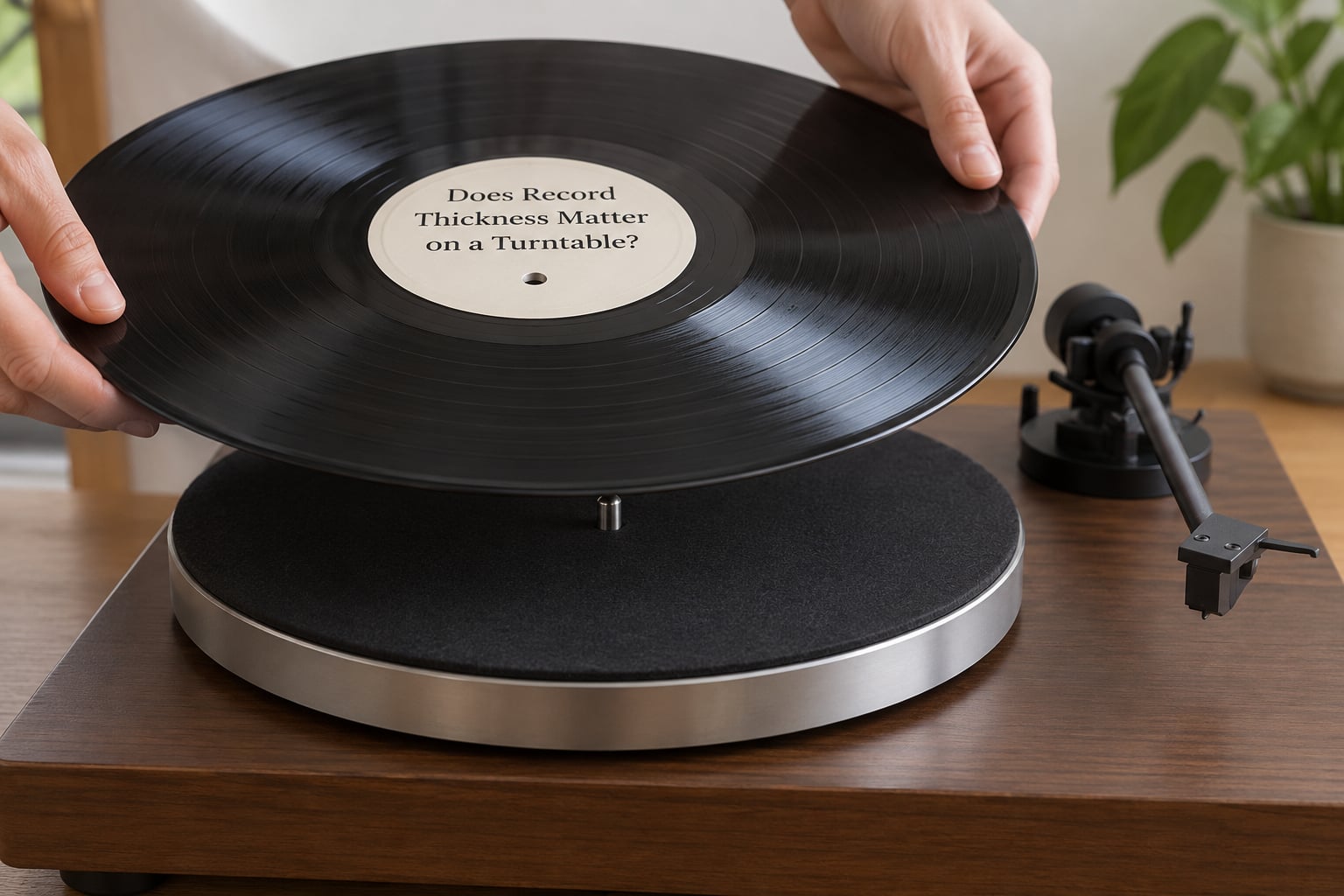
Sometimes, and the answer depends entirely on what is under the record. A thicker disc is a small piece of added inertia sitting on the end of the tonearm, and inertia is what a stylus sitting in a groove actually wants.
On a decent turntable, the effect is close to nothing. Platter mass, bearing quality and tonearm effective mass dominate how a record tracks, and a well-set-up system handles a 140g disc as happily as a 240g one. DUAL, one of the makers quoted by What Hi-Fi? on this question, points out that proper flatness is achievable at around 130g, so thickness beyond that buys no playback advantage.
Is Heavier Vinyl Better Quality on a Budget Turntable?
Here weight does something real. On an entry-level belt drive with a light platter and a compliance-heavy tonearm, the extra mass of a 180g or 200g record damps the feedback loop between the groove and the cantilever. Less feedback means less chance of the stylus skating outward on a loud, sustained passage. Owners of modest systems report noticeably fewer skips and more consistent tracking on heavier pressings.
That is a system benefit, not a vinyl benefit. The same record on a well-suspended, well-aligned deck shows no such difference, and anyone who tells you otherwise is usually describing their turntable, not the pressing.
Do record weight stabilizers and clamps work?
A weighted clamp or stabilizer on a moving platter does the same physics: it adds inertia to the disc-and-platter assembly. On good decks the measurable gain is minimal. On a cheap one it can be noticeable, and the improvement you hear usually comes from the added mass rather than anything about the clamping mechanism itself.
Fit matters more than weight here. A clamp that touches the record label can stress the label paper over decades, which is a slow way to ruin a collectible. If you use one, keep the contact light and centred.
Is Vinyl Weight the Same as Quality?
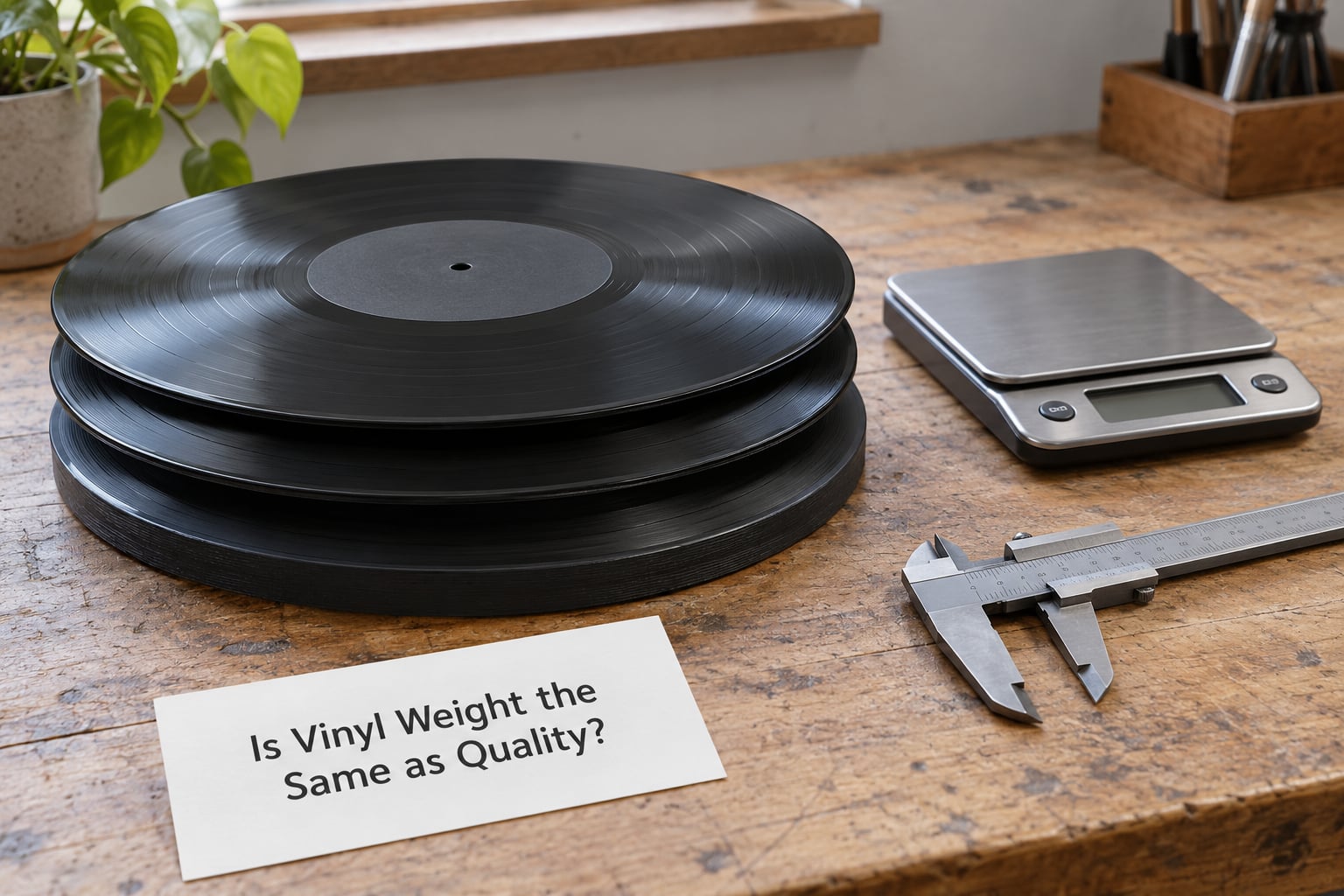
No, and the gap has widened over the years. A 180g pressing in 2026 means something close to what a 140g pressing meant in 1975, only with a bigger sticker on it. When every new release carries the badge, the badge stops carrying information.
Manufacturing cost is the honest reason heavy records cost more. More compound per disc, a thicker plate, a slower cooling cycle, and a higher rejection rate when quality control finds a bad biscuit. A plant loses a 240g record that fails flatness inspection, and the good ones are priced to cover the bad ones. You are paying partly for a better object and partly for the plant’s insurance premium.
Here is the order I would actually rank quality signals in, highest first:
- Mastering source. An analogue tape transfer or half-speed master beats a 360 kHz file resampled to look busy. Ask what the source was before you ask anything else.
- Mastering engineer and house. A named credit means somebody made a set of decisions about this record. Credits on 45 RPM and half-speed releases are a strong signal.
- Pressing plant and stamper. Matador, RTI, Fidelity, GZ, Optimal and Heavy Melody have track records, and a fresh stamper cuts cleaner than an end-of-life one. Matrix and runout etchings can tell you.
- Flatness. Lay the disc on a level surface. If it rocks or you can slide a finger under the edge, near the label especially, quality control missed it.
- Groove geometry and speed. 45 RPM, 45 RPM double LP and half-speed cuts are worth more than any gauge upgrade.
- Weight. Last on the list for sound, first on the list for survival.
None of those signals are printed on the front of the sleeve, which is exactly why collectors end up reading the weight instead. It is the only number they can see.
Ask the collectors who are loudest about it and most of them land in the same place. The top-voted take on the r/vinyl thread about heavyweight hype is that the sticker is perception and marketing, and the real signals are the mastering credit, the source and the plant. Several people in that same thread describe their best-sounding records as light originals, half-speed and cut thin, which is the opposite of what the label would have you want.
Why Do Gen Z Listeners Love Vinyl?
Worth a short aside, because it explains the current pressure on the 180g badge. Most new buyers are not buying a sonics upgrade, they are buying an object. A record is a thing you can hold, shelve, post and hand around, and the heavier it feels the better it fits that picture. The format’s revival is a culture story far more than an audio one, which is exactly why weight ended up carrying a meaning it cannot support.
The practical consequence is that supply and perception got ahead of engineering. When a 180g reissue cut from a digital file costs more than the original pressing did, the gram figure is doing marketing work, not quality control. Buyers who learn the four signals above stop being easy targets for it.
How Do Mastering and Pressing Quality Affect the Record?
A record is the product of a chain, and weight is the last and least interesting link. Here is the chain in order.
The master. A high-resolution digital file of the recording, transferred at 24-bit and 192 kHz or better, is what most modern pressings are cut from. It is not automatically bad. It is a source, and it decides the ceiling on what any pressing can deliver.
The lacquer cut. A lathe in a mastering house cuts the groove onto a copper-plated lacquer disc. The engineer sets the level, decides on the pre-emphasis, and manages how much is packed into each groove. A rushed cut distorts and sounds thin no matter how heavy the finished record is.
The stamper. The negative lacquer is plated to make a metal stamper, which is the die that forms the record. Stampers wear out after a large number of units, and the last few hundred records off a dying stamper are audibly worse.
The press. The stamper presses a biscuit of black vinyl at a controlled platen temperature, then the disc is cooled. This is where heavy pressings get fragile. Thick discs cool unevenly, and a disc that leaves the platen hot and cools under constraint can bow permanently.
The compound. Virgin PVC and recycled compound behave differently, and coloured and transparent formulations need plasticisers that can make a disc slightly heavier for the same gauge. Colour is a formulation choice before it is a look.
No step in that chain is repairable by adding grams. A badly cut lacquer pressed at 240g is still a badly cut record, and it will cost you more to buy.
What Record Weight Should Collectors Choose?
Treat 180g as the baseline rather than the prize. It is the current entry point for a new record, and paying a premium to step up from it buys very little. Spend the difference on a better mastering, or on the original pressing if one exists.
Pay up for 200g or 240g in a few specific cases. A 45 RPM double LP set, where the mastering is doing real work and the weight follows the format. A record you will genuinely handle often, like a DJ set or a copy that lives on a shelf it gets knocked. And a Mobile Fidelity Sound Lab UHQR or Classic Records Quiex SVP title where the source and the flat-surface pressing programme are documented, in which case the weight is one detail among several good ones.
Skip the premium in other cases. Any 45 RPM single, where size sets the weight. A modern 180g reissue with no mastering credit and no named source. Anything sold as 180g but priced above the original pressing it replaced, which is the most common sign that weight is being used to cover a digital master.
Are 200g and 220g records worth the step up from 180g?
Usually not. The jump from 140g to 180g is the one that gets discussed because 140g was once the standard and 180g became the new one. Going from 180g to 220g adds a couple of ounces and a modest increase in manufacturing cost, and it sits far closer to 180g than 180g ever did to 140g. Reading those two figures as the same upgrade step is a mistake.
There is also a practical ceiling. Past roughly 240g the extra rigidity starts to work against flatness during cooling, and plants run into more rejected discs. Several audiophile programmes stopped climbing because the returns ran out, not because buyers objected.
What a 220g record is really buying is shelf presence and handling confidence. On a desk next to a cheap turntable, that is not nothing. As a sound upgrade over a good 180g pressing, it is very close to nothing.
One genuine case: discs that get handled. A live DJ set, a record you pull out and put on fifty times a month, a warehouse-find copy with no sleeve. Here the extra mass is doing exactly what it was always good at.
How to check a record’s weight at home
You can verify a sleeve claim in a few minutes.
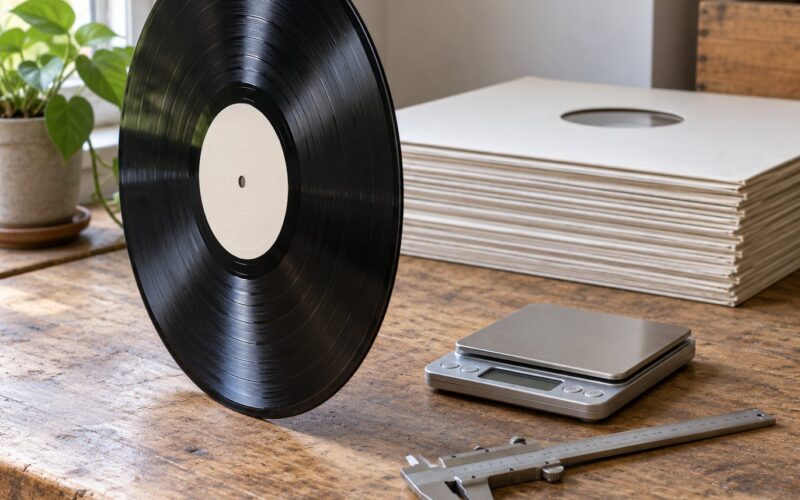
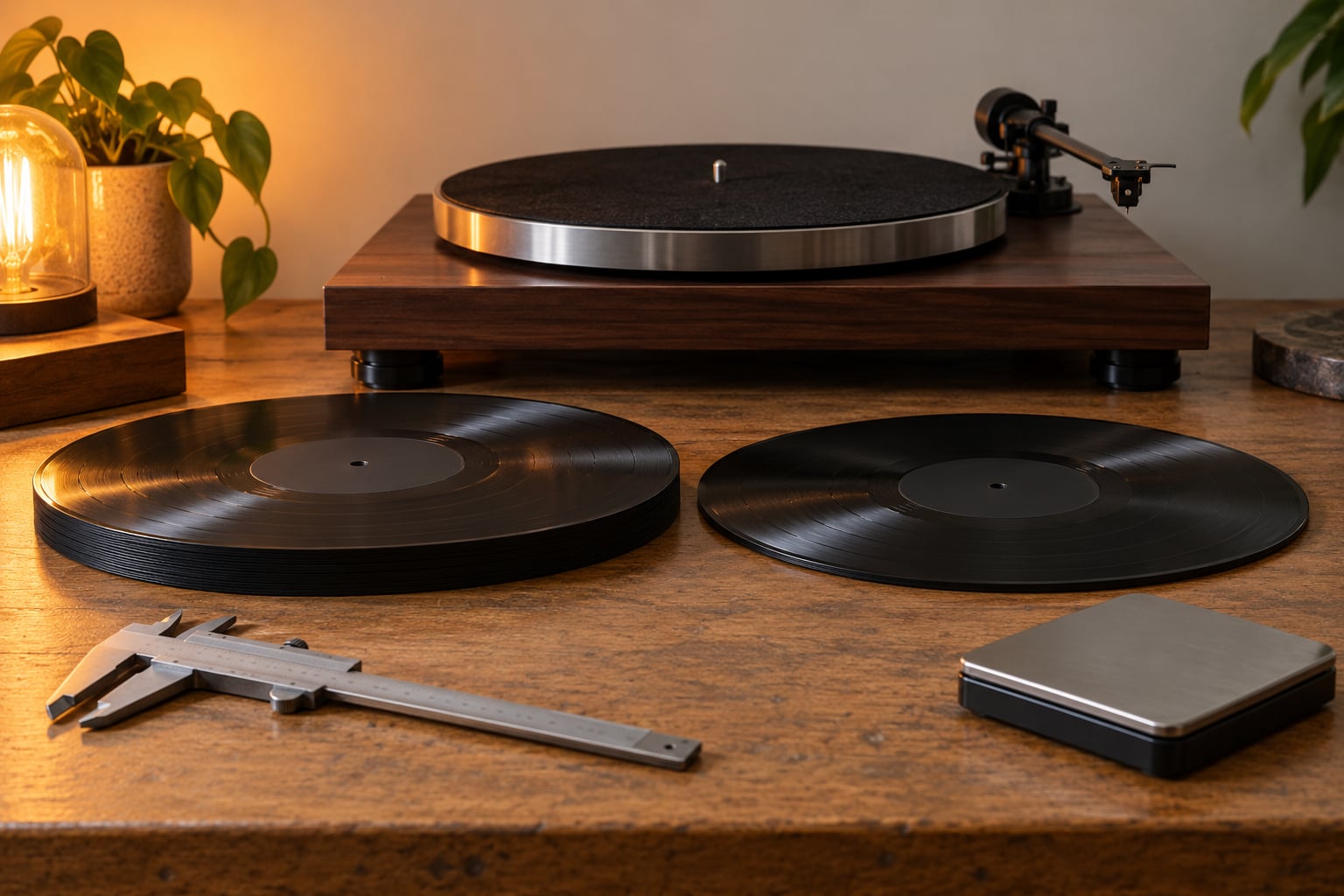
- Put the record and its inner sleeve on a digital scale together, then weigh the sleeve alone. The difference is the disc.
- If you do not have a small scale, weigh three or four copies and average them. Sleeve and record weights vary, a single copy lies.
- Check thickness with calipers at the label and about two inches out from the edge. A 180g usually measures near 0.5 mm, a 140g near 0.4 mm.
- Look on the back sleeve for the weight, the mastering credit and the pressing plant. A label that prints all three is telling you something.
That last step is the real test. Once the 180g sticker is on every record in the shop, the only way to judge a pressing is to read what the label is willing to claim about the cut.
Frequently Asked Questions
Does 240g vinyl sound better than 180g vinyl?
Not by itself. If both records are cut from the same lacquer, the groove geometry and depth are the same, and a pressing plant confirms extra mass does not change the sound. What you may notice is a small reduction in micro-vibration transfer on a budget turntable, plus a sturdier object. Judge the cut, not the gram figure.
Are thicker records more durable?
Yes, and this is the strongest real argument for heavyweight vinyl. Thicker discs put the groove walls further from the surface, so scratches have to travel further to reach the music, and they resist everyday knocks and the slow warping that heat and pressure cause. The trade-off is that a warped thick pressing is far harder to flatten than a standard one.
Does heavier vinyl warp less?
A heavier disc is more rigid, so it holds its shape better in storage and resists the slow bow that comes from heat and tight stacking. The catch is in the factory rather than your shelf. Thick discs leave the platen hot, so a cooling failure leaves a permanent curl that is very difficult to fix. Less initial warp, a worse failure mode when it does happen.
Can you tell the weight of a vinyl record without weighing it?
Roughly, yes. Hold it edge-on and compare: a 140g feels noticeably lighter and more flexible, a 180g sits flat in the hand, and a 240g has real heft. Flex it gently between two fingers and a thin 140g bows while a heavier one barely moves. That is an estimate, though, so a scale or calipers is the only accurate answer.
Why do some heavyweight records cost more?
More compound per disc, a thicker plate, a longer cooling cycle, and a higher rejection rate when a heavy disc fails flatness inspection. The plant prices the good discs to cover the bad ones, so part of the premium is manufacturing cost and part is insurance. Part of it is also simply that collectors have learned to read weight as a quality signal.
Do heavier records skip more often?
No, the opposite is more common. On an entry-level turntable with a light platter and a compliant tonearm, the extra mass of a 180g or 200g record helps damp the feedback between groove and stylus, which reduces skipping on loud sustained passages. On a well-aligned deck the difference disappears. A heavy record that skips is usually warped, dirty or sitting off-centre.
Conclusion
Is heavier vinyl better quality? It is a better-made object, not a better-sounding record. Weight tells you how much vinyl went into the press, and that predicts how well the disc survives handling, storage and decades of use. It tells you nothing about the master, the cut or the plant.
So read the pressing notes instead. Look for a mastering credit, a stated source, a named plant and a flat disc on your table. Then treat 180g as the baseline rather than the prize, and put your money toward a good cut rather than a heavy one. If a record weighs 240g and was half-speed mastered from tape, you have found a rare thing. If it weighs 240g and nobody will say where the master came from, the weight is the only impressive part.