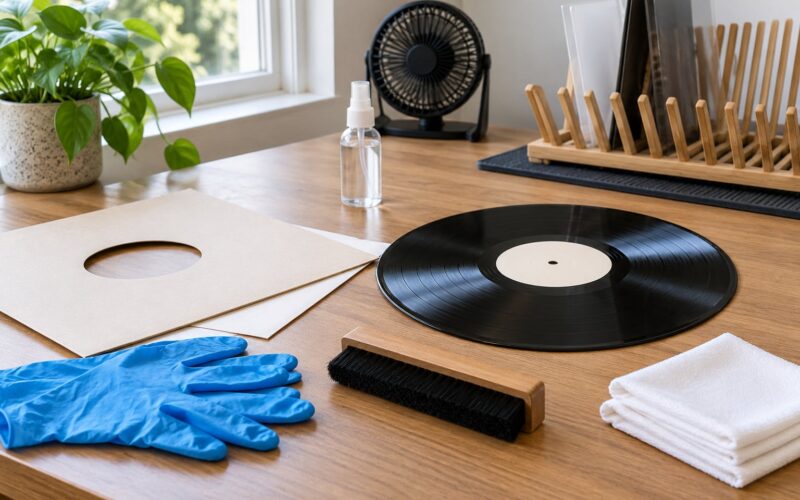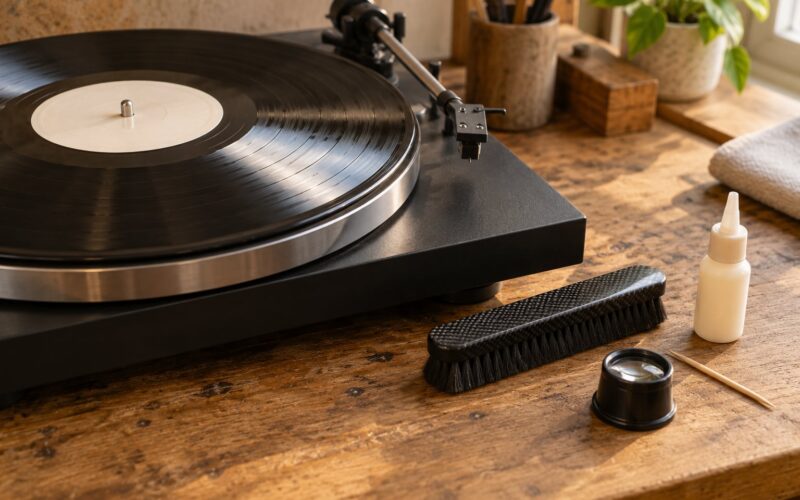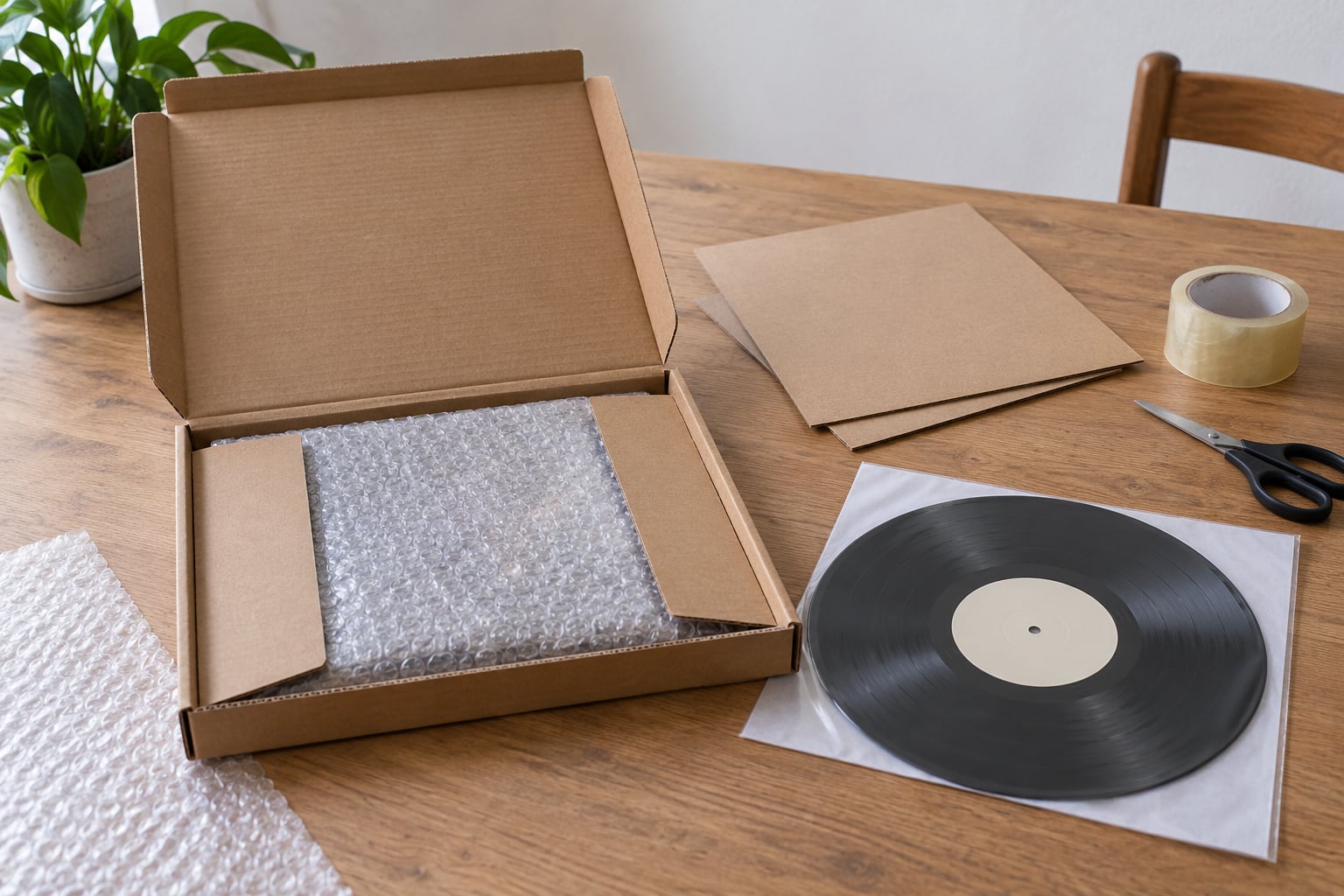
Shipping vinyl records safely comes down to three things: a rigid mailer that fits the record, cardboard stiffeners on both faces, and a pack with zero movement inside when you shake it. Most damaged records are not destroyed by a catastrophic drop. They are destroyed by a thin mailer bending under a stack of parcels, or a loose disc hammering against the corners for four days.
The whole job takes about ten minutes per record once you have the supplies. A first-timer buys a mailer, a couple of bubble wrap sheets and a roll of tape, and that covers dozens of shipments. If you sell on Discogs or eBay regularly, or you are moving part of a collection to another state or another country, the difference between a snug pack and a sloppy one decides whether the buyer gets a playable record or a refund.
Below is the method collectors actually use, followed by the mistakes that cause the claims, the carriers worth paying for, and what to do when something arrives broken anyway.
Table of Contents
- What You Need
- Step-by-Step: How to Ship Vinyl Records Safely
- 1. Choose a Mailer for the Record Size
- 2. Protect the Sleeve and Record
- 3. Fill Empty Space and Prevent Movement
- 4. Seal the Package for Handling
- 5. Label, Insure, and Ship Vinyl Records Safely
- Common Mistakes
- Shipping Tips for Valuable or Rare Vinyl
- Frequently Asked Questions
- What is the best packaging for vinyl records to send for postage?
- Can I ship vinyl records via USPS Media Mail?
- Is USPS Media Mail safe for vinyl records?
- How many records can I fit in one record mailer?
- How do I pack 7-inch 45 singles?
- What should I do if a record arrives damaged?
- Conclusion
What You Need
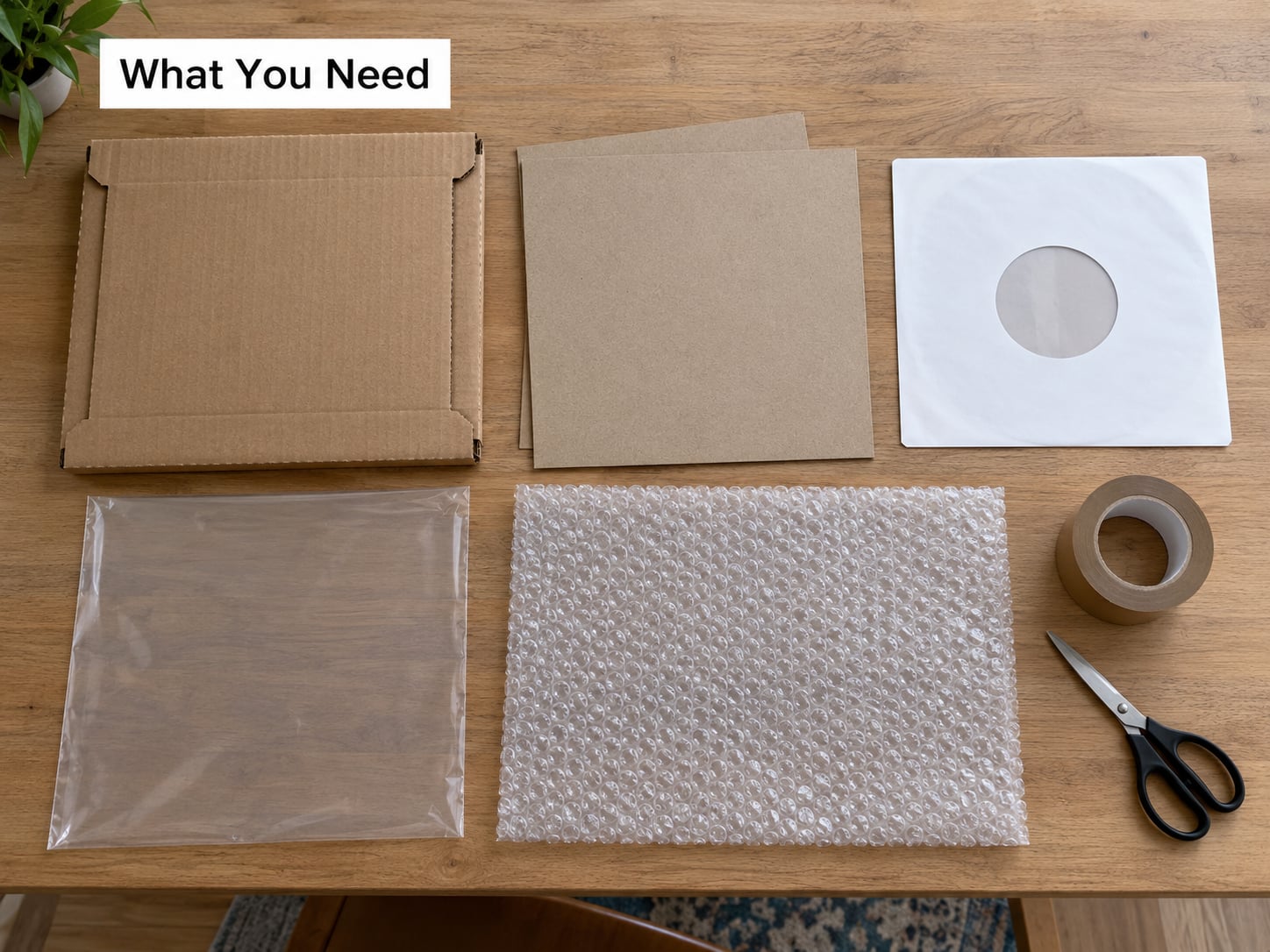
This is the full kit. Everything on this list has a specific job, and skipping one leaves a gap the carriers will find.
- Rigid corrugated LP mailer with a snug internal width, so the record sits without sliding side to side. Cardboard, not bubble mailer, not a padded envelope.
- Two corrugated stiffener sheets cut to the exact size of the record, one in front of the sleeve stack and one behind it.
- Anti-static inner sleeve in the record’s original size, with the film not touching the vinyl itself.
- Outer poly sleeve (a protector or poly outer) the width of the jacket, to guard record corners and stop the jacket face scuffing.
- Bubble wrap for the disc bundle, and cardboard corner protectors if the jacket is a gatefold or a box set.
- Packing tape, wide enough to seal the full seam of the mailer. Paper tape alone is not enough on a corrugate mailer.
- Tracking on every parcel, and insurance or declared coverage on anything you would be upset to lose.
- A shipping rate calculator for your carrier, plus a rigid shipping envelope or a box for the packing step that will not fit in a mailer.
Mailer quality varies more than any other item on the list. The cheap unbranded ones often use thinner board and glue that lets the corner seam give way, which is why experienced sellers keep a couple of specific makes in the cupboard and reuse them carefully rather than buying the lowest price each time. Check the mailer by squeezing the faces together: it should resist and spring back, not crease.
Two optional items earn their keep once you ship regularly: corner protectors folded from scrap corrugated board for gatefold jackets, and a small step stool or work surface that lets you pack at a comfortable angle. Sealing a mailer while hunched over a low table is where a lot of half-sealed corners come from.
Step-by-Step: How to Ship Vinyl Records Safely
1. Choose a Mailer for the Record Size
Match the mailer to the record. A 12-inch LP needs a 12-inch or 13-inch corrugated mailer, a 7-inch single needs a much smaller and flatter mailer, and a box set or a multi-LP set needs a snug cardboard box with a fitted tray rather than an envelope at all.
Two rules do most of the work here. The mailer must be rigid, because a bending mailer is what produces a warped disc. And it must be snug, because a record rattling in a roomy mailer is a record taking repeated impacts at the edges.
For a bulk shipment of roughly 20 records, the option collectors reach for is the US Postal Service M-Bag, which can travel as several parcels of up to 66 lbs each inside the one bag. Individual orders go in a single record mailer, and anything valuable or going overseas gets double boxed.
You will know the mailer is right when the album fills the internal width and the lid flap closes without straining.
2. Protect the Sleeve and Record
Take the record out of the jacket. The reason is mechanical: a disc sitting inside a jacket pushes outward at the corners, and the jacket seam splits as it flexes. A seam split is the single most common cosmetic damage on a used jacket, and it happens during shipping more than anywhere else.
For an unopened, still-sealed record, leave the shrink wrap alone and pack it exactly as it came. If it is already open, slide the disc into a fresh anti-static inner sleeve, then into a poly outer sleeve so the two surfaces never touch. The disc goes in separately from the jacket, and the jacket goes in a new protector sleeve of its own.
Double LP gatefolds need one extra step. Both discs come out, get their own inner and outer sleeves, and go into the mailer flat on top of each other. A gatefold that has been opened and then folded back closed along the spine is a structural weakness, so brace the spine with a cardboard strip before it goes in.
Check the disc under a light before you pack. If you can see a crack near the run-out or a deep scratch you can feel with a fingernail, photograph it now, before it leaves your hands. That image is your baseline in a dispute later.
3. Fill Empty Space and Prevent Movement
Bubble wrap the disc bundle, then stiffen it. Wrap the sleeved disc and the protected jacket together as one unit, bubble side out with a couple of inches of overlap, and fold the ends over rather than twisting them.
Then put a cardboard stiffener on each face of the stack, so the sandwich is cardboard, bubble, records, bubble, cardboard. The check regular sellers use takes one second: hold the packed bundle in one hand and strike it with the flat of the other palm. A good pack sounds like a ripe watermelon and nothing shifts under your fingers. Any rattle means more padding before the mailer goes anywhere near a label.
For anything travelling loose inside a box, cut cardboard to fill the void so the record is suspended rather than resting on the bottom. Loose filler is what allows a record to pivot onto a corner during a turn.
Check the fit one last time before sealing: nothing moves, nothing rattles, and no part of the disc presses directly on a mailer wall.
4. Seal the Package for Handling
Seal the mailer along the full length of the seam with packing tape, running the strip past both ends. Parcels travel through sorting machines and get stacked under heavy weight, so a half-length strip of tape is what lets a lid pop open in a trailer.
Reinforce the two places most likely to fail: the corners of the mailer where the flaps meet, and the bottom seam. A strip of tape across each corner takes seconds and closes the most common tear point.
Fragile stickers do almost nothing on their own. The word has no effect on how a parcel is stacked or sorted, and plenty of mail arrives marked fragile with a crushed corner. Structure does the protecting.
There is a fifth force that catches people out: the disc moving inside its own outer sleeve while the sleeve sits still. A tight poly sleeve with the record filling it end to end stops that. If the sleeve is a size up, the disc can slide to one end and the corner takes the whole impact.
The seal is done when no flap can be lifted with a fingernail and the mailer reads as one solid object when you press on the faces.
5. Label, Insure, and Ship Vinyl Records Safely
Use the buyer’s address exactly as given, and confirm anything unfamiliar before you commit. A parcel to a wrong or incomplete address is a parcel that comes back to you, sometimes weeks later.
Print the label flat on the largest clean panel of the mailer, cover the barcode completely, and never tape over the tracking number. If you are reusing a mailer, scrape off the old label and the old barcode underneath it. A second barcode underneath a new one sends a parcel to a sorting facility and costs you a week.
Weigh the packed parcel before you buy the label, then pay attention to the rounded dimensions. A stiff mailer that measures a fraction over a size threshold can jump a whole price band, and trimming a corner flap is often enough to drop it back down.
Purchase tracking on every single shipment. On higher-value parcels, add declared value or insurance and consider signature confirmation so the carrier hands it to a person rather than leaving it on a step.
| Service | Tracking | Insurance | Best for |
|---|---|---|---|
| USPS Media Mail | Basic scan events only | Not included | Low-value domestic shipments of printed media |
| USPS Priority Mail | Detailed scans | Available as an add-on | Most domestic orders as a default |
| UPS Ground | Detailed scans | Available as an add-on | Shipments where declared value matters |
| FedEx Ground | Detailed scans | Available as an add-on | Orders over a few hundred dollars |
| USPS Priority Mail International | Detailed scans | Available as an add-on | Cross-border sales, always double boxed |
Media Mail is the cheapest way to move a record domestically and LPs do qualify as printed media, so it is a legitimate choice for a common pressing. What collectors complain about repeatedly is what it does not include: no included insurance, and thin scan detail, which means a damage claim runs into a wall of missing data. For an inexpensive record that is a fair trade. For a first pressing or anything a buyer would be upset to lose, pay for a service with full scans and add insurance on top.
Keep the receipt, the tracking number, and your packing photos until the delivery scan shows the parcel reached the buyer. Once it is confirmed delivered and a few days pass with no complaint, you are clear to recycle the mailer and the cardboard.
Common Mistakes
Each of these shows up again and again in collector threads, and each one has a straightforward fix.
- Bubble mailer with no cardboard. A padded envelope bends under a stack of parcels, and a bent jacket plus a bent disc is a warped record. Fix: a rigid corrugated mailer with two stiffeners. This is the minimum acceptable standard, and thin mailers are the number one reason buyers complain.
- The record stays inside the jacket. The disc pushes out at the corners and splits the seam. Fix: remove it unless the album is factory sealed, and sleeve it separately.
- A loose record in an oversized box. Everything moves. Fix: cut cardboard fillers so the stack is suspended, and run the palm-strike test before sealing.
- Reused mailers with creased corners. Once a corner is crushed, it cannot recover, and a buyer can see it immediately. Fix: inspect every reused mailer under the light and scrap any that has taken a set.
- Old labels and barcodes left on the mailer. Fix: peel, scrape, and wipe before applying the new label.
- Under-declared weight, or postage bought on the mailer size instead of the packed size. Fix: weigh and measure the finished parcel, never the empty box.
- Relying on insurance you never purchased. Media Mail includes none, and a claim with no coverage is simply a loss. Fix: decide the value threshold before you ship, not after something breaks.
- Waiting weeks to report damage. Claims have deadlines and get harder to support as evidence ages. Fix: open the claim as soon as the record is unwrapped.
One more worth naming: a pizza box. It shows up constantly in forum threads as an acceptable record mailer. It is fine as an outer layer in a double box, and it is not fine as the only thing between the record and the sorting floor.
Over-packing has a failure mode too, though it is gentler. Wrapping so many layers that the mailer bulges creates a soft, bendy object where a rigid one would have held its shape, and the record ends up floating in a cavity that was meant to be tight. If you have to cram the mailer shut, the mailer is too small for what you put in it. Get the next size up instead of forcing the flap.
Shipping Tips for Valuable or Rare Vinyl
Rare pressings have a different failure mode. A common reissue that arrives bent is an annoyance; a Mono pressing that arrives cracked is a permanent loss, because the copies that survive stop being rare.
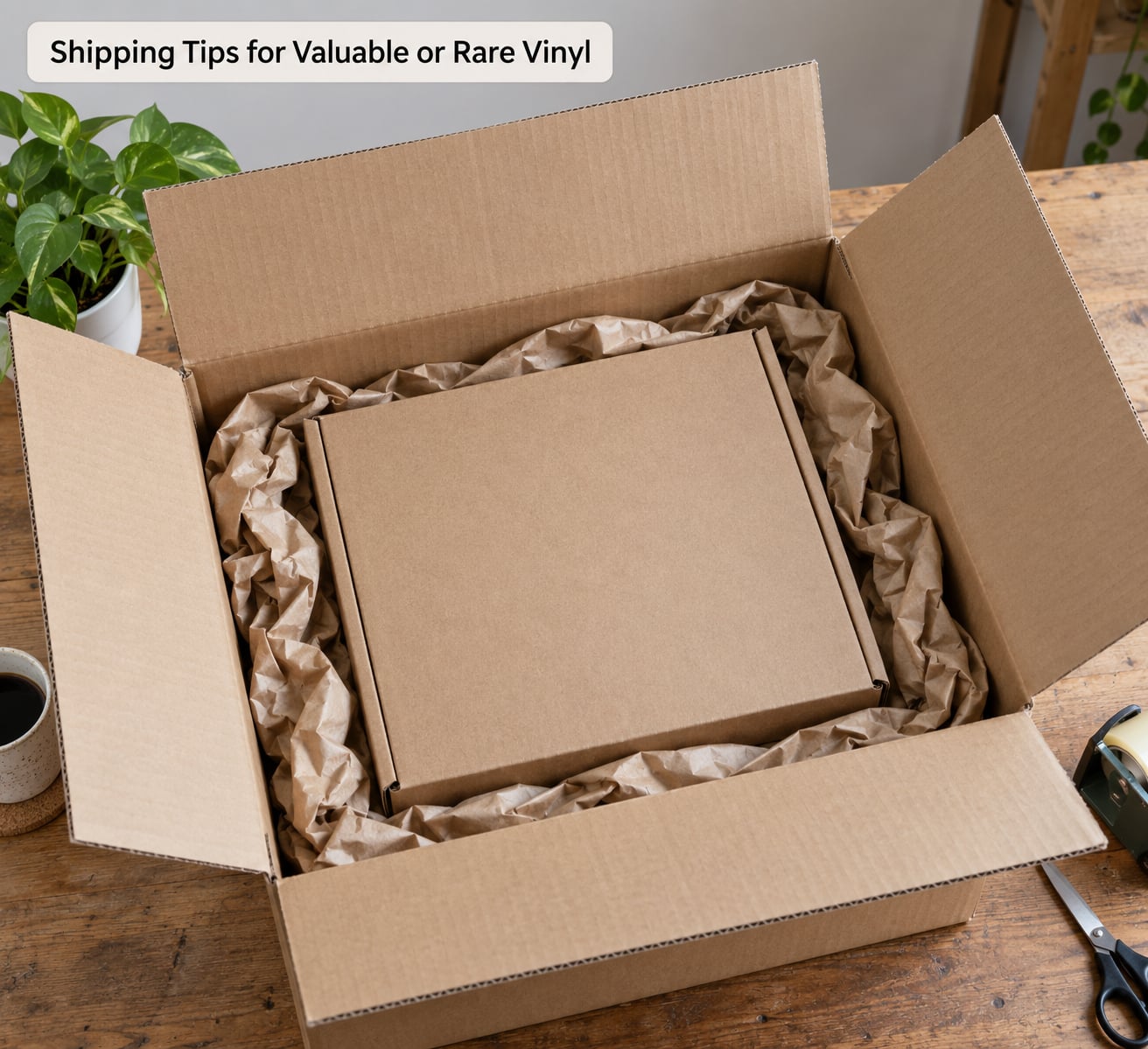
Double box anything international or above a few hundred dollars. Put the sealed record mailer inside a larger box and fill the gap between them with kraft paper or bubble so the inner box cannot move. The outer box takes the impact, and the inner mailer keeps its shape. This is also the arrangement most experienced collectors use for anything crossing a border.
Photograph at three points: the record before it goes in, the packed bundle before the mailer closes, and the sealed parcel with the label visible. Add a ruler or a coin in one frame for scale. If a claim is ever filed, those images are the difference between a conversation and a refund.
Split large orders into smaller parcels when you can. Three records in three snug mailers travel better than three records in one roomy box, and a partial loss is smaller. If a buyer is buying a full set, ask them how they would rather receive it.
Signature confirmation and declared value both add protection on high-value parcels, and both are worth the small extra charge when the alternative is writing off a scarce record.
Heat is the quiet one. A record left in a hot vehicle or sitting on a hot porch in summer can bow enough to skip, and no packing method prevents that. Ship early in the week so the parcel is not parked in a depot over a weekend, and avoid dispatch days with forecast heat. A padded record mailer insulates a little; a rigid corrugated one insulates better.
If something arrives damaged, photograph the parcel before you open it, then the record in place, then the damage itself. Note the date on the tracking record and file the claim well inside the carrier’s window. When a Media Mail parcel is damaged, expect the process to be slow, because the scans you would need rarely exist. That is the argument for paying for a tracked, covered service on anything you cannot replace.
Frequently Asked Questions
What is the best packaging for vinyl records to send for postage?
A rigid corrugated LP mailer with two cardboard stiffeners, the record removed from its jacket and sleeved separately, and packing filled so nothing moves. Bubble wrap the bundle, tape the full seam, and use tracking. Thin bubble mailers are the leading cause of damage claims.
Can I ship vinyl records via USPS Media Mail?
Yes. LPs qualify as printed media, so Media Mail is a valid domestic option and the cheapest way to move a record in the US mail. What it does not include is insurance, and its scan detail is thin, which makes a damage claim hard to support. Use it for common pressings and low values.
Is USPS Media Mail safe for vinyl records?
The service is as safe as your packing. The parcel is handled the same way any other mail is, so a rigid mailer and a snug pack protect the record just as well. The weakness is after the damage: no included insurance and limited scan events mean fewer facts to support a claim.
How many records can I fit in one record mailer?
One LP per single-record mailer is the safe answer, and it is what most sellers use. Two fit in a heavier mailer or a small box with cardboard between them, snugly. For 20 records or more, collectors use the USPS M-Bag, which travels as several parcels of up to 66 lbs each inside a single bag.
How do I pack 7-inch 45 singles?
Slide the single into a stiff outer sleeve protector, stiffen both faces with card cut to the 7-inch size, and use a small rigid mailer sized for 7-inch records. The same rules apply as for an LP: remove the disc from any thin paper sleeve it ships in, immobilise it, and check for rattle before sealing.
What should I do if a record arrives damaged?
Photograph the sealed parcel before opening it, then the record in place, then the damage. Save the tracking record and your packing photos, and file the claim inside the carrier’s window rather than waiting. On Media Mail, expect a slow process, so report quickly and keep copies of everything you send.
Conclusion
Start with the three things that prevent nearly every shipping failure. Match the mailer to the record so it is snug and rigid, take the disc out of the jacket and sleeve it separately, and immobilise the contents so nothing shifts when you shake the parcel. Add tracking, add insurance above whatever value you would be upset to lose, and everything else is detail.
The method has not changed in decades because it works against the only three forces that damage a record in transit: crushing, bending and seam splits. Build the pack around those, and shipping vinyl records safely stops being something you worry about.