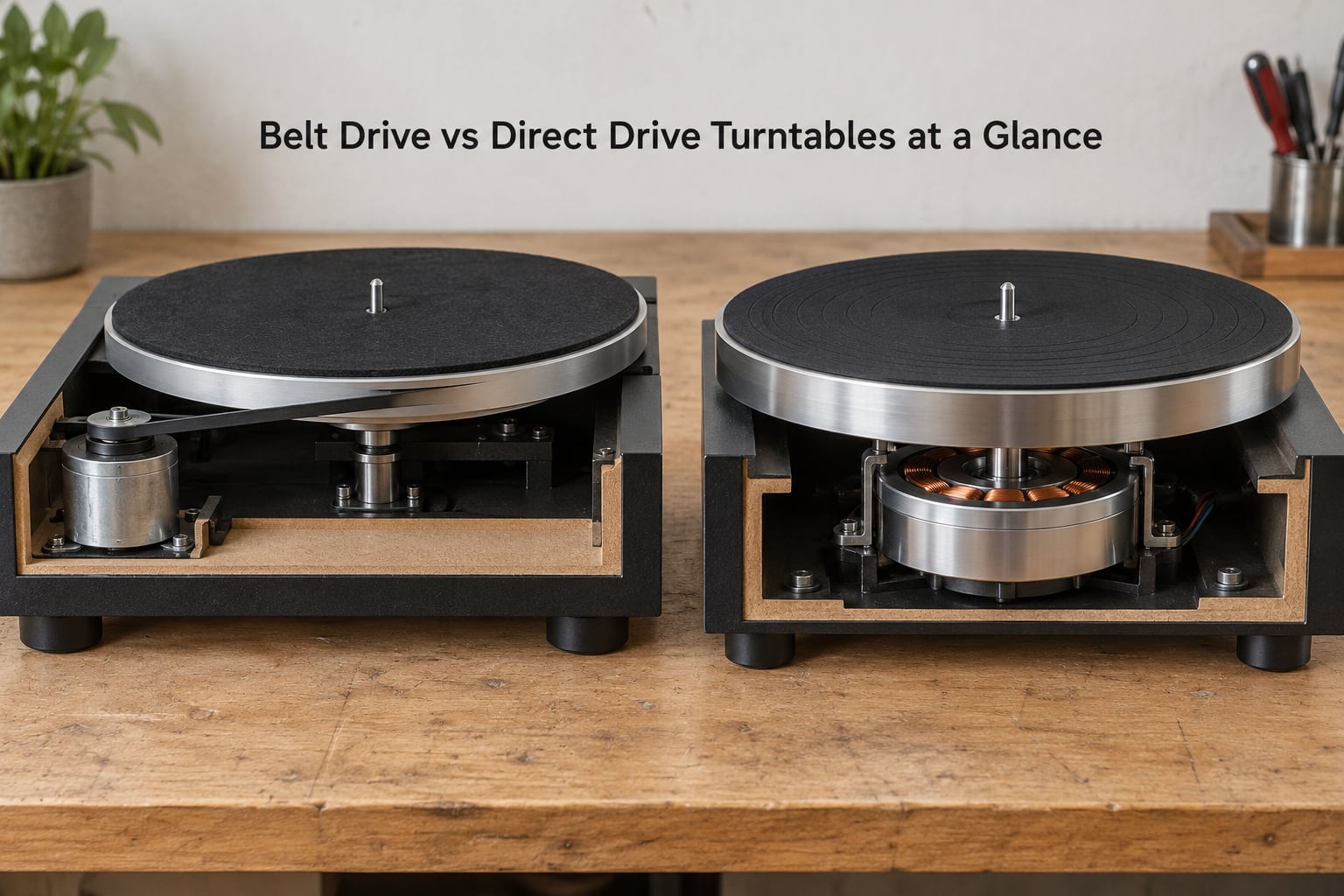
Belt drive vs direct drive turntables come down to one mechanical question: how the motor gets its power to the platter. A belt drive sends that power through a stretched rubber loop, which softens high-frequency vibration and keeps motor noise out of the record. A direct drive bolts the platter straight onto the motor shaft, which trades that isolation for instant start, steady speed and zero consumables. For most home listeners the belt wins on quietness; for DJs, scratching and anyone recording to a computer, the direct drive wins on control.
The trap is treating this as a sound-quality argument. A well-built deck of either type beats a cheap deck of the other type almost every time, and the differences people argue about online are often differences in plinth, tonearm and setup rather than drive mechanism. So here is the honest breakdown, mechanism by mechanism.
Table of Contents
- Belt Drive vs Direct Drive Turntables at a Glance
- How Belt Drive and Direct Drive Turntables Work
- Telling which drive type you already own
- Sound and Noise Differences
- Belt Drive Turntables: Strengths and Limitations
- How it works
- Pros
- Cons
- Best for
- Direct Drive Turntables: Strengths and Limitations
- How it works
- Pros
- Cons
- Best for
- Which Drive Type Is Better for Vinyl Collecting?
- Belt Drive vs Direct Drive Turntables for Different Uses
- How to Choose a Belt Drive or Direct Drive Turntable
- Tonearm and cartridge
- Speed control options
- Plinth and isolation
- Build quality and serviceability
- Connectivity
- Record condition
- Warranty and parts
- Which Should You Choose?
- Frequently Asked Questions
- What are the disadvantages of belt drive turntables?
- Is belt drive better than direct drive?
- Which turntable has the best sound quality?
- How often should you replace the belt on a turntable?
- Why is my turntable making a slow sound?
- Does drive type affect how fast records wear out?
- Final Verdict: Choose the System That Matches Your Music
Belt Drive vs Direct Drive Turntables at a Glance
| Criterion | Belt drive | Direct drive |
|---|---|---|
| How power reaches the platter | Elastic rubber or silicone belt between motor pulley and platter rim | Platter mounted directly on the motor shaft |
| Start-up time | A few seconds to spin up and a slower stop | Instant start and stop |
| Speed accuracy | Depends on belt condition and motor quality; drifts as belts stretch | Very stable, often electronically corrected against a reference |
| Wow and flutter | Very low with a fresh belt; degrades noticeably with a cheap or stretched one | Very low; limited mainly by motor torque ripple |
| Noise floor | Motor rumble and hum largely decoupled from the platter | Some motor noise and vibration can reach the platter and plinth |
| Torque and pitch control | Typically fixed speed, no variable pitch | Instant torque, pitch fader on DJ models |
| Maintenance | Belt inspection and occasional replacement | No belt; occasional cleaning and lubrication |
| Recording to a computer | Possible with a phono preamp and a separate capture chain | Common built-in USB output on many models |
| Record protection | No effect either way; wear comes from cartridge and tracking force | No effect either way; wear comes from cartridge and tracking force |
| Portability | Often bulkier, some models have a dust cover and storage | Many models are compact and easy to carry |
| Best suited to | Careful home listening, album sessions, collectors | DJ cueing, scratching, practice, digital archiving |
How Belt Drive and Direct Drive Turntables Work
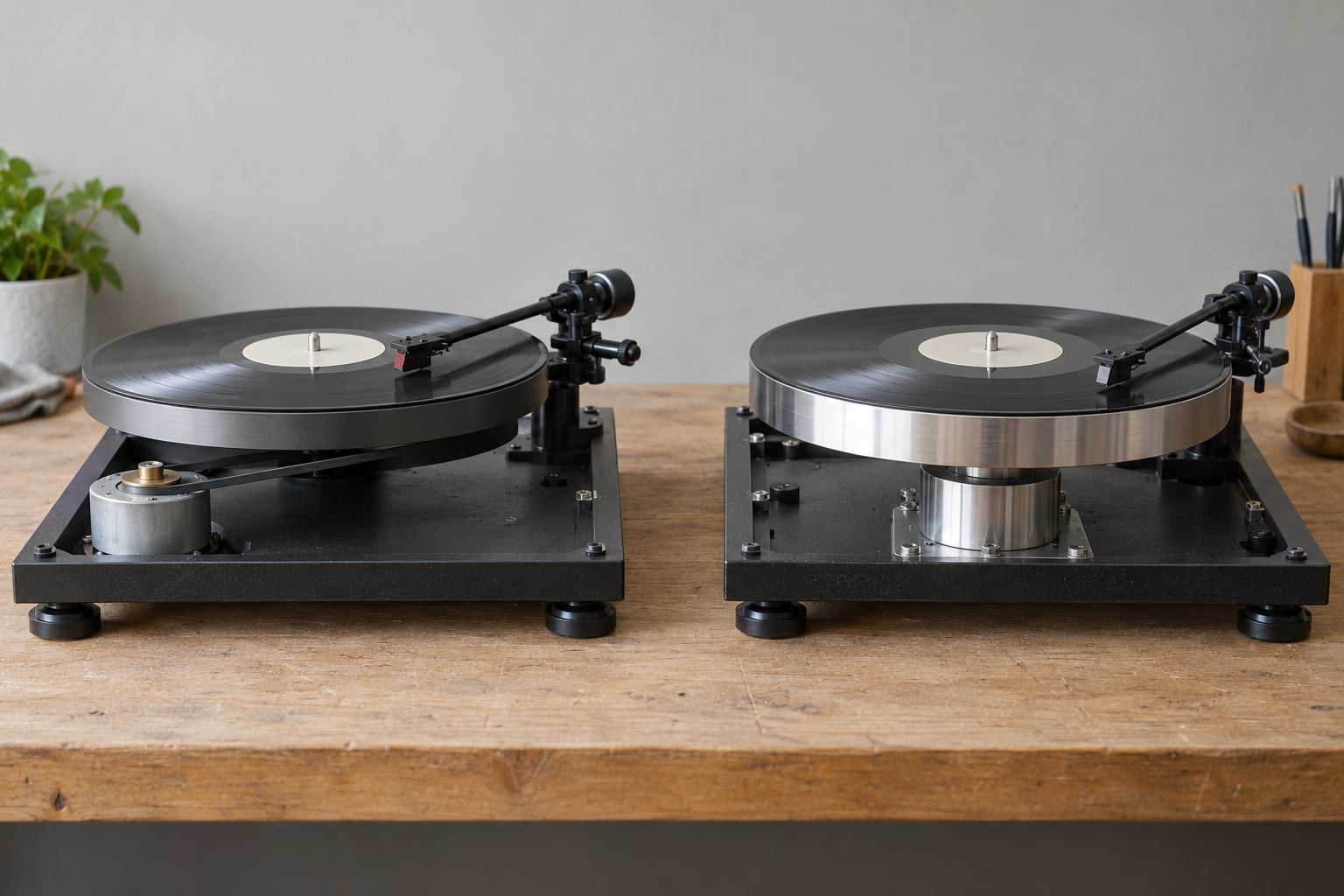
A belt-drive turntable has a small motor pulley and a much larger platter pulley, joined by a loop of rubber or silicone. The motor turns the small pulley, the belt transmits that rotation to the big one, and the platter spins at record speed. That belt is doing more than transmitting power. It acts as a mechanical filter, absorbing the fine vibration that a motor produces and never quite delivering it to the platter.
A direct-drive turntable skips the link entirely. The platter sits on the motor shaft, so the motor’s torque reaches the record with nothing in between. That direct coupling is why these tables start and stop instantly, hold speed tightly, and can be reversed or stopped by the motor itself rather than by letting friction do the work.
Telling which drive type you already own
Most people can identify their own table in under a minute. If you can see a rubber loop running from a small pulley to the platter rim, it is belt drive. If the platter sits on top of a chunky motor can directly under the platter, it is direct drive. Three other cues confirm it: a direct drive usually has a power switch that starts the platter immediately, a belt drive takes a second or two to come up to speed, and a belt drive has a small replaceable belt you can find by opening the plinth. Old RCA, Garrard and Pioneer 1200-series decks use a third method, idler drive, where a spinning idler wheel pushes against a rim on the underside of the platter.
That idler design is worth knowing about even if you never buy one. It is a mechanical link like a belt, without a stretchy loop, and it explains a lot of the very heavy plinths and low platter speeds on classic turntables.
Sound and Noise Differences
The most reliable difference is background noise, and it comes down to isolation. A belt physically sits between the motor and the record, so motor hum and high-frequency buzz are attenuated before they reach the groove. On a direct drive, the motor is the floor the record stands on, which means any motor noise and any vibration it generates travel straight into the platter and through the tonearm.
That is a mechanical fact, but how much you hear depends entirely on the quality of the machine. Good direct drives use heavy, well-damped plinths, rubber isolation between motor and chassis, and balanced rotors to keep noise down, and they are quiet. Bad belt drives, especially cheap models with a small motor and a thin plinth, can be audible droning machines. On a forum, one owner noted the criticism of direct drives is really aimed at cheap DC-motored budget tables rather than the mechanism itself.
Wow and flutter tell a similar story. Wow is a slow drift in pitch, flutter a fast one, and both come from speed variation during rotation. A fresh, correct belt on a good motor gives figures that match expensive direct drives. One AudioKarma member reported that swapping the belt on a Thorens TD-125 Mk II changed its measured wow and flutter by more than 300 percent, and that budget replacement belts also made the rumble figures worse. In other words, belt quality is a maintenance variable, not a fixed property of the design.
Here is the number to keep in mind: a badly centred pressing produces more pitch wobble than any turntable you are likely to own, and it is still usually inaudible. Speed accuracy specs matter far less to how a record sounds than people assume.
Belt Drive Turntables: Strengths and Limitations
How it works
The motor turns a small pulley, an elastic belt carries the rotation to a larger pulley on the platter, and the record spins at the chosen speed. Nothing about the motor is bolted to the record itself.
Pros
- Excellent isolation from motor hum and vibration, so the background under quiet music stays low
- Simple, well-understood mechanics that most repair shops can service
- Cheaper to build well, which is why the best value in home listening usually sits here
- Loads evenly regardless of platter size, with no strong pole alignment to worry about
- Gentle on the motor, since the belt absorbs startup load
Cons
- The belt is a consumable that stretches, cracks and eventually needs replacing
- Takes a few seconds to reach full speed, which is awkward for DJ-style cueing
- No instant start, stop or reverse, and no pitch fader on most models
- A stretched or cheap belt can slow the platter and increase rumble
Best for
Home listening at normal volumes, especially for people who sit down and play albums, and for collectors who want the quietest possible background between tracks. It is also the calmer choice in a room with hard floors where footfalls are a worry, provided the deck uses a suspended subchassis or good feet.
Direct Drive Turntables: Strengths and Limitations
How it works
The platter is mounted on the motor shaft itself, so torque is delivered straight to the record with nothing in between. Many models add a small reference signal or sensor so an electronic circuit can hold the speed at exactly the right value.
Pros
- Instant start and stop, which makes cueing and scratching feel immediate
- Speed holds steady and recovers quickly after a bump or a nudge
- No belt to stretch or replace, so less routine maintenance
- Pitch faders, reverse and variable speed on DJ models, features belt drives rarely offer
- Often smaller and lighter, and frequently built with a USB output for recording
Cons
- The motor is structurally connected to the platter, so vibration and hum can reach the record
- Budget models can hum noticeably and pass motor noise into the tonearm
- Older direct-drive motors can show cogging, a faint rhythmic ripple once per motor pole
- Less tolerant of very light tonearms on some designs, because a stiffer coupling can transmit subchassis movement
Best for
DJs and anyone who scratches, cues or practices, plus people archiving vinyl to a computer. Modern high-end direct drives are quieter than cheap belt drives by a wide margin, so the noise argument only holds at the lower end of the price range.
Which Drive Type Is Better for Vinyl Collecting?
For careful listening, belt drive is the safer default. You are usually playing at moderate volume with the room quiet, which is exactly the situation where a low background matters most and where a few extra seconds of spin-up time never registers.
Rare and fragile records do not care about drive type at all. Record wear comes from stylus pressure, cartridge tracking force, tip wear and how often you clean the record, not from how the platter is driven. What a fragile record needs is a light tracking force, a clean stylus and a well-aligned cartridge, and a direct drive will not damage it any more than a belt drive will.
Storage and portability tip toward direct drive. Many direct-drive models are smaller, some are battery or USB powered, and fewer have deep plinths that make a shelf sag. For the heavy suspended-subchassis belt drives collectors often prefer, a sturdy furniture piece matters more than the drive.
One more collector-specific point: a table with a suspended subchassis isolates motor vibration well but reacts to footfalls, because a footstep moves the whole sprung assembly. A solid-plinth direct drive with rubber feet is more forgiving in a wooden-floored flat. That trade-off confuses a lot of belt versus direct arguments, because the real variable is the plinth, not the drive.
Belt Drive vs Direct Drive Turntables for Different Uses
- Casual listening and background music: either works. Pick the one you can live with near a bookshelf, and lean belt drive if the room is quiet.
- Serious collecting and album sessions: belt drive, mostly for the background noise and because that is where build quality concentrates at sensible prices.
- DJing and scratching: direct drive, without question. Instant start, instant stop and a pitch fader are not available on belt decks.
- Ripping and archiving to a computer: direct drive with a built-in USB output saves you a separate phono preamp and capture chain.
- Small rooms and apartments: direct drive, because the smaller footprint and lighter weight are easier to place, and vibration transfer is less of a problem at low volume.
- Minimal maintenance and forget-about-it ownership: direct drive, since there is no consumable part with an expiry date.
- Piano and classical playback at low volume: belt drive, where a low noise floor is the whole point.
- Band rehearsal and live practice: direct drive, where a bumped or knocked table recovers speed in a second or two.
How to Choose a Belt Drive or Direct Drive Turntable
Once the drive type is settled, these are the things that actually decide whether you enjoy the deck years from now.
Tonearm and cartridge
A balanced straight tonearm on a quality cartridge matters more for sound than the drive mechanism ever will. Check that the arm has adjustable tracking force, and that a moving magnet cartridge in the range you want is easy to fit. Very low mass arms suit suspended plinths; heavier arms suit solid plinths and direct drives.
Speed control options
For home listening, a 33 and 45 rpm control is enough, and quartz lock is a bonus rather than a necessity. For DJ work, a pitch fader with a wide range and a reset at zero is the requirement. A strobe dot on the platter edge helps you confirm speed by eye.
Plinth and isolation
Solid plinth with good feet handles footfalls well and is a sensible default. A suspended subchassis isolates motor and acoustic vibration but moves when you walk past it. Whichever you get, put it on a level, heavy surface away from the speakers.
Build quality and serviceability
Look for a metal platter and tonearm tube over plastic, and check whether spare parts exist. This matters most with older decks: a vintage direct drive can have a complex motor and control board that is expensive to restore, while a simple belt-drive architecture is usually cheap to service.
Connectivity
A built-in phono preamp with a line input and a switch saves money and avoids hum from a long cable run. A grounding wire matters more than people expect. A USB output is only worth paying attention to if you intend to record.
Record condition
Warped, off-centre or heavily scratched records change the equation. A warped disc can stall a low-torque belt deck, and an off-centre pressing produces pitch wobble no turntable can fix. If your collection is mostly well-kept records, choose on handling and noise; if it is mostly beat-up ones, choose on torque and tracking force.
Warranty and parts
Check that the manufacturer lists replacement belts or stylus cartridges for the model, and that the warranty covers the motor rather than only the parts. On a belt deck, a spare belt costs very little and takes minutes to fit, which makes the drive type far less of a long-term commitment than it sounds.
Which Should You Choose?
Choose belt drive if you mostly listen at home, play albums rather than cueing single tracks, and care about the silence between notes. Choose direct drive if you DJ, scratch, want a pitch fader, plan to record your vinyl, or simply do not want a consumable part to think about. If you are still torn, decide based on your listening volume and room first, and only then check the tonearm and build quality, because that is where the audible difference lives.
Frequently Asked Questions
What are the disadvantages of belt drive turntables?
The main disadvantages are the consumable belt, which stretches and eventually slows the platter, the few seconds needed to reach full speed, and the lack of instant stop, reverse or pitch control. On a well-designed deck the noise and speed penalties of a belt drive are small, but a cheap replacement belt can noticeably increase rumble and wow. Servicing is otherwise simple and inexpensive compared with many direct-drive designs.
Is belt drive better than direct drive?
Neither is universally better. Belt drive usually wins on background noise and value for home listening, while direct drive wins on instant start and stop, torque, speed recovery and pitch control. The gap between a good belt-drive deck and a good direct-drive deck is narrower than the gap between a cheap and an expensive deck of either type, so build quality and tonearm matter more than the label.
Which turntable has the best sound quality?
A well-built turntable of either type sounds better than a cheap one of the other type, and cartridge tracking force, tonearm alignment and phono stage settings make a larger difference than drive mechanism. Low background noise matters most at quiet listening volumes, where belt drive tends to have the advantage. At normal volume, most listeners hear the cartridge and the room before they hear the drive.
How often should you replace the belt on a turntable?
Inspect the belt every year or two and replace it when it looks shiny, cracked, flattened or slack, or when the platter takes noticeably longer to reach speed. There is no fixed interval because a stored deck in a cool room can go a decade, while a daily-played deck in a warm one may need attention sooner. A good belt costs very little and takes minutes to fit.
Why is my turntable making a slow sound?
A stretched, glazed or incorrect replacement belt is the most common cause, because a slipping belt lets the platter run below its rated speed. Check the belt for shine, cracks or a loose fit, and confirm speed with a strobe or an RPM app. Dirty or worn motor bearings, a heavy record mat and a misaligned belt are the other usual suspects.
Does drive type affect how fast records wear out?
No. Record wear comes from stylus pressure, tracking force, a worn or damaged needle, and how often you clean your records. Neither belt drive nor direct drive touches the groove differently. What actually protects a record is a light, correct tracking force, a clean stylus tip, a fresh cleaning cloth and a level, non-slipping surface.
Final Verdict: Choose the System That Matches Your Music
Start by asking one question: is this for sitting down and listening, or for controlling playback? Quiet home listening and collecting point to belt drive; DJ cueing, scratching, recording and zero-maintenance ownership point to direct drive. Then spend your attention where it counts, on the cartridge, tonearm alignment and build quality, because that is what you will actually hear every time the needle drops.