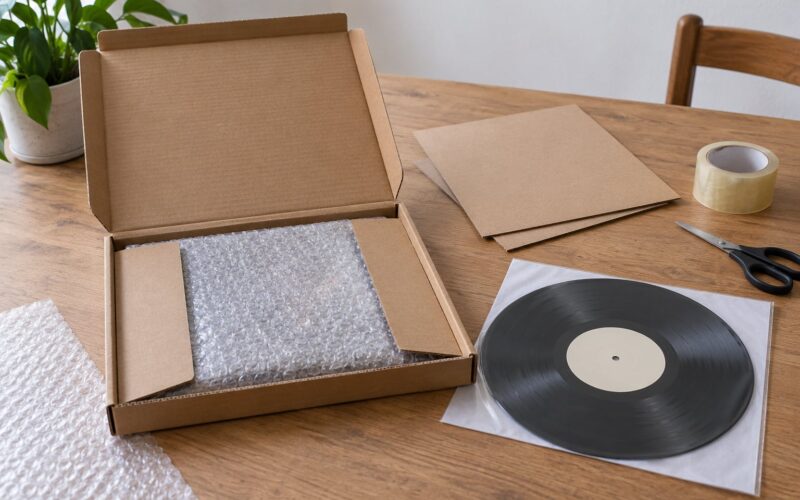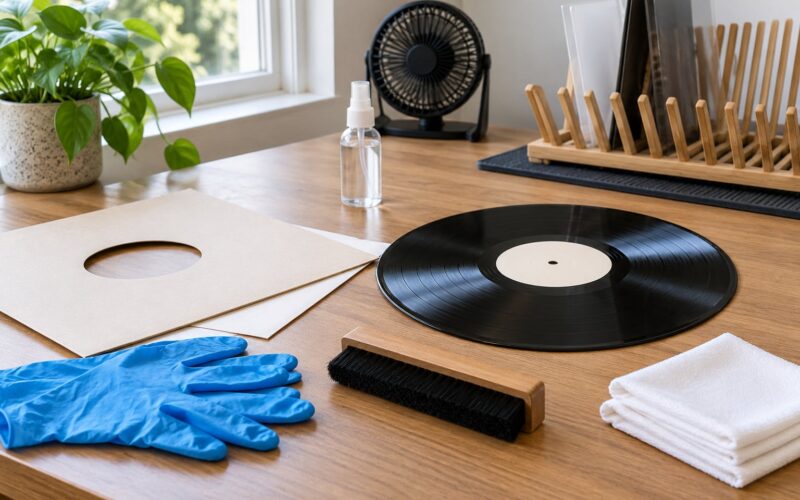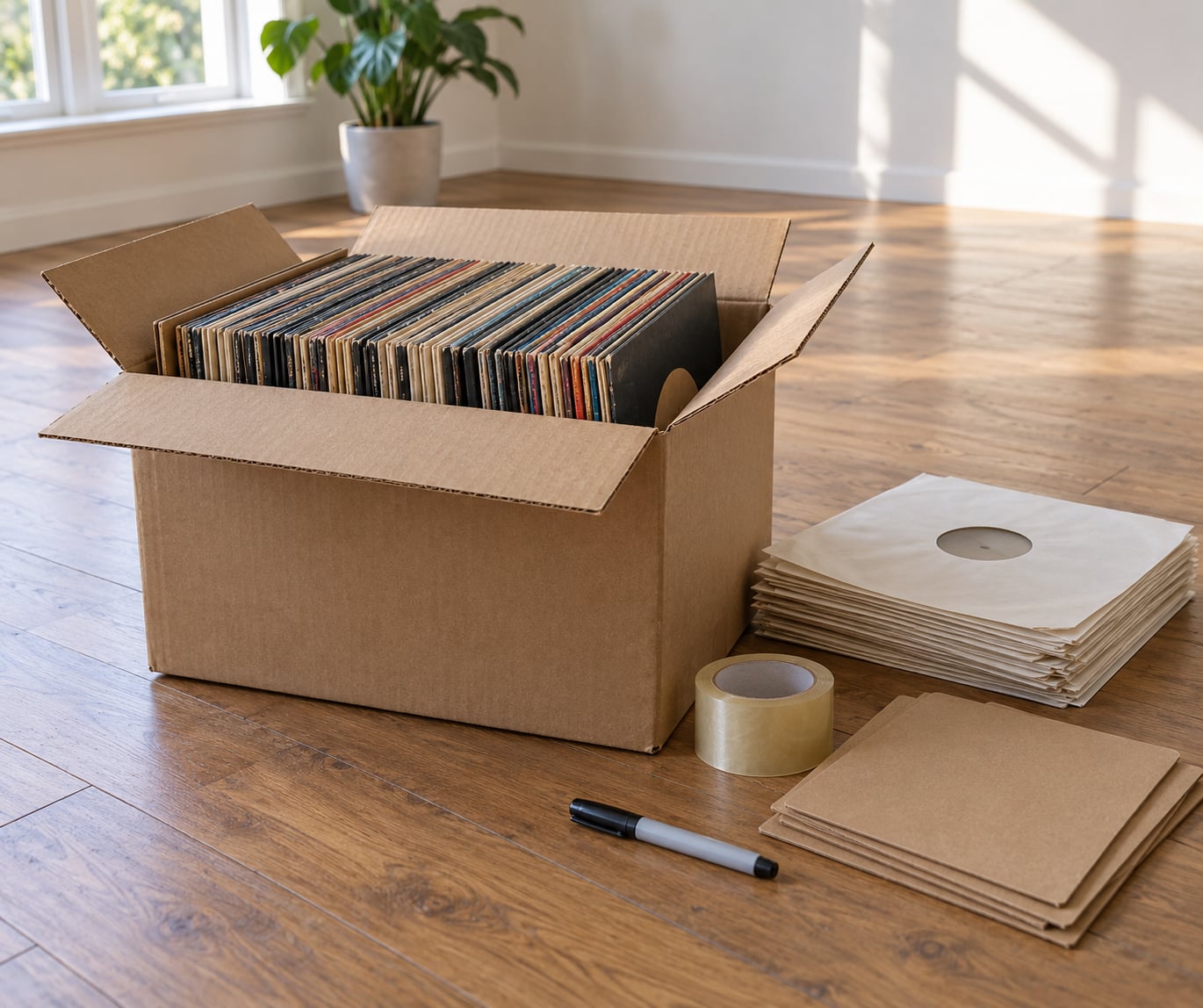
To pack records for moving safely, use small, sturdy boxes and stand every record upright like books on a shelf, packed snug enough that nothing shifts but not so tight that jackets bend or corners crease. It takes about an hour per box for a modest shelf of LPs, and the whole job is mostly preparation before you tape anything shut.
Most of the damage I have seen after a move did not come from a drop. It came from heat in a truck, from a box that was too big so the records leaned and fell, and from jackets whose seams had already split and then split further. Fix those three things and the collection usually arrives playable.
Table of Contents
- What You Need
- Step-by-Step: How to Pack Records for Moving
- 1. Sort your collection before you pack records for moving
- 2. Clean and inspect every record
- 3. Put each record in a proper inner sleeve
- 4. Pack records upright, not flat
- 5. Fill gaps and cushion the box
- 6. Label boxes by room, shelf, and contents
- 7. Move boxes carefully and unpack promptly
- Wet records, first move
- Common Mistakes
- Packing a turntable, preamp, and the rest of the gear
- Mailing records instead of putting them in a truck
- Short moves, long hauls, and storage in between
- Frequently Asked Questions
- What is the best box for moving vinyl records?
- Should vinyl records be packed stacked or standing up?
- How tight should I pack records for a move?
- What destroys vinyl records during a move?
- How much would 500 vinyl records weigh?
- What do I do if records arrive warped or damaged?
- Conclusion
What You Need
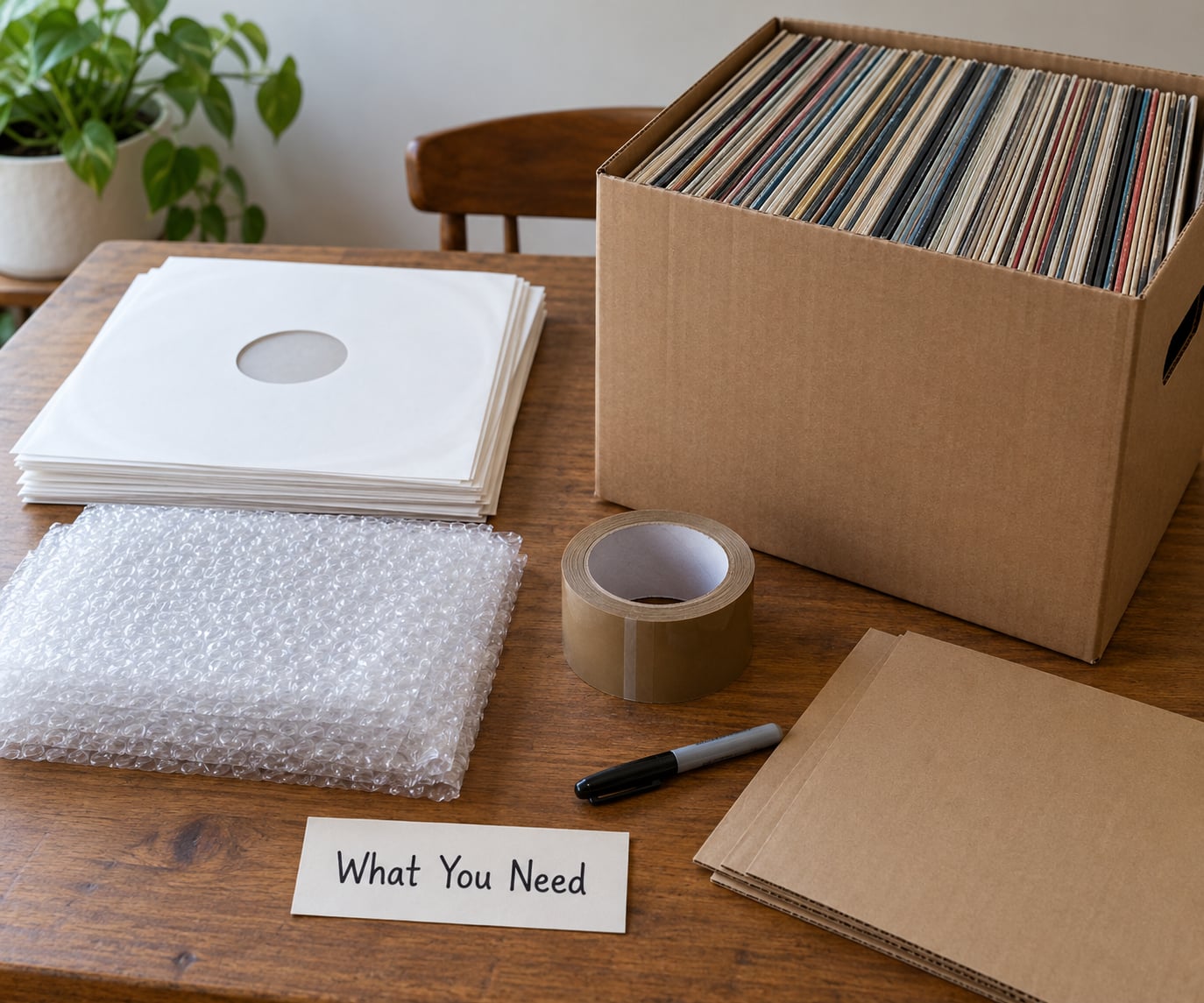
The single most-repeated piece of advice from collectors is small boxes, and by a wide margin. The small book box sold for moving books is the standard choice for 12-inch records, roughly 25 to 35 albums depending on how thick the jackets are.
You will also want the following, and none of it is exotic:
- One box size per record format. 12-inch LPs, 10-inch records, 7-inch singles and 78s each get their own boxes. Mixing sizes is what makes records lean.
- A different box for 7-inch singles if you have a stack of them. They are thin and a regular book box will be mostly air unless you fill it with 45s or add padding.
- Inner sleeves for records that have none, plus poly outer sleeves for jackets already showing wear or a seam crack.
- Cardboard dividers, cut from extra box panels, to group records in blocks of 10 to 15.
- Heavy-duty packing tape and a marker for labeling.
- Packing paper, bubble wrap or foam sheet for the top and bottom of each box, and for gear.
- An inventory sheet, either paper or a note on your phone, listing what is in each numbered box.
- A dehumidifier if your records will sit in storage or a damp basement between move-out and move-in.
One more thing that costs nothing: a roll of painter’s tape for flagging the ones that cannot be stacked. Anything fragile, oversized or valuable gets its own box and rides with you, not in the truck.
Step-by-Step: How to Pack Records for Moving
1. Sort your collection before you pack records for moving
Start by sorting into what goes where, not what goes in which box. Most people end up with three or four destinations: the new place, a storage unit, the car, and a box of records they have decided to sell, trade or donate.
Pull those last ones out first. Deciding while you are still surrounded by your shelves takes an evening; deciding in an unfamiliar apartment after a long move day takes weeks, and the records usually end up in the charity bin anyway.
Then make your inventory. A numbered list, box 1 through box 12, with a rough count and format on each line, is enough. This is the single habit that prevents the worst outcome, which is opening a sealed box months later and having no idea what is inside.
2. Clean and inspect every record
Run a soft brush over each disc as you go and check the jacket for tears, lifted corners and, most importantly, split seams. A jacket with a cracked seam lets the record ride partway out during transit, and that is how corners get knocked off.
Set aside anything warped, cracked or brittle. It travels in a separate box or stays home. A warped record pressed flat between others in a truck can go from slightly curved to unplayable in a week of heat.
Make sure everything is dry before it goes in a box. A sleeve that feels cool or damp will mold the jacket it touches.
3. Put each record in a proper inner sleeve
Three layers do three different jobs. The jacket is the artwork and the structure. The inner sleeve protects the disc from dust and surface scratches. The poly outer sleeve protects the jacket from scuffs, torn corners and seam splits, and buys you years.
Use one clean inner sleeve per record wherever you can, and open the sleeve at the top so you can slide the disc out without dragging it across the jacket. When you add a poly outer sleeve, keep its opening facing up for the same reason.
If a seam is already split, do not tape the record inside its own jacket and hope. Slide it out, put the disc in a fresh inner sleeve, and tuck the empty jacket in beside it or slip it behind the album as cushioning.
4. Pack records upright, not flat
This is the rule. Records stored or transported flat sit under the weight of everything above them, and vinyl relaxes slowly under sustained pressure. The disc ends up gently curved and skips before it plays through.
Stand the records the way books stand, spine out, sleeve openings facing up. Then judge the box by how the records sit in it. If they lean, the box is too big, and nothing else you do will fix that. A leaning row means a shifting row, and shifting rows are what cause seam splits.
Keep one format per box. A 7-inch single wedged between two LPs tilts both neighbours and creates a pocket where the disc edge can take the hit.
Here is roughly what fits and what it weighs, so you can keep boxes liftable and stay under a mover’s or trucker’s limits:
| Format | Records per small book box | Approximate packed weight | Notes |
|---|---|---|---|
| 12-inch LP | 25-35 | 30-40 lb | The standard case. Snap the bottom across two people if it feels heavy. |
| 10-inch record | 35-45 | 25-32 lb | Use a smaller box so the rows are tight. |
| 7-inch single (45 RPM) | 100-150 | 25-35 lb | Pack them in short blocks of 20-30 with a divider between blocks. |
| 78 RPM shellac | 60-90 | 35-45 lb | Heaviest option. Smaller boxes and a flat, stable stack position. |
| Multi-disc box set | 3-5 | 30-40 lb | Pad the corners and pack upright like everything else. |
That table also answers the question collectors ask most: 500 records in full-size LPs weighs roughly 400 to 500 pounds packed. That is about twelve to sixteen book boxes, which is a realistic amount to move yourself over a couple of hours.
5. Fill gaps and cushion the box
Drop a divider every 10 to 15 records so a small collapse in one section does not travel through the whole box. Cut the dividers from spare box panels and slot them in from the top as you fill.
Pack snug, not tight. You should feel the records push back when you press the row, but you should not be able to slide your thumb down the jackets without resistance. Crushing jackets causes bow and curl that lasts long after the move.
Finish with a sheet of packing paper, a foam sheet or folded bubble wrap across the top, so nothing is resting directly on the lid. Tape the bottom of the box twice across the seam, close the top, and add tape along the sides.
Then do the shake test. Lift the box and shake it. If you hear records slapping against each other, add a divider and more padding before you label it.
6. Label boxes by room, shelf, and contents
A workable label has four parts: a box number, a destination, a format, and a count. Something like “3 of 12 / Living room shelf A / 12-inch LP / 28 records” gives you everything you need to rebuild the shelf without opening boxes out of order.
Write the same number on your inventory sheet. Mark any box that must not be stacked with painter’s tape across the lid, and add FRAGILE and THIS SIDE UP on the boxes holding 78s, box sets and anything you would be genuinely upset to lose.
Say nothing about the contents on the outside beyond the format. People move boxes, and a label reading 200 rare 45s invites a different kind of attention than one reading household books.
7. Move boxes carefully and unpack promptly
Record boxes are heavy for their size and easy to misjudge. Two people for anything over about 35 pounds, and lift from the bottom rather than pulling the top flap.
In the truck, boxes go flat on the floor or against a wall, not on the shelf above anything heavy. Never stack more than two record boxes on top of each other, and keep nothing else on top of them at all.
Heat is the other risk. A closed moving truck in summer can exceed the temperature that starts warping vinyl within a few hours, and cardboard absorbs moisture rather than blocking it. Keep boxes off the floor, out of direct sun through an open door, and never leave a load sitting in a parked truck for hours.
Unpack within a few days if you can. Record boxes stacked in a corridor or a damp basement are where mold finds jackets and cardboard starts to bow. When you open a box, let a warped record sit flat under something light for a week or two before you judge it.
Wet records, first move
If a box took water in transit, separate the records immediately, keep them from touching, and stand them upright to air with space between them. Paper towels or newspaper pressed against a damp jacket for a few hours pulls surface moisture out faster than anything else. Some jackets survive; ones with a sticky surface or a musty smell usually do not.
Common Mistakes
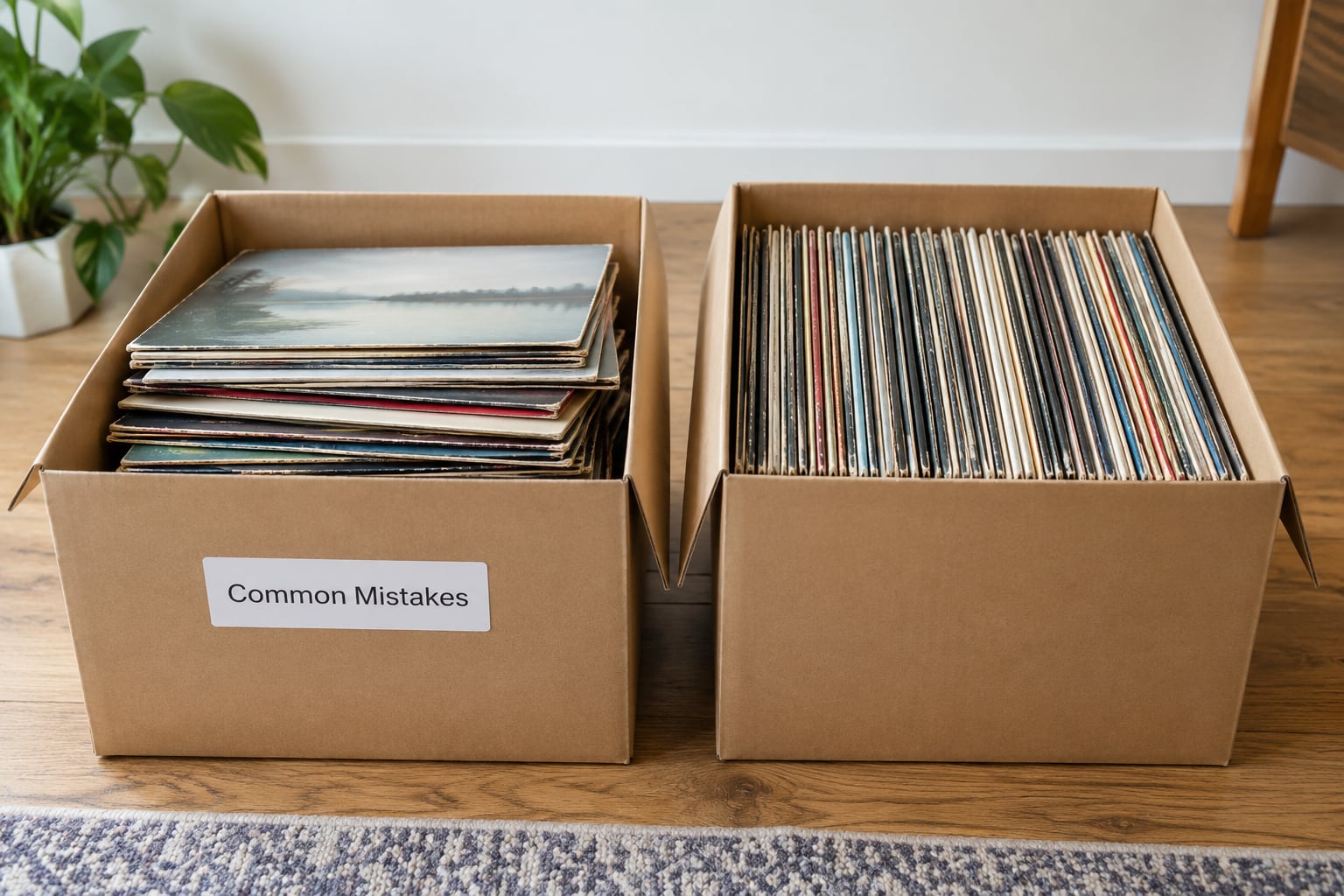
Almost every damaged collection I have unpacked came down to one of these:
- Packing records flat in the box. Put them upright. There is no version of this that works.
- Using a box that is too big. Records lean, gaps open, and the shift does the damage. A tight row in a small box beats a padded row in a large one.
- Forcing in two more albums. Packing tight is not packing crushed. If the row will not compress into the box snugly, it belongs in the next one.
- Leaving records in split jackets. A seam that has already opened will finish the job in transit.
- No dividers. One collapsed section then drags the entire row.
- Stacking more than two boxes high or loading them high in a truck. This is how the flat-packing habit starts, by the way, because stacked boxes squash the bottom row.
- Letting full-service movers handle them without instructions. Movers are good at their job, and a record box is not a book box to them. Carry the valuable ones yourself.
- No inventory list. Missing records are usually not missing, just lost in a box nobody remembers opening.
| What goes wrong | What you see | How packing prevents it |
|---|---|---|
| Heat in a truck or parked car | Warped, rippling discs | Climate-controlled storage, insulated totes, unpacking fast |
| Flat stacking or weight on top | Permanent bow, skips partway through a side | Upright packing, two-box stacking limit |
| Shifting in an oversized box | Split seams, knocked-off jacket corners | Small boxes, dividers, snug fill, shake test |
| Humidity or a damp basement | Mold bloom, wavy jackets, bowing cardboard | Dehumidifier, off the floor, climate-controlled unit |
| Sunlight through a window or open door | Faded artwork, faded sleeve printing | Boxes out of direct light, covered during loading |
| Dust and grit in the box | Surface noise on playback | Inner sleeves, jackets wiped before packing |
Packing a turntable, preamp, and the rest of the gear
Records are not the fragile part of a setup, oddly enough. The gear is. A turntable packed badly is far more likely to end a move than a shelf of LPs.
- Remove the platter and the dust cover, wrap each in a towel or foam, and pack them separately so nothing presses on the spindle.
- Lock the tonearm, remove the headshell if it is detachable, and tape the arm rest loosely in place. Never tape it down tight.
- Fill the plinth cavity with foam so the internals do not rattle, then pad the whole deck on all six sides.
- Use the original box if you still have it. Failing that, double-box: a snug inner box inside a larger padded box with two inches of cushioning all round.
- Carry the turntable in the cabin or with yourself rather than in the truck, and give it an hour at room temperature before you power it up so the parts acclimate.
Preamps, receivers and speakers follow the same logic: pad every face, fill the voids with foam or clothing so nothing moves, and label the cables separately in a bag taped to the unit.
Mailing records instead of putting them in a truck
Shipping your vinyl collection can beat a truck for small moves, and it is the only sane option when you are moving across the country without your shelves. For up to about 30 LPs, a rigid record mailer with a card stiffener on each side of the stack and corner protectors handles the journey well.
For anything heavier, double-box: an inner box packed upright with dividers, then an outer box with two inches of padding on every side. Fill inner voids with paper so nothing shifts when you shake it, and put your address and a return number inside the box as well as on the outside.
Choose a carrier that handles larger parcels without tossing them, insure anything genuinely valuable, and expect a few days in transit. Mailing avoids heat and stacking entirely, which is why some collectors with 100 to 200 records simply ship and never see a moving truck.
Short moves, long hauls, and storage in between
For a move within an hour or two, the car is the best transport. Keep the boxes in the cabin or an air-conditioned vehicle, out of the trunk if it gets hot, and drive straight home. Do not put records in a hot trunk for a two-hour errand and expect them to play flat afterwards.
For a cross-country truck move, expect the biggest risks to be stacking and heat. Two-person lifts, no more than two boxes high, a dehumidifier in any storage you use in between, and a quick unpack are the whole playbook.
If the move-out and move-in dates are weeks or months apart, choose climate-controlled storage over a standard unit. Cardboard and jackets absorb damp, and mold that starts in a storage unit is often discovered only after you have reshelved everything.
Frequently Asked Questions
What is the best box for moving vinyl records?
The small moving book box is the collector consensus, roughly 16 by 12 by 12 inches. It holds 25 to 35 full-size LPs, keeps the rows tight so nothing leans, and stays inside a weight two people can lift. Use a separate box for 7-inch singles, 10-inch records and 78s so every row is snug. Avoid one large box for the whole collection.
Should vinyl records be packed stacked or standing up?
Standing up, always. Pack them upright like books on a shelf, spine out, with sleeve openings facing up. Records laid flat or stacked under other records sit under sustained weight, and vinyl relaxes into a gentle curve that causes skips and can stay permanently warped. If records lean in the box, the box is too large.
How tight should I pack records for a move?
Snug, not tight. Press the row and feel the records push back, but a thumb should not slide down the jackets easily. Packing too loose lets rows lean and shift, which causes seam splits. Packing too tight bows jackets and crushes corners. Add a cardboard divider every 10 to 15 records so one soft spot does not travel.
What destroys vinyl records during a move?
Three things: pressure, heat and shifting. Flat stacking and heavy boxes on top flatten discs. A hot moving truck or parked car warps them in hours. Records leaning in an oversized box shift and tear jacket seams. Humidity in damp storage grows mold on jackets. Upright packing, small boxes, two-person lifts and fast unpacking prevent nearly all of it.
How much would 500 vinyl records weigh?
A full-size LP in its jacket weighs about 7 to 8 ounces. Five hundred of them comes to roughly 400 to 500 pounds packed, which fills about twelve to sixteen small book boxes at 25 to 35 records each. Seven-inch singles are much lighter, so a 500-record box of 45s weighs closer to 90 to 110 pounds. 78s are the heaviest per record.
What do I do if records arrive warped or damaged?
Stand warped records upright with space between them and let them relax flat under something light for a week or two, then test playback. If water got in, separate everything immediately, keep records from touching, and press paper towels against damp jackets. Records with a split seam usually survive fine once re-sleeved. Deeply cracked shells and mouldy jackets are usually beyond repair.
Conclusion
If you only remember five things, remember these. Sort your records and write down what is in each box before you seal anything. Give every record a clean inner sleeve, and pull out anything whose jacket seam has already split. Pack records upright in small boxes, snug but never forced, with a divider every 10 to 15. Label each box with a number that matches your inventory list. Then keep boxes off the floor, two high at most, and unpack them within days.
That is the whole of how to pack records for moving. None of it is expensive or complicated, and every piece of it exists to stop the same three failures: pressure, heat and movement.