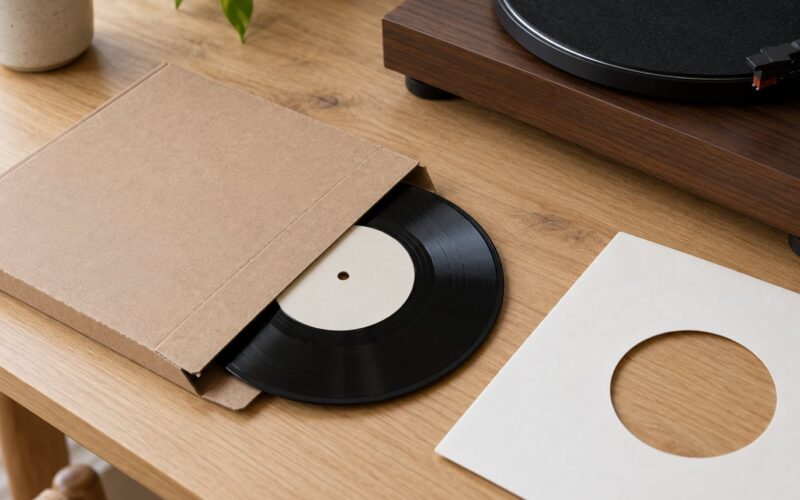
Read the dead wax first. How to date a vinyl record without a year on the label comes down to the runout groove between the centre label and the last track, where a matrix number is etched or stamped into the vinyl. Cross-reference that string and you usually land on the exact pressing, year and country included, in about twenty minutes at a table.
The printed year is the worst place to start. A copyright date on a sleeve belongs to the artwork, and represses reuse that artwork unchanged, so a 1978 pressing of a 1965 album still says 1965. Two different dates live on most modern records: the copyright year, written with a C in a circle, and the phonographic copyright year, written with a P in a circle. One describes the design, the other the sound recording, and neither tells you when this particular disc came off a press.
Before opening a database, spend sixty seconds on four clues.
- Runout groove. Turn the disc over, hold it at an angle to a window or lamp, and look for etched or raised marks between the label edge and the outer rim.
- Catalog number. Check the centre label, the sleeve spine, the back cover, any obi strip, and any sticker pasted over a barcode.
- Label design. Logo position and shape, rim text, the company address printed around the edge, the colour of the label stock.
- Sleeve construction. Tip-on, flipback, gatefold, or a plain sealed cardboard jacket.
Those four narrow the field fast and none of them cost anything. The job is not a difficult one, it is a patient one. Where beginners usually get stuck is lighting the runout properly and transcribing what they see without tidying it up.
Table of Contents
- What You Need to Date a Record With No Printed Year
- Step-by-Step: How to Date a Vinyl Record Without a Year on the Label
- 1. Identify the artist, album, and label
- 2. Find the catalog number, and know what it cannot tell you
- 3. Read the runout groove and decode the matrix number
- 4. Compare the label design, sleeve, and country marks
- 5. Search release histories and pressing databases
- 6. Separate the release year from the pressing year
- Common Dating Mistakes and How to Fix Them
- Frequently Asked Questions
- How do I tell what year my vinyl was pressed?
- How do I find the catalog number on a record?
- What does the number 33 mean on vinyl records?
- How can I tell a first pressing from a reissue with no year on the label?
- What do the letters in the runout mean, like S or PORKY?
- Why does my record say 1971 when it was a 1968 pressing?
- Conclusion
What You Need to Date a Record With No Printed Year
The list is short. You can date a record without every item here, but each one removes a guess rather than adding a step.
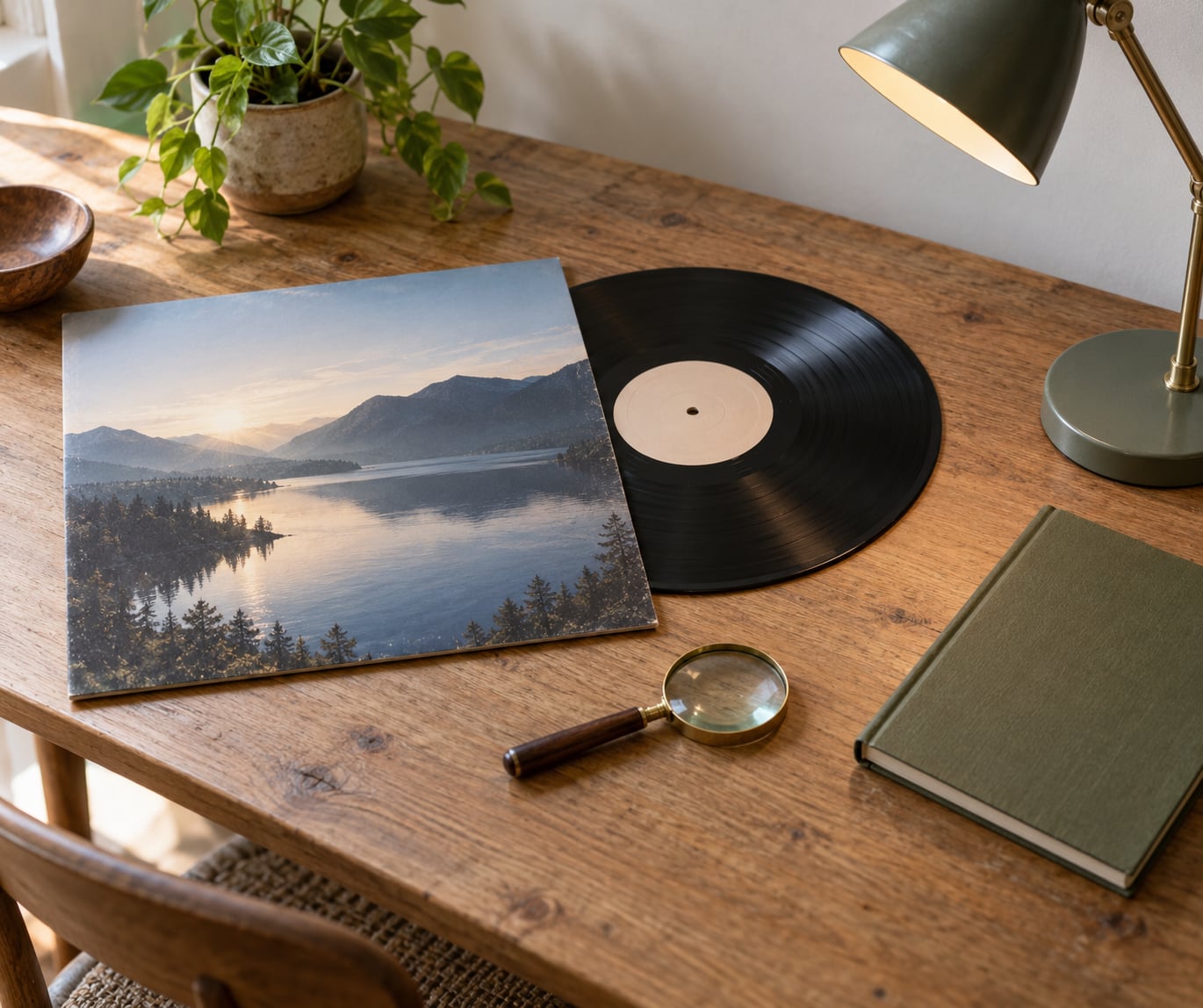
- A light source you can move. A desk lamp at a shallow angle across the record beats an overhead lamp, because the groove scatters light differently depending on where the light comes from. A window works well in daylight, and a phone flashlight held low along the surface does the job at night.
- A magnifier or loupe. Hand etching stands about a millimetre high. A cheap 10x loupe, or the little clip-on lens on a pair of reading glasses, is plenty. No microscope required.
- Cleaning supplies. A carbon brush and a fluid, or an ultrasonic cleaner. Dust and fingerprints in the dead wax are the single most common reason people conclude a record has no matrix number when it plainly does.
- Discogs, free to browse. A free account lets you run the exact runout string, which is the highest-leverage move in the whole process. The individual release page, not the master release page, carries the year and country.
- A notebook or your phone. You will write down several candidate years and change your mind at least once. Collectors who keep written notes end up with fewer arguments and better records.
- The sleeve and everything loose inside it. Obi strips, stickers, inserts and inner sleeves are all dating evidence, and all get binned by careless sellers.
A light, a loupe and a browser is a workable kit. That is genuinely all it takes.
Step-by-Step: How to Date a Vinyl Record Without a Year on the Label

Work in this order. Each step is cheaper than the one after it, and the early steps tell you what to search for later.
1. Identify the artist, album, and label
Start with the front and back cover, then move to the centre label. Even with no year anywhere on the record, you almost always have an artist, a title and a label name, and those three give you a search key instead of a guessing game.
While the sleeve is open, work out whether this is a studio album at all. Compilations, soundtracks and greatest-hits packages often carry a copyright date that belongs to a song rather than to a release, and the logo on the label may belong to a licensee or a subsidiary rather than the company that pressed the disc. Japanese and European issues in particular were licensed by a different company in nearly every territory, which is exactly why one catalog number turns up in so many countries.
Note both copyright lines if they are there. The P-in-a-circle year refers to the sound recording, the C-in-a-circle year to the artwork and liner notes. When the two differ, the P-in-a-circle year is usually closer to the sessions and the C-in-a-circle year closer to the packaging. Neither is a pressing date, and the gap between them can run to several years.
You should finish this step with a confirmed artist, title and label, plus a rough sense of which release versions plausibly exist.
2. Find the catalog number, and know what it cannot tell you
Look in five places, in this order: the centre label, the sleeve spine, the back cover near the bottom, an obi strip on Japanese releases, and any sticker covering a barcode on the disc or the sleeve.
The catalog number identifies a release within a label’s own numbering system. It does not date anything. Please Please Me is catalog PMC 1202, and that single number returns dozens of Discogs releases across the UK, the Netherlands, Greece, the Philippines, Yugoslavia, New Zealand, Singapore, Denmark and Sweden, covering several decades of pressing.
Treat it as a filter, not a verdict. Search it, shortlist the versions whose label colour and country of origin match yours, then move on to the runout. Copy the number exactly as printed too, punctuation included, because search engines treat T-1009 and T1009 as different strings.
3. Read the runout groove and decode the matrix number
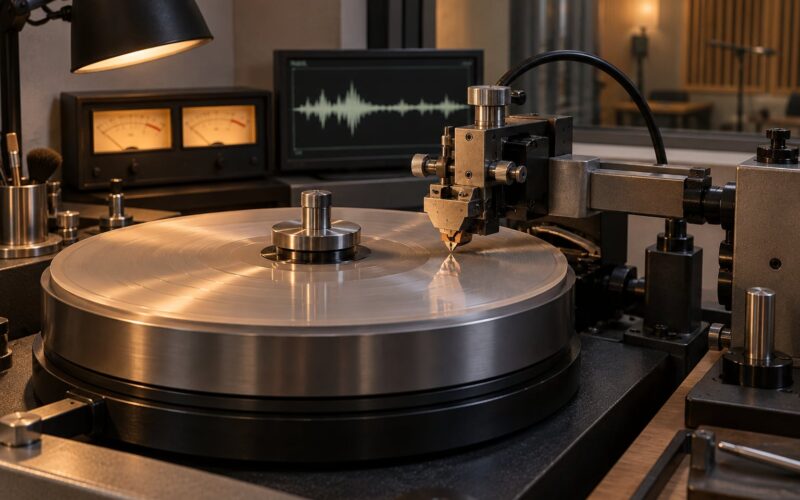
The dead wax is the smooth band between the edge of the label and the start of the last track. It carries the matrix number, the identifying string assigned when the master was lacquer-cut and the stamper pressed from it. Every plant adds its own prefix and suffix, which is why the same album reads differently in the runout from one pressing to the next.
To read it, lay the record flat and shine the light across it at a shallow angle, roughly level with the vinyl. Marks etched into the surface scatter the light and look like dark recessed lines. Marks pressed in from the other side catch the light and look bright and raised. Clean the disc first; a dirty runout reads as blank, and I have chased that particular dead end more than once.
Photograph it with the light still in the same position, straight down, with the label edge in the frame for context. Then transcribe what you see character by character, including asterisks, dashes and any hand-scratched additions. Do not clean it up. A tidy transcription is how people end up searching for a pressing that never existed.
| Segment | What it means | In this example |
|---|---|---|
| ST | Stereo cut; MO means mono | ST |
| A | Label or master prefix | A for Atlantic |
| 712285 | Master number, shared across that plant’s pressings | 712285 |
| -A | Lacquer cut, with -B usually marking the second cut | -A, the first cut |
| RL | Mastering engineer initials | RL, Robert Ludwig |
Etched versus stamped tells you something on its own. Hand etching, where a technician cuts the characters into the master one at a time, was normal for early runs and smaller orders. Machine stamping, pressed in from the stamper side, arrived at larger plants as volumes grew. Neither proves a first pressing by itself, but a hand-etched character in a plant that had switched to stamping is a genuine early-run signal.
Some plants encode a date in their own layout. A Sonopress runout reading 87541 B-4/78S III Made In Germany reads as a 1978 cut, because under that plant’s conventions the numbers before the S encode the cutting year. That is why collectors learn the big plants by name, since the convention only means something once you know whose plant it is: Columbia’s Terre Haute, Santa Maria and Pitman works, RCA Indianapolis, Capitol Scranton, Decca, Pye, Philips, Sonopress, and the CBS plants in Britain and Europe.
Trailing letters have their own meanings. A -A or -B usually marks the first or second lacquer cut, and indicators such as -1E, -1S or -G identify a plant or a specific pressing run at certain factories. Initials at the end are normally the mastering engineer, with RL for Robert Ludwig, KG for Kevin Gray and BG for Bernie Grundman being the three you will meet most. A nickname such as PORKY is a plant identifier passed around the trade, nothing worse than that.
4. Compare the label design, sleeve, and country marks
Label design dates a pressing by placing it inside an era rather than on a date. Watch the logo’s shape and position, the type of the rim text across the top of the label, and the company address printed around the bottom. Labels change their address when a company moves or switches plant, and those changes happen on a schedule other collectors have already mapped out.
Rights society codes pin the country of manufacture more reliably than the sleeve text does. A P-in-a-circle followed by a society code means the record was licensed through that society, which narrows where it was pressed.
| Code | Society and where it points |
|---|---|
| BIEM | Pan-European body, used across much of Western Europe |
| GEMA | Germany |
| STEMRA | Netherlands |
| NCB | United Kingdom, before PRS took over |
| SACEM | France |
| APRA | Australia and New Zealand |
| ASCAP | United States |
| PRS | United Kingdom, later period |
Other codes turn up less often, HFA being one of them, and those are worth searching directly rather than guessing at a country.
Sleeve construction is the other half of this step. Triple-flipback jackets were common through the late 1960s, bi-flipbacks followed, and by roughly 1973 the flipback had largely disappeared from UK and European releases. A tip-on jacket, where the front cover is glued to a card and will not open flat, points toward a 1950s or 1960s original rather than a modern repress. Gatefolds, obi strips and the presence of an inner sleeve with printed lyrics all narrow the window as well.
Here are the hard boundaries worth memorising, because they are the quickest sanity check available.
| Clue | Boundary | What it rules out |
|---|---|---|
| Label code with an LC prefix | Introduced by IFPI in 1977 | Any claim that the record predates 1977 |
| Barcode on a US LP | First appear in 1979 | US LP pressings after 1979 that have none |
| Barcode on a US 7-inch single | CBS begins adding them in 1983 | Claiming a CBS single is a 1980s copy without one |
| Flipback sleeve | Falls out of use around 1973 in the UK and Europe | A UK copy described as mid-1970s with a flipback jacket |
| First commercial LP | Released in 1962 | Anything claiming LP pressings before the format existed |
One more cheap check sits alongside these: a disc marked 33 and a fraction is running at 33 and a third rotations per minute, and the running time in minutes on the label is not a date. People misread both constantly.
5. Search release histories and pressing databases
Now open Discogs, search the artist and title, go to the master release page, and read the list of versions underneath it. Then run a second search on the full runout string, in the runout field, with the exact punctuation you transcribed. The version whose runout matches yours is your pressing, and the year on that version’s page is the year you are after.
For 7-inch singles, 45cat and MusicBrainz are worth checking alongside it, and label-specific discography sites remain the best source for Japanese and European issues. Two independent sources agreeing is worth considerably more than one confident page.
When dates conflict, work out why rather than splitting the difference. The usual causes are that the entry you matched is a different country’s issue, that somebody has edited the release page and conflated a reissue with the original, or that your runout belongs to a different album that shares a master number prefix. A runout sharing a master number but differing in its plant suffix is a different pressing, not a closer match. Discogs release pages are still being corrected in 2026, so check the notes and the edit history before you commit to a year.
6. Separate the release year from the pressing year
Three dates get tangled together here: when the album was released, when this disc was pressed, and when it was reissued. They can sit decades apart. Some reissues reuse the original sleeve and even the original catalog number, and some labels reactivate numbers first issued twenty years earlier, so a number alone cannot separate the two.
A runout containing an explicit date-like string, or a matrix number that a database ties to a specific mastering session, is your strongest evidence for the pressing. A sleeve copyright is evidence for the artwork. Write both down and label which is which.
Then record your confidence honestly. Most useful findings read something like this: no earlier than 1977 because of the LC label code, most likely late 1970s from the Sonopress cut, album released 1971, sleeve possibly a later replacement because the back-cover address postdates the first issue. That is more useful than one confident year and much harder to argue with later.
Store it while the disc is still out. A line in your collection log, a photo of the runout, and a link to the release page you matched. The runout photo is the one piece of evidence that gets lost permanently, because the next time the record is out of its sleeve somebody will have moved it.
Common Dating Mistakes and How to Fix Them
Assuming the latest known reissue is the copy in your hands. Search results are ordered by popularity, not by pressing date, and the most-documented version of an album is rarely the earliest. Open the version list and match the runout instead of trusting the top hit.
Reading a catalog number as a date. Numbers containing 62 or 74 mean nothing as years. The number is a location within a label’s catalogue, and the same one was reused across countries for decades.
Trusting the sleeve over the disc. Sleeves get replaced. Records get traded, stolen, pulled from radio libraries and paired with a nicer cover by careless sellers. When the sleeve copy and the runout disagree, believe the runout and note the sleeve as suspect.
Misreading stamped as etched. Bright raised characters are pressed in from the stamper side; dark recessed ones were cut into the master. A photograph taken with the light overhead makes every marking look the same, which is why the light angle matters more than the camera.
Reading a matrix number as a serial number. The number belongs to the master and the cut, not to your individual copy. Two records from the same runout are the same pressing, and neither one tells you which of the thousand copies you own.
Using vinyl colour as a date. Coloured and marbled vinyl was available in limited runs from the 1950s onward and reappeared in quantity from the 1980s and 1990s for the audiophile market. The colour narrows a reissue nicely and tells you very little about an original.
Judging a sleeve from wear alone. A crisp tip-on jacket means it is a good copy, not that it is an original. Condition and age are separate questions, and plenty of 1970s represses survive better than the first pressing they replaced.
One habit covers most of the above: take clear, well-lit photographs of the label, the runout, the spine, the back cover and any obi before you do anything else. Bad photographs cause more failed identifications than any missing clue does.
Frequently Asked Questions
How do I tell what year my vinyl was pressed?
Read the runout groove, then confirm it against a database. Hold the disc at an angle to a lamp and look for etched or stamped marks between the label and the last track. That matrix number identifies a specific pressing, and searching it returns a release page carrying a year and country. Label design, rights society codes and sleeve construction narrow the range first, but the runout settles it. Record the result as a likely pressing year, not a certainty.
How do I find the catalog number on a record?
Check five places: the centre label, the sleeve spine, the back cover near the bottom, an obi strip on Japanese issues, and any sticker covering a barcode. The catalog number tells you a label’s own numbering for that release and nothing about its year. The same number can appear in dozens of countries across several decades, so use it to shortlist versions and then confirm with the runout.
What does the number 33 mean on vinyl records?
It is the speed: 33 and a third rotations per minute, printed as 33 1/3. Full-size LPs run at that speed, which is where the long playing name comes from. Numbers elsewhere on the label are usually running time in minutes or an LP size marking, and prefixes such as ST or MO in the runout indicate a stereo or mono cut. None of them are dates.
How can I tell a first pressing from a reissue with no year on the label?
Almost never from one clue. A first pressing usually pairs an early runout with original sleeve construction such as a tip-on or flipback jacket, a period-correct label design, and inserts that later issues dropped. A reissue often brings a barcode, a modern sleeve with a company address that postdates the album, and a runout matching a later version in the database. Where sleeve and runout disagree, trust the runout.
What do the letters in the runout mean, like S or PORKY?
Each plant stamps its own prefix and suffix onto the master, so the same album reads differently plant by plant. Letters at the end often identify the plant or its pressing run, initials such as RL, KG or BG are usually the mastering engineer, and nicknames like PORKY are plant codes passed around the trade. A number that looks like a date, such as a slash-separated 4/78, means something only under that plant’s own layout.
Why does my record say 1971 when it was a 1968 pressing?
Because the year on a sleeve is a copyright date for the artwork or the recording, and represses reuse the original printing unchanged. A record pressed in the 1970s or 1980s from a 1968 album usually still says 1968, or the year the sessions happened. Report the two separately: release year 1968, pressing year whatever the runout evidence supports, and note the gap in your collection log.
Conclusion
Start with the four free clues and nothing else: identify the artist, title and label, find the catalog number, look at the runout groove under a low lamp, and check the sleeve construction. Those take five minutes and tell you what to search for.
Then read the matrix string, note the label design, rights society code and any LC prefix, and search the full runout in a pressing database. Combine the physical evidence with the release entry and you will have a date range that holds up, usually to a year or two.
And write the range down rather than a single confident guess, with the clues that support it attached. If a collector app or a cover photo gets you to a candidate release in seconds, use it as a shortcut, then confirm the pressing with the runout before you trust it. A stated range is honest, checkable, and useful six months from now. A confident wrong year is none of those things.