Most records sell for about a dollar each at a yard sale, and fifty cents when nobody wants to dig through the crate. Two to five dollars is realistic for the small number of titles collectors actively seek, and almost nothing belongs in the ten-dollar bin unless you have already checked the sold prices yourself. Here is the honest version of how to price records for a yard sale, including the parts most guides skip: the grading, the labour math, and when to stop sorting entirely.
That gap between a record’s listed value and what a folding table actually produces is where most sellers get burned. Online figures and scanner apps track near-mint copies moving at auction, not a dusty sleeve on a Saturday morning in someone’s driveway.
Some context before the method. A record store will typically offer roughly a quarter of what a title eventually resells for, and that is the reference point to keep in your head. If a dealer would give you two dollars for it, marking it eight on your garage table is not a strategy, it is hope.
Table of Contents
- What You Need
- How to Price Records for a Yard Sale Checklist
- Step-by-Step
- Step 1: Identify the Record
- Step 2: Grade the Condition
- Step 3: Check Recent Sales
- Step 4: Set a Yard-Sale Price
- Step 5: Organize and Display the Records
- Common Mistakes
- Frequently Asked Questions
- How much to sell records for at a garage sale?
- How do I price a whole crate of records without checking each one?
- Should I sell my records at a yard sale or trade them in?
- What should I keep instead of selling at a yard sale?
- Are first pressings worth more at a garage sale?
- Is there a free app to check what my vinyl records are worth?
What You Need
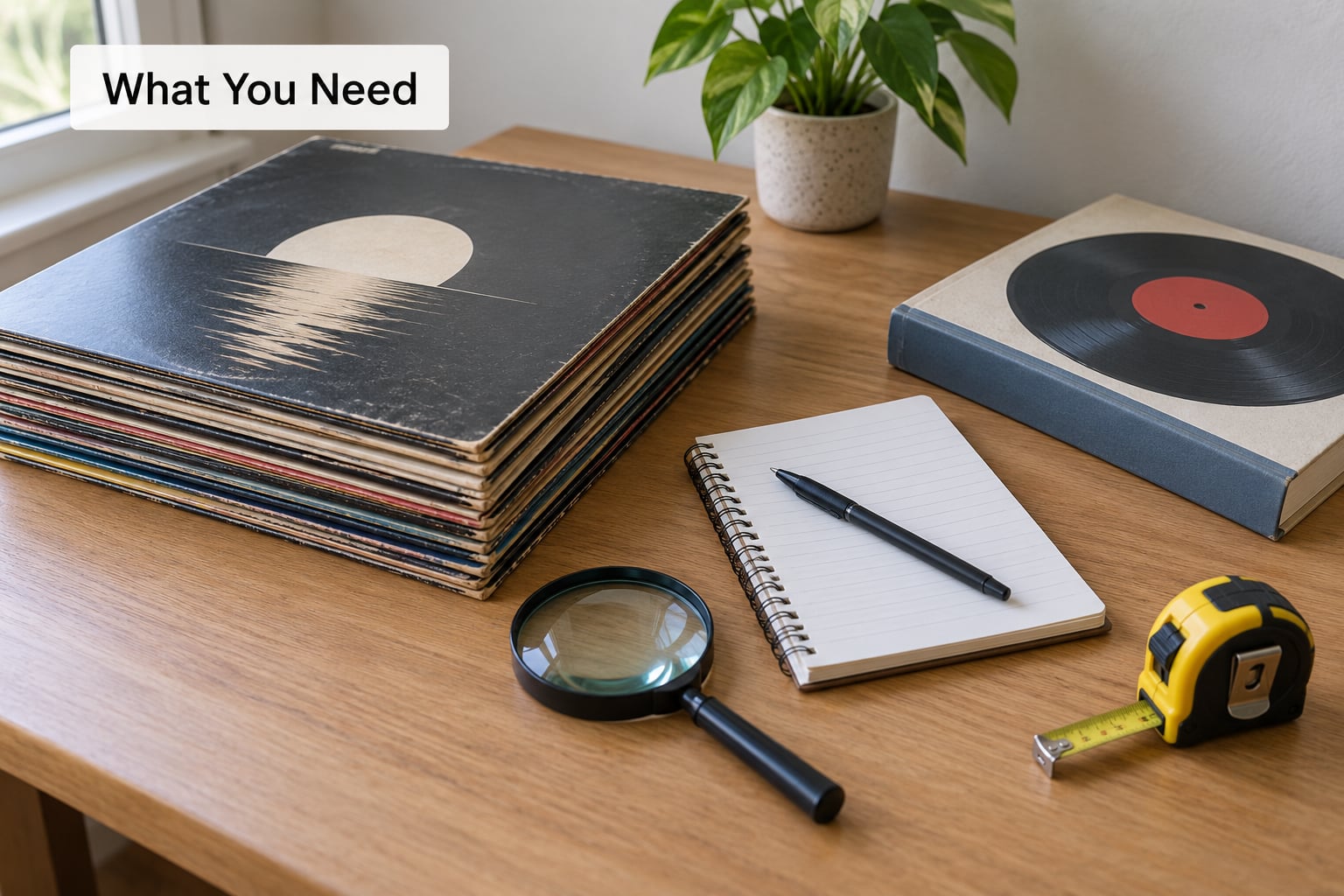
You do not need much. The tools that actually change your results are a way to look up recent sold prices, a way to grade what you have, and somewhere to write numbers down fast. Everything else is furniture.
- Crates or sturdy cardboard boxes. Records that live loose in a cardboard box sit warped by the afternoon, and a warped record is a record nobody wants. One crate per price tier is better than one big pile.
- Outer plastic sleeves and a roll of tape. Loose sleeves crease, and creased sleeves make a VG+ record look like a G.
- A marker or stickers for pricing, and a notebook to track what sold as the day goes.
- A Discogs account. Free, and the Sales History on a release page is the single most useful reference for pricing. Its collection feature also handles bulk.
- Popsike and eBay sold listings as cross-checks, since one database’s median is not the whole market.
- A Goldmine grading glossary, printed or on screen. You only need the eight bands and what each one looks like.
- A soft brush and a clean, flat surface for inspecting vinyl before you mark it.
One more thing, and it is not a tool. Pull a keep-box before you price anything. Anything you would miss, anything a family member would ask about, anything you want to look at on a Sunday afternoon goes in the box and off the table. Regret is a cost that never shows up in the dollar figures.
How to Price Records for a Yard Sale Checklist
Run every record through these seven questions before it gets a sticker. If you cannot answer the first three in about fifteen seconds, that record is a dollar record and nothing more.
- Do I know the artist and album title with certainty?
- Can I find a catalog number on the sleeve, label or inner ring?
- Is this a common pressing or something unusual, and how do I know?
- What condition is the vinyl in, on its own, separate from the sleeve?
- What condition is the sleeve in, separate from the vinyl?
- Do recent sold prices for this release sit above twenty dollars, or well below?
- Do I actually want to part with it?
Step-by-Step
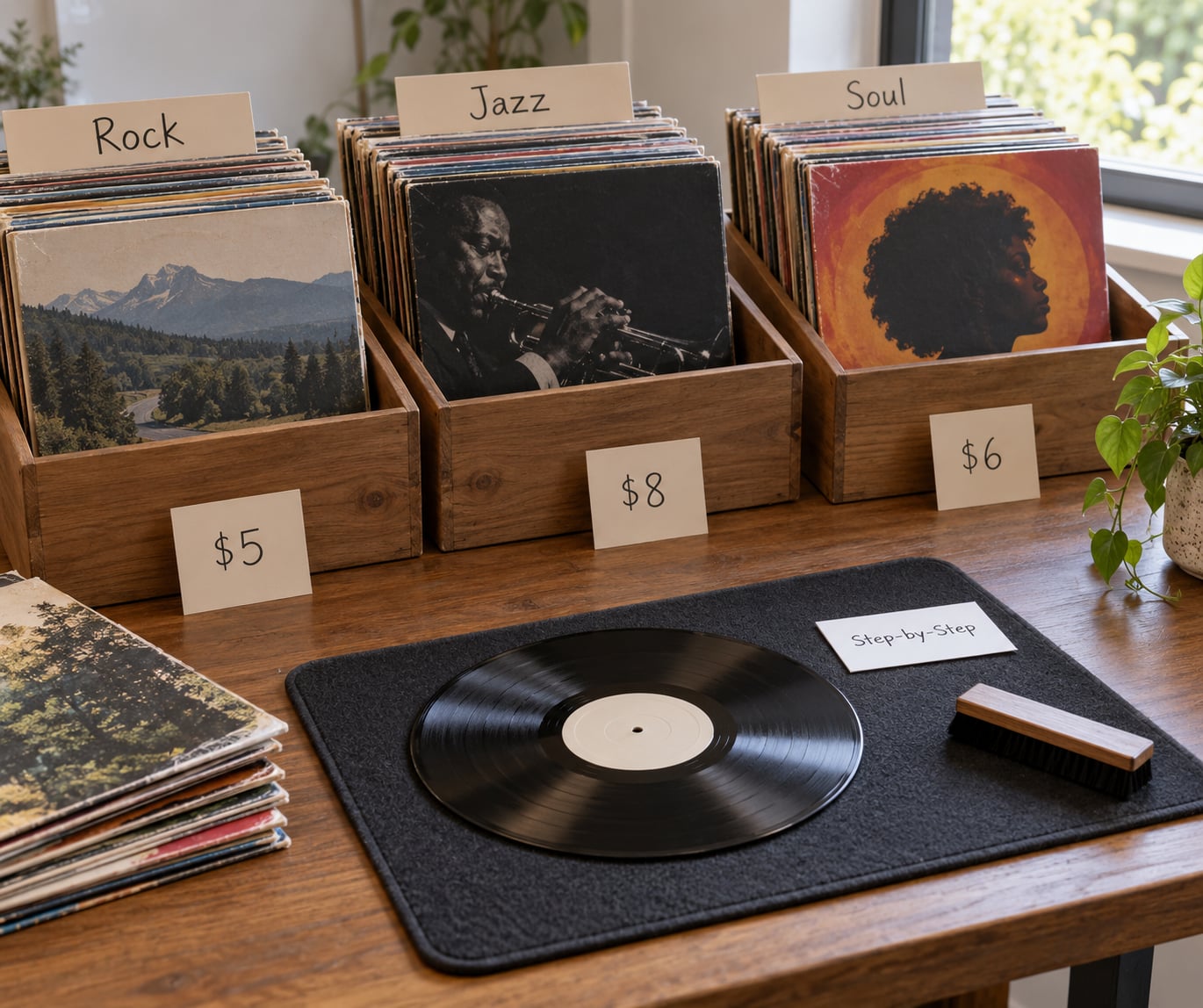
Work in this order and you will finish a crate of two hundred records in an evening instead of a fortnight. The order matters because the cheap decisions come first and the expensive ones come last.
Step 1: Identify the Record
Identification tells you which market you are pricing into. The same album exists as a common reissue and as a first pressing with a completely different buyer pool, and only one of them is worth your time at a garage sale.
Read the label first, then the sleeve. The catalog number printed on the label or the inner-ring etch is the fastest way to pin down a specific release, and the runout etching in the groove near the label often names the pressing plant or carries a first-pressing mark. A small triangle or the words first pressing in the runout area are a real signal, not folklore.
Then check mono or stereo, country of pressing, and whether a Japanese pressing has its obi strip still attached. None of that matters much at a yard sale, and all of it matters a great deal if you later list the record online. Note the details for anything that looks unusual and move on.
One warning from the collector side of the hobby: age is a weak signal. A record from 1972 is not automatically worth more than one from 1987. Popularity, scarcity and condition do the work, which is why a forgotten album by a working band can beat a famous record in an overplayed pressing.
Step 2: Grade the Condition
Condition moves the price more than any other factor you control, and the sleeve and the vinyl are graded separately. A pristine record in a torn jacket is a damaged record, and buyers know it.
| Goldmine grade | What you are looking at | Effect on the yard-sale price |
|---|---|---|
| Mint or Near Mint | Unopened, no marks worth mentioning, plays clean | Top of whatever tier the record sits in, and worth listing online instead |
| Very Good Plus | Light spindle marks, sleeve clean with faint ring wear, plays without much noise | Full asking price for its tier |
| Very Good | Noticeable marks, audible surface noise between tracks, creased corners | Drop it one price step, usually a dollar |
| Good Plus | Heavy wear, colour noise in the quiet parts, seam splits, writing on the sleeve | Filler territory. Fifty cents, or put it in the bulk crate |
| Good or lower | Warp that does not lie flat, splits at the runout, water marks, mould | Do not sell it as a record. Give it away or recycle it |
Play a few seconds of every side on a decent system. A record that crackles constantly, hitches or wobbles is worth very little to a serious buyer, and a serious buyer is the only one who pays more than a dollar. Warped records are the single most common reason a good record leaves your table for nothing.
Buyers reject worn copies without hesitation. Collectors routinely pass on titles in the Very Good band, which is exactly why an honest grade matters: you would rather a buyer inspect and accept than negotiate and walk away.
Step 3: Check Recent Sales
Check sold prices, never asking prices. The median on a Discogs sales history is the useful figure, because the highest sold price on any release is usually a single copy in near-mint condition that will never resemble what is in your crate.
Three lookups cover it. Open the release on Discogs and read the sales history, including how many copies sold and how long ago. Cross-check Popsike for completed sales in the same condition band. Then filter eBay listings to sold only, because active listings tell you what sellers hope for, not what buyers paid.
Real yard sale outcomes cluster far below those medians, and collectors say so openly. One buyer on a record forum describes roughly seventy percent of their collection coming from yard sales and thrift stores at a dollar each. Another posted a haul of twenty-three albums from the seventies and eighties for forty dollars, about a dollar seventy-five per album. A third thread shows a seller moving records at a dollar each, then a dollar raise only for one cult favourite.
Use those numbers as your anchor. If a release’s median sits under five dollars, marking it over two at a garage table is a bad bet, because the buyers who would pay more are the ones shopping online where shipping is included.
Step 4: Set a Yard-Sale Price
Set a flat asking price per tier and stop. Buyers at a yard sale want an easy decision, and a table covered in nine different prices asks them to do research you should have done. Working out how to price records for a yard sale comes down to two numbers per crate: the trade-in figure and the tier it earns.
| Tier | What belongs here | Asking price |
|---|---|---|
| Bulk crate | Unsorted common pop, easy listening, novelty singles, soundtrack and compilation filler with no following | Fifty cents to a dollar each, or a flat price for the whole crate |
| Common rock and pop | Albums a collector recognises but would not drive across town for | One to two dollars |
| Wanted artist or genre | Records collectors actively flip, usually punk, prog, soul, disco or 1980s new wave | Two to three dollars |
| Collectible pressing | First pressings, mono copies, promos, coloured vinyl, picture sleeves, low matrix numbers | Five to ten dollars, and pull them off the table entirely |
| Verified grail | Anything you have confirmed sells above fifty dollars in the collector market | Do not sell it here. List it properly or trade it in |
Count backwards from the trade-in figure. If a shop would give you two dollars, a fair table price is one dollar and buyers will happily take it. If the trade-in is nothing, the record is a dollar record no matter what a guide says.
If your market is the UK rather than the US, the same bands apply in pounds, and a pound converts to a little over a dollar, so the relative position of each tier barely moves. What changes is who turns up at a car boot sale, which tends to be a little younger and often more curious about the dance and electronic end of a collection.
Step 5: Organize and Display the Records
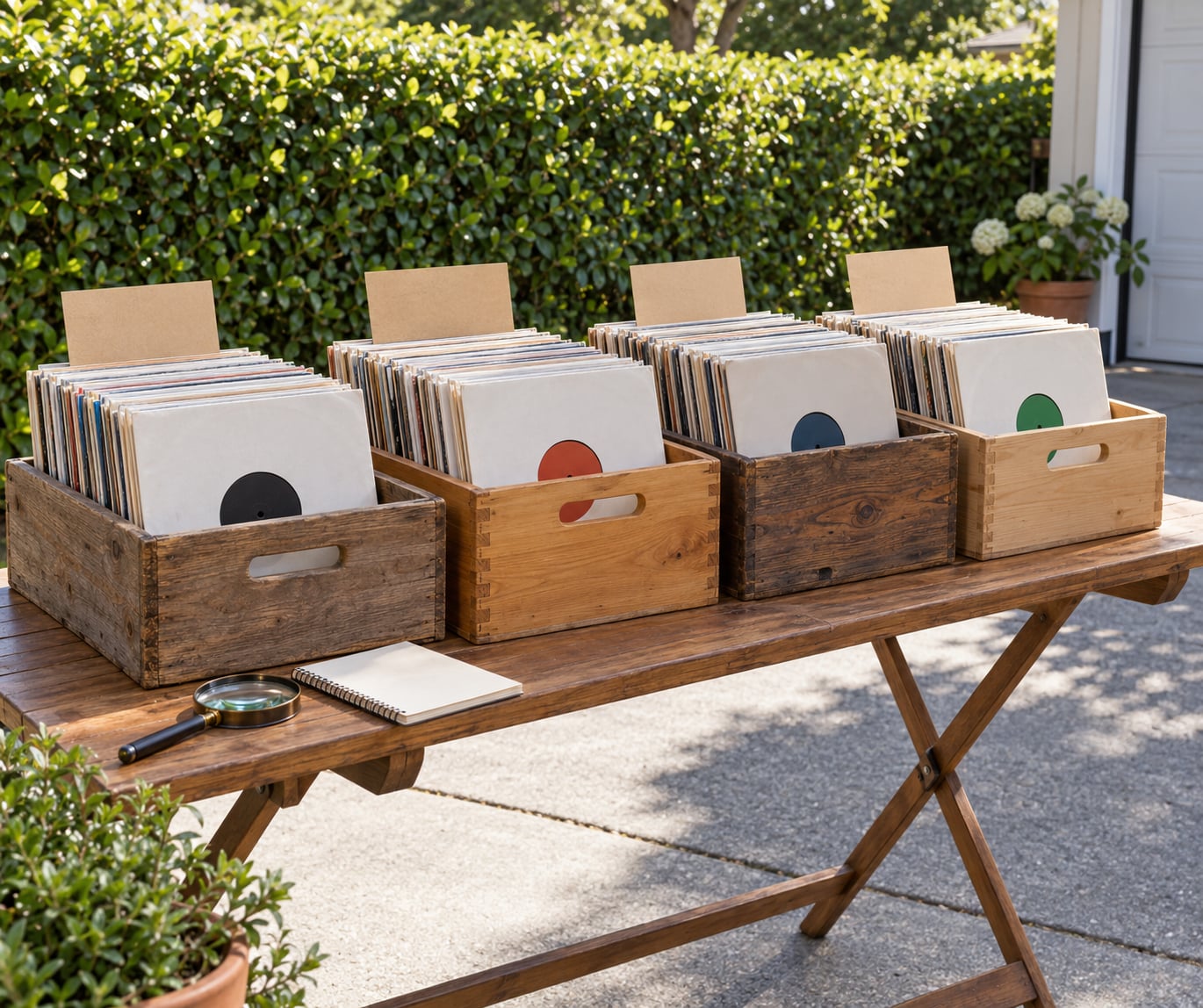
Presentation is worth more than most sellers expect. A crate that is sorted into obvious groups, with a price written on each one, moves faster than a pile of unmarked records, and it tells buyers you know what you have.
Sort into price bins first and genre second, because the price is what a stranger is scanning for. Put a label on the front of every crate. Mark damaged records plainly with a sticker saying heavy wear rather than hoping nobody notices, since a disappointed buyer will lowball everything else on the table.
Two more practical points. If you have a record mounted in a frame, leave it framed; framed records travel badly and arrive broken, and the frame is usually worth more than the record anyway. And do not plan on the last hour of the sale to move anything, because it will not.
On negotiation, decide your floor before the sale starts and do not move it while you are standing behind the table. Buyers at a yard sale open low by habit, and a flat response works better than a counter-offer. If nobody has bought from a crate in the first hour, cut the price once rather than doing it repeatedly in front of a crowd.
Some collections clear faster in bulk than they would one at a time. If you have more than two hundred records, a lot price often beats sorting, simply because the labour is the scarce resource. One honest rule: if checking a record would take more than a couple of minutes, it is almost certainly not clearing twenty dollars, so fire it at a dollar and spend the time on the crate that might sell.
Common Mistakes
Almost every disappointing record table traces back to one of a handful of mistakes, and each has a simple fix.
Pricing from active listings instead of sold ones. Asking prices are optimism. Filter every marketplace to completed sales, and use the median rather than the top result.
Treating age as value. A dated-looking sleeve in 1970s style means nothing. Popularity, scarcity and condition decide the number.
Ignoring condition. A warped or noisy copy of a common record is worth a fraction of a clean one, and the gap is wider than most sellers expect.
Treating every vintage record as rare. Most of a typical inherited crate is common pressings, reissues and compilations. If the catalogue number shows a reissue, price it like one.
Using one price for the whole table. A single price punishes you on the titles worth more and wrecks you on the ones worth less. Bins solve this for free.
Failing to identify the edition. A first pressing and a later reissue of the same album are different products. Two minutes with the runout groove is the cheapest research you will ever do.
Negotiating with no floor. Pick your number before the tables go up. A seller without a floor ends at half price and talks herself into it.
Selling what you would keep. Pull the keep-box first. The records you would have kept are the ones that leave a bad feeling behind, even if they sell.
And the last one, the big one. Do not quote a whole collection total at a garage sale. The number of records times a list price means nothing, and collectors who have seen it done are actively suspicious of sellers who work it out loud.
Frequently Asked Questions
How much to sell records for at a garage sale?
Most records sell for about a dollar each at a yard sale, with fifty cents being realistic for an unsorted bulk crate of common pop, easy listening and compilations. Two to three dollars fits titles by artists collectors actively seek, and four to five is defensible for something you have already verified sells for twenty or more in the collector market. Most of a typical crate is worth a dollar or less at the table.
How do I price a whole crate of records without checking each one?
Price the crate flat and let the buyer sort, which is how most bulk lots move. If you insist on sorting, use the checklist first: known artist, catalog number found, condition checked for warp and noise. Anything you cannot identify in fifteen seconds gets fifty cents, and you move on. The time you save is better spent on the small group of records that clear twenty dollars.
Should I sell my records at a yard sale or trade them in?
If your goal is speed and clearing the shelf this weekend, the yard sale wins. If your goal is the most money for the least time, trade in, because a record store will typically offer about a quarter of the resale price and takes the whole crate in one visit. Yard sale prices depend on who wanders through, so treat any proceeds above trade-in value as a good surprise rather than a plan.
What should I keep instead of selling at a yard sale?
Keep anything with sentimental value, anything a family member would ask about, and anything you verified recently sells for a figure that would bother you. Keep your first pressings, promos and coloured vinyl, even unplayed, because they are the easiest records to list online later. Keep anything in better condition than your other copy, and keep one record per artist for sentimental reasons.
Are first pressings worth more at a garage sale?
Only rarely, and not for the reason people expect. A first pressing does not command a premium from a casual yard sale buyer, because they cannot tell and will not check the runout. Where it matters is online, where buyers do check and will pay properly. The sensible move is to pull first pressings and unusual variants out of the crate, verify the sold prices, and keep them for a proper listing.
Is there a free app to check what my vinyl records are worth?
Discogs is the closest thing to a free reference: look up a release, read the sales history and the median, then use its collection feature to value a whole crate at once. Popsike and eBay sold listings are useful cross-checks, and scanner apps read a barcode or cover photo in seconds. All of them report collector-market figures, which run several times higher than what a driveway table will produce, so use them for ranking, not for pricing.
Start tonight, not on the morning of the sale. Pull a keep-box, spread the rest out by price, and put a dollar sticker on everything you could not identify in fifteen seconds. Then spend your limited time checking the twenty or so records whose recent sold prices say they might be worth more than that.
Everything else is a dollar record, and treating it like one gets the table cleared in a morning instead of dragging home three unsold crates.