If you want to know how to flatten a bent album cover, the short answer is simple: take the record out, sandwich the sleeve between two flat sheets of clean paper or parchment, and leave slow, even weight sitting on top for several days. Slight warmth helps stubborn board; strong heat, soaking and clamps are what ruin sleeves.
It is a job you can do on a kitchen table with things you already own, and the messy version takes ten minutes. The patient version takes three to seven days, which is annoying but is the entire trick. Paper has fibre memory: a bend sets because moisture and stress let the fibres slip and then hold the new shape. Pressure does not overpower that memory, it gives the fibres time to move back.
Why bother? A bent sleeve does not harm the record. It does block the sleeve from closing flush, sticks out of the rack, dents the value of a graded copy, and tells any buyer the album was stored badly. For a limited pressing you cannot replace, that last point is the reason to bother at all.
Table of Contents
- What You Need
- Step-by-Step: How to Flatten a Bent Album Cover
- 1. Remove the Record and Check the Sleeve
- 2. Gently Loosen a Curled or Stuck Sleeve
- 3. Place the Cover Under Even Weight
- 4. Flatten and Dry the Cover
- 5. Reinsert the Vinyl and Store It Flat
- Common Mistakes
- Frequently Asked Questions
- Can a bent album cover be repaired permanently?
- How long should I leave a bent album cover under weight?
- Are heavy books safe for flattening a record sleeve?
- Can I use an iron, hair dryer or steamer on an album cover?
- What do I do about mould, tears or a delaminated cover?
- Will a bent album cover hurt the record inside?
- Conclusion
What You Need
You need a flat, clean working surface and something to press with. That is genuinely the whole list, with one rule that matters more than any tool: the cover must never touch the weight directly.
- A flat table. Glass, a countertop or a sheet of MDF on the floor. A bed is too soft and a lap is not flat.
- Clean books or a DIY clamp rig. Heavy hardbacks work. The rig collectors actually use is two 13-inch ceramic or marble floor tiles with spring-loaded carpenter’s clamps, the method that gets repeated on Audiokarma.
- Cheap substitutes if you have no tiles: a thick cutting board, two acrylic or perspex sheets, or a sheet of glass. What matters is two surfaces, perfectly flat, roughly the size of an LP jacket.
- Two barrier sheets. Parchment paper or baking paper is the standard. Plain printer paper works in a pinch; newspaper is a bad idea because ink transfers onto gloss.
- A bone folder or the back of a spoon. For burnishing a crease after it loosens, not for forcing it.
- Optional: a cardboard shim the exact thickness of the jacket, so heavy clamping does not over-compress the board.
Prepare the surface first. Wipe the table, wash your hands, and lay out your barrier sheets before the cover comes off the record. Once you have the sleeve in your hands with one hand free, you will want the rest of the setup already done.
Step-by-Step: How to Flatten a Bent Album Cover
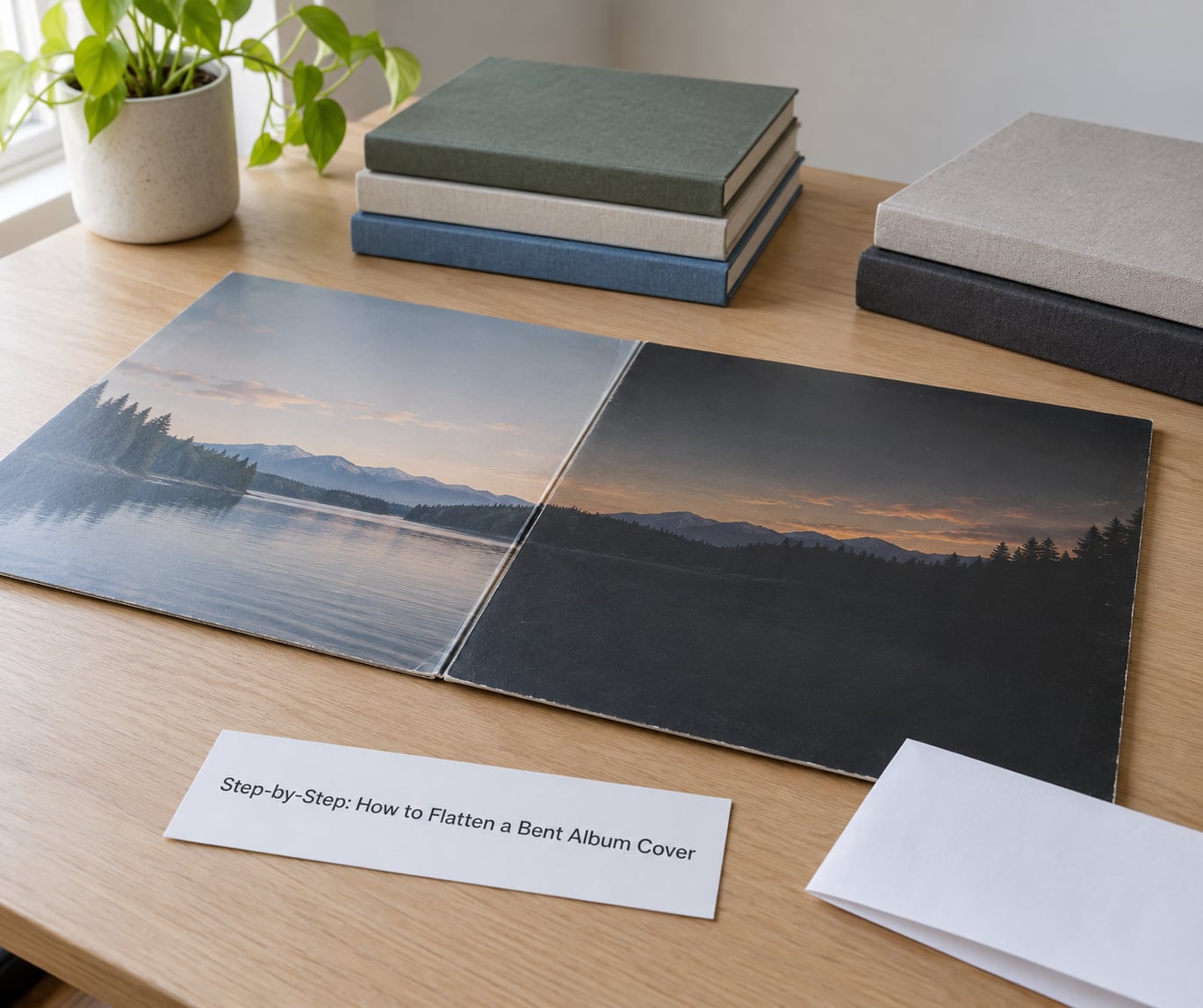
1. Remove the Record and Check the Sleeve
Slide the record out first. Every time. This is the step people skip and it is the step that leaves permanent damage: a clamped record presses a ring-shaped impression into the cardboard that never comes out.
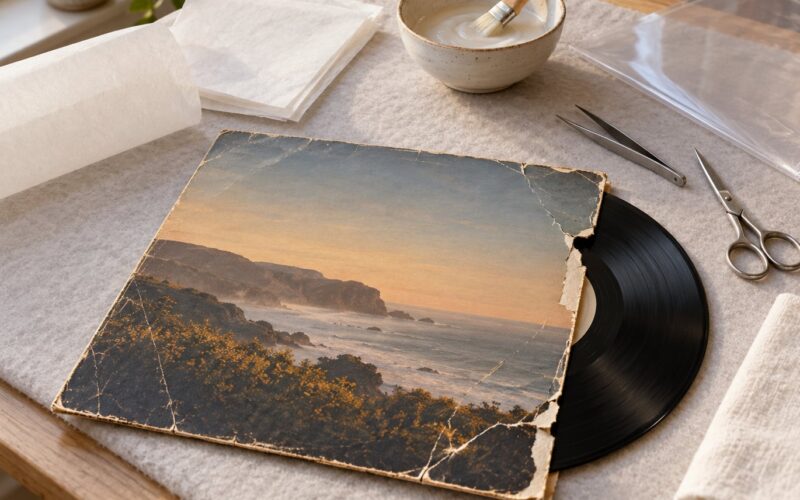
Then look at the sleeve properly, on the table, under good light. You are looking for four things: splits along a glued seam, mould or a musty smell, laminate or gloss lifting away from the board at a corner, and hard creases with a visible white line where the fibres have broken.
If you find any of those, stop pressing. Peeling laminate means the face of the cover will transfer to whatever it touches, so the barrier sheet must sit between the artwork and the paper you press with, not just between the paper and the weight. Torn seams and mould are conservator work, and the FAQ below covers why.
2. Gently Loosen a Curled or Stuck Sleeve
A sleeve that has curled shut will fight you. Start at a free edge, the opening edge or an outer corner, and work your fingernail or a plastic card under the fold. Go slowly along the fold rather than prying one point.
Never pull against a glued seam. That is where jackets tear, and the tear will always be worse than the bend was. If the sleeve is stuck to the record with a bit of shrink wrap or a glued inner, separate them along the edge with a gentle twist, the way you would open a book glued shut, and expect a few small paper fibres to give.
Once it lies open and roughly flat on its own, move on. Curling that needs real force will relax under weight instead, over days.
3. Place the Cover Under Even Weight
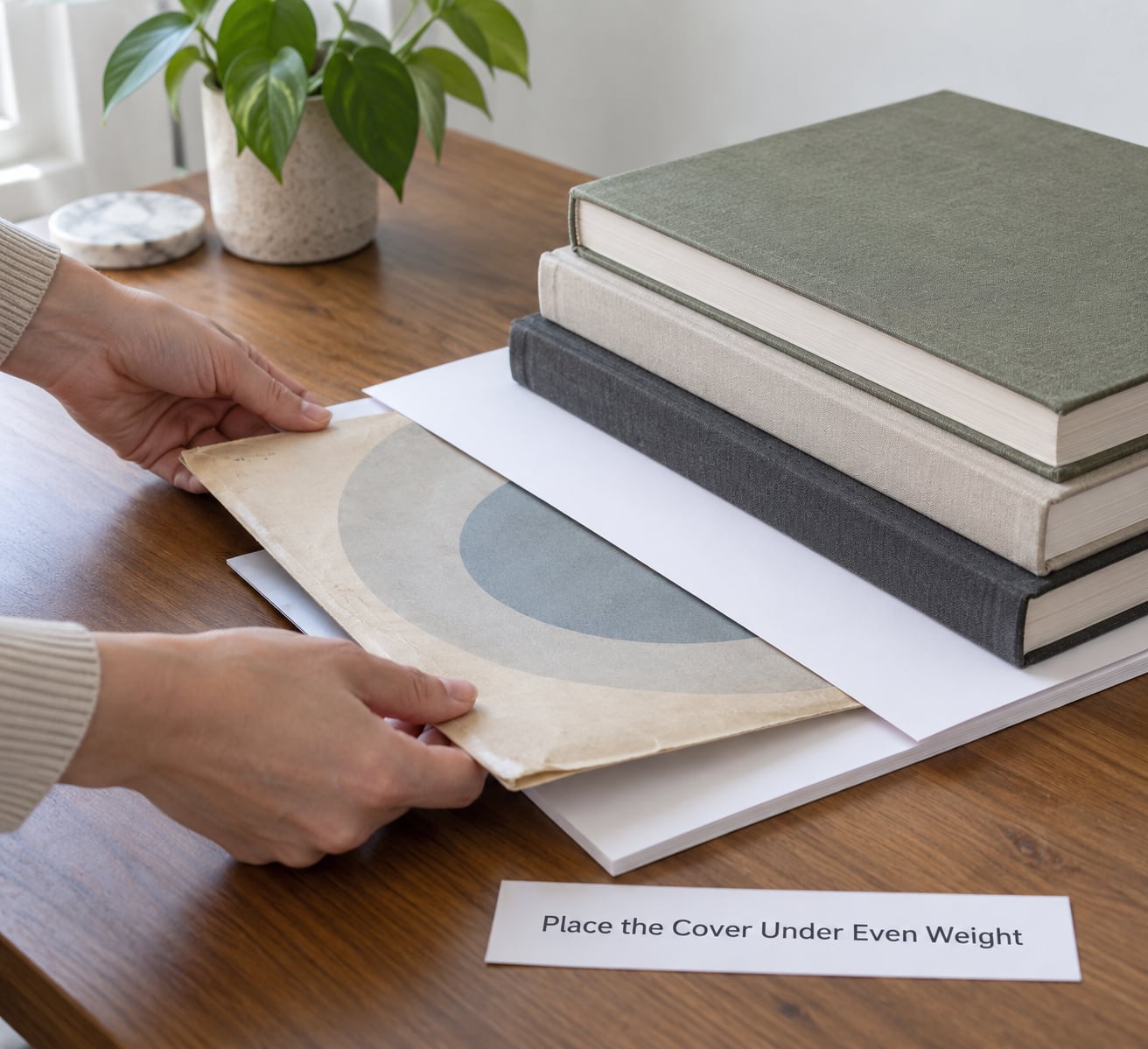
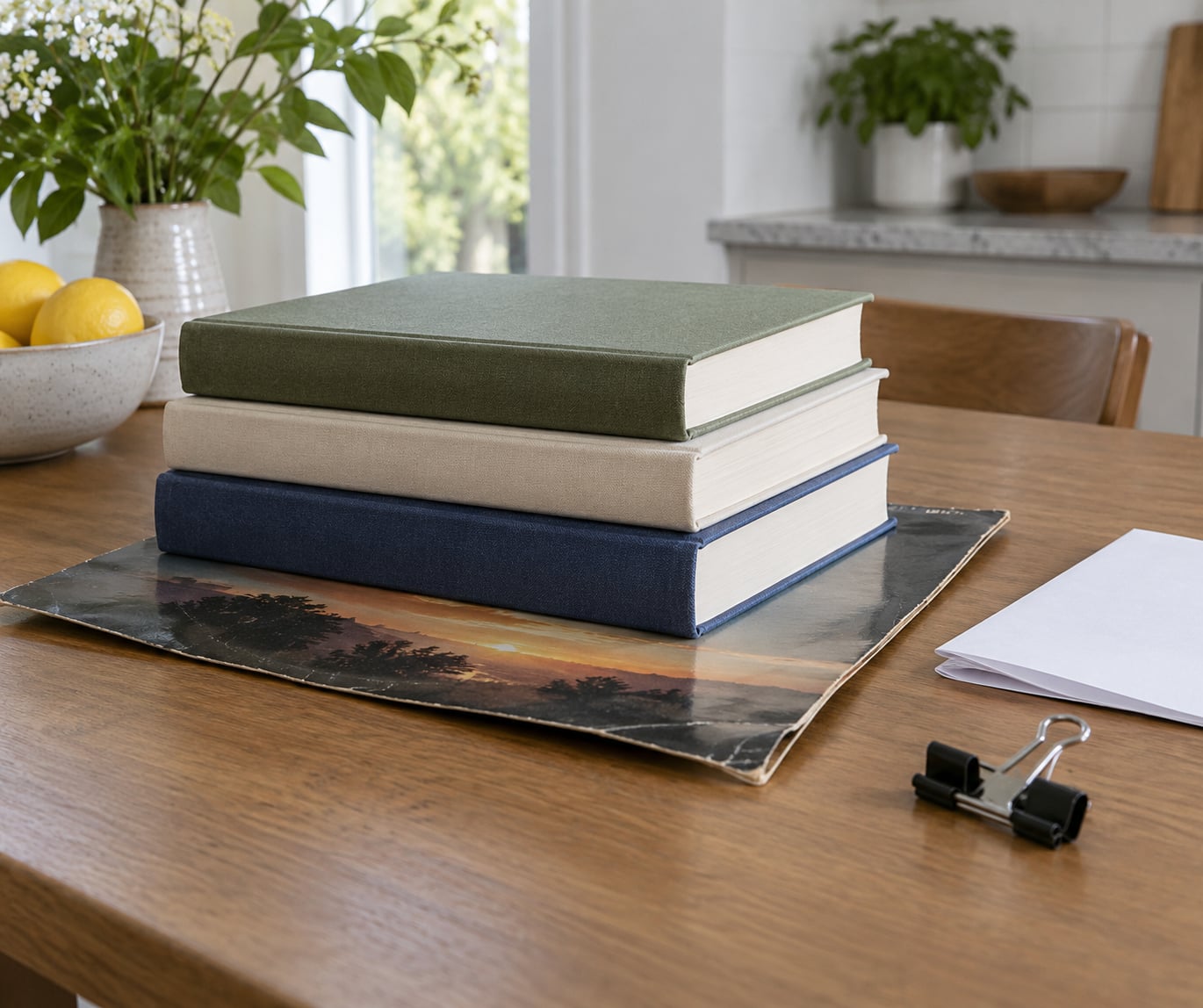
Lay one barrier sheet on the table. Put the sleeve on it, artwork side up, and put the second barrier sheet on top. Then the weight, distributed as evenly as you can manage.
Even is the whole game. A stack of books in the middle of the sleeve gives you two flat spots and a bend that never leaves. Spread the books across the full 12-inch square, or use the tile-and-clamp rig, where two clamps squeeze the plates together and the pressure comes from the frame rather than from one point.
Pressure should be firm, not brutal. A tight clamp that dimples the board is overkill; a few hardbacks resting evenly is plenty for most damage. If the sleeve has a thick card insert or the record fits inside, put the cardboard shim between the jacket and the paper so the pressure matches the jacket thickness rather than crushing it thinner than it should be.
4. Flatten and Dry the Cover
Now you wait, and how long depends on how bad the bend is. Sources contradict each other on this, hours against weeks, so here is the range that actually makes sense.
| Damage | Time under weight | Realistic result |
|---|---|---|
| Slight bow or one soft bend | 24 to 48 hours | Usually flattens fully |
| Sharp crease or a lifted corner | 3 to 7 days | Flattens, crease stays faintly visible |
| Gatefold curl or a hard fold | 7 to 14 days | Mostly flat, may need a shim when shelved |
| Heavy board crushed or creased through | 2 weeks or more | Partial recovery only, fibres are broken |
Check every day or two. Lift the weight at one edge, look at the surface, and put it back if the sleeve is still bowed. Pulling the cover out early to see how it is going is exactly how sleeves re-bend, so peek, do not remove.
Dry is the important word. If the sleeve is damp from damp storage or a leak, do not press it. Let it air-dry flat and open on its own first, because trapped moisture under pressure causes mould, ink bleed and cockling that is worse than the original bend.
For stubborn bends, warmth helps. A garment steamer held a few inches away, or a hair dryer on the cool setting, relaxes the fibres so the weight can do more. On r/vinyl the popular cheap version is an iron on its lowest setting with a pillowcase over the sleeve, but that is the last resort, not the first: direct heat scorches board, bleeds ink and transfers gloss to the cloth. YouTube’s top-ranked demo for this query is the opposite approach, borrowing comic-book pressing technique: a bone folder burnished over the crease plus weight and controlled drying, no heat at all. That method is gentler and worth trying first on a valuable sleeve.
Once the sleeve lies flat with no bow under its own weight, burnish a stubborn crease line with a bone folder. Round strokes, light pressure, from the outside of the crease toward the centre.
5. Reinsert the Vinyl and Store It Flat
Let the sleeve cool and settle for an hour before the record goes back in. Put the record in at the open edge, do not slide it the whole way if the opening is tight, and never force the flap shut over a stiff sleeve.
Store the album upright on a shelf with the spines facing out, in a room that does not swing between damp and dry. Leave a finger’s width of space so neighbouring albums do not push the sleeve into a curve again, and keep it away from radiators, car interiors and loft eaves. For anything valuable, an acid-free outer sleeve adds protection once the artwork is back to normal.
If the bend came from records stored flat and stacked in a pile, the same thing will happen again in a fortnight. Weight in the middle of a stack is the exact cause of a bowed jacket, so stacks of more than a few need a rigid shelf or a divider every fifteen or so records.
Common Mistakes
Every mistake below has a version on a forum thread from someone who learned it the expensive way.
- Using the oven. Oven advice exists for flattening the vinyl disc, not the jacket. It scorches board, drives off whatever is in the ink and can bubble laminate. Never.
- Soaking the sleeve. Water into card means swelling, then cockling, then mould, and ink that bleeds while it is wet. Dry sleeves get weight, damp sleeves get air-dried first.
- Putting an iron straight on artwork. Gloss transfers to the iron plate, colours bleed and board warps unevenly. If you use heat at all, keep it low, indirect, brief and behind a cloth, and treat the dry weight method as the default.
- Clamping with the record still inside. This leaves a permanent ring impression in the cardboard. The record comes out every single time.
- Piling weight in the middle. Two flat spots and a bow that never leaves. Spread the load across the full jacket or use clamps with plates.
- Pulling the cover out too early to check it. Twenty-four hours feels long and it is still not enough for a real crease. Peek at an edge; leave it alone.
- Taping the front face. Tape pulls gloss off the artwork and leaves a rectangle of dull finish. Archival Japanese tissue is the right material for anything that has to hold a fold.
- Pressing a torn or delaminated cover. The tear opens, the gloss transfers to your barrier sheet, and both are worse than the bend you started with.
Test on a copy you do not care about first. That one habit will save every valuable sleeve in your collection.
Frequently Asked Questions
Can a bent album cover be repaired permanently?
Often, partly. A soft bow or a curled gatefold usually goes flat for good under several days of even weight. A hard crease through heavy board breaks fibres, so it flattens but the line stays visible. Once that happens the jacket always wants to bend back toward the crease, which is why collectors add a thin cardboard shim so the shelf does not re-press it. Severe crushing may only partially recover no matter what you do.
How long should I leave a bent album cover under weight?
Judge it by severity. A slight bow needs 24 to 48 hours, a sharp crease or lifted corner needs 3 to 7 days, and a curled gatefold needs 7 to 14 days. Crushed board that has been creased through can need two weeks or more and may never fully recover. Check by lifting one edge rather than pulling the whole sleeve out, since early removal is the main reason covers re-bend.
Are heavy books safe for flattening a record sleeve?
Yes, provided the pressure is spread across the whole jacket and something sits between the artwork and the books. Stack books in a single flat layer covering the full 12 inches rather than piling them in the centre, which gives two flat spots and a lasting bow. Always place parchment or baking paper on both faces, and put a cardboard shim the thickness of the jacket underneath if you are clamping hard.
Can I use an iron, hair dryer or steamer on an album cover?
Only gently, and only after weight alone has failed. An iron on its lowest setting with a pillowcase over the sleeve is the version r/vinyl collectors reach for, but direct contact scorches board, bleeds ink and transfers gloss. A garment steamer or a hair dryer held a few inches away is safer because it relaxes fibres without touching the surface. Any temperature hot enough to scorch is far too hot.
What do I do about mould, tears or a delaminated cover?
Stop pressing and take it off the pressure list. Mould spores spread to everything else in the collection, so isolate the sleeve and handle it outdoors or with gloves. Torn glued seams, lifting laminate and crushed board are conservator territory, especially for a graded or limited pressing, because a repair that lifts the artwork permanently removes more value than the bend ever did.
Will a bent album cover hurt the record inside?
No. Sleeve damage is cosmetic as far as the disc is concerned, and it is worth separating the two problems because collectors often assume a bent jacket means a warped record. A disc with a slight warp usually plays, and some records ship with a small bow that disappears on a warm turntable. Check the disc separately with the cueing lever over the outer groove, and never push the tonearm down to test it.
Conclusion
Take the record out, look at the sleeve in good light, and press it flat only if it is dry and structurally sound. How to flatten a bent album cover comes down to one idea: slow, even, breathable pressure for days, with paper between the artwork and the weight. If the cover is torn, delaminated or mouldy, stop there and let a conservator handle it rather than pressing a problem into it.