The best way to archive old magazines and zines is to slip each issue into an acid-free, lignin-free sleeve with a rigid backing board, then house those sleeves flat inside a buffered archival box kept in a dark, dry room at roughly 40-50% relative humidity. Budget a slow afternoon for sorting and a couple more hours for boxing, and go slower on anything that feels fragile.
That matters because most print magazines and photocopied zines are made with wood-pulp paper. The lignin in that paper breaks down over decades into organic acids, and those acids migrate into whatever sits next to them. Left alone in a drawer, a 1979 punk zine goes yellow, then brittle, then it cracks when you open it. None of that is reversible.
A few collectors I know keep their back issues in a plastic tub under a bed. Five years later the covers have gone tacky and the staples have bled rust halos into the paper. The magazines still exist, but they are worth less and read worse than they did before the tub.
Below is the process I would follow today, updated for 2026: condition check, sort, dry clean, support, sleeve, box, label, store. Nothing in it needs a dedicated room, and most of the hardware is a one-time buy that lasts decades.
Table of Contents
- What You Need
- Step-by-Step: Best Way to Archive Old Magazines and Zines
- 1. Assess the Collection and Check Its Condition
- 2. Sort Issues Without Removing Covers or Pages
- 3. Clean and Support Each Magazine or Zine
- 4. Scan or Photograph the Collection
- 5. Label and Catalog the Archive
- 6. Store Issues in Archival Boxes
- 7. Create a Retrieval and Disaster Plan
- Common Mistakes
- Frequently Asked Questions
- Should old magazines and zines be stored flat or upright?
- What is the safest box for archiving old music magazines and zines?
- Can I use newspaper or plastic bags to wrap fragile zines?
- Is scanning old magazines better than storing only physical copies?
- How should I handle a magazine or zine that smells musty or shows damp stains?
- How do I prevent mold, pests, and yellowing in a magazine collection?
What You Need
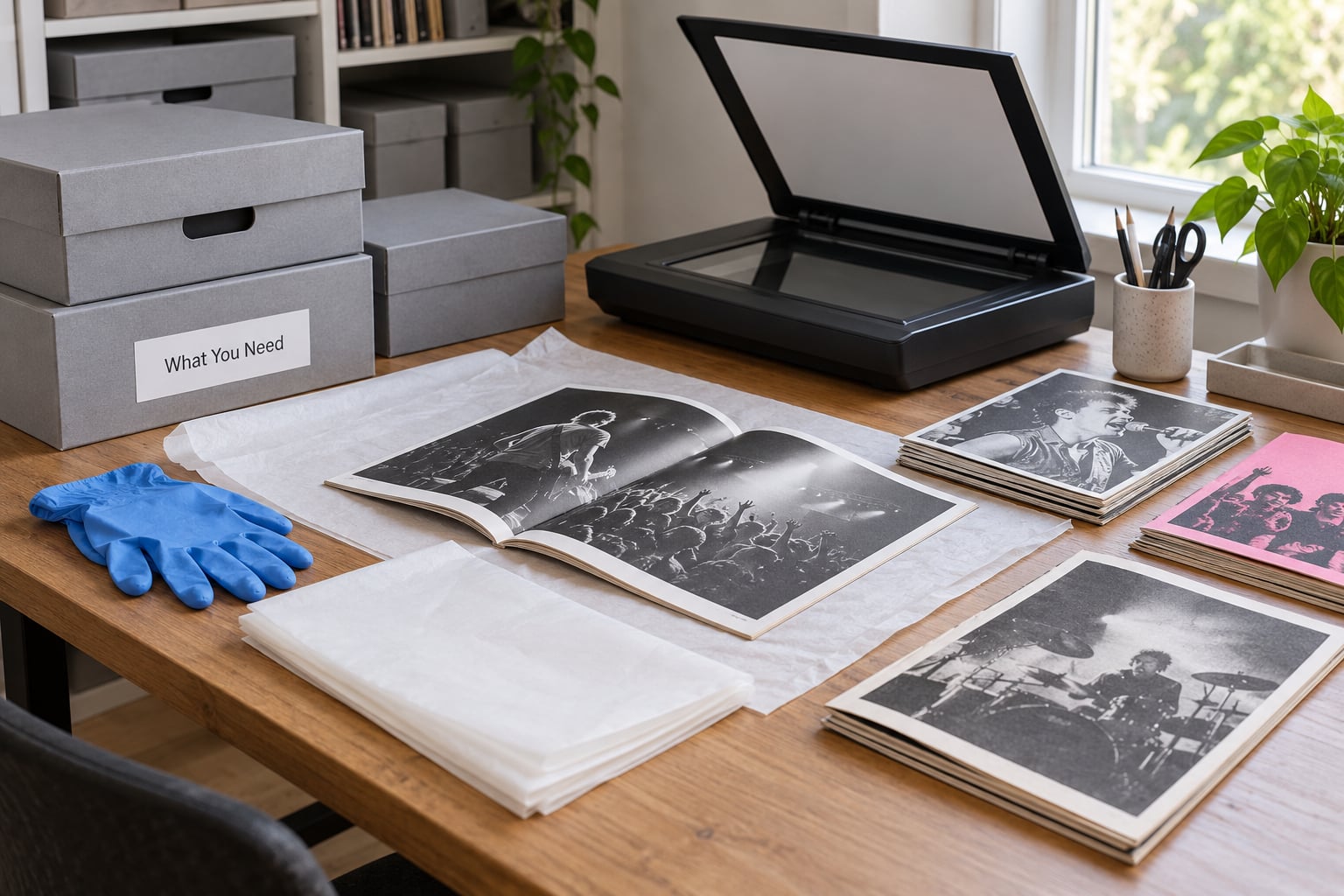
Most home collections can be handled with a short list of supplies. None of it is exotic, and the order you buy it in matters less than the order you use it in.
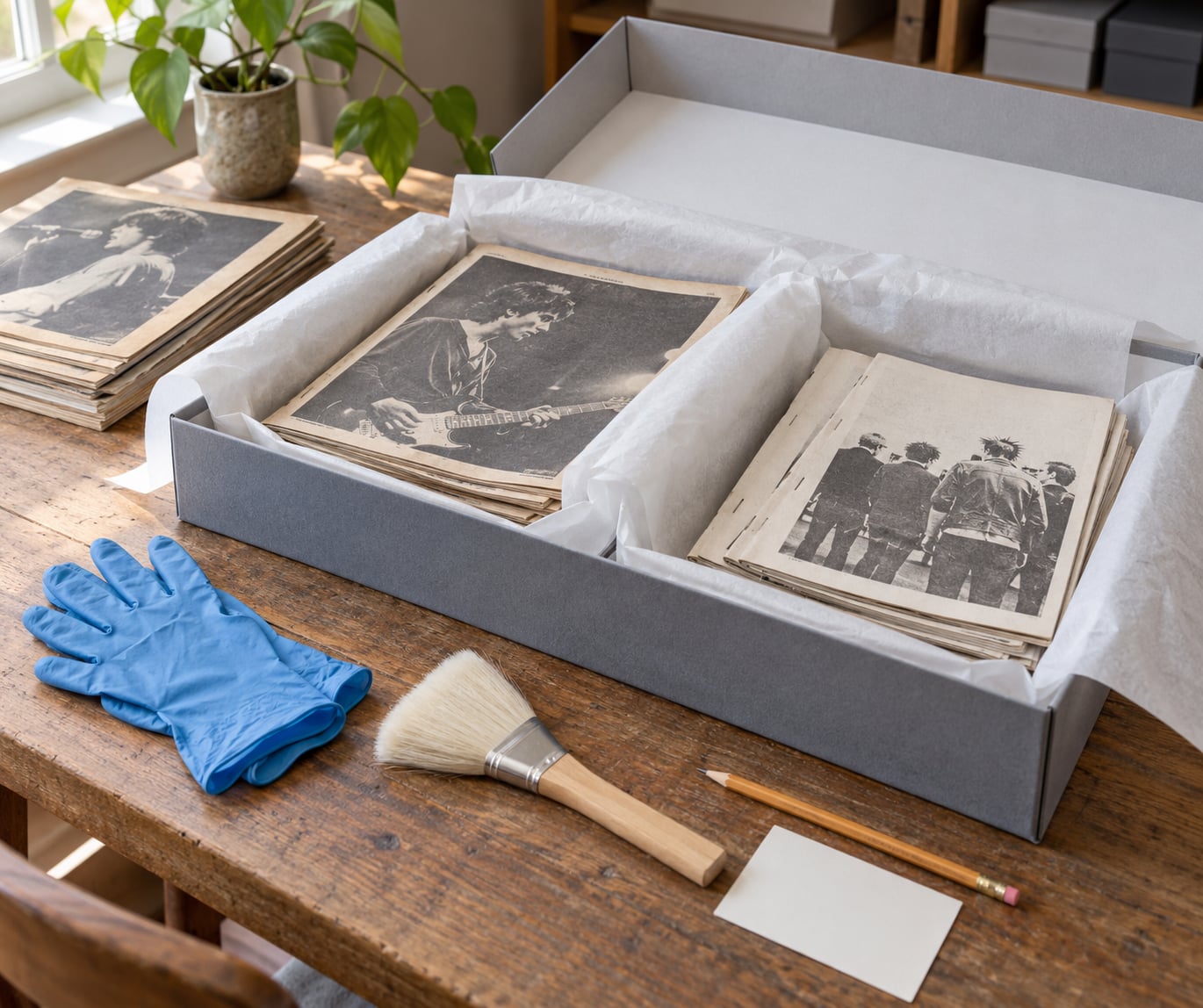
- Nitrile gloves. Clean hands carry oils and salt to paper, and those speed up staining. Gloves also save you from feeling that something is about to tear.
- Soft, dry brushes. A clean sable or hog-bristle dusting brush plus a soft-bristled pastry brush for crevices. Skip anything with a sticky or treated head.
- Acid-free tissue and folders. Unbuffered tissue interleaves between issues. Buffered folders hold a group of zines loosely.
- Polyester (Mylar) or archival polypropylene sleeves. Both are inert and stable. Polyester is stiffer and resists creasing, which suits thin stapled zines. Cheap comic bags exist, but r/zines collectors repeatedly warn that some of them bleed or smudge against ink and glossy cover stock, so test a bag on a photocopy first.
- Rigid backing boards. Corrugated board or two-piece archival foam-core. This is what stops a magazine from curling in a box.
- Buffered archival boxes or clamshells. Lignin-free board with an alkaline reserve. Recognised makers in this space include Hollinger Metal Edge, Lineco and BCW. A buffered box is one whose board is treated to neutralize acid from the air and from neighbouring items.
- Silica gel packets and a cheap hygrometer that reads relative humidity.
- UV control. Blinds, curtains or UV-filtering film on any window that faces the storage area.
- A scanner or camera, plus a notebook and pencil. Pencilled notes can be erased. Pen cannot.
One more thing worth buying: a rigid magazine file or a magazine-slot box if you intend to keep anything upright. Upright storage is fine, but only with a back panel that stops the issues slumping forward.
Step-by-Step: Best Way to Archive Old Magazines and Zines
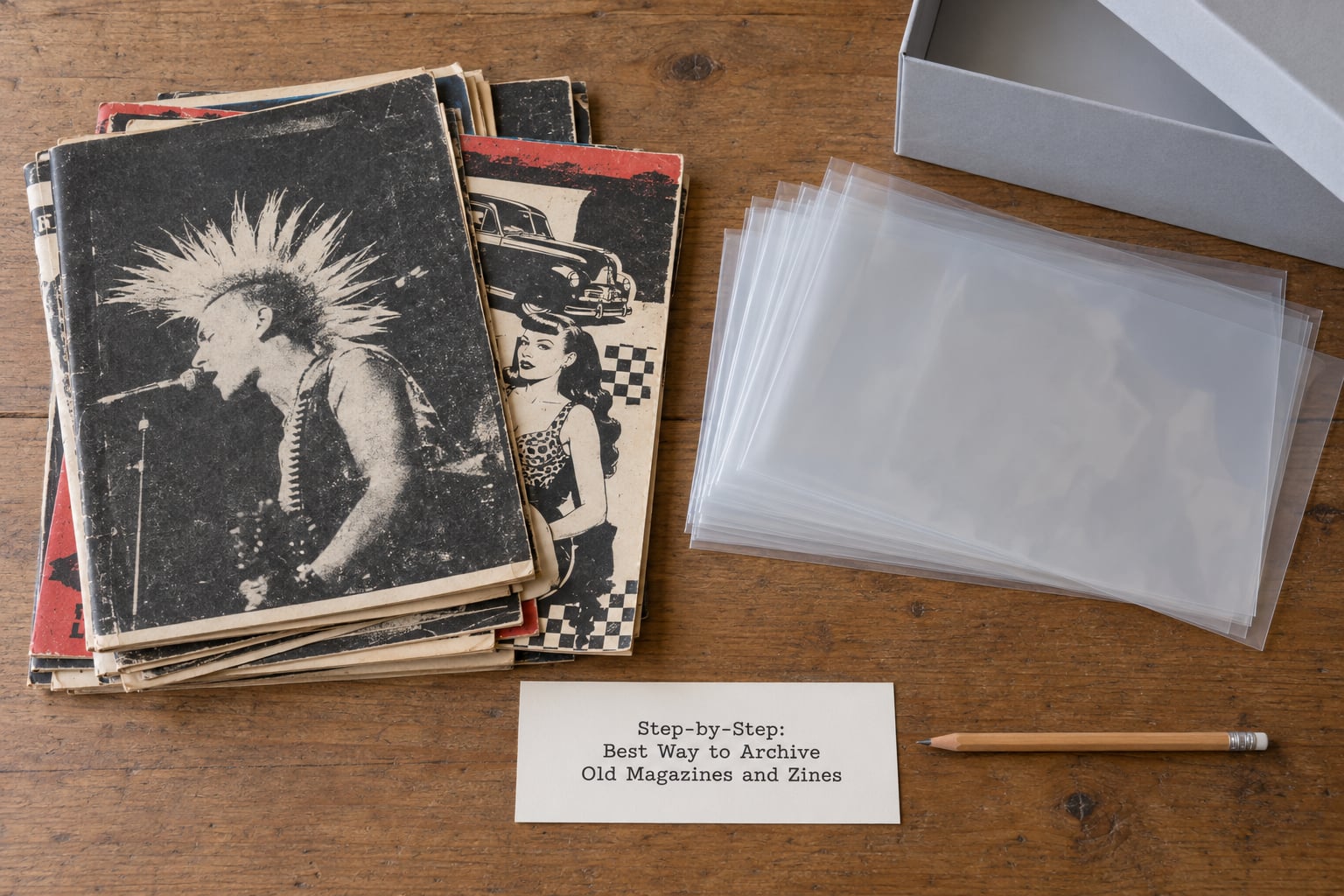
Seven steps, in this order. Skipping ahead usually means handling the same issue twice, and every second handling is a small risk.
1. Assess the Collection and Check Its Condition
Spread everything out on a clean surface and do a triage pass before anything else. You are sorting items into three buckets: stable, fragile and unknown.
Stable means the paper feels like paper, holds a shape when you lift one corner, and has no sticking or tearing. Fragile means visible brittleness at fold lines, loose or detached pages, edge chipping, tears, or a spine that creases when you open it. Unknown means anything with previous repair work on it: tape, lamination, rubber bands, glue, or a staple rusted into a rust-coloured halo.
Do not clean, un-tape or de-laminate during the assessment. You are only deciding what to do later. For the unknown pile, and for anything with real monetary value, get a paper conservator to look at it before you touch it. Chemical removal of tape is a specialist job because the wrong solvent takes ink and cover art with it.
2. Sort Issues Without Removing Covers or Pages
Group by title first, then by issue date inside each title. A collector who wants a complete run of a garage and rockabilly magazine cares about issue one through issue forty, in order, with the covers intact.
Write a short code on the box list, never on the item: title, issue number, month and year, volume where it exists. If an issue is missing a rear page or a centre spread, note that in your inventory rather than quietly trimming the magazine down to match the others. Collectors pay more for a complete run than a tidy one, and completeness is the whole point of an archive.
Resist the urge to remove anything that looks loose. A detached cover is evidence, not rubbish. If it is genuinely fragile, slip it into its own polyester sleeve with a note, and keep the association by putting that sleeve with its magazine.
3. Clean and Support Each Magazine or Zine
Cleaning here means dry surface removal only. Take the magazine in gloved hands, support the spine with your other hand, and sweep a soft brush across the pages in short strokes, working outward from the gutter. Loose grit falls off; ink does not.
What not to use: household sprays, glass cleaner, water on a cloth, damp wipes, solvents, erasers, eraser crumbs, and anything that smells. People on r/Archivists and r/zines keep repeating the same warning for a reason. Liquid on old paper spreads tidying marks and can carry acid across the sheet, and a damp magazine sealed into a sleeve afterwards will grow mold inside the plastic.
Once the surface is clean, support the item. Interleave acid-free tissue between issues when you stack them, and give every magazine a backing board sized so the item sits flat with no overhang. Thin photocopied zines get a polyester sleeve rather than a paper wrapper, because paper wrappers stick to soft ink. Leave staples where they are unless you have a specific plan, which is the next point.
Staple removal is optional, and most libraries do not do it. It only makes sense on a zine held with stable metal staples that you can re-fasten with acid-free clips or a removable fastener. Never pull staples from glue-bound, sewn or brittle items, and never pull from a staple that has rusted, because the brown stain it leaves is permanent and spreads.
4. Scan or Photograph the Collection
Digitising is not a replacement for the physical copy. It is insurance and a way to read a zine without unstuffing a box. On r/Archivists, collectors routinely digitise first and then get serious about physical storage.
For a flatbed scanner, use 300 to 400 dpi in 24-bit colour and save a TIFF master plus a JPEG copy for everyday reading. Put a colour target card in the first scan of each session so you can correct colour later. For thin stapled zines, scan duplex single pages on a V-cradle or book cradle so you are not pressing the cover flat against the glass.
Phone photography is fine for a quick reference set. Even window light, a sheet of white card as a background, and no flash will beat a bad scan. Shoot each cover as a square-on image and use those covers as thumbnails in your catalogue.
Name files so they sort usefully: Title_IssueNumber_Year_Page.jpg, with underscores so the sequence stays in order. Back up everything on a drive you do not touch, plus one copy off-site. Three copies, two media types, one off-site is the standard and it costs nothing extra now.
5. Label and Catalog the Archive
Two labels, minimum. One on the outside of the box giving title, date range and box number, and a contents sheet inside listing every item in order with its condition notes. If a box is ever separated from its sheet, the collection can still be reassembled.
Keep the catalogue itself as a spreadsheet. Nine columns handle almost anything: title, creator or publisher, issue number, date, physical size, condition, box number, position in box, digital file name. Add a notes column for things like staple rust or a missing centre spread.
Cataloguing a large run is genuinely overwhelming, which is the most common complaint in r/zines threads. Get a pilot batch of ten issues completely finished first, then copy that pattern. Zinelibraries.info is the community resource hub people point to when they want a workable catalogue standard.
6. Store Issues in Archival Boxes
Flat is the default for magazines. Stand them on their lowest edge, stacked, with acid-free tissue between issues, and keep the stack shallow enough that you can lift any issue without dragging the ones above it. Upright storage works only in a magazine file with a rigid back panel; loose upright issues on a shelf will lean, crease at the spine and eventually fail at the fold.
Match the container to the format. Standard magazines go in buffered boxes in single or small stacks. Digest and half-size zines go in acid-free folders inside a box. Mini zines fit polyester sleeves with a card slightly larger than the item. Oversized items need a clamshell box or a rigid art portfolio so nothing bends the spine.
Leave headroom in the box. Overpacking crushes spines, and a crushed spine never recovers. Fill to roughly three-quarters and cushion the empty space with acid-free tissue.
Where you store the box matters as much as the box. An interior closet off the floor, away from exterior walls, radiators and plumbing beats a basement, garage or attic every time. Aim for 40-50% relative humidity and a cool, stable temperature around 65 to 70 degrees Fahrenheit. Stability matters more than hitting a perfect number: swings do more damage than a slightly warm room.
7. Create a Retrieval and Disaster Plan
Write down where every box is, and photograph each labelled shelf. In five years you will not remember that the 1978 titles are in the cupboard under the stairs. Keep a simple map in the same folder as the catalogue.
For disasters, know the move before you need it. Water: get boxes off a wet floor fast, air the contents loose, and get advice before sealing anything. Mold: quarantine the affected items in a dry place and never seal damp paper in plastic, which traps the moisture and feeds the mold. Pests: quarantine new additions for a few weeks before they go in with the rest, and set a monitor trap to see what is actually in the room.
If a collection is worth real money, have it appraised and ask your insurer what a rider for paper ephemera requires. An appraisal is a document, not a repair, but it is what a claim needs.
Common Mistakes
Almost every ruined magazine I have seen was ruined by one of these, usually by someone trying to help.
- Scotch tape or glue on tears and loose spines. Tape forms a chemical bond with the paper fibres, pulls colour out in a stain, and makes the area brittle. It also lowers the item’s value to any serious collector. Instead, keep the piece in its own sleeve, supported by tissue, and note the damage in your inventory.
- Laminating a cover or a whole run. Lamination is irreversible, traps acid and moisture, and removes the option of any future conservation treatment.
- Newspaper as interleaving or wrapping. Newsprint is among the most acidic paper in the house. Use acid-free tissue.
- Ordinary plastic bags. Off-gassing from cheap polythene yellows and sticks to surfaces over time, and unverified bags can smudge fresh ink. Use polyester or archival polypropylene sleeves.
- Rubber bands around issues. They leave a permanent dark stain that keeps spreading for years. Use a polyester sleeve or a paper wrap instead.
- A windowsill, a glass shelf in direct sun, or a lit display case. UV fades inks and cover art long before the paper fails. Intermittent light is worse than constant dim light, so rotate displays rather than leaving one cover out permanently.
- Sprays and wipes during a tidy-up. No cleaner, no water, no eraser. Dry brush only.
- Handling issues repeatedly while sorting. Set each one down in its final pile rather than shuffling stacks. Gloves on, two hands, spine supported.
- Writing on the item with pen. Pencil can be erased. Use a sticky flag or write the note on the sleeve.
- Sealing damp paper into plastic. Mold grows happily inside a closed sleeve, and it is far harder to treat than to prevent.
Frequently Asked Questions
Should old magazines and zines be stored flat or upright?
Store magazines flat, stacked on their lowest edge with acid-free tissue between issues. Upright storage is acceptable only inside a magazine file or slot box with a rigid back panel that stops issues slumping forward. Loose upright stacks on a shelf crease at the spine and fail at the fold over time. Keep stacks shallow enough that you can lift any single issue without dragging the ones above it.
What is the safest box for archiving old music magazines and zines?
A buffered, lignin-free archival box or clamshell. Buffered board has an alkaline reserve that neutralizes acid from the air and from neighbouring items, and lignin-free board avoids the brown staining that lignin causes over decades. Recognised makers include Hollinger Metal Edge, Lineco and BCW. Match the box to the format, and do not overpack: leave about a quarter of the box empty and cushion it with acid-free tissue.
Can I use newspaper or plastic bags to wrap fragile zines?
No to both. Newsprint is highly acidic and will discolor whatever it touches, so use unbuffered acid-free tissue for interleaving. Ordinary plastic bags off-gas as they break down, yellow and cling to surfaces, and unverified bags can bleed ink onto glossy cover stock. Use polyester sleeves or archival polypropylene instead, and test any new sleeve on a photocopy first to check for smudging.
Is scanning old magazines better than storing only physical copies?
Scanning is an addition, not a replacement. A digital copy protects the content and lets you read a zine without unstuffing a box, but screens cannot show paper texture, ink bleed, or the feel of a stapled fanzine, and a scan is only as permanent as your backups. Scan 300 to 400 dpi in 24-bit colour, keep a TIFF master, then store the physical issue properly as well.
How should I handle a magazine or zine that smells musty or shows damp stains?
Do not seal it in plastic, because trapped moisture makes the mold worse. Quarantine the affected items in a dry, ventilated spot, air them loose with fans running gently, and never use a household cleaner or spray. For foxing and light tide lines, isolate those items from the rest of the collection so active mold does not spread. Persistent or valuable mold should be handed to a paper conservator.
How do I prevent mold, pests, and yellowing in a magazine collection?
Keep the relative humidity between 40 and 50 percent with a hygrometer and a dehumidifier if your rooms run damp, and keep the boxes off the floor away from exterior walls. Yellowing comes from acid and light, so use acid-free sleeves, buffered boxes and UV control. For pests, quarantine new arrivals for a few weeks and set a monitor trap to find out what is actually present rather than guessing.
If you do one thing this month, take ten issues through all seven steps and get them properly boxed. You will learn more from ten finished issues than from a hundred half-sleeved, and the rest of the collection can wait for you to build up to it.