Extreme heat is the temperature that ruins vinyl records. Sustained heat around 140°F (60°C) can permanently warp a disc, and above 212°F (100°C) the vinyl actually melts. Between 85°F and 90°F (30°C to 32°C) the slow damage starts, and a sunny shelf or a parked car gets there in an afternoon.
There is no single reading that ruins every record the same way. A pressing matters, the thickness matters, whether it is clamped in a jacket matters, and so does how many hours it sits there. That is why you will see 140°F, 150°F and 170°F quoted in different places, and why the honest answer has conditions attached.
Short version: ordinary indoor cold is not the enemy. Heat is. I have moved boxes out of a hot attic and seen the difference on a turntable the same evening, and I have never seen a record ruined by a normal winter bedroom.
Table of Contents
- What Temperature Ruins Vinyl Records?
- How Heat Damages Vinyl Records
- Does Cold Ruin Vinyl Records?
- What Temperature Ruins Vinyl Records? Heat and Cold Compared
- Where Vinyl Overheats Fastest
- What to Do If a Record Gets Too Hot
- How to Store Vinyl at a Safe Temperature
- Can a Warped Record Be Fixed?
- Frequently Asked Questions
- Can vinyl records warp in a hot attic?
- What is a safe storage temperature for vinyl records?
- Can I leave vinyl records in a car overnight?
- Is it safe to store vinyl records in a garage?
- How should I handle a record that was left in extreme heat?
- Conclusion
What Temperature Ruins Vinyl Records?
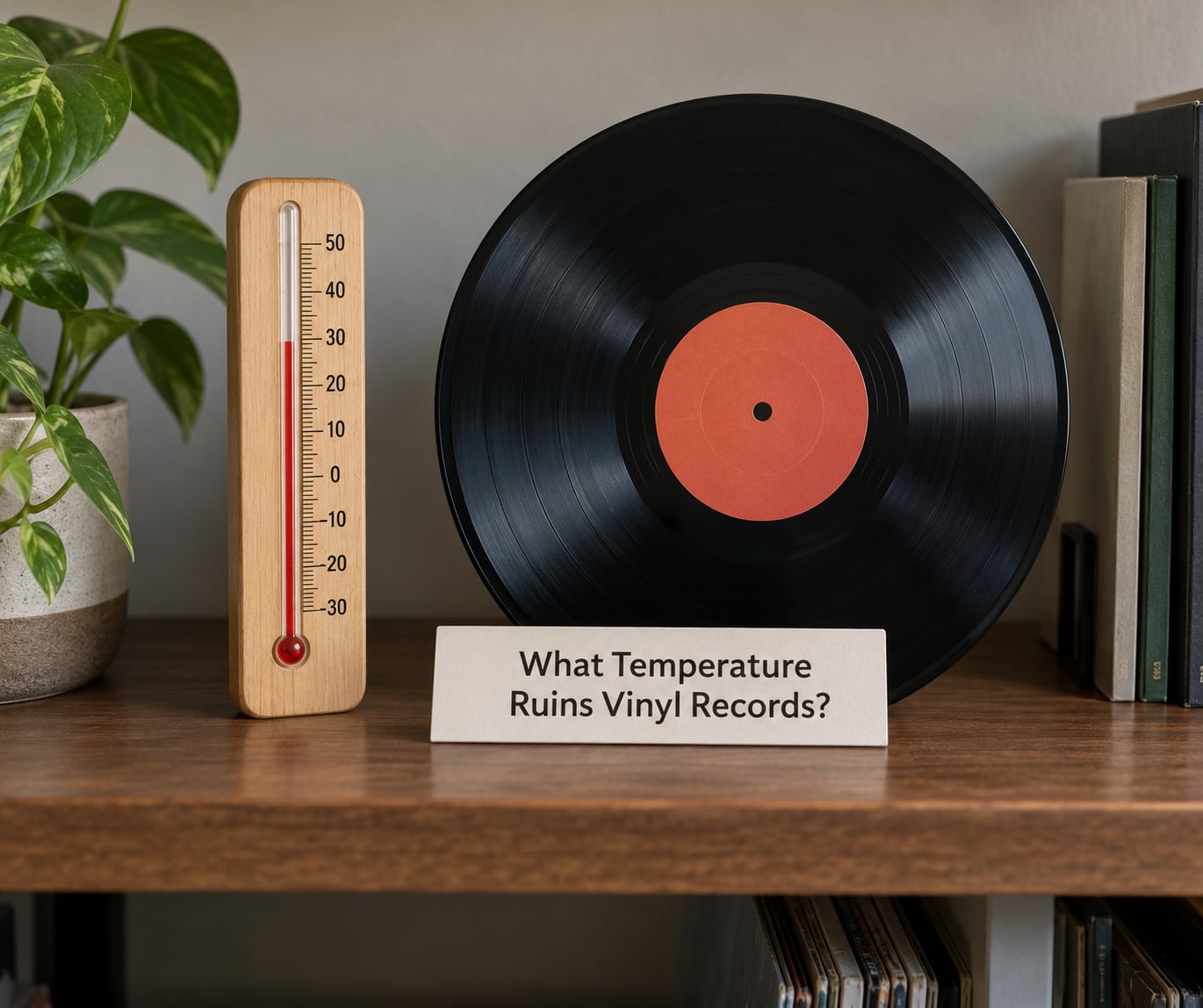
The temperature that ruins vinyl records is sustained heat, and the thresholds below are the working numbers collectors use. Treat them as guideposts rather than guarantees.
- Ideal range, 65°F to 70°F (18°C to 21°C). A normal, climate-controlled room. Nothing good happens above this that needs to happen.
- Caution zone, 85°F to 90°F (30°C to 32°C). Vinyl itself is fine for a while, but glue, shrink wrap and paper sleeves start complaining first.
- Softening, about 120°F (49°C). The disc loses rigidity and starts to take the shape of whatever is pressing on it.
- Warping point, around 140°F (60°C). This is the number most collectors and record forums quote. Under weight or a tight jacket, deformation here becomes permanent.
- Melting point, 212°F (100°C). The vinyl becomes liquid. Records have survived this, but nothing survives it intact.
- Cold, below 32°F (0°C). Temporary brittleness and condensation risk on the way back into a warm room, not usually permanent damage.
The gap between the caution zone and the warping point is where most real-world damage happens, because a 90°F attic or car is easier to ignore than a 140°F oven.
How Heat Damages Vinyl Records
Vinyl is polyvinyl chloride, a thermoplastic. That means it softens when heated and hardens when cooled, over and over, and it never fully forgets the shape it was in while soft.
A record in a sleeve, sitting in a box, under another record, is clamped. When the vinyl softens it relaxes into that stack instead of lying flat, and when the box cools the record cools in the wrong shape. That is warp, and it is the whole mechanism.
The jacket does not escape either. Shrink wrap pucksers and clouds, the glue holding the gatefold lets go, paper sleeves yellow faster, and the label adhesive creeps. On a heat-damaged record the sleeve is often the first clue, before the disc itself.
Sunlight adds a second problem on top of the heat. Ultraviolet light fades printed sleeves, bleaches titles and dulls black vinyl, while the infrared component of the same beam heats one side of the disc more than the other. That uneven warming is why a record near a west-facing window can dish or curl while the shelf next to it stays flat.
Two collector myths are worth clearing up. A heavier pressing is not a safer one: members on r/vinyl and the Steve Hoffman forums point out that 180g weight does not make a record warp resistant. And colored or picture-disc pressings deserve more caution than plain black vinyl, because the pigmented or printed surface absorbs more solar energy and picture discs are often thinner to start with.
Does Cold Ruin Vinyl Records?
Usually no. Healthy vinyl stored in a cold room or through a northern winter comes back to normal, and collectors on record forums regularly report collections sitting in cool rooms with no problem at all.
Two things do change in the cold. Vinyl gets less flexible, so a frozen or chilled disc is more likely to crack if you flex it, drag it across a shelf lip, or pull it out by the edge at an angle. Handle cold records gently and let them warm before you play them.
The bigger cold-related risk is condensation. A record carried from a freezing porch or car into a warm room can pick up moisture, and moisture on paper sleeves and cardboard boxes is how mold starts.
What Temperature Ruins Vinyl Records? Heat and Cold Compared
The table below compares everyday conditions and what each one actually does. No single reading applies to every pressing, so read the effects column as a risk, not a verdict.
| Condition | Likely effect | Warning signs | Safe action |
|---|---|---|---|
| Cool indoor storage, 60°F to 70°F (16°C to 21°C) | None expected | None | Store as normal |
| Warm household room, 75°F to 85°F (24°C to 29°C) | No disc damage; sleeve glue and paper age faster | Yellowing sleeve edges, tacky shrink wrap | Improve airflow, keep records off radiators and sunny glass |
| Hot attic or loft in summer, often 120°F to 160°F (49°C to 71°C) | Warping in tightly packed boxes, especially the bottom row | Flat spots, ridging, sleeves fused to the disc | Move the collection out immediately and inspect the lowest boxes first |
| Parked car, which can pass 120°F (49°C) in full sun | Fast warping, sleeve and label damage, warped inner sleeves | Records touching across the box, a faint plastic smell | Take records with you, or leave them at home in a cool room |
| Freezer-like conditions, below 32°F (0°C) | Temporary brittleness, condensation when brought into warmth | Frost on the sleeve, damp cardboard | Let it warm sealed, dry it off, handle it flat |
Where Vinyl Overheats Fastest
An uninsulated attic is the classic one. Hot air rises, the roof radiates heat downward, and a box in July can be far past the softening point without anyone noticing until the records are visibly dished.
Then there are the spaces that heat up fast and cool down slowly. Metal sheds and outbuildings have no insulation, so they follow outdoor temperature with a lag. Unventilated storage units trap daytime heat and release it at night. Hot boxes packed tightly in a cupboard lose their air gap, and the middle of the stack stays warm long after the edges cool.
Vehicles are the worst offender in summer. A closed car in direct sun climbs fast, and the trunk or back seat can exceed 120°F (49°C) in under an hour. If a record ever rides in a car, treat that as a one-record emergency rather than a habit.
Indoors, the usual suspects are sun-facing rooms, windowsills, glass cabinets in direct light, and the top of a wall unit near a heating vent or radiator. A shelf that is a foot inside a sunny window is warmer than the window sill itself, because glass blocks infrared while the room behind it bakes.
Stack orientation and packing make a difference too. Records stored flat under heavy weight have no room to relax, which is the exact condition that turns soft vinyl into a permanent warp.
What to Do If a Record Gets Too Hot
Stay calm and work in a sensible order. The goal is to stop the damage, not to rescue the disc.
- Get it out of the heat source. Move the whole box to a shaded, ventilated room rather than pulling records out one at a time in the hot space.
- Handle the edges only. Never touch the playing surface with your fingers, and keep the disc flat on a table rather than tilting it to look at it.
- Let it cool gradually at room temperature. Do not use a fan, a fridge or a cold surface to speed things up. Fast cooling on one side adds uneven stress.
- Inspect it flat. Place the record on a level surface and look for a shadow line around the rim, or lay a straightedge across it. A dished record shows daylight underneath one edge; an edge warp shows a bump or ripple on the rim.
- Separate stuck records carefully. If two records are fused, check the sleeve and label first. Split them gently along the edge with a thin plastic card, and expect the sleeve to tear. Adhesive or shrink wrap that has melted onto the surface is a job for a professional.
- Wait before playing. Give a warped record 24 to 48 hours in a cool room, then test it on a cheap cartridge or at low volume. If it skips, mistracks or drags, stop. Continuing loads the stylus and cantilever for nothing.
How to Store Vinyl at a Safe Temperature
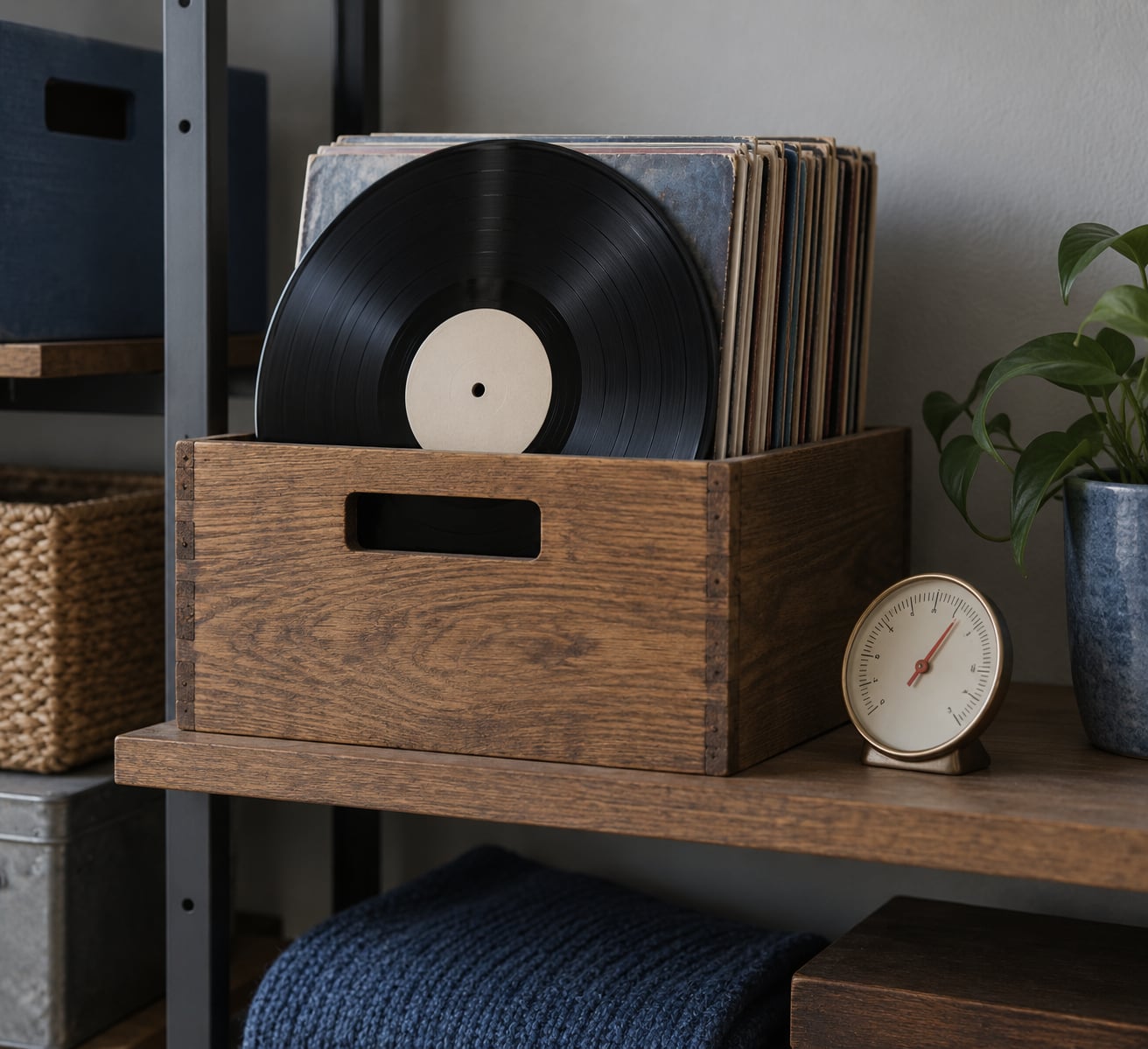
Steady beats cold. A shelf that holds 65°F to 70°F (18°C to 21°C) through the year, with modest humidity at 35% to 45% relative humidity, does more for a collection than any single gadget.
Keep records upright, not flat. Upright storage removes the weight that lets softened vinyl settle into a curve, and it makes shelf space far more efficient. Leave a little space between the spine and the wall of the shelf so air can move.
Shade beats insulation. Blinds or a curtain on a sunny window, and keeping the shelf out of direct light, do more than a fan ever will. Aim for airflow in the room rather than a specific machine.
Paper sleeves and outer sleeves matter more than most people expect. A poly-lined or rice paper inner sleeve reduces static and protects the disc from the adhesive and rough paper of the jacket, and a resealable polyethylene or polypropylene outer sleeve keeps dust and moisture out. Skip anti-static claims and focus on acid-free, lignin-free materials.
Monitor rather than guess. A simple digital hygrometer with a temperature reading, placed on an actual shelf rather than on the wall, tells you what your collection is experiencing. A data logger left inside a box during a heat wave or a move is even better, because it records the peaks you slept through.
Run a short seasonal check. In summer: confirm the hottest shelf, move anything near a window, check the attic and garage for boxes you forgot, and make sure your delivery is not sitting on a porch in the sun. In winter: watch for damp and frost if you store in an unheated space, and check boxes that sit on concrete floors.
One more habit pays off for collectors: when a box comes out of storage, look at the records that were at the bottom and on the sun-facing side first. That is where problems appear first, and finding them early means you can rehome a warp before it becomes permanent.
Can a Warped Record Be Fixed?
Sometimes, mildly. A record with a slight dish and no cracking can relax back toward flat under gentle, even weight at a stable room temperature, inside its sleeve, with something flat and evenly distributed on top. Slow and low pressure over weeks is the safe version of this.
Oven methods, hair dryers, hot plates and car dashboards are the folklore that keeps circulating on forums, and collectors on the Steve Hoffman boards have seen records permanently deformed by them. A record clamped between hot plates or warmed in an oven is already partly stuck to its jacket, and the flattening that comes back wrong is very hard to undo.
Professional flattening is the sensible route for anything with real value. Pressing services control temperature, pressure and dwell time, and they can usually tell you on sight whether a warp is recoverable or whether the disc is cracked through.
There are two warp types worth knowing. Dish warp curves the whole record into a shallow bowl, with one edge rising. Edge warp deforms only a section of the rim, which produces a bump you feel once per rotation. Dish warp often responds to patient weight; a rim crack does not respond at all.
When the warp is severe, the record skips, or the disc is a pressing you cannot replace, display it flat and upright rather than risk it. A collectible that is never played loses a little of its function but keeps its value, and a snapped stylus is an expensive lesson.
Frequently Asked Questions
Can vinyl records warp in a hot attic?
Yes, and an attic is the single most common place collectors ruin records by accident. Hot air rises and the roof radiates heat downward, so a box in July can sit well past 120°F (49°C) without anyone noticing. Records packed flat under weight are the most likely to warp because soft vinyl relaxes into the stack. Move collections out of attics entirely, and inspect the bottom rows first when you do.
What is a safe storage temperature for vinyl records?
Keep records between 65°F and 70°F (18°C to 21°C) with humidity around 35% to 45% relative humidity. That is an ordinary climate-controlled room, and stability matters more than hitting an exact number. Treat anything above 85°F to 90°F (30°C to 32°C) as a reason to move the records somewhere better, and use a hygrometer with a temperature reading on the shelf itself rather than guessing from the thermostat.
Can I leave vinyl records in a car overnight?
No. A closed car in direct sun can pass 120°F (49°C) in under an hour, and a warm night does not let the interior recover. Records left in a vehicle are the most common source of warped arrivals from other collectors, along with boxes that sat in a hot delivery area. If you are moving records in summer, take them inside at your destination and let them cool flat before you inspect or play anything.
Is it safe to store vinyl records in a garage?
Only in a climate-controlled, insulated garage with steady temperature and humidity. A typical attached or detached garage swings with the weather, and metal sheds and unventilated storage units follow outdoor temperatures closely. If records must live there, use sealed plastic bins with the lids closed, keep them off the concrete floor, and check them in summer and winter. Attics are worse than garages for the same reason: more heat, and less of your attention.
How should I handle a record that was left in extreme heat?
Move the whole box to a shaded, ventilated room, handle records by the edges only, and let them cool gradually at room temperature rather than with a fan or a cold surface. Then inspect each record flat for a dish shape, a shadow line at the rim, or a bump in the rim itself. Separate any fused records carefully, check sleeves and labels for melted adhesive, and wait 24 to 48 hours before testing playback on a cheap cartridge.
Conclusion
Sustained heat is what temperature ruins vinyl records, not ordinary indoor cold. Start by moving records out of attics, vehicles, garages and direct sunlight, then inspect them flat in stable room-temperature conditions before you play anything.