If you have ever wondered what are outer sleeves for records, the short answer is simple: they are clear plastic covers that slip over the whole jacket package and keep your album artwork from rubbing, cracking and fading on a shelf. One cheap sleeve per record buys years of protection for artwork you will never be able to replace.
Most people first meet the idea at a record shop counter, where staff sleeve a purchase in front of you. It looks like a small, fussy gesture, and it is. What that gesture protects is usually the most fragile part of a record: the printed cardboard jacket and the original paper or poly sleeve inside it.
Table of Contents
- What Are Outer Sleeves for Records?
- Why Do Vinyl Collectors Use Outer Sleeves?
- What Is the Difference Between an Outer Sleeve and an Inner Sleeve?
- What Types of Outer Sleeves Are Available?
- Clear poly sleeves
- Polypropylene sleeves
- Polypropylene resealable or flap sleeves
- Archival and rigid covers
- How Do You Choose the Right Outer Sleeve for a Record?
- What Size Outer Sleeve Does a Vinyl Record Need?
- Are Outer Sleeves Safe for Vinyl Records?
- How Do You Put a Record in an Outer Sleeve?
- What Is the Best Way to Store Records in Outer Sleeves?
- Frequently Asked Questions
- Do I need outer sleeves for my records?
- What thickness outer sleeve should I buy?
- Will outer sleeves damage my record?
- Can a standard 12-inch outer sleeve fit a gatefold or box set?
- Do outer sleeves affect resale value?
- Conclusion: Choose Protection Without Overcomplicating Your Collection
What Are Outer Sleeves for Records?
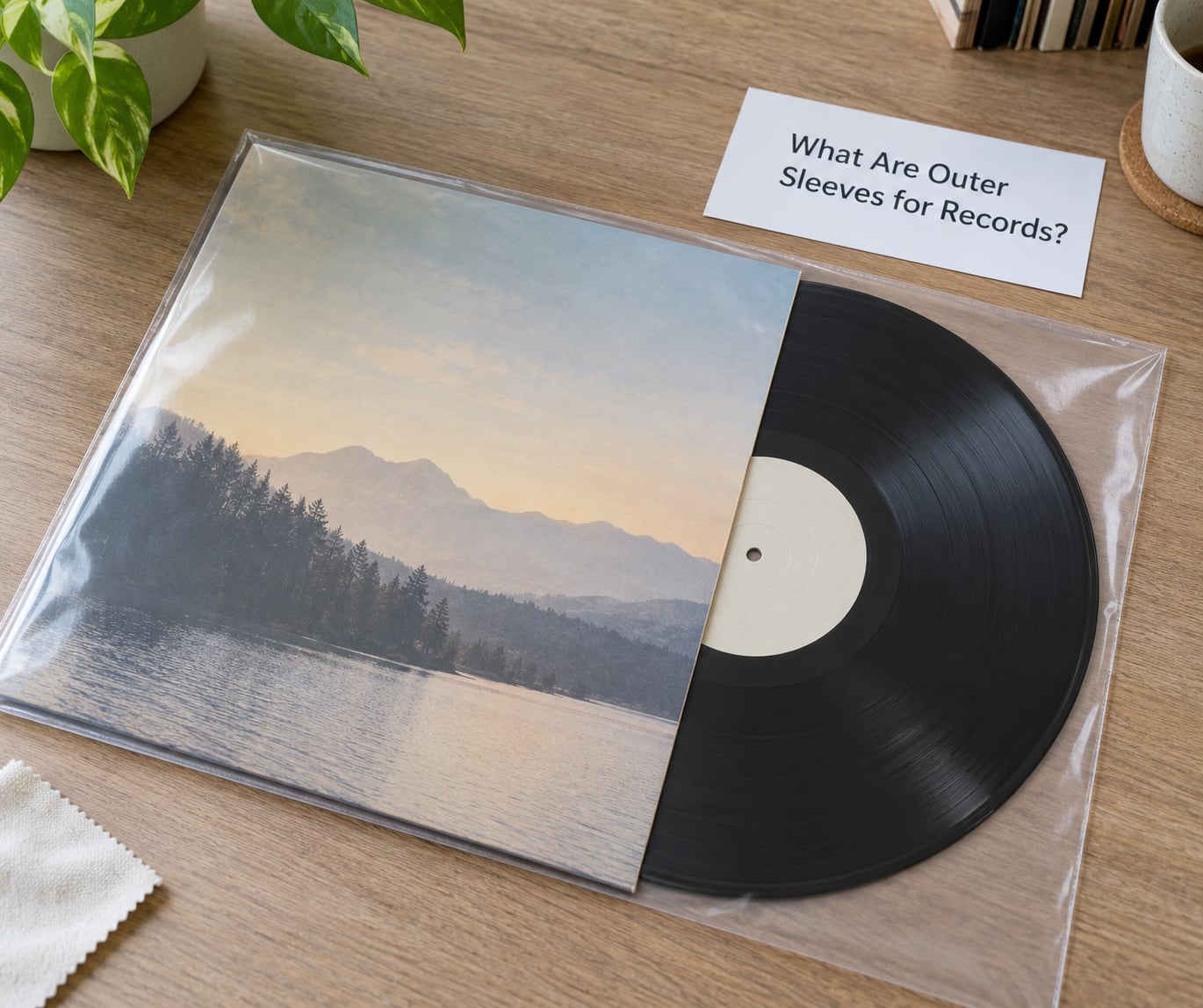
An outer sleeve is a removable protective cover that goes over a record’s original album jacket and its contents. It slides on from the top or the side, adds a thin barrier between the jacket and everything it touches, and comes off again whenever you want to look at the art properly.
The jacket itself is not a structural part of a record. A vinyl disc is the disc. The jacket is a cardboard package that holds it, and cardboard is exactly as durable as cardboard sounds: it scuffs, it corners, it splits along the seam where the spine meets the front and back panels.
So the outer sleeve exists to take the hits the jacket would otherwise take. Dust, fingerprints, sunlight, moisture, the constant scuffing of neighbouring records, and the knocks that come with pulling a record out of a full shelf.
It also keeps the record’s inner sleeve from sticking to neighbouring jackets, which is the slow, boring way that album art disappears. A sleeve on every record means the friction happens between two plastics instead of between two printed jackets.
Why Do Vinyl Collectors Use Outer Sleeves?
Collectors use them for five practical reasons, and none of them involve sound quality. The vinyl is played through a needle; the jacket is never touched by one.
- Ring wear is the circular scuff the record edge leaves on the inner sleeve when you pull it out and push it back in. A fresh outer sleeve keeps the printed inner sleeve from picking up that ring over hundreds of plays.
- Seam splits happen when a jacket flexes at the spine. The outer sleeve holds the package rigid, so the seam takes less stress.
- Corner wear is where jackets rub against their neighbours in a crate or on a shelf. Corners stop softening into rounded grey blobs.
- Dust and moisture settle on exposed jacket surfaces. A sleeve keeps both off, and keeps condensation from reaching the board.
- Fading from sunlight and air exposure slows right down, because the plastic blocks both.
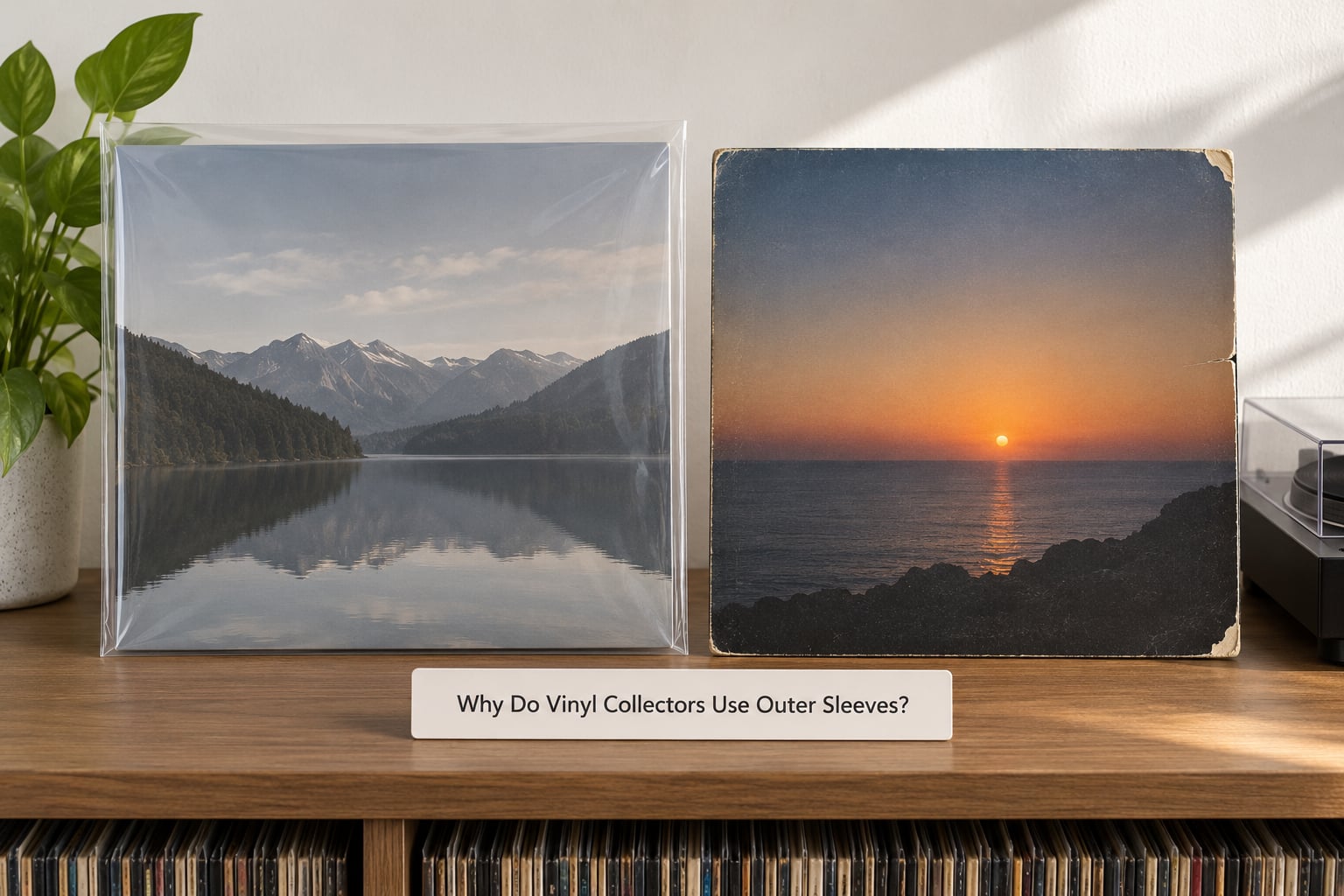
Collectors also care about resale. A record with a clean, sharp jacket and no ring wear simply presents better, whether you are selling, trading, or just pulling it out for someone to see.
Two things an outer sleeve does not do. It does not repair a jacket that is already split or creased, and it does not replace proper storage. A sleeve inside a damp basement is still in a damp basement.
What Is the Difference Between an Outer Sleeve and an Inner Sleeve?
The difference is what each layer touches. The inner sleeve touches the vinyl. The outer sleeve touches the jacket. That single fact explains nearly every other difference, including the ones that trip people up.
| Feature | Album jacket | Inner sleeve | Outer sleeve |
|---|---|---|---|
| Touches the vinyl | No | Yes | No |
| What it protects | Nothing; it is the item being protected | The record surface | The jacket and the inner sleeve |
| Typical material | Printed cardboard | Paper, HDPE poly, anti-static liner | Clear polypropylene or polyethylene |
| Typical thickness | Cardboard | Paper to 2 mil | 2 mil to 5 mil |
| Opening style | Full open or gatefold | Open-ended or resealable flap | Open-ended or resealable flap |
| Common failure | Seam split, corner wear, fading | Yellowing, ring wear, tearing | Wrinkling, clouding, static cling |
Put together on a standard 12-inch LP, the stack works like this. The record slides into its inner sleeve. The inner sleeve goes into the jacket, artwork facing out. The outer sleeve goes over the entire jacket. When you want to play something, the outer sleeve comes off and stays out of the way, the jacket opens or the record slides free, and the vinyl touches nothing but your hands and a felt surface.
That third layer is also what stops the package falling apart on the shelf, because it holds the jacket and the record together as one unit.
What Types of Outer Sleeves Are Available?
Most outer sleeves fall into four families, and the differences come down to material, thickness and how they open.
Clear poly sleeves
Polyethylene is the soft, cheap, slightly cloudy option. It is the sleeve most shops hand you by default. Fine for a while, fine for light use, and it gets cloudy and brittle with age.
Polypropylene sleeves
Polypropylene is stiffer, clearer and more scratch-resistant than polyethylene, and it does not go tacky or clingy over time. Collectors on r/vinyl describe it as the sweet spot, and it is the default recommendation for most shelves.
Polypropylene resealable or flap sleeves
These have a folded-over flap you press closed. The flap is the reason many people switch: an open-ended outer sleeve with an open-ended inner sleeve lines the two openings up, and the record slides halfway out of the package every time you browse a shelf. A flap closes that gap.
Archival and rigid covers
Mylar and BOPP wraps are stiffer again and cost more. Semi-rigid covers add cardboard backing. Both are for records you care about most, or for jackets that are already fragile enough that bending them is a real risk.
Avoid unbranded PVC. Over years it off-gasses, yellows, becomes brittle, and in the worst case sticks to the jacket it is supposed to protect.
How Do You Choose the Right Outer Sleeve for a Record?
Work through these six checks and you will not go wrong.
- Match the format. Measure the package first. A 12-inch sleeve that fits an LP tightly will not fit a gatefold or a box set.
- Pick the material. Polypropylene for everyday collections, archival wraps for the valuable stuff, nothing made of PVC.
- Choose thickness. Mil means one-thousandth of an inch. Under 3 mil, sleeves wrinkle and cloud up fast. Collectors generally land on 4 or 5 mil.
- Decide on the opening. Resealable flap if the record sits on a shelf you browse. Open-ended if you pull records rarely and want the lowest profile.
- Check the closure. Good sleeves have a clean resealable strip, not a glued flap that tears the jacket on the second use.
- Buy in bulk. Sleeves come in packs, and buying fifty at a time means one more job done rather than fifty small ones. It also stops you running out halfway through a shelf.
Thin low-quality sleeves are worse than nothing in one specific way: they wrinkle, and a wrinkled sleeve rubs harder than bare cardboard on the jacket next to it. r/vinyl collectors call cheap 3 mil sleeves about as useful as no sleeve at all once they start creasing. If a sleeve will not sit flat, take it off and change it.
What Size Outer Sleeve Does a Vinyl Record Need?
Size follows the record format, and the failure mode of getting it wrong is simple: too small and the jacket buckles, too large and the record drifts inside and corners.
| Record format | Typical outer sleeve use | Sizing advice |
|---|---|---|
| 12-inch LP | Standard clear poly or resealable sleeve | Buy by count for your shelf; this is the bulk of most collections |
| Double LP and gatefold | Sleeve must clear the opened panel | Check the closed width first, then confirm it fits the gatefold lying flat |
| 7-inch single | Same concept, smaller sleeve | Confirm whether you want singles sleeved individually or as a bulk stack |
| 10-inch record | Rarer; measure before buying in quantity | Order a small pack first and test the fit |
| Box set or oversized package | Semi-rigid or large-format wrap | Oversized sleeve runs thin. Order a few rather than a bulk pack |
For a gatefold, the test is simple: close it, slide it in, and check that the jacket sits flat with no bowing at the seam. For a box set, measure the box and buy deliberately, because this is where most standard sleeves fail.
Are Outer Sleeves Safe for Vinyl Records?
Yes, with the right material and reasonable handling. The record itself sits between the inner sleeve and the jacket, so an outer sleeve never touches the vinyl at all.
The real risks are elsewhere. PVC is the first one, and it is the one to rule out. Adhesives that off-gas or leave residue on the jacket are the second; good sleeves use a clean resealable strip rather than glue. Trapped moisture is the third, and it comes from storing damp records, not from the plastic. And excessive pressure is the fourth: over-stuffed crates bend jackets no matter what they are wrapped in.
The habit that protects records most is cheap: wash and dry your hands, hold the jacket by its edges rather than pressing a thumb into the art, and never pull a record out of the shelf by gripping the sleeve at the top.
How Do You Put a Record in an Outer Sleeve?
This is the part most guides rush through, and it is the part that decides whether your sleeves last.
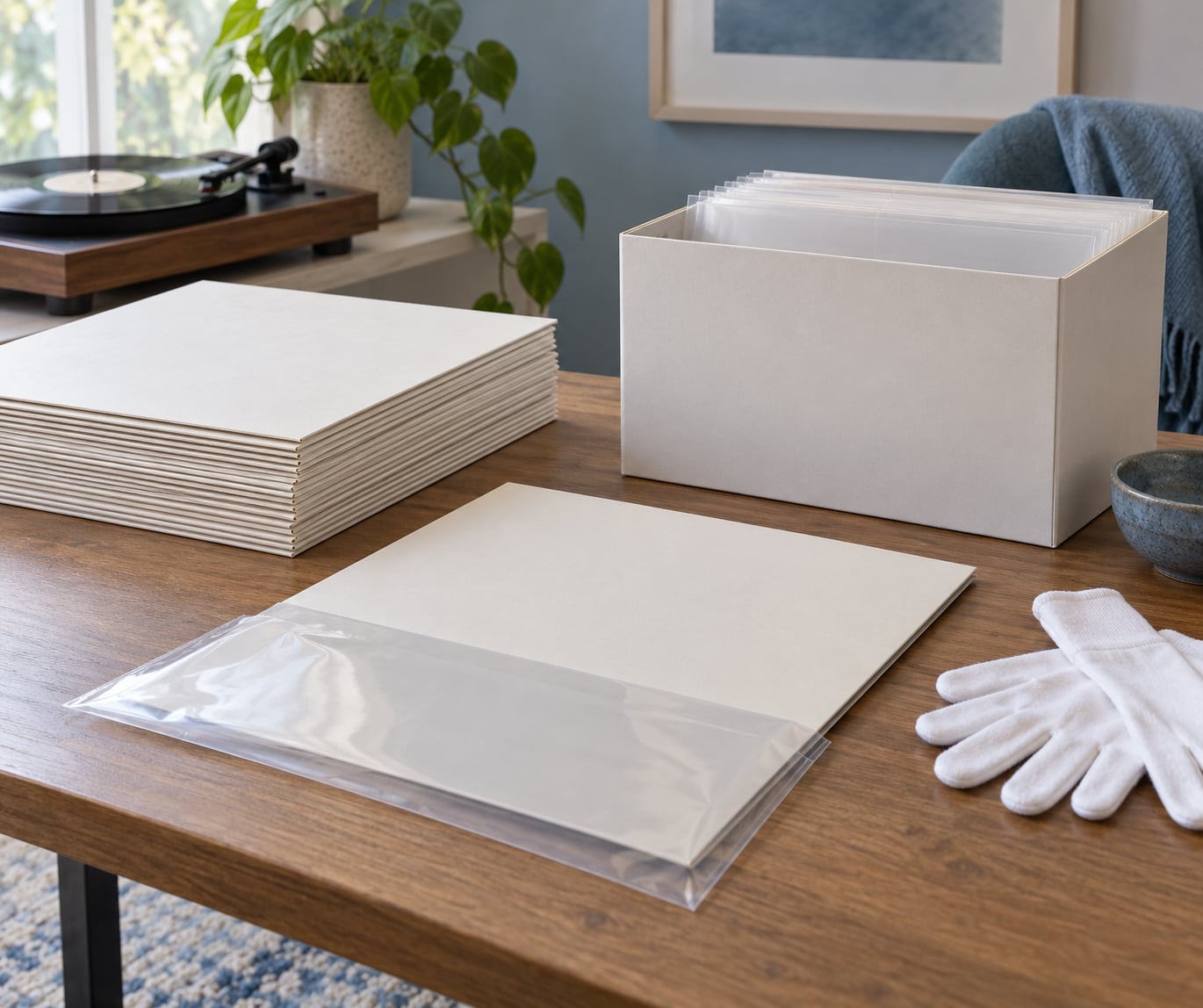
- Work on a clean surface with clean, dry hands.
- Put the record into its inner sleeve first, disc edge straight, not twisted at the corner.
- Slide the inner sleeve, record included, into the jacket with the artwork facing out. Take the corners gently.
- Open the outer sleeve wide with your thumbs and slide the jacket in from the top, front cover facing you.
- Line up the two openings on purpose. If your outer sleeve has a flap, put the flap on the side where you pull the record from and close it every time.
- Push the package all the way to the bottom of the outer sleeve so nothing is left hanging out.
The step collectors argue about most is the inner sleeve. Most people keep it on the record, which is right for a square-back jacket. If your jacket is open on both sides, remove the inner sleeve and store it behind the jacket so the record slides out flat instead of catching.
Two mistakes to avoid: forcing a gatefold into a sleeve sized for a single LP, and peeling a protective film off the outside of a sleeve in one violent pull. Do the second slowly, from a corner, with a fingernail. Nobody has ever ruined a record by taking too long to open a sleeve, and plenty of people have by rushing it.
What Is the Best Way to Store Records in Outer Sleeves?
Store sleeved records upright, the way books go on a shelf. Laying a sleeved LP flat under a stack puts the same weight on the same spot for years, and no sleeve rating survives that.
Do not overpack the shelf. Leave enough room at the top to slide a record out without tugging, because most damage happens on the way out rather than while it sits there.
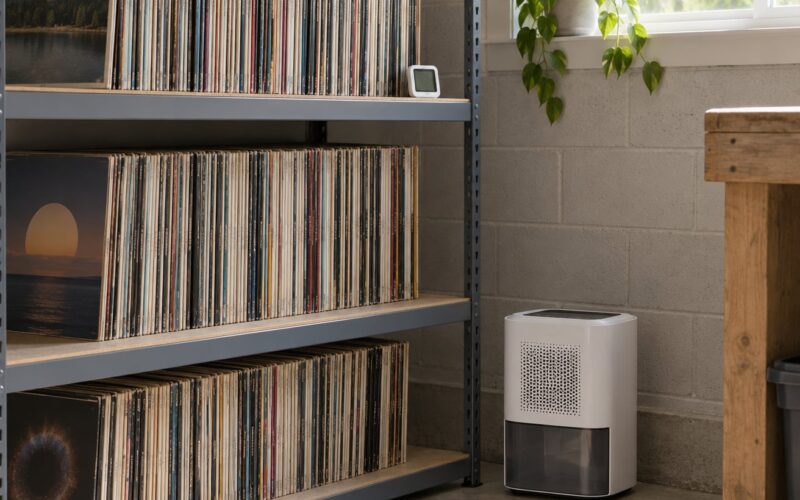
Keep conditions stable and indoors. Heat swings and humidity swings do more to jackets than dust does, and a sleeve cannot block either one. Away from a window or a radiator matters more than the brand of sleeve.
Give the shelf a glance every few months and check for fading, yellowing, brittleness or a seam that has started to give. A sleeve that has turned cloudy can be swapped in seconds, and it is an easy fix.
And be clear about what protection you have bought: an outer sleeve keeps dust, moisture and friction off a jacket. It does not make a record waterproof, dishwasher safe or indifferent to a dropped shelf.
Frequently Asked Questions
Do I need outer sleeves for my records?
If your records live on a shelf and you care about album artwork, you need them. Outer sleeves cost very little per record and stop the jacket wear that is impossible to undo. If you only pull records out to play them and never display them, the case for is weaker, but it is still an easy way to keep ring marks off a fresh inner sleeve.
What thickness outer sleeve should I buy?
Look for 4 or 5 mil polypropylene. Below 3 mil, sleeves wrinkle, turn cloudy and stop sitting flat, and a wrinkled sleeve can rub harder on a jacket than no sleeve at all. Thick sleeves feel stiffer, keep the package square and stay clearer through years of handling. Buy them in packs and keep spares for replacing damaged ones.
Will outer sleeves damage my record?
No, because the outer sleeve never touches the vinyl. The record sits inside the inner sleeve, and the inner sleeve sits inside the jacket, so the outer plastic only ever contacts cardboard. Damage comes from handling and storage instead: dirty hands, pulling a record out by the top edge, or a damp room. Wash your hands and store the shelf upright.
Can a standard 12-inch outer sleeve fit a gatefold or box set?
Sometimes, but measure first. A gatefold needs a sleeve that clears the closed package without bowing the seam, and a box set usually needs a large-format or semi-rigid cover that standard 12-inch sleeves will not manage. Buy a couple before committing to a full pack, since oversized sleeves are sold in much smaller quantities.
Do outer sleeves affect resale value?
They help, indirectly. Buyers pay for a clean, sharp jacket with no ring wear, split seam or soft corners, and those are exactly the things a sleeve prevents. A record sleeved from day one grades better than the same record stored bare. The sleeve itself is not graded, so it adds nothing on its own, but it protects the thing that is.
Conclusion: Choose Protection Without Overcomplicating Your Collection
It is one job with three parts: measure the package, pick a correctly sized sleeve in 4 or 5 mil polypropylene, and store the shelf upright somewhere dry and out of direct light.
If you do only one thing this weekend, take your ten most-played records out and sleeve those first. The technique takes about a minute per record, and the jackets you handle most are the ones that were already wearing out fastest.