A skip is when the stylus jumps forward out of the groove and drops back in further along, leaving a gap in the music. A loop is when the stylus gets caught and replays the same second or two of groove over and over before it moves on. A loop is effectively a skip that never escapes.
Both faults start with the same failure: the stylus tip stops sitting in the groove where it belongs. What differs is what happens next, and that difference decides where you should look first.
Most troubleshooting guides put skipping and looping in one bucket, which is why people end up fixing the wrong thing. The order you diagnose in still decides how fast you solve it, and most of these problems cost nothing to put right.
Table of Contents
- What Is a Skip Versus a Loop at a Glance?
- What Does a Vinyl Skip Sound Like?
- What Does a Vinyl Loop Sound Like?
- What Causes a Skip?
- What Causes a Loop?
- How to Tell the Difference on a Record
- How to Fix a Skip Without Damaging Your Vinyl
- How to Fix a Repeating Loop
- Skip vs. Loop: Which Problem Are You Actually Hearing?
- Which Should You Choose?
- Frequently Asked Questions
- Is a vinyl skip the same as a repeating loop?
- Why does my record keep skipping the same section?
- Can cleaning a record fix skips and loops?
- How do I know if my stylus is causing the problem?
- Does a warped record always cause a skip or loop?
- Should I keep playing a record that skips?
- Conclusion: Start With the Record, Then Check the Turntable
What Is a Skip Versus a Loop at a Glance?
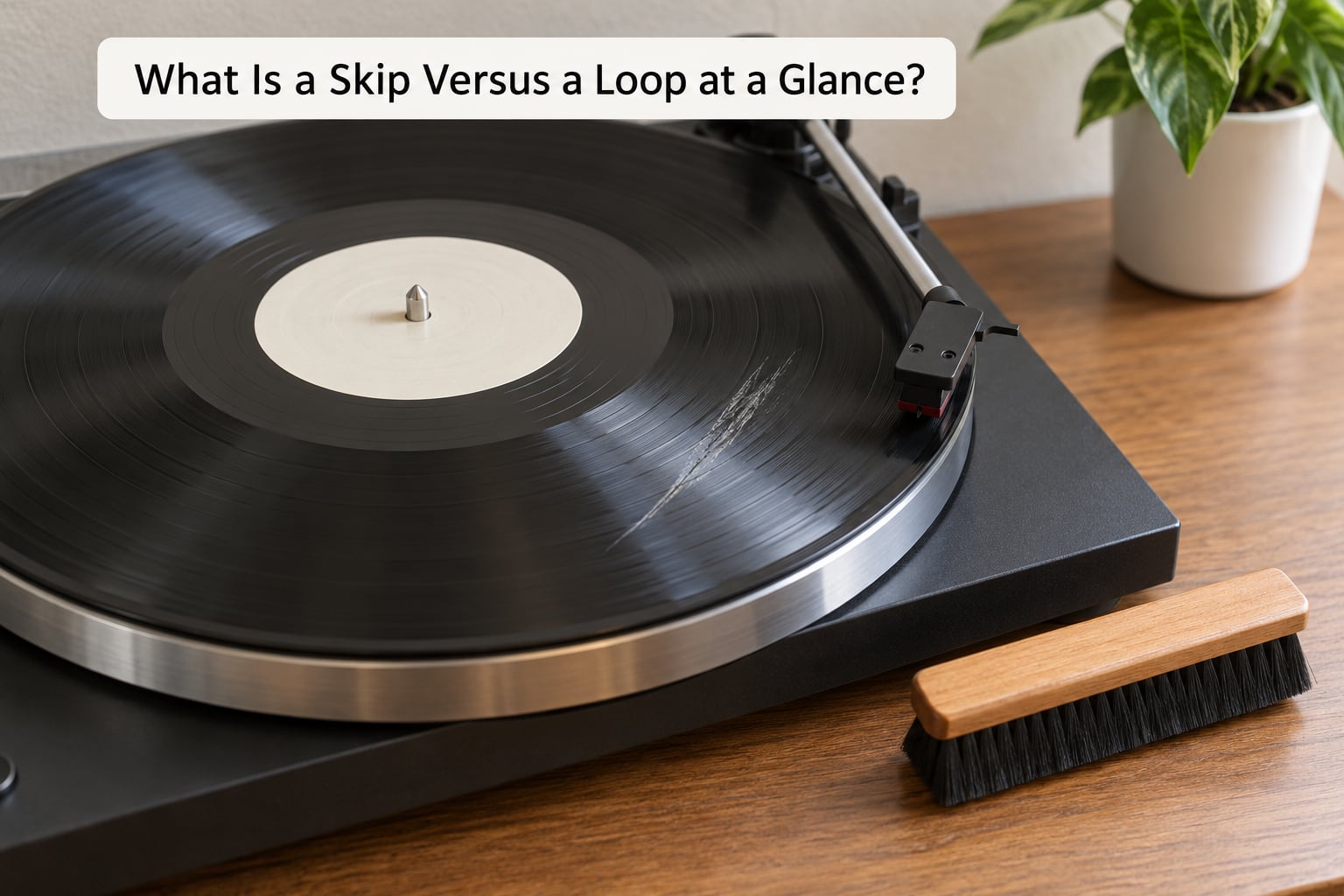
Here is the short version. Both mean the stylus left the groove, but they leave in opposite directions.
| Criterion | Skip | Loop |
|---|---|---|
| What happens | The stylus lifts out and lands further along the record | The stylus keeps re-entering the groove it just left |
| Direction of travel | Forward | Backwards, over the same audio |
| What you hear | A chunk of music missing, then playback resumes | The same one to eight seconds buzzing back at you in a stutter |
| Does it stop itself | Yes, usually within a fraction of a second | No, it repeats until you intervene |
| Typical cause | Dust, tracking force too light, worn stylus, footfall vibration | Debris in the groove, a scratch that redirects the tip, a pressing defect, anti-skate too high |
| Where it shows up | Anywhere, and often on every record | Usually one spot on one record, often the loudest passage or near the run-out |
| Does cleaning help | Usually yes | Sometimes, and it is the first thing to try anyway |
| First thing to try | Brush the record, then check tracking force | Inspect and clean the groove, then re-tune tracking force and anti-skate |
One more distinction worth holding on to: a loop is not a separate problem from skipping. It is a subtype of it. The mechanism is identical at the start, so a fix that helps skips often helps loops too, just at a different setting.
What Does a Vinyl Skip Sound Like?
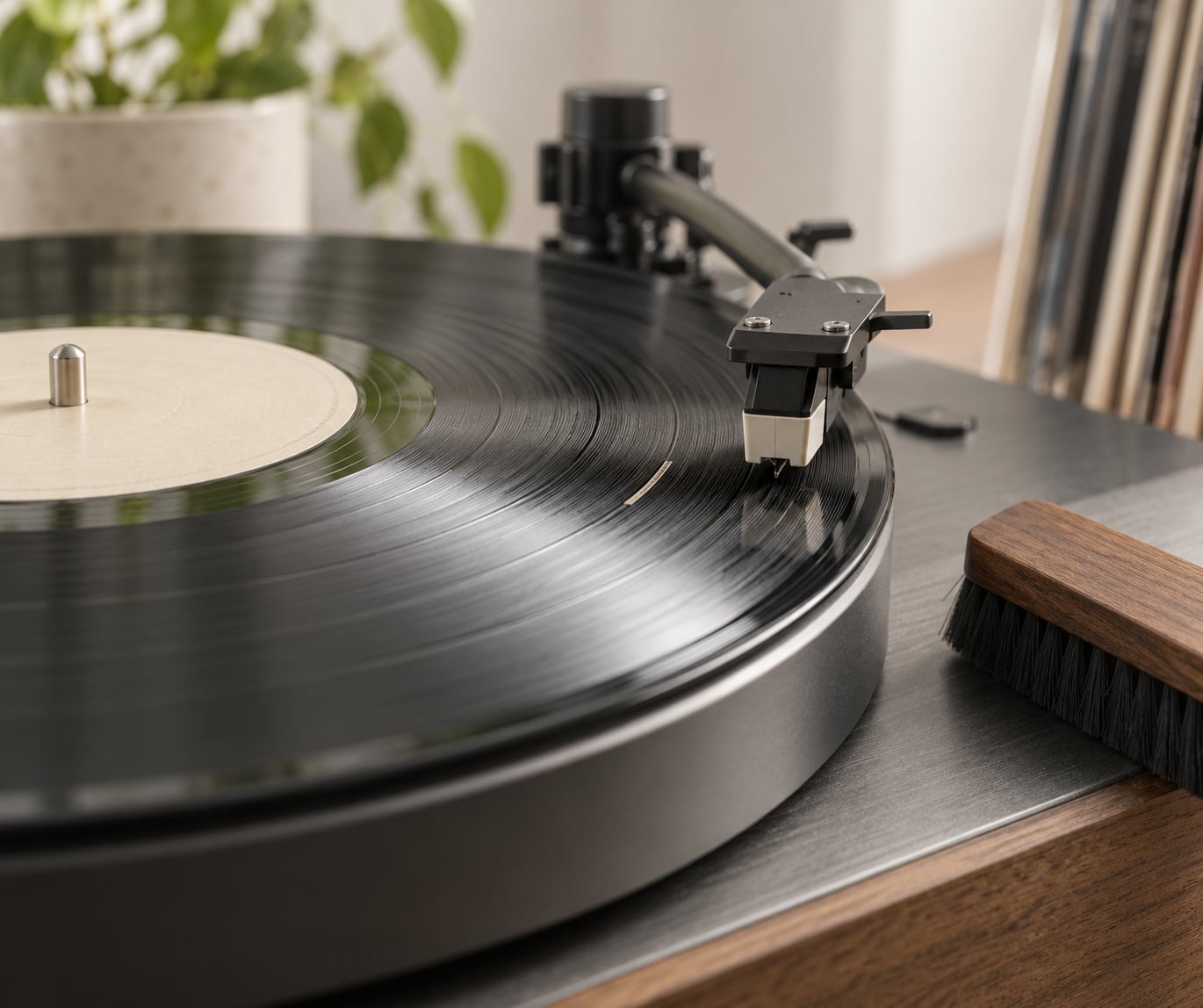
A skip is a clean forward escape. The tip rides up out of the groove, travels across a short section of blank land, and settles back into a groove further ahead. The music jumps ahead with a hole in it.
Held in your hand it feels less dramatic than it sounds. You might notice one drum hit missing, or the vocal line cutting to the next bar. On a quiet passage you may not hear it at all, and on a dense mix of percussion it can hide for a while.
A single skip that you hear once is usually nothing more than a particle of dust meeting the stylus. A skip that returns at the same point every time you play that passage is a different animal, and closer to a loop in effect even though it is not one.
What Does a Vinyl Loop Sound Like?
A loop is a stuck return. The stylus moves backwards into the groove it has just left and plays that stretch of audio again, usually with a buzz or grind underneath it. The phrase is usually short, somewhere between a second and several seconds.
On a spoken-word passage the tell is unmistakable: the same word repeats over and over, syllable by syllable. On a dense instrumental passage it sounds more like a stutter, and it can be easy to mistake for a bad pressing.
Unlike a skip, a loop does not resolve on its own. It will repeat indefinitely until you lift the tonearm, stop the platter, or the stylus finally finds its way forward on a lucky pass.
Collectors describe the pattern in a single line: loops tend to occur where the groove “kisses itself” during a more dynamic passage, and a stylus that jumps back into the previous groove often points at anti-skate set too high.
What Causes a Skip?
Dust and debris come first, and they account for most of it. A single particle sitting on the record surface acts as a tiny ramp, lifting the stylus out of the groove and dropping it ahead. A carbon fibre brush before and after each side clears most of it in seconds.
Tracking force set too light is the next most common cause. At the low end of the 1.5 to 2.5 g range typical of moving-coil and high-output cartridges, a quiet or slightly worn groove cannot hold the tip down and it lifts easily.
A worn stylus is a quieter cause and often gets blamed on the record. Most diamond tips give up somewhere around 800 to 1,000 playing hours, and a record can hold roughly 1,500 feet of groove per side, so wear adds up faster than most people expect. The tip gets blunt, rides higher, and skips more readily.
Vibration from footfalls and an unlevel deck are the causes people forget. If your record skips every time you walk past the deck, the floor is moving the plinth, and a bubble level check plus a firm shelf or isolation pads usually settles it.
Warping deserves its own mention because it produces a skip that ignores every other fix. A dished record makes the stylus lose contact on the way down into the warp and again on the way out, often with two skips per revolution of the same bent section.
What Causes a Loop?
The core cause is directional. Something bends the path of the stylus so that on its way out of one groove it falls back into the groove behind it, and the same thing happens again on every pass.
Debris in the groove is the gentle version of that. Forum consensus leans heavily toward small pieces of vinyl material and shop dirt sitting in the groove and blocking the tip from riding out. That is usually clearable.
A scratch that crosses the groove at an angle redirects the tip sideways and downwards. If it crosses where the groove pitch is tight, the tip can be pushed back a whole groove. On scratched used copies this is the usual culprit.
A pressing defect is the stubborn version. On new vinyl, a sliver of vinyl can curl over the groove and prevent the stylus advancing to the next one. Forum members describe this as rare on good pressings but real, and it is the reason a brand new record can loop on a healthy turntable.
Setup contributes more than people expect, especially at the end of a side. In the run-out and inner-groove region the grooves sit closest together and the arm needs the most anti-skate compensation. Set anti-skate above your tracking force there and the arm is being pulled inward against the record’s natural tendency, which is exactly the recipe for a loop.
Loud, dynamic passages raise the odds too. More energy in the groove means more modulation for the stylus to follow, so a marginal setup that sails through a quiet intro can loop three bars into a chorus.
How to Tell the Difference on a Record
You can identify which fault you have with four quick tests, and none of them cost money.
- Play a different record. If the fault follows the record into another groove on another pressing, the record is the problem. If it follows the same rotational position on every record, your setup is.
- Check the rotational position. Note roughly how far into the side it happens. A fault that recurs at the same point on several different records points at tracking force, anti-skate, or deck level rather than the vinyl.
- Turn the volume down. Many skips disappear at low volume because the groove is no longer being modulated hard enough to throw the tip. Loops are more stubborn and often persist even when quiet.
- Walk past the deck while it plays. A skip that appears only on footfalls is vibration. Try the same record somewhere else entirely, on a wall-mounted shelf or a different deck, and watch what happens.
One more check costs nothing and settles most arguments. If the record is new and has never played properly, suspect your setup before you suspect the pressing: a fresh copy from another shop will sit at the same place on the platter and do it again.
How to Fix a Skip Without Damaging Your Vinyl
Work in order, cheapest step first, and stop as soon as the skipping stops.
Brush both sides with a carbon fibre brush before and after each play. That alone resolves a surprising share of skips, and it costs nothing beyond the brush.
If skipping continues, do a proper wet clean with a fluid designed for vinyl, a lint-free cloth and a brush. Residue picked up in a record shop looks exactly like a manufacturing defect and cleans up completely.
Next, check your tracking force with a VTF gauge against the cartridge manufacturer’s range. Too light is far more common than too heavy, and bumping toward the upper end of the range is a safe first move.
Then look at the stylus under magnification. A grooved or chipped tip is finished, and no amount of cleaning will change that. Replacing the stylus is cheap next to replacing the cartridge, and far cheaper than the damage a bent cantilever does.
Finish with the deck itself: check it sits level, confirm the isolation feet or pads are doing their job, and keep speakers off the same shelf or wall as the plinth.
Stop before you reach for anything harsher. A record that will not play through a careful clean, a correct setup and a fresh stylus is telling you something about the groove.
How to Fix a Repeating Loop
Lifting the tonearm by hand ends the loop without ending the side, and that is the correct way to step past it. Do not tap the turntable or knock the plinth to push the music along. Collectors warn specifically that this can throw the stylus out of the groove entirely and do far more damage than the loop ever did.
Put the record on, go to the problem spot, and stop the platter. Inspect it under a bright angled light. A scratch shows as a hard bright line; debris looks like a speck sitting in the path of the groove.
Clean that section properly. If there is something solid sitting in the groove, the gentle toothpick trick with the record playing slowly, ideally under magnification, can persuade it out. Collectors argue about whether this is good practice, so use a wooden toothpick only, never metal, and never force it.
If the groove looks clean, re-tune the deck for the passage. Drop anti-skate to zero and raise tracking force by roughly 30 to 50 percent, inside what your cartridge allows. This is the standard fix recommended for a suspected anti-skate loop, and it costs nothing.
Play that section through five to ten times. A slightly deformed groove often reforms under the stylus and the loop stops returning. That is the cheapest fix available and it works more often than it has any right to.
If the loop survives all of that, it is a defect. A new record that loops on a healthy system is worth returning or exchanging; the shop will usually take it back, and telling them it is not your setup makes the conversation easier.
One last warning: backcueing a stuck loop with a conical DJ stylus can reshape the groove, but long-time collectors describe it as a good way to ruin a cartridge. It is also unsafe on a belt-drive turntable. Leave it alone unless you know exactly what you are doing.
Skip vs. Loop: Which Problem Are You Actually Hearing?
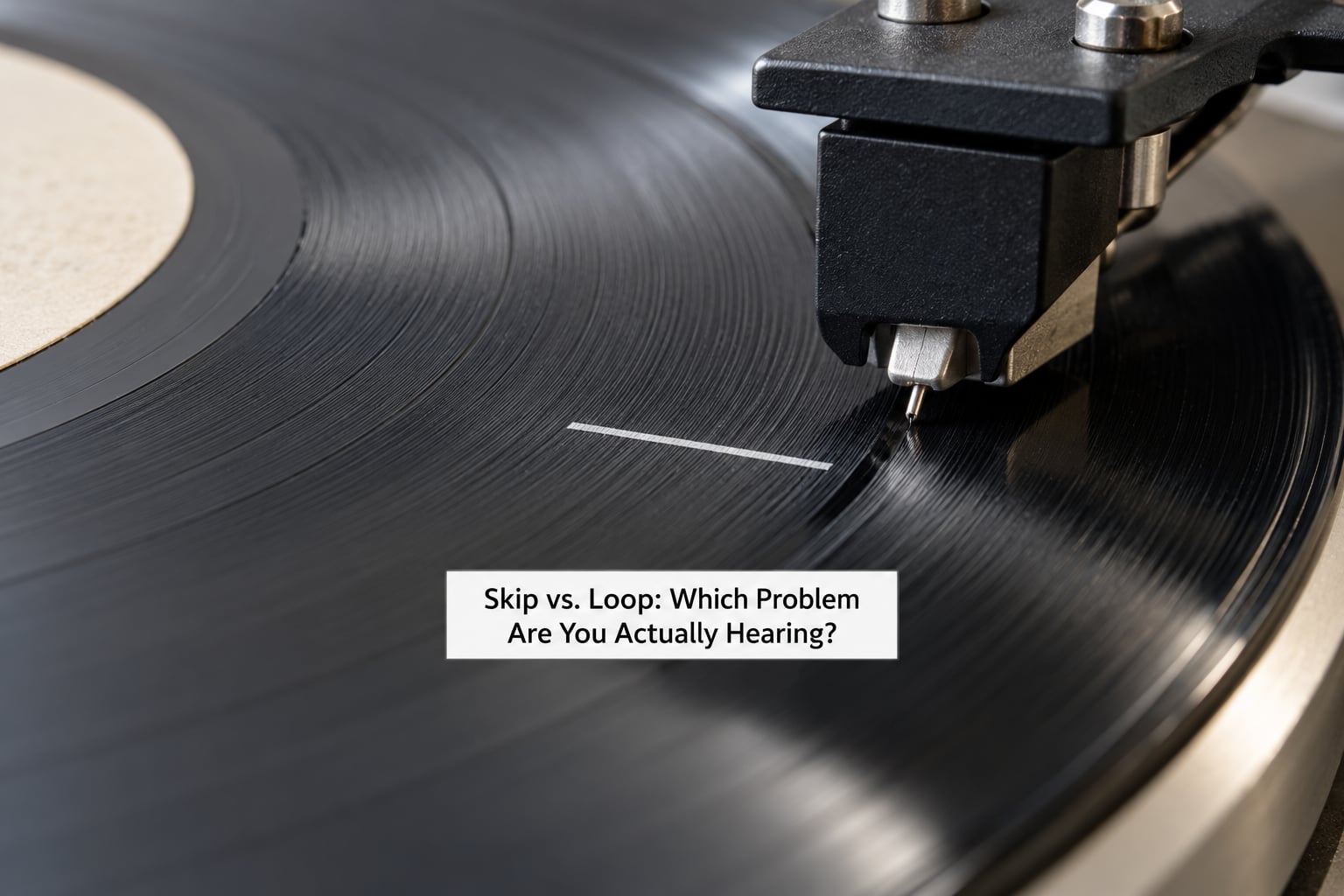
Here are five real situations that all get called “the record skipping”.
A track that jumps forward once and carries on. That is a skip, and it is almost always dust or a tracking force that is a fraction too low.
A word that repeats until you lift the arm. That is a loop, and debris, an angled scratch or an inner-groove anti-skate setting are the three candidates.
A passage that genuinely repeats in the music. Some records loop on purpose, in industrial, noise and experimental music, and the giveaway is that the phrase repeats identically on every clean copy rather than only on yours. The drum and bass figure that closes The Who’s “A Quick One, While He’s Away” is the example collectors point at most.
A buzz that speeds up or slows with the music. That is neither. You are hearing tracking feedback or a motor and speed problem, and no cleaning will touch it.
A scratch you can see but cannot hear. A light surface scratch is cosmetic. A skip or loop needs a defect deep enough to move the stylus off the groove wall, which is why most visible scratches are harmless.
The pattern holds: a forward jump with a gap is a skip and usually means setup or dust. A stuck repeat of the same audio is a loop and usually means the groove itself.
Which Should You Choose?
Choose by symptom, and the sequence is short.
If the fault moves forward and leaves a gap, start at the record: brush it, wet clean it, then check tracking force and the stylus. If the same seconds keep coming back, start at the groove: inspect under light, clear debris, then drop anti-skate to zero and raise tracking force.
If it happens on every record at the same point, it is the turntable and no cleaning will help. If it happens on one record in one place, it is the record and no setup change will fix it reliably.
And if it only appears on new vinyl, read that as a signal about your setup before you read it as a bad pressing. Many owners who thought they had defective records found out that the fault sat in the last two tracks of a side, where the grooves run closest together.
Frequently Asked Questions
Is a vinyl skip the same as a repeating loop?
No, though they share one root cause. A skip is a forward jump: the stylus lifts out and lands ahead, so the music resumes further on with a gap. A loop is a backward jump: the stylus falls back into the groove it just left and replays the same second or several seconds until you stop it. A loop is best understood as a skip that never escapes.
Why does my record keep skipping the same section?
If it is one record in one place, the groove is damaged or dirty. Debris in the groove, an angled scratch and a pressing defect all produce this. If it happens at roughly the same point on several different records, your tracking force, anti-skate or deck level is the problem instead. Note the position and test a second record to tell the two apart in under a minute.
Can cleaning a record fix skips and loops?
Often enough to be the first step every time. A carbon fibre brush clears most skips in seconds, and a wet clean removes shop dirt and fine debris that blocks a loop. Cleaning will not repair a scratch that has deformed the groove wall or a pressing defect where vinyl curls over it. If a careful clean changes nothing, the fault is in the groove geometry, not the dirt on top of it.
How do I know if my stylus is causing the problem?
Look at the skips. A worn or dirty stylus shows up on every record, usually on light or quiet passages, and gets worse as the side plays on. A single record with one bad spot points to the vinyl instead. Check the tip under magnification for grooving or a flattened tip, and remember that most diamond styli last roughly 800 to 1,000 playing hours.
Does a warped record always cause a skip or loop?
No. Warping causes skips far more often than loops, because the stylus loses contact as the record dips down and comes back out. A warp also tends to produce two skips per revolution at the same place, which reads as a repeating pattern without being one. If a warped record also loops, the loop is coming from a scratch or debris rather than the warp itself.
Should I keep playing a record that skips?
Yes, carefully. A skip or loop does not damage the record, though the fault itself will not go away on its own. What can cause damage is forcing a locked groove past the stylus or tapping the turntable to move the music along, which can throw the stylus out of the groove. Lift the tonearm to step past a loop and keep the rest of your routine the same.
Conclusion: Start With the Record, Then Check the Turntable
A skip jumps forward and leaves a gap. A loop goes backwards and repeats the same audio until you stop it. That is the whole difference, and it tells you where to start looking.
Stop the record when the fault happens and note the position. Clean the groove properly, brush the surfaces, and check the damage under a bright light. Then play a second record: if the fault follows that one too, it is your setup, so check tracking force, anti-skate and whether the deck is level.
If only the one record is affected, re-tune before you give up on it. Anti-skate to zero, tracking force up 30 to 50 percent, then play the section through five to ten times to let the groove reform. Most loops that look terminal give up somewhere in that sequence.
And if you have to ask whether something is a defect, lift the tonearm rather than tapping the turntable. Your stylus is the expensive part of this whole puzzle.