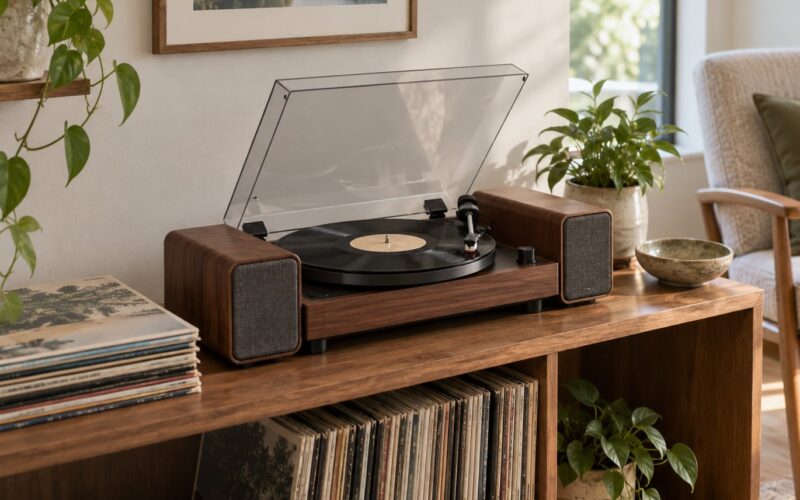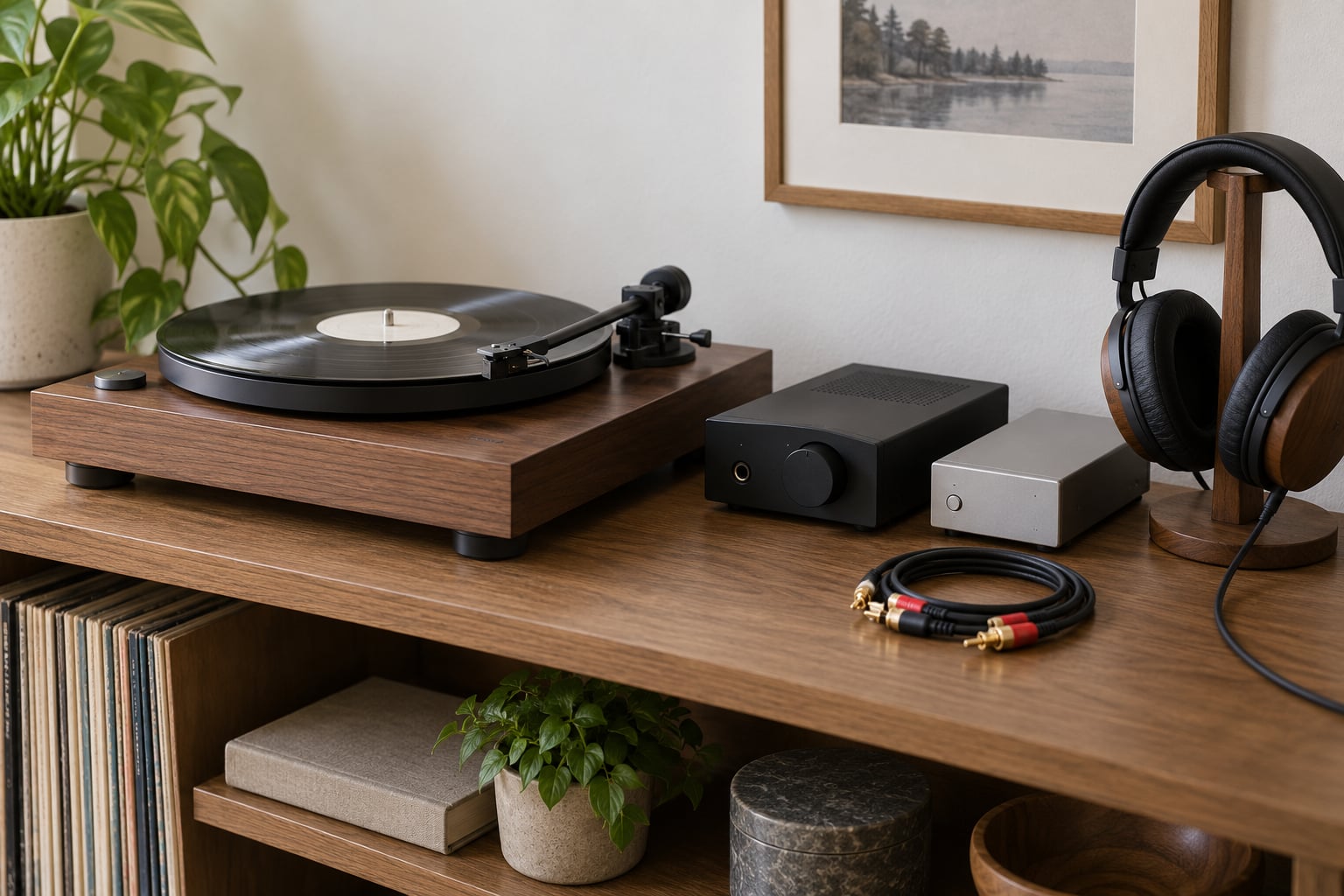
You cannot plug headphones straight into most turntables and expect to hear music. The signal leaving a turntable is phono level — tiny, and with the bass and treble deliberately shaped a certain way — so it has to pass through a phono preamp to become line level, then through a headphone amplifier with enough power to drive your headphones properly.
The whole chain takes about twenty minutes to wire up the first time. Two boxes, two sets of cables, and a turntable with a built-in preamp saves you one of them.
Below is how to listen to vinyl with headphones without replacing the player you already own: what each box actually does, three ways to hook it up, what Bluetooth costs you, and what to do when the sound comes out silent, whisper-quiet or hissing.
Table of Contents
- What You Need
- Three ways to listen to vinyl with headphones
- Does the turntable need a built-in preamp?
- Do you need a DAC?
- Step-by-Step: How to Listen to Vinyl With Headphones
- Check Your Turntable’s Phono Output
- Choose the Right Headphone Connection
- Connect the Headphones Without Humming or Hiss
- Set the Volume and Start the Record
- Common Mistakes
- The honest drawback: surface noise
- What about Bluetooth?
- Listening tips
- Frequently Asked Questions
- Can I listen to vinyl records with headphones without an amplifier?
- Do I need a phono preamp to listen to vinyl with headphones?
- Why does my vinyl sound quiet or distorted when I use headphones?
- What is the best headphone amplifier for a turntable?
- Can I use Bluetooth headphones with a turntable?
- How loud should I listen to vinyl through headphones?
- Conclusion
What You Need
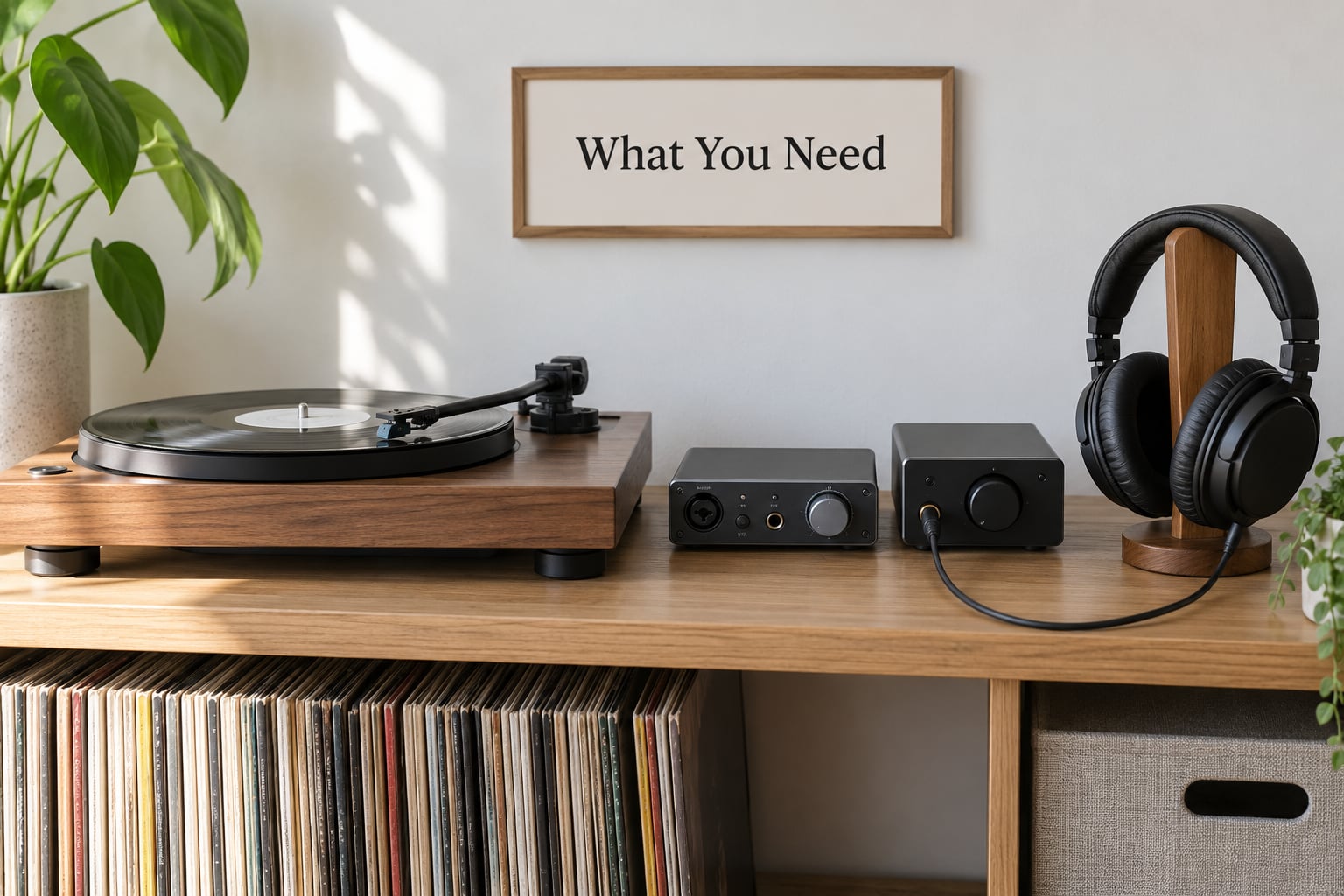
The chain has four links, and every one of them has a job. Get this right and you never think about it again.
- Turntable — the cartridge and stylus convert groove movement into an electrical signal.
- Phono preamp — applies the RIAA equalisation curve and boosts the signal to line level, roughly 2V.
- Headphone amplifier — supplies the voltage and current to drive the earphones at a volume you can actually hear.
- Headphones — plus whatever cable or adapter connects to the amp’s output.
Three ways to listen to vinyl with headphones
- Bluetooth turntable — a player such as the Audio-Technica AT-LP60XBT streams straight to wireless headphones. Zero boxes in between, and real trade-offs (see the Bluetooth section below).
- Dedicated headphone amp with an external phono preamp — the enthusiast route, and the cleanest for a hi-fi turntable with no built-in preamp.
- Stereo receiver or integrated amplifier with a headphone jack — the phono stage and headphone output live in the same box. For most beginners this is the cheapest and fewest-cables answer.
Does the turntable need a built-in preamp?
Not strictly, but it decides how many boxes you buy. A built-in preamp lets you run the turntable into any line-level input on an amplifier. Switch it on and the turntable’s RCA outputs carry line-level signal instead of raw phono level.
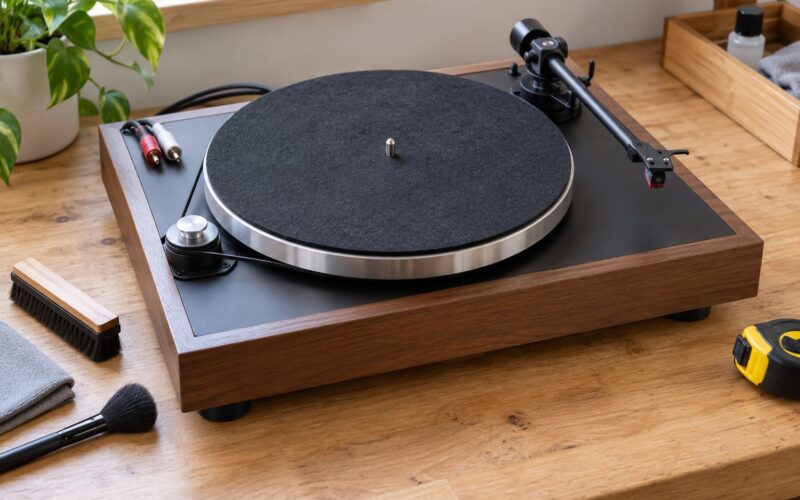
Players with a line/phono switch or a small button near the RCA jacks usually have one. Look for a label near the output, or check the manual for a “phono/line” toggle. If you see a small knob marked gain near those jacks, that is the preamp.
A built-in preamp is not a magic upgrade — cheap ones are usually fine, and a good external one beats a bad internal one. But it means you can start listening tonight with what you already own.
Do you need a DAC?
No. A DAC converts digital audio to analogue; a turntable output is already analogue. The box people mistake for a DAC is the phono preamp. If someone told you to add a DAC to a vinyl setup, they meant a phono stage.
Step-by-Step: How to Listen to Vinyl With Headphones
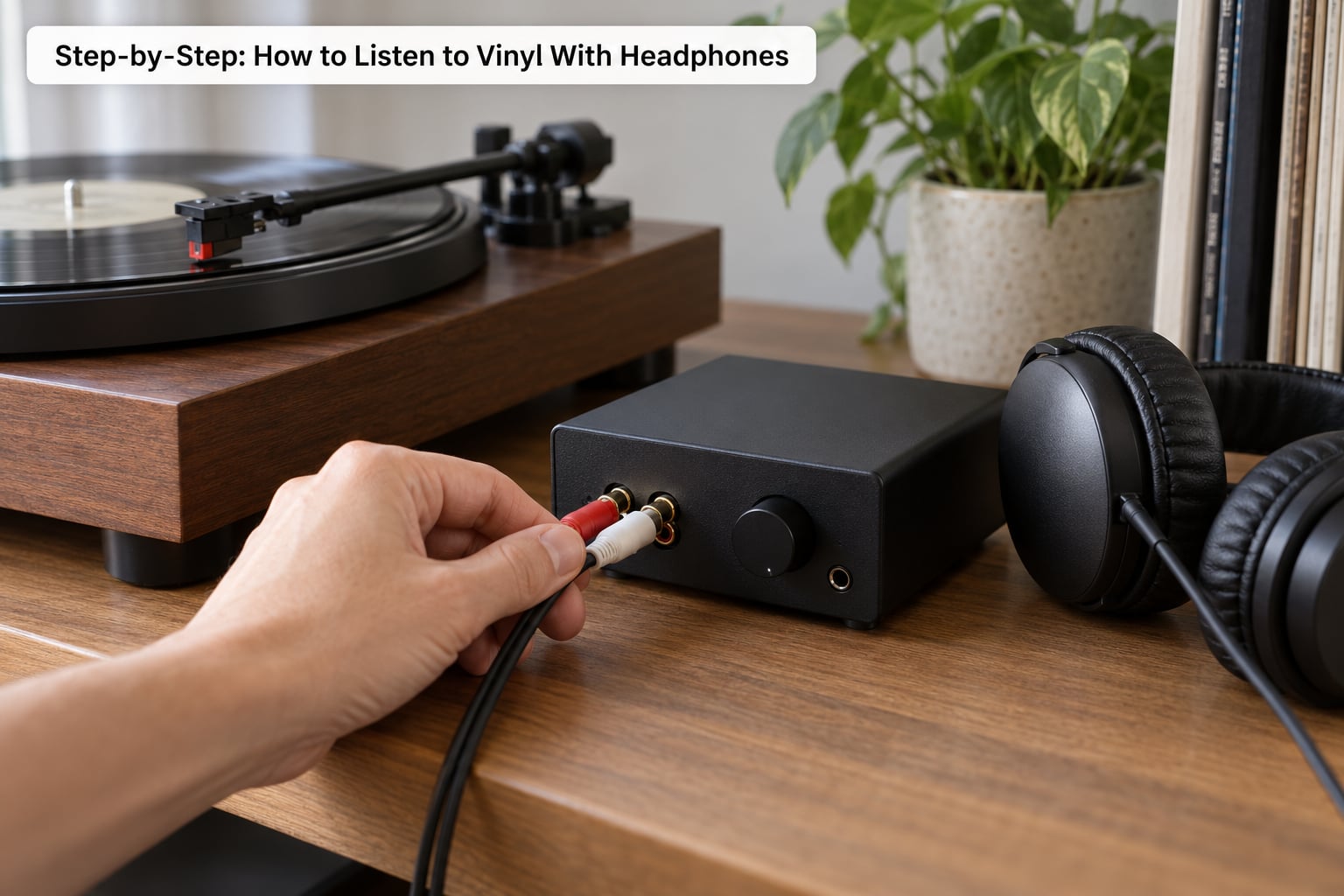
Check Your Turntable’s Phono Output
Start at the source. Look at the back of the turntable and find the RCA output pair, usually red and white and labelled PHONO or LINE OUT.
- Find a switch, button or removable jumper on the back panel marked line/phono. If it exists, set it to the position you need and note where it was.
- If there is no switch, check the manual. Players with a built-in preamp usually ship with the line side engaged or with a shorting plug fitted.
- If the outputs are labelled PHONO only and there is no switch, assume phono level. You will need a preamp stage downstream, either external or built into the amp you connect to.
The test is simple: with a preamp downstream, phono-level output sounds quiet and thin. Line-level output sounds roughly where you would expect it. If it is too quiet, flip the switch rather than turning the volume up.
Choose the Right Headphone Connection
Headphone outputs come in a few sizes, and the socket you have decides what cable you need.
- 6.35 mm (quarter inch) — the standard full-size headphone socket, found on most amplifiers and headphone amps. Full-size headphones use it natively.
- 3.5 mm — the same plug scaled down. Earbuds and travel headphones use it; a simple screw-on adapter handles the rest.
- 4.4 mm balanced — used by some portable gear and higher-end amps. Only worth wiring up if both your amp and your headphones support it.
None of that matters until the amp can drive what you plug in. High-impedance headphones — many planar magnetic models in particular — want an amp with real voltage, and a small desktop amp that looks cheap may just struggle. A headphone that stays quiet, sounds thin, or changes character when you turn it up usually means the amp, not the record.
If you already own speakers and an integrated amplifier, check it before buying anything. Most budget amplifiers have a headphone jack on the front and a PHONO input on the back, which covers the entire chain in one box.
Connect the Headphones Without Humming or Hiss
Wire it in this order: turntable into preamp, preamp out into the headphone amp, headphones into the amp. Do not run the chain sideways, and keep power cables away from the RCA interconnects.
Channel order matters. Red goes to right, white to left, and if one side is missing you have usually swapped them somewhere. Plugging a balanced cable into an unbalanced socket and vice versa can cost you a channel or add a hum you did not ask for.
Loose adapters are the most common cause of a rattle or intermittent buzz in this chain. Seat every plug firmly, and if a cheap adapter is the only thing between your cable and the amp, replace it before you blame the preamp.
Set the Volume and Start the Record
With the record stopped, turn the amp volume all the way down before you connect anything. Connect the headphones, then bring the volume up to about one third. Cue the tonearm, drop the needle, and let the record spin.
Expect a phono-level signal into a phono stage to be fairly quiet compared with streaming or CD. Turn up gradually rather than slamming the gain. If the amp has a gain switch, set it for your cartridge: moving magnet cartridges work with most stages, moving coil cartridges usually need the higher-gain position or an external headshell-mounted stage.
Once it is playing, keep the level moderate. Around 110 dB is roughly where long sessions start to feel uncomfortable for most people, and higher levels get tiring much faster. Headphone listening tends to creep upward because there is no room sound to remind you the volume went up.
Common Mistakes
Almost every beginner problem comes down to one of these.
- No sound at all — usually the wrong input. Line-level signal into a PHONO input sounds tiny; phono-level into an AUX or CD input sounds thin and quiet. Move the cable.
- Very quiet sound — phono level with the preamp bypassed, or a low-impedance headphone on a weak amp. Check the line/phono switch first.
- Thin, harsh or nasal sound — the RIAA curve is not being applied. You are feeding phono-level signal straight into a line-level headphone stage.
- Humming or buzzing — an unconnected ground, a loop between components, or a cheap adapter. Unplug and reconnect one cable at a time to isolate it.
- One-sided playback — channels swapped or a partially seated plug. Check red-to-right and white-to-left at every connection.
- Constant crackle and hiss — this one is the record, not the electronics. See below.
- Volume too high on the amp — if you cannot turn it down far enough, your cartridge or headphone pairing is wrong, not your taste.
The honest drawback: surface noise
Headphones remove the room, and with it any masking of surface noise. A light crackle that vanishes behind a pair of speakers sits right in front of you in headphones, and it is the single complaint that comes up most often in listening forums.
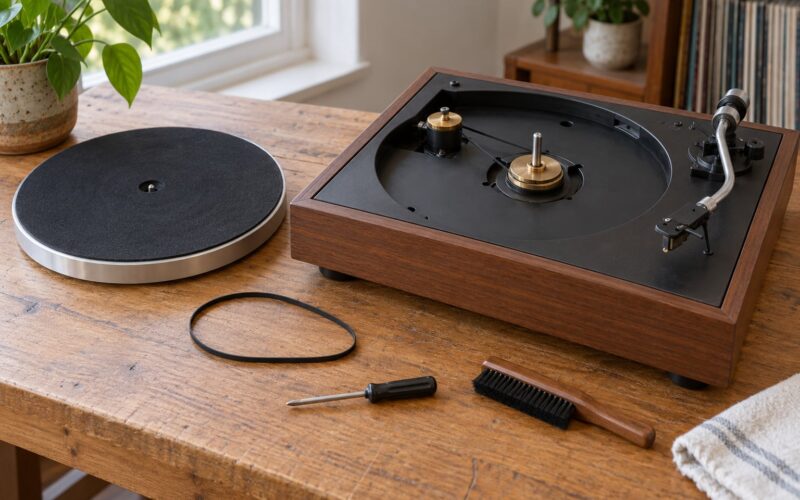
This is why records matter more, not less, on a headphone setup. A soft brush and a cleaning fluid, used before every side, removes most pops. A carbon-fibre brush used dry, following the groove in the direction of rotation, takes care of the fine crackle between tracks. A stylus cleaner clears the dust that makes the pops. None of it takes more than a minute.
What about Bluetooth?
You can listen to vinyl over Bluetooth, and plenty of people do. A Bluetooth-capable turntable pairs directly with wireless headphones, which is convenient at 11pm and in a small flat. It is not the best-sounding route, for three reasons.
- Compression — wireless audio is encoded and squeezed. SBC, the baseline codec, is lossy in a way that dulls fine detail. AAC, aptX HD and LDAC all hold more of the original signal, but only if both devices support the same one.
- Latency — the delay between the stylus touching the groove and the sound arriving is enough to blunt the needle drop and make timing feel loose.
- It muddies the record — a wireless setup makes people blame vinyl for what is actually a codec problem. Judge the format on a wired chain before you judge the format at all.
Wireless is a convenience trade, not a quality upgrade. Use it when convenience matters more, and reach for a cable when you are assessing how a record actually sounds.
Listening tips
Volume moderate, session short enough that you still enjoy the second side. Match the headphone to the session: closed-back for a shared room and for hearing record noise less, open-back for the wide soundstage that suits a well-recorded stereo cut, and planar magnetic only if your amp has the voltage for it.
Clean the record before it goes on, not after you decide it sounds tired. And when a record disappoints, the headphones rarely moved the needle that far — mastering, cleaning and cartridge tracking account for most of what you hear.
Frequently Asked Questions
Can I listen to vinyl records with headphones without an amplifier?
Only if your turntable has a headphone jack and a built-in phono preamp, which is rare. Standard turntables output a tiny phono-level signal, and the 6.35 mm jack on many players is meant for a line-level signal from an external preamp. Plugging ordinary headphones into a bare phono output gives you either silence or a very faint, thin sound.
Do I need a phono preamp to listen to vinyl with headphones?
You need one stage that performs the function, and that stage can live in three places. A turntable with a built-in phono preamp already has it, a stereo receiver’s PHONO input is one, and a headphone amp with a plug-in phono card is one. What matters is that the RIAA equalisation curve gets applied somewhere between the cartridge and your ears.
Why does my vinyl sound quiet or distorted when I use headphones?
Quiet usually means phono-level signal reaching a line-level stage, often because the line/phono switch is in the wrong position. Distortion usually means the headphone amp is being asked for more voltage and current than it can deliver, which is common with high-impedance planar magnetic headphones on a small desktop amplifier. Check the switch before you change any hardware.
What is the best headphone amplifier for a turntable?
Match the amp to the headphone, not the turntable. Low-impedance dynamic headphones need very little voltage and work from almost any amp with a 6.35 mm output. High-impedance models need an amplifier with genuine voltage headroom and low output impedance, or they will sound quiet and flat. A stereo receiver with a headphone jack is a perfectly capable starting point.
Can I use Bluetooth headphones with a turntable?
Yes, if the turntable has Bluetooth output, and it is convenient for late listening or small rooms. You lose some fine detail to codec compression and you gain enough latency to blunt the needle drop. Codecs such as AAC, aptX HD and LDAC sound better than baseline SBC, but a wired connection still wins on both clarity and timing.
How loud should I listen to vinyl through headphones?
Lower than you think. Roughly 110 dB is where long sessions begin to feel uncomfortable for most listeners, and the figure rises fast once you are past it. Because there is no room sound to signal that the level has crept up, turn the volume down a notch every side. A headphone amp that makes you turn it down far is telling you the pairing is poor.
Conclusion
Start at the back of the turntable. Confirm whether its RCA output is phono level or line level, put a phono preamp on the signal, run that into something with a headphone output, and set the volume low before you drop the needle.
Everything past that is preference — which headphone, which room, how many cleaning passes. The chain itself takes an afternoon, and once it is wired correctly, listening to vinyl with headphones is the quietest, most detailed way to hear a record.