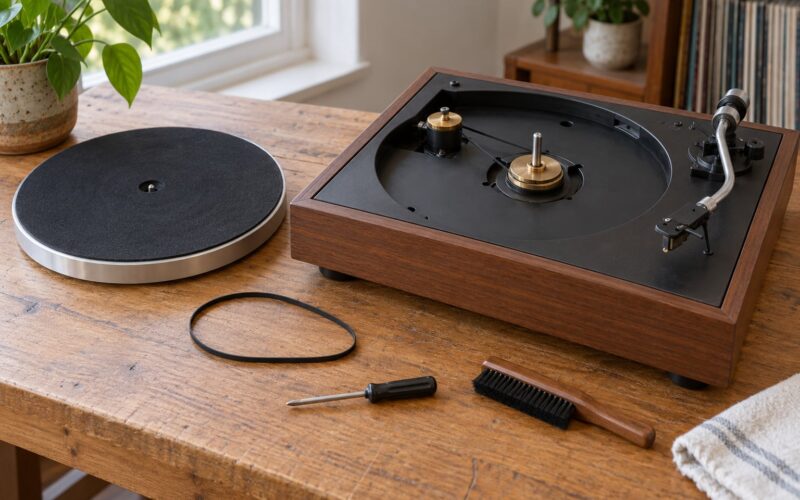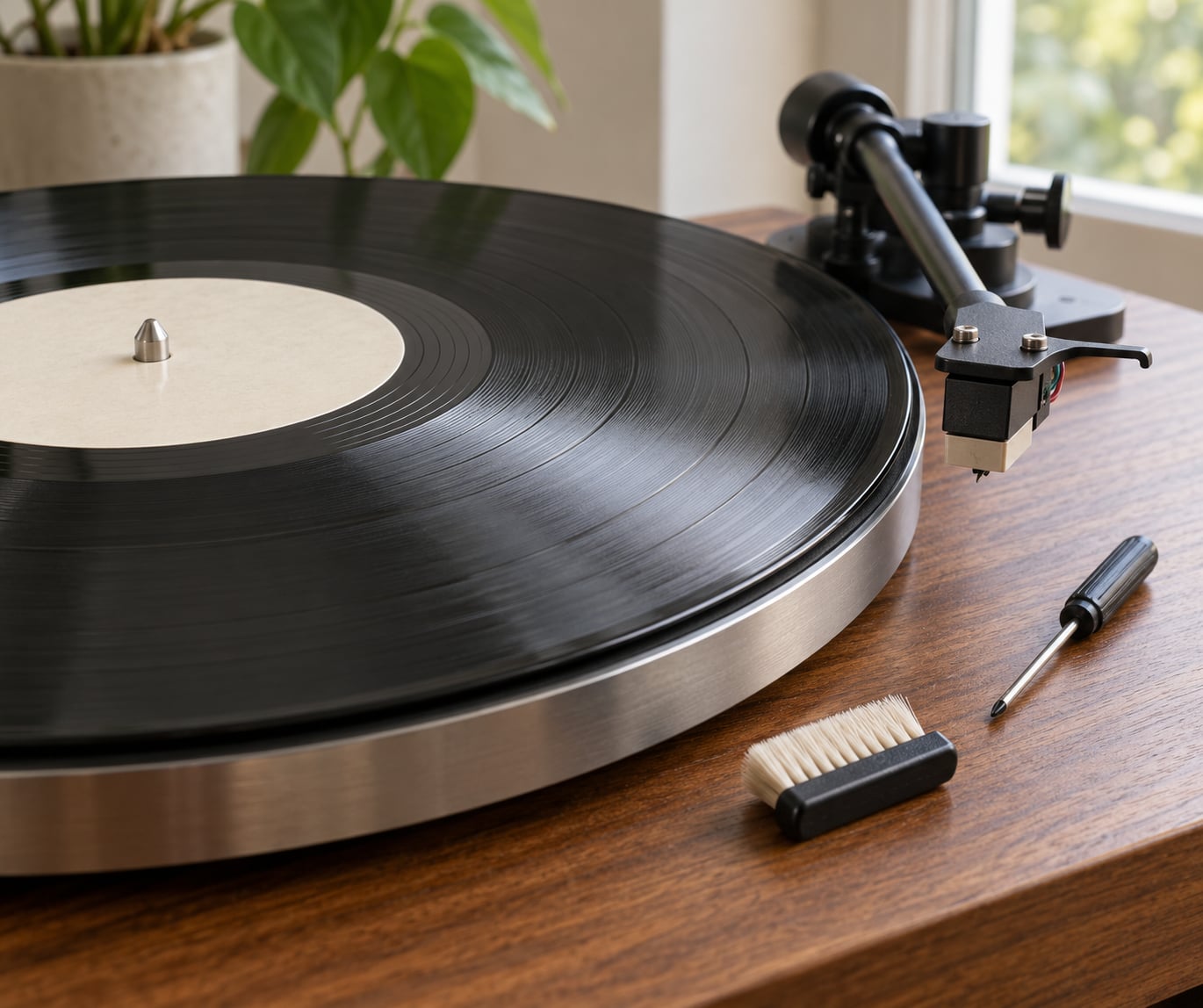
Why does the end of my record distort? Because the last few tracks of each side sit in the narrowest, slowest and most sharply curved grooves on the disc. If those tracks sound harsh, squeaky or fuzzy, you are hearing inner groove distortion. A dirty or worn stylus, poor cartridge alignment or too little tracking force makes it much worse, and all three are fixable at home.
I have spent more hours than I care to admit chasing this with cheap belt-drive decks and entry-level cartridges, and the pattern is almost always the same. The record is rarely the main culprit, even when it looks battered.
Table of Contents
- What Does a Distorted End of a Record Mean?
- Why the outer grooves ask more of your stylus
- Why Does the End of My Record Distort?
- 1. A worn or damaged stylus
- 2. A dirty stylus
- 3. Poor cartridge alignment
- 4. Not enough tracking force
- 5. Anti-skate and tonearm geometry
- 6. Warp or off-centre pressings
- 7. Platter speed and preamp settings
- Why Does Only the Last Part of the Side Sound Bad?
- How to Tell Whether the Record or Turntable Is Causing It
- How to Fix Distortion at the End of a Record
- When You Should Replace the Record or Cartridge
- Frequently Asked Questions
- Why does my vinyl sound distorted only near the end?
- Can a warped record cause distortion at the end of a side?
- How do I know if the problem is my stylus or my record?
- Does a heavier tracking force fix distortion at the end of a record?
- Why does my record speed up or sound lower at the end?
- When should I stop playing a record with a damaged outer groove?
- What Should You Check First?
What Does a Distorted End of a Record Mean?
Inner groove distortion, usually shortened to IGD, is the loss of clarity that shows up in the final few minutes before the run-out groove. Sibilance on cymbals and hi-hats is the classic signature. Listeners also describe it as grainy, fizzy, or as if the music were being squeezed through a narrower path.
It is worth separating that from other problems, because they need different fixes. Fading is a loss of level and treble that spread evenly across the whole side. Clipping is flat-topped crunch from an overloaded preamp or a badly cut master, and it can hit any part of a track. Crackle is random clicking from dirt or static, not concentrated at the end. A pitch problem makes the whole side run slow or fast.
Concentrating at the inner grooves points to geometry. Near the label a 12-inch LP has only about 4.75 inches of usable groove left, so the stylus has to trace the same musical information in a fraction of the space.
Why the outer grooves ask more of your stylus
A record is a spiral. As the stylus moves inward, the groove gets narrower, the lateral groove speed drops and the recorded wavelengths get shorter. That means the stylus has to follow faster, tighter curves to read the same high frequencies.
At 33 1/3 RPM the linear groove velocity is roughly 20 inches per second at the outer edge and closer to 8 or 9 inches per second near the label. Same signal, less room, more curvature. That is the physics behind the problem, and it is also why nobody plays a record from the label outward.
Why Does the End of My Record Distort?
Seven causes account for nearly every case. I have listed them in the order I would work through them, simplest and cheapest test first, rather than by how serious they sound.
1. A worn or damaged stylus
A stylus has a tiny, precisely shaped tip that is expected to last somewhere around 500 to 1000 hours depending on the profile and the records it plays. As it wears, the tip flattens and no longer matches the groove wall geometry, so tracking gets worse exactly where the groove is hardest to follow.
Look at the tip under a strong light with a magnifier or your phone camera zoomed in. A healthy tip looks symmetrical and sharply defined. A worn one looks flat, jagged or asymmetric, and a bent cantilever is visible as a curve rather than a straight line.
2. A dirty stylus
This is the most common cause and the easiest to fix. Dust and static stick to the tip and form a little abrasive that scratches the groove wall as it plays. A stylus that played an old LP without a cleaning brush can pick up enough debris to sound terrible within a single side.
Symptoms are hiss and a scratchy edge on top of the sibilance, and the damage usually improves slightly and then keeps climbing across the side. It also means you are grinding dirt into your record whether you can hear it or not.
3. Poor cartridge alignment
Every tonearm follows an arc, not a straight line, so the cartridge has to be angled to compensate. Get it wrong and the stylus approaches the groove walls at a bad angle, which produces lateral tracking error that grows as the groove curves get tighter. Alignment errors also raise the vertical tracking angle, and that one climbs quickly once you pass the inner region.
A cartridge that was mounted quickly in the headshell is the usual reason. If the body sits square in the headshell with no rotation at all, it is not aligned, regardless of how good the cartridge is.
4. Not enough tracking force
The stylus is held down by a small force, measured in grams. Under-track and the cantilever gets pushed around by the groove, so it rides the walls instead of following the modulations, and the output grows gritty. Track too hard and you get a different problem: distortion from the stylus being forced off its optimum, plus accelerated record wear.
The manufacturer’s tracking force for the cartridge is a starting point, not a target you never move from. If you are on the light side of that range and the inner tracks distort, nudging it up a fraction of a gram is a reasonable test.
5. Anti-skate and tonearm geometry
Anti-skate is the outward force that stops the arm dragging inward from friction. Set too high, it drags the stylus outward toward the outer edge of the groove wall; set too low, the arm sits inboard and rides the inner wall. Either error is worst at the inner grooves where the walls are closest together.
Arm geometry also matters. Short arms have a tighter arc and more tracking error across the whole record. A radius-fidelity arm or a long arm traces a flatter line and changes tracking error less between the outer and inner grooves.
6. Warp or off-centre pressings
A warped disc rises up and down in the groove, and the stylus has to follow the height changes. Near the label the groove pitch is tighter, so a small warp that went unnoticed at the rim turns into a rise and fall you can hear. An off-centre hole makes the record orbit, which rattles the arm and produces the same kind of unevenness.
7. Platter speed and preamp settings
An off-speed platter makes the whole record pitch-shifted, but a small speed error plus a badly matched preamp can make the end of the side sound worse than it should. Moving-magnet cartridges need far more gain and a very different load than moving-coil ones, and mismatching them adds a harshness that is easy to mistake for groove distortion.
Why Does Only the Last Part of the Side Sound Bad?
Three things stack up as the stylus approaches the centre. Groove pitch narrows, so there are more groove walls per inch. The lateral velocity falls, so the stylus spends less time on each waveform. And the wall curvature rises, so the stylus must swing back and forth faster to follow it.
Each of those increases tracking error on its own. Together they explain why the symptom shows up in the last two to four minutes rather than spread evenly across the side.
There is also a detail almost nobody mentions. The error does not rise in a straight line. Tracking error dips to a minimum at the point where the arm’s arc crosses the radial line, and rises again on either side. Technicians call these the null points, and the second one sits right at the innermost grooves. That is why some records sound acceptable until a specific track and then fall apart.
The run-out and lead-in grooves tell you something too. If the stylus jumps or the pitch wavers in that empty spiral at the end, the groove itself is probably fine, because there is no signal to distort. You are hearing the setup, not the music.
Some records hit this harder than others for reasons that have nothing to do with your system. Dense modern rock mastered loud, and any side cut close to the label, use up groove space quickly. A 45 RPM single holds each note over a much longer stretch of groove at a faster velocity, which is why audiophile 45s usually handle the last track well. A finer tip is not automatically the answer either: a cartridge that resolves more detail can turn mild sibilance into harsh sibilance, so a problem that appears on one record and not the next is perfectly normal.
How to Tell Whether the Record or Turntable Is Causing It
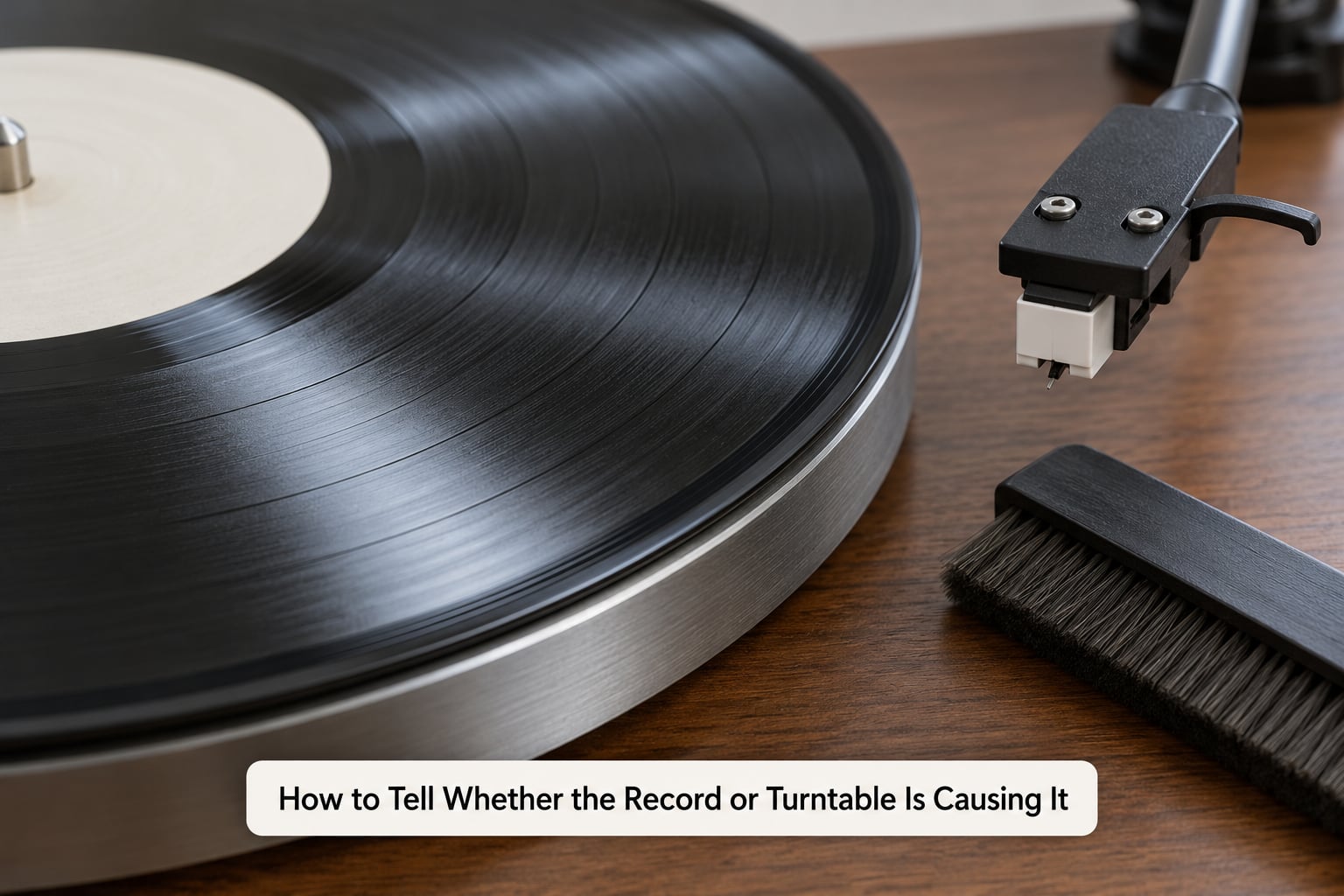
Work through these in order and stop as soon as the problem stops. Each step costs a few minutes and rules something out.
- Play a record you know is clean. A first pressing of something widely reissued is ideal, played from the beginning. If the last tracks of that one are clean and the problem record is not, the record is doing something. If both fade into sibilance at the same point on the side, the setup is the likely cause.
- Check the speed before anything else. Put a strobe or a phone app on the platter and confirm 33 1/3 or 45 RPM exactly. A few percent off is easy to miss by ear and makes the whole side sound tiring.
- Look at the stylus tip under magnification. Clean first, then look, because dirt can look like wear. Any asymmetry, flattening or bend means you are dealing with a damaged cartridge.
- Clean the stylus and the record before replaying. A brush with a single stroke per track, and a proper fluid on a cloth for the record surface, is often enough to change what you hear.
- Play a section near the end of a side and listen for skips. Repeated skips at the same point, in the same place every play, mean groove damage rather than a setup problem. One random skip means little.
Do not test repeatedly with a stylus you already suspect. Every pass puts a damaged tip on a good record and can turn a fixable tracking problem into permanent damage.
| What you hear | Most likely cause | What to try |
|---|---|---|
| Sibilance only in the last two or three minutes of each side | Cartridge alignment or tracking force | Re-align the headshell, then raise tracking force a fraction of a gram |
| Hiss and fuzz that builds as the side plays | Dirty stylus | Clean the tip and the record, replay the same track |
| Gritty, scraping distortion, sometimes on every track | Worn stylus | Replace the stylus or the cartridge |
| Same track skips every single play | Damage to that groove | Stop playing the record there and check for a warp |
| Rises and falls in level, like a slow swell | Warp or off-centre hole | Check the disc edge; a technician can flatten it |
| Whole side sounds sluggish or bright | Platter speed or preamp loading | Verify speed with a strobe, then check the preamp settings |
| Distortion in the empty run-out groove | Setup, not the music | Treat it as a tracking and alignment test |
How to Fix Distortion at the End of a Record
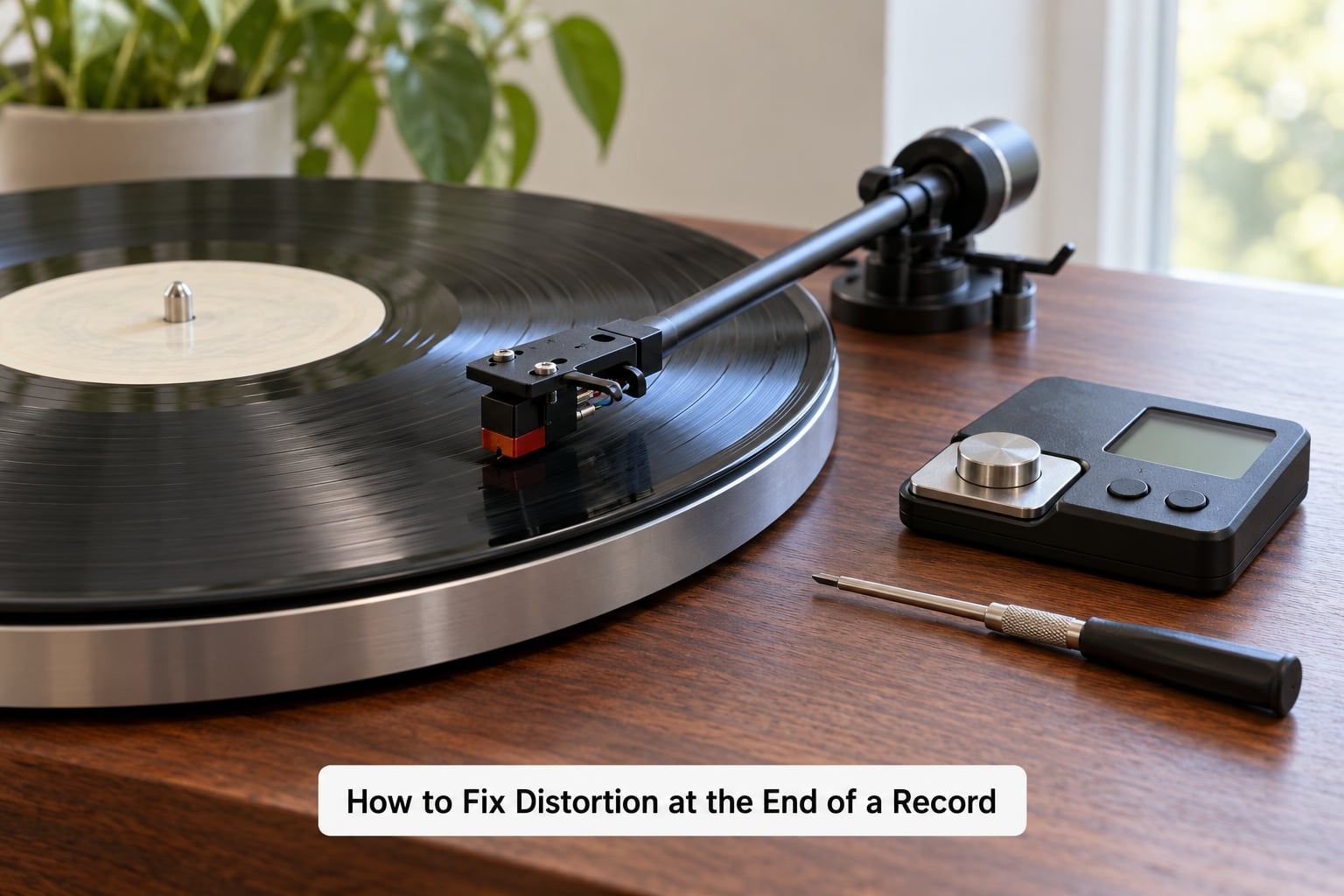
Work down this list from free to expensive. Most people solve it in the first three steps and never reach the bottom.
- Clean the stylus. Use a proper stylus brush, stroke it from front to back, never sideways, and never while the record is running. A fluid-safe gel cleaner on the tip works too. Do it again every few hundred records.
- Clean the record surface. A carbon-fibre brush sweeps loose dust off the grooves, and a dedicated fluid removes fingerprints and oily residue. A damp cloth on the running platter, followed by a good brush stroke, is a solid twenty-minute routine.
- Raise the tracking force slightly. Use a digital gauge on the tonearm at the rest position. If you are a tenth or two of a gram below the cartridge’s specified range, add that and replay the same passage. If the grit disappears and the tracking stays solid, you have found it.
- Reset anti-skate. With the cueing lever up, set anti-skate to match the tracking force at the scale, then lower it until the arm just stops drifting inward with the tonearm balanced and no record on the platter.
- Re-align the cartridge. Loosen the headshell screws and rotate the cartridge body, then slide it forward or back to set overhang. The two common standards are Baerwald, which balances the distortion between the inner and outer grooves, and Stevenson, which favours the inner grooves where you need the help. Follow the template for your arm and cartridge rather than guessing.
- Check vertical tracking angle. With the stylus resting in a fixed test record’s land, raise or lower the arm until the cantilever is parallel to the record surface as your cartridge maker specifies. Too shallow and the tip rides the top of the groove, which costs you treble and stability.
- Verify the arm is stable. An arm that wobbles, a headshell that is loose, or a platter that is not heavy enough for the arm will wreck alignment. Confirm the counterweight turns freely and the arm wire is not caught.
- Confirm speed with a strobe. Do this before and after any adjustment so you know the change in sound came from what you changed.
- Only then consider a different cartridge. Match the cartridge to the arm and the preamp rather than swapping blindly.
On stylus profiles, this is the part that matters most for the inner grooves.
| Profile | Inner groove behaviour | Notes |
|---|---|---|
| Conical | Most likely to sound grainy in the inner grooves | Symmetric tip, forgiving of bad alignment, cheap to replace |
| Elliptical | Noticeably cleaner than conical | The usual first upgrade; tracks tight inner grooves well |
| Microline | Best at reducing the fuzzy, grainy quality | Rounder tip profile than an elliptical, good all-rounder |
| Shibata | Reduced tracking error at high frequencies | Needs more accurate alignment than the profiles above |
| Line contact | Best at taming sibilance | Demanding on the preamp and on the record surface |
Swap one variable at a time and the evidence becomes obvious. A conical tip swapped for an elliptical on the same deck, same arm, same alignment, is the cleanest A/B test you can run at home, because the inner grooves are exactly where the difference shows. Keep it in mind when a shop tells you a cartridge upgrade is pointless.
The counterpoint is worth knowing too. A conical cartridge that is properly aligned and tracking at the right force will beat a badly aligned elliptical every single time. Alignment and tracking force explain far more cases than tip shape does.
| Alignment standard | Where it optimises | Best for |
|---|---|---|
| Baerwald | Outer and inner grooves, balanced | General listening across a whole side |
| Stevenson | Inner grooves | Readers whose problem is specifically the last tracks |
| Manufacturer template | Whatever the cartridge maker specifies | Modern cartridges with a supplied jig |
When You Should Replace the Record or Cartridge
Some symptoms have no adjustment attached to them.
- Radial skips. The stylus jumps outward at the same point on every play, leaving a small nick. That groove is damaged and no setup change will fix it.
- Deep groove damage. A scratch you can feel with a fingernail across several tracks will not play cleanly, and running it repeatedly makes it worse.
- A worn or bent stylus. Once the tip is flattened or the cantilever is bent, replacing it is cheaper than risking your records.
- Skipping on several records. When the problem follows the cartridge rather than the record, it is the cartridge.
- Unstable warp. A disc that flexes and clicks as it turns, or hops on the platter, needs flattening or a technician, not a cleaner.
- Cartridge failure. A dead output channel, a humming coil or a cantilever that will not move is not a tracking force problem.
Warped and off-centre records are often returnable if you bought them new and can show the defect, and sellers will usually accept a photo of a disc that clicks on the turntable. Check before you write a record off.
Full re-cutting of a badly damaged record exists but it is not the same record any more. For anything you care about, a good cleaning and a warp-flattening press will beat a transfer every time.
Frequently Asked Questions
Why does my vinyl sound distorted only near the end?
Because the innermost grooves are narrower, slower and more sharply curved than the rest of the side. Groove velocity falls from about 20 inches per second at the rim to 8 or 9 near the label, so the stylus has to follow faster curves with less margin for error. If that extra tracking error pushes past what your setup can manage, sibilance and grit appear in the last few minutes.
Can a warped record cause distortion at the end of a side?
Yes. A warp rises and falls in the groove, and near the label the grooves are packed closer together, so the same warp produces a larger vertical excursion and the stylus has less room to absorb it. You may also hear the record pitch wander slightly. Off-centre holes cause the same effect by making the disc orbit under the stylus.
How do I know if the problem is my stylus or my record?
Play a record you know is clean near its label. If it stays clean, the record is at fault. Then clean your stylus and replay the problem record. If the distortion drops noticeably, it was dirt. If it persists, look at the tip under magnification for flattening or bending, and check whether the trouble follows the cartridge to other records.
Does a heavier tracking force fix distortion at the end of a record?
Sometimes. If you are under-tracking, adding a fraction of a gram inside the cartridge’s specified range can clear the inner grooves entirely. If you are already at the top of that range and distortion remains, more force will not help and you will just wear the record faster. Alignment and stylus condition usually account for more than tracking force does.
Why does my record speed up or sound lower at the end?
That is not inner groove distortion, it is a speed or height problem. A platter running slightly fast makes the whole side climb in pitch as it plays. A warp makes the stylus rise and fall, which can sound like the music dipping. Check the platter with a strobe first, then inspect the disc for bending.
When should I stop playing a record with a damaged outer groove?
Stop as soon as you get repeated skips or a scratch you can feel with a fingernail. Every pass puts a damaged or worn stylus into the groove, which deepens the damage and can scratch the stylus tip. Clean and inspect first, and if the same track jumps every play at the same point, the groove is gone and further plays will not bring it back.
What Should You Check First?
If damage is suspected, stop playing it. A bent stylus on a decent record turns one scratch into three, and that record is not replaceable.
Then, in order: clean the stylus, clean the record, and replay the same passage near the label. If it improves, you had dirt. If not, put on a record you know is clean and listen to the end of side one. That single test tells you which half of the problem you are chasing.
Only once you know the record is innocent should you touch the setup, and start at the top of the fix ladder with tracking force and anti-skate before buying a single part. Most of what gets sold as inner groove distortion is a dirty stylus and an unaligned headshell, and both cost nothing but an evening.