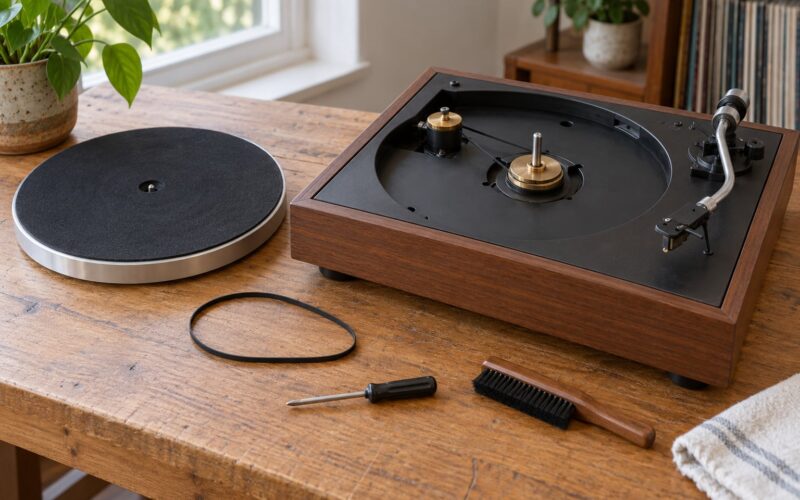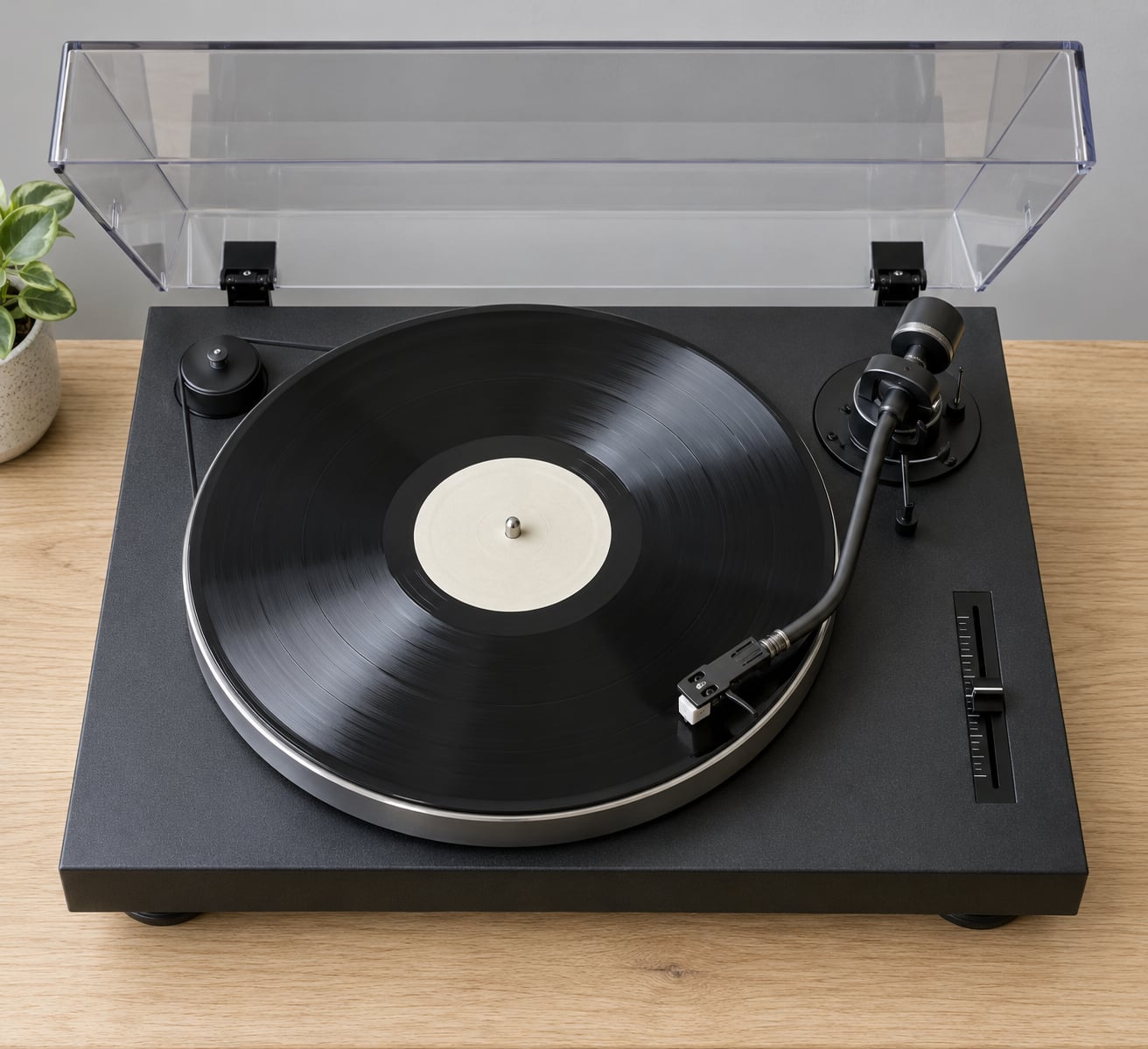
If you have just unpacked a record player and are trying to work out what everything is called, here is the short version. A turntable has roughly eighteen core parts, and they fall into four groups: the parts that spin the record, the parts that carry and position the needle, the parts that hold and read the groove, and the parts that get the signal out to your amplifier.
The names confuse people more than the parts do. A manual will say “plinth” and “platter” and “headshell” as if those were obvious, and half the questions in my inbox are really somebody asking what a word on a diagram points at. This guide walks through the parts of a turntable one at a time, says where each one sits, and explains what happens when it wears out.
A quick note on vocabulary first. “Record player” and “turntable” are used interchangeably in everyday speech. Strictly, the turntable is the deck and tonearm assembly, and “record player” usually means the whole box or the turntable bundled with speakers. I use turntable throughout because that is what most manuals use.
Table of Contents
- What Are the Main Parts of a Turntable?
- The Platter and Record Surface
- The Tonearm, Cartridge, and Stylus
- The Motor, Belt, and Drive System
- The Controls and Turntable Base
- How the Parts Work Together During Record Playback
- Which Turntable Parts Are Most Important for Good Sound?
- Simple Ways to Check Your Turntable Parts
- Frequently Asked Questions
- What does anti-skate do on a turntable?
- What is a removable headshell?
- What is the circle thing that came with my record player?
- Can I replace the stylus on my own?
- How do I tell if my tonearm is damaged?
- Conclusion
What Are the Main Parts of a Turntable?
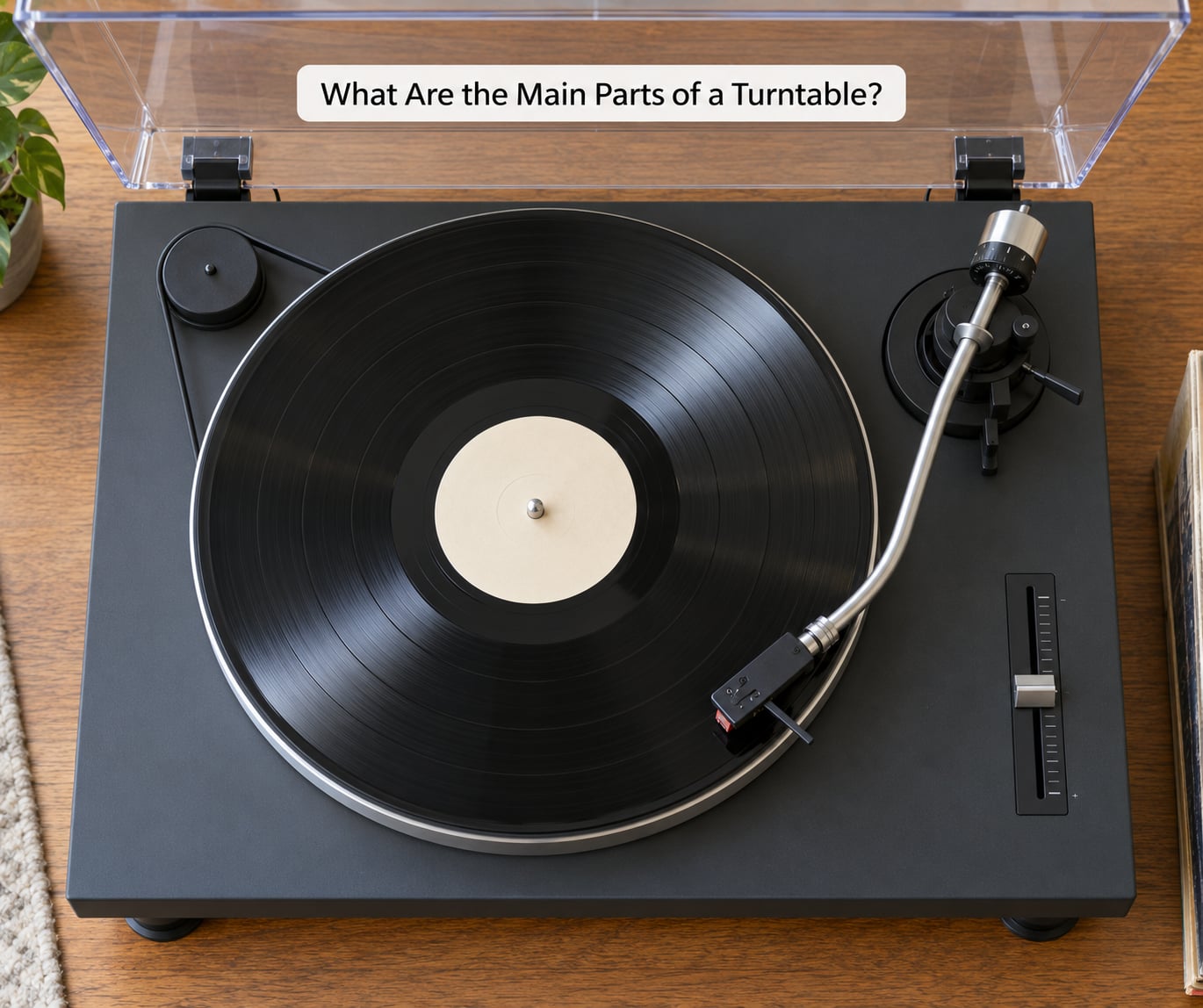
Here are the main parts of a turntable in the order they appear in the signal chain. Each one is worth learning, because nearly every fault you will ever meet traces back to a single component.
- Platter — the heavy disc the record sits on.
- Slipmat — the round rubber or felt pad on the platter. This is the “circle thing that came with my record player”.
- Spindle — the small steel pin the record is pushed down onto.
- Spindle adapter — the small plastic clip that fits a 45 RPM single with a bigger hole.
- Drive belt — the rubber loop transferring motor power to the platter.
- Motor — the quiet motor that turns the belt.
- Idler wheel — the driven wheel on idler-drive turntables, usually found on older decks.
- Tonearm — the pivoting arm that carries the needle across the record.
- Headshell — the small bracket at the end of the arm that holds the cartridge.
- Cartridge — the component that converts groove vibration into an electrical signal.
- Stylus — the needle itself, at the tip of a tiny cantilever.
- Counterweight — the sliding weight at the back of the arm that sets tracking force.
- Anti-skate — the dial that counteracts the arm’s inward pull.
- Tonearm lift — the lever or arm that raises and lowers the headshell.
- Plinth — the base or cabinet everything else is mounted on.
- Feet — the isolators under the plinth.
- Phono preamp — built into some decks, otherwise a separate box in the chain.
- Dust cover — the hinged plastic lid.
The Platter and Record Surface
The platter is the big disc that spins. Its job sounds trivial, but weight is what makes it resist wobble: a heavy platter holds its speed through the small pressure changes as the stylus enters a groove.
Direct-drive decks bolt the platter straight onto the motor shaft, which is why they need heavier motors and start instantly. Belt-drive decks drive the platter through a rubber belt, which isolates motor vibration and costs almost nothing to replace when it stretches.
Two parts sit between the platter and the record. The slipmat is the round disc, usually rubber or felt, that came in the box. A felt mat grips the record gently and insulates it from the hard platter. A rubber mat is heavier and more stable but has less grip, which is why the record can drift on cold mornings.
The spindle is a hardened pin, usually 1.7 mm at the business end, and it centres the record hole on the platter’s centre. If the spindle is bent or the record hole is deformed, the record will wobble and you will hear it as a periodic thump once per revolution.
Watch for a platter that is visibly wobbling, a surface with deep scratches, or a mat that has gone hard and shiny. All three are cheap to fix compared with what they do to a record.
The Tonearm, Cartridge, and Stylus
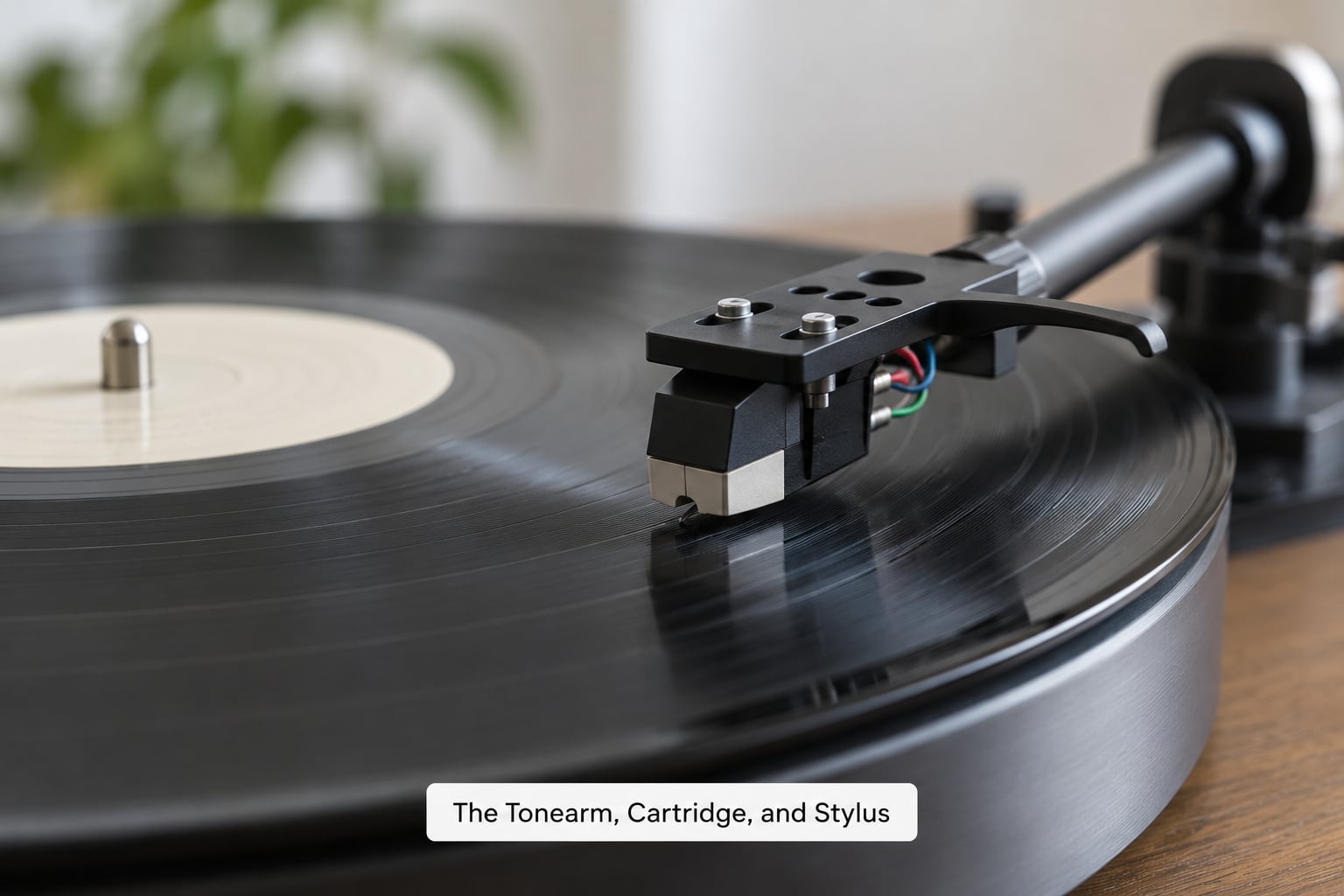
The tonearm is a lever on a pivot. You set it down on the record and it stays there while the stylus moves inward and the arm creeps slowly outward across the surface. That combination is what lets you play one side without touching the controls.
Know the main parts of a turntable and this section stops being jargon. Worth learning by name: the arm base and pivot bearing, the arm tube, the counterweight, the anti-skate dial and its small weight, the finger lift, the cueing lever, and the headshell with its azimuth adjustment screw. On a budget deck the counterweight may be fixed or hidden inside the base, which is the reason people who have just unpacked a deck cannot find it.
Tracking force is the downward pressure of the needle on the groove, measured in grams. Set the counterweight so the arm floats freely, lower it onto a calibrated stylus gauge, and slide the counterweight until you hit the number printed on the cartridge. Anti-skate works the other way: it pushes the arm very slightly outward to cancel the inward pull created by the arm’s geometry. Set it near zero on a straight tonearm and around the middle on an S-shaped one; that is the advice that finally makes sense after the conflicting advice online.
The headshell is the finger-shaped bracket that clips on to the arm tube and holds the cartridge. Removable headshells use one of three standard fittings — bayonet, two-pin or four-pin — and they are the part you detach to swap or align a cartridge.
The cartridge sits in the headshell and contains a tiny cantilever with the stylus welded to its tip. Moving magnet cartridges use a permanent magnet and are more forgiving; moving coil cartridges generate their signal from a coil moving in a magnetic field, produce less output and cost more. Moving magnet is the sensible starting point for most beginners.
The stylus is the only part that touches your records, and it wears out first. A dull or cracked tip tracks badly, sounds thin and scratchy, and can chew a groove permanently.
The Motor, Belt, and Drive System
The motor spins a small pulley, and something carries that rotation to the platter. On a belt-drive deck it is a rubber loop. On a direct-drive deck the platter sits on the motor shaft itself. On older idler-drive decks a rubber-tipped wheel pushes against the underside of the platter rim.
Belt-drive is the traditional choice because the belt acts as a vibration isolator between motor and platter. It is also the easiest part to replace, and a dried or glazed belt is the single most common cause of a deck that runs slow.
If the speed is drifting, check the belt first. If you see shine, glazing or a flat spot, replace it with the correct belt profile and length for the model. Then check the motor for a hum, because a bearing that is dry or worn will drag the belt and slow the platter.
A platter that speeds up and slows down by small amounts while playing is showing wow and flutter, which points at the same belt, the motor bearing or the spindle.
One clarification worth making: the motor never touches the record and never reads the groove. It only turns the platter. Everything to do with sound starts at the stylus.
Vintage decks add parts you will not see on anything new: an idler wheel with a hardened rubber rim, a stepped drive pulley, and cartridge mounting fittings that are no longer manufactured. All of them are serviceable, but sourcing them takes patience.
The Controls and Turntable Base
The power switch turns the deck on, usually at the front edge. The speed selector chooses 33 1/3 RPM for LPs or 45 RPM for singles, and it may be a mechanical switch or a button. A pitch slider lets you nudge the speed up or down in small increments, which matters most on DJ decks and for beat-matching, but it is not something a beginner needs to touch.
The start-stop control gets the platter going. The cueing lever raises and lowers the tonearm so you can place the needle without dropping it. The tonearm rest clips the arm when it is not playing.
Underneath, the feet isolate the plinth from the surface it sits on. A bubble level on the plinth tells you when the deck is level. Levelling matters more than most beginners expect, because a tilt pushes the arm sideways against its bearing.
The dust cover protects the record and arm. On many models it is hinged at the back and there is a latch that holds it down during transport.
The phono preamp is the part that surprises people. A cartridge produces a tiny signal measured in millivolts, with bass and treble sculpted by the recording process. A phono preamp applies the RIAA inverse curve and raises the output to line level. If your amplifier has a PHONO input, that is the preamp. If it does not, you need one built into the deck or a separate box. Thin, quiet, bassless sound is almost always a missing or mismatched phono stage, not a broken record.
How the Parts Work Together During Record Playback
Here is the whole chain, in order. The motor turns the belt, the belt turns the platter at a steady 33 1/3 or 45 RPM, and the record spins on the spindle with the slipmat gripping it.
The stylus sits in the groove and vibrates. That vibration drives the cantilever and the moving parts inside the cartridge, which generates a small electrical signal matching the shape of the groove.
The phono preamp applies RIAA equalisation and boosts the signal from a few millivolts to line level. RCA cables carry it to an amplifier, the amplifier powers the speakers, and you hear the record.
Which Turntable Parts Are Most Important for Good Sound?
No single part makes a turntable good, but the order of importance is not a tie. The stylus and cartridge come first, because a worn or mismatched needle degrades everything downstream and no amount of plinth mass fixes it. The tonearm is second, since a heavy or badly damped arm transfers more energy into the record than the cartridge was designed to handle.
Third is the platter and drive system, which decides whether the stylus sees steady speed. Fourth is the phono stage, which decides whether the signal that arrives at the amplifier is actually correct. Last is the plinth and feet, which matter more than most hobbyists admit but less than the other four.
| Part | What it controls | Typical wear or fault | Fixable by you? |
|---|---|---|---|
| Stylus | Groove tracking | Dull or chipped tip, skipping, thin sound | Yes, if the cartridge allows |
| Cartridge | Tone and output level | Worn suspension, cracked body, buzzing | Often, needs alignment |
| Tonearm | Tracking force and geometry | Stiff bearing, bent tube, dropped arm | Setup yes, repair rarely |
| Platter and drive | Speed stability | Glazed belt, worn motor bearing, wobble | Belt yes, motor rarely |
| Phono preamp | Signal level and equalisation | Wrong input selected, wrong loading | Yes, by switching or adding one |
| Plinth and feet | Vibration isolation | Unlevel deck, hollow cabinet resonance | Yes, with levelling |
Simple Ways to Check Your Turntable Parts
Unplug the turntable before you move it, clean it, or put anything near the arm. A deck that is plugged in can start the platter the moment you touch the controls.
Look at the record and the spindle first. Clean records and a straight spindle prevent most skipping. Next, start the platter with your hand out of the way and listen: a smooth hum-free spin at a steady pitch means the belt and motor are probably fine.
Look at the stylus under a light with a magnifier or your phone camera. If the tip is bent, flattened or sitting at an odd angle, replace it before you play anything else. Then balance the tonearm: float it level, set tracking force to the cartridge specification, and set anti-skate to match your arm type.
Move the pitch slider to both extremes and let go. If the speed does not return to normal, the motor control may need attention. Finally, check the controls without opening the deck. Every beginner fault I get asked about comes down to a switch in the wrong position or a missing phono stage, not to a broken component.
| Symptom | Most likely part | First thing to check |
|---|---|---|
| Record skips at the same spot | Stylus or tracking force | Stylus condition, then tracking force |
| Runs slow or bogs down | Drive belt or motor bearing | Belt glaze and tension |
| Speed wavers during playback | Belt, motor or spindle | Platter wobble and belt wear |
| Quiet, thin, bassless sound | Phono preamp or cables | Which input the amplifier is set to |
| Rumble or thump once per revolution | Platter, bearing or warped record | Platter wobble by hand |
| Arm drifts inward across the record | Anti-skate or counterweight | Anti-skate setting and balance |
Frequently Asked Questions
What does anti-skate do on a turntable?
Anti-skate applies a very small outward force to the tonearm to cancel the inward pull caused by the arm’s pivot geometry. Without it the arm creeps toward the centre of the record and eventually drops early. Set it near zero on a straight tonearm and around the middle on an S-shaped arm.
What is a removable headshell?
A removable headshell is the small bracket that clips onto the end of the tonearm tube and holds the phono cartridge. Because it detaches, you can swap or align a cartridge without removing the whole arm. Heads use one of three standard fittings: bayonet, two-pin or four-pin.
What is the circle thing that came with my record player?
It is the slipmat, sometimes called a turntable mat. It sits on the platter between the platter surface and your record, keeping the record flat and giving it grip. New decks usually include a felt or rubber one. It is not a coaster and it does not need replacing unless it is torn.
Can I replace the stylus on my own?
Usually yes, if the cartridge has a replaceable stylus. Many budget and mid-range cartridges clip a stylus out by hand; others are bonded in and must go back to a specialist. Check the cartridge model first, buy the correct stylus, and never force a bonded one. Turning a bonded stylus by mistake usually ruins the cartridge.
How do I tell if my tonearm is damaged?
Listen for a scraping sound as the arm tracks, look for a bent arm tube or a headshell that sits crooked, and check that the arm floats level with no drag from one side. A stiff or gritty pivot bearing is a common fault and often just needs cleaning and lubricant. A bent tube is a workshop job.
Conclusion
The core parts of a turntable are the platter and slipmat that spin the record, the tonearm that positions the needle, the headshell and cartridge that hold it, the stylus that reads the groove, the motor and drive belt that set the speed, the plinth and feet that keep it steady, and the phono preamp that makes the signal usable.
Start by inspecting the record, the spindle and the stylus, then balance the tonearm and set tracking force to the cartridge specification. From there, work one step at a time: speed problems belong to the belt and motor, quiet thin sound belongs to the phono stage, and tracking problems belong to the needle or the force on it.