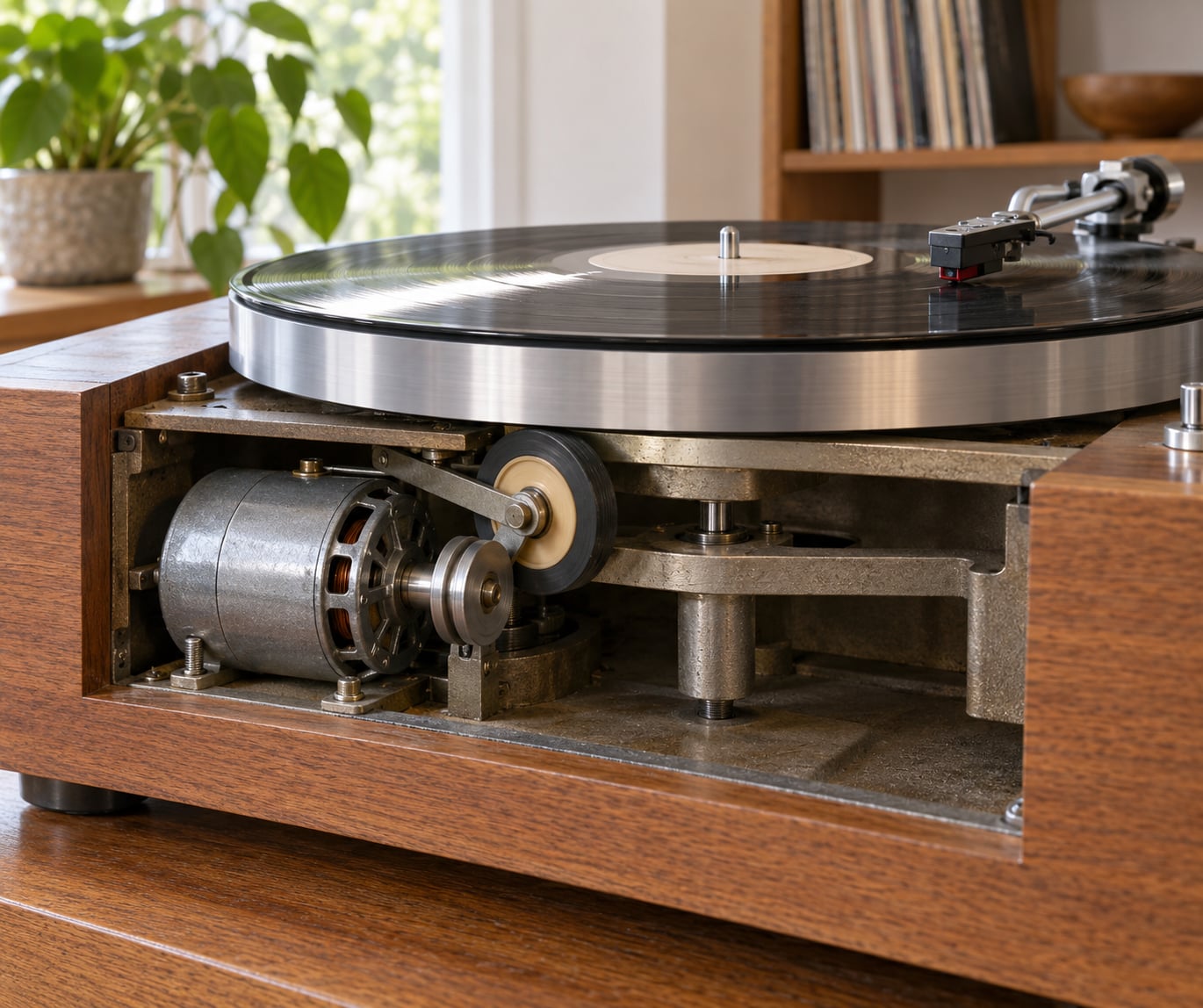
An idler wheel turntable drives its platter with friction instead of a belt. A small rubber-rimmed wheel is pressed against both the motor’s pulley and the platter, so the motor’s rotation passes straight through to the platter and nothing stretches or slips in between.
If you own a vintage deck, or you are thinking about restoring one, understanding that short chain of parts explains nearly everything about how the machine behaves: why it starts instantly, why it needs an idler arm spring, and why it will not hold speed when the rubber goes stale.
Below is the mechanism from the plug inward, the way the power actually travels, and the handful of things worth checking when a platter runs slow.
Table of Contents
- What Is an Idler Wheel Turntable?
- How an idler wheel turntable differs from a belt-drive deck
- Idler drive is not the same thing as rim drive
- The Main Parts of an Idler Wheel System
- The motor
- The motor pulley, or capstan
- The idler wheel
- The idler arm and its spring
- The platter and spindle
- The platter rim or drive surface
- How an Idler Wheel Turntable Works Step by Step
- Why the platter turns the opposite way to the motor
- Where the platter is actually driven
- What Controls Platter Speed?
- The four speed-control methods you will meet
- Why Idler Wheels Are Used in Record Players
- Deck families that use an idler drive
- Why Is My Idler Turntable Slow or Changing Speed?
- The rubber tyre has perished
- The wheel is not touching the platter
- Residue on the drive surface
- The motor or the brake
- How to Set Up an Idler Wheel Turntable Safely
- How to Clean and Maintain the Idler Wheel
- Cleaning the wheel and the platter rim
- Replacing perished rubber
- The rest of the service
- Frequently Asked Questions
- Why do idler wheel turntables not need a belt?
- Does the idler wheel touch the record?
- How does an idler wheel change the platter speed?
- Can I adjust the speed manually on an idler wheel turntable?
- Is it normal for an idler wheel turntable to make more motor noise?
- Conclusion
What Is an Idler Wheel Turntable?
An idler drive turntable is a record player in which a motor spins a small rubber-rimmed wheel held against both the motor pulley and the platter, transferring power from the motor to the platter without a belt. The wheel is called an idler because it is never the power source. It sits in the middle of the drive train and simply passes rotation along.
That single fact explains the design’s character. There is no belt to stretch, fray or slip, and the coupling between motor and platter is positive the moment the switch is thrown. You get strong starting torque and a platter that comes up to speed fast, which is exactly what you want when a stylus drops onto a lead-in groove.
Most of the decks people still seek out were built this way between the mid-1950s and the late 1970s, before direct drive became normal on new budget machines.
How an idler wheel turntable differs from a belt-drive deck
A belt-drive turntable connects the motor to a large platter with a rubber loop, usually on a stepped pulley so the motor can run fast and the platter can run slow. That arrangement isolates the motor and damps its vibration, but the belt is a springy part that stretches, wears and eventually needs replacing.
An idler deck deletes the loop. Instead, friction does the coupling directly, which means there is nothing to stretch but a small wheel whose rubber hardens with age. The trade goes straight from a replaceable consumable to a clean, simple, durable mechanism that wants routine cleaning instead of a new belt every few years.
Idler drive is not the same thing as rim drive
Modern decks from brands like VPI and Teres are often sold as rim-drive machines, and the words get mixed up constantly. Rim drive means a motor spins a wheel that touches only the outer edge of the platter, with no second pulley anywhere in the chain.
A true idler drive has three parts in contact: the motor pulley, the idler wheel, and the platter. If you open the back of a deck and find a wheel bridging two surfaces, it is an idler drive. If the wheel touches the platter and nothing else, it is a rim drive.
The Main Parts of an Idler Wheel System
Six components do the work, and once you can name them the mechanism stops being mysterious.
The motor
Usually a small synchronous or shaded pole induction motor turning at a few hundred rpm. It has no brushes to wear and no sensors, which is why these motors still work after half a century. Some are load-sensitive: if the platter resists, the motor slows rather than stalling.
The motor pulley, or capstan
A small metal pulley on the motor shaft, often stepped with two or three diameters of different size. The steps are how a single motor speed becomes several platter speeds. You may also see a clutch pulley that slips briefly at start-up on some models.
The idler wheel
A plastic or metal hub with a moulded rubber tyre, roughly the size of a poker chip. It rides on an arm and leans in at an angle so its tyre touches both the motor pulley and the platter. It transmits power through friction alone.
The idler arm and its spring
A pivoting arm carries the wheel, and a tension spring pushes it into contact. That pressure is what makes the coupling positive. A tired spring is a common cause of a deck that spins but no longer holds speed.
The platter and spindle
The platter is the heavy weighted disc that holds the record, turning on a spindle carried by the main bearing. Mass here is what smooths out small speed variations from the motor, and it is why an idler deck can sound stable despite a simple drive.
The platter rim or drive surface
Where the idler actually touches. Some decks drive the outer edge, some drive an inner rim on the underside of the platter, and some use a separate sub-platter below. The Garrard 301 and 401 use the inner rim; the classic Dual decks drive the outer edge.
How an Idler Wheel Turntable Works Step by Step
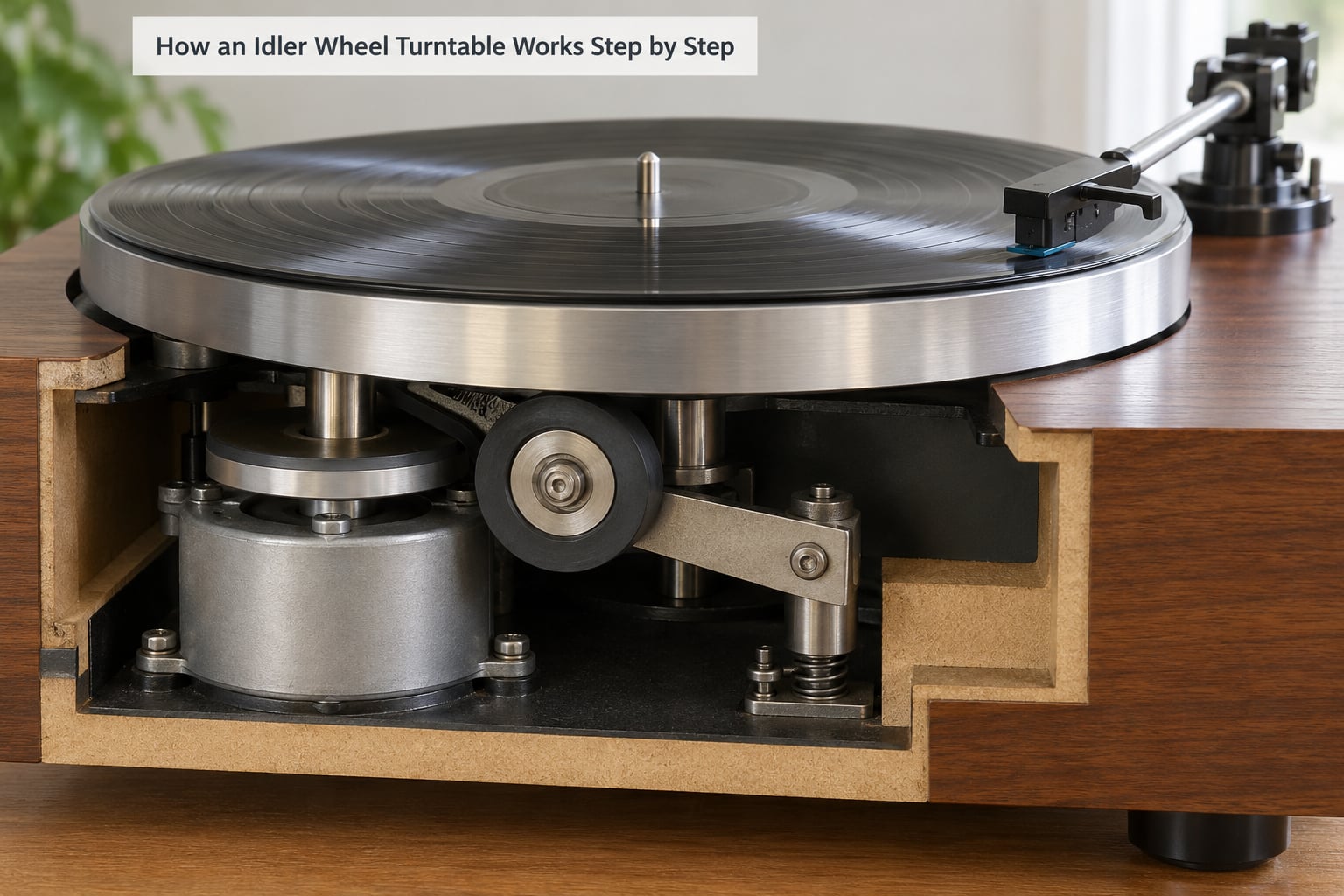
Here is the power path, in order, with nothing skipped.
- Mains power reaches the motor. The switch closes the circuit and the motor spins up. A shaded pole motor hums and takes a moment to reach its running speed; it is not instant from cold.
- The motor turns its pulley. This is the capstan, the stepped metal pulley on the motor shaft. It rotates fast, typically several hundred rpm, which is far too fast for a record to play at.
- The idler wheel spins against the capstan. The motor pushes the rubber tyre hard enough to drive it without slipping. The wheel is free to rotate on its own arm, so this costs almost nothing.
- The idler wheel pushes on the platter. Because the wheel is pinched between the spinning capstan and the platter, friction on both contact surfaces passes the rotation into the platter. The arm spring sets how hard that squeeze is.
- The platter turns at record speed. The speed reduction from motor to platter is just a ratio of diameters, nothing more clever than that. A large wheel driving a small one turns the small one faster; the layout on an idler deck works the other way round.
- The stylus tracks the groove. The record is held by the mat on the spinning platter, the tonearm lowers, and the stylus reads the modulation cut into the groove.
Why the platter turns the opposite way to the motor
Because the idler wheel is driven on one side and drives on the other. Two wheels in rolling contact, driven from opposite sides, counter-rotate, exactly like a reverse gear in a car. It is a small detail that trips up almost every beginner who lifts the lid for the first time, and it costs nothing to work around.
Where the platter is actually driven
Three layouts show up on idler decks, and they matter when you are cleaning or replacing parts.
- Outer edge drive: the idler touches the outside of the platter. Common on many 1960s European decks, and easy to see from above.
- Inner rim drive: the idler reaches up into the underside of the platter and touches a machined inner rim. This is the Garrard 301 and 401 layout, and it keeps the drive force low and centred.
- Sub-platter drive: the platter sits on a separate smaller driven disc, so the record surface stays completely free of any contact point.
What Controls Platter Speed?
Platter speed is decided by two diameters and one choice of position: the diameter of the motor pulley, the diameter of the idler wheel, and which part of the platter the wheel has been moved to. Change any of them and the ratio changes.
| Speed | Typical use | How the deck gets there |
|---|---|---|
| 33 1/3 rpm | LP records, the default for most music | Largest pulley step, or the wheel seated at the widest point of the drive surface |
| 45 rpm | Singles and 7-inch discs | Smaller pulley step, or the wheel slid inward toward the centre |
| 78 rpm | Old shellac 78s on decks fitted for them | Third pulley step or a further position of the wheel; many decks cannot reach it at all |
Note the direction of travel in that table. Moving the idler wheel toward the centre of the platter increases speed, because a smaller effective radius has to turn faster to drive the rim along at the same linear speed.
The four speed-control methods you will meet
- Stepped motor pulley. Two or more diameters machined on one pulley. The idler arm stays put and the motor end changes, usually by rotating or sliding the pulley. Garrard 301 and 401 use this approach.
- Sliding idler wheel. The motor pulley stays fixed and the wheel moves along the platter or inner rim to select speed. This is the classic Dual approach, and on the 1229 the wheel slides on a slanted face with a locking washer holding it in place.
- Pitch slider plus locking washer. The wheel sits at a fixed position and a slider sets fine adjustment for individual records. The washer matters, because a wheel left free to drift will drift.
- Eddy brake. On decks with load-sensitive shaded pole motors, a small aluminium disc turns in a magnetic field and drags on the motor. It stabilises speed and gives a real pitch control. Think of it as a governor rather than a gear.
Idler decks are manual about speed because the geometry is visible. Nothing is hidden behind a button, which is a genuine pleasure if you enjoy understanding how a thing works, and a mild inconvenience if you want one setting and never think about it again.
Why Idler Wheels Are Used in Record Players
The design survived four decades for good mechanical reasons.
Torque is the headline. A motor coupled straight to a heavy platter feels load, so direct-drive designs needed bigger motors to spin up quickly. An idler wheel multiplies torque across the contact patch, so a small, cheap motor can still get a heavy platter to speed in about a second. Enthusiasts hear the result as firm note starts and a sense of forward push through the groove.
There is also nothing to replace. No belt stretches, no slip, no pitch drift as a rubber loop ages. And because the motor’s vibration reaches the platter through a rubber tyre rather than a rigid shaft, some of that noise never arrives at the stylus at all.
Which brings the honesty part. An idler drive also has real drawbacks:
- The rubber tyre perishes and oxidises with age, and it crazes and cracks rather than wearing smooth. It usually keeps working, then suddenly stops transmitting well.
- Speed accuracy is only as good as the motor and the brake. Load-sensitive shaded pole motors can run fast when warm and slow when cold.
- Fast, accurate pitch control means extra parts: locking washers, slide mechanisms, eddy brakes.
- Assembly matters enormously. Get the wheel position wrong after a strip-down and it can spin beside the platter without touching it.
The famous rumble reputation mostly belongs to forty-year-old bearings rather than to the drive system. Owners who have serviced these decks report that a cleaned and relubricated idler machine is not especially noisy at all.
Deck families that use an idler drive
Worth knowing if you are shopping or restoring: Garrard’s 301 and 401, Dual’s 1019 and 1229, Thorens models including the TD-124, BSR, Miracord, Elac, Rek-O-Kut and Presto all use one form or another of idler drive. Bang & Olufsen borrowed a Thorens for the Beogram 3000, which tells you how highly the engineering was regarded at the time.
Why Is My Idler Turntable Slow or Changing Speed?
Almost every speed complaint traces back to one of four things. Work through them in order, from cheapest to most involved.
The rubber tyre has perished
Watch the idler wheel while the deck runs. The outer surface should look matte and slightly textured. If it looks glossy, hard, or is cracked and crazed, it has oxidised. Even badly cracked rubber often still transmits, so replace it when the symptom shows up rather than preemptively.
The wheel is not touching the platter
This is the most common thread on restoration forums. If the idler spins but the platter stays still, the arm is not swinging far enough into contact. A weakened spring, a bent linkage, or a wheel refitted on the wrong side of its arm all produce exactly this. Some owners report holding the speed lever down to get the wheel to bite, which confirms the geometry rather than the rubber.
Residue on the drive surface
A shiny glaze on the inner rim or outer edge of the platter, often from decades of a slightly perished mat sitting on it, will glaze the rubber and cut friction. Clean both surfaces and the symptom usually goes away. This one costs a cloth and ten minutes.
The motor or the brake
If the deck runs fast rather than slow, think about the motor. Shaded pole induction motors are load-sensitive, so a heavier platter, a worn bearing or an over-tight idler arm will pull the speed down, and an under-loaded deck will run above its nominal figure. On a cold start the same motor will not read the same as it does after twenty minutes, which is normal rather than a fault.
One more ordinary explanation: a mat sitting askew or a record seated on the edge of the spindle adds drag. Check that before opening anything.
How to Set Up an Idler Wheel Turntable Safely
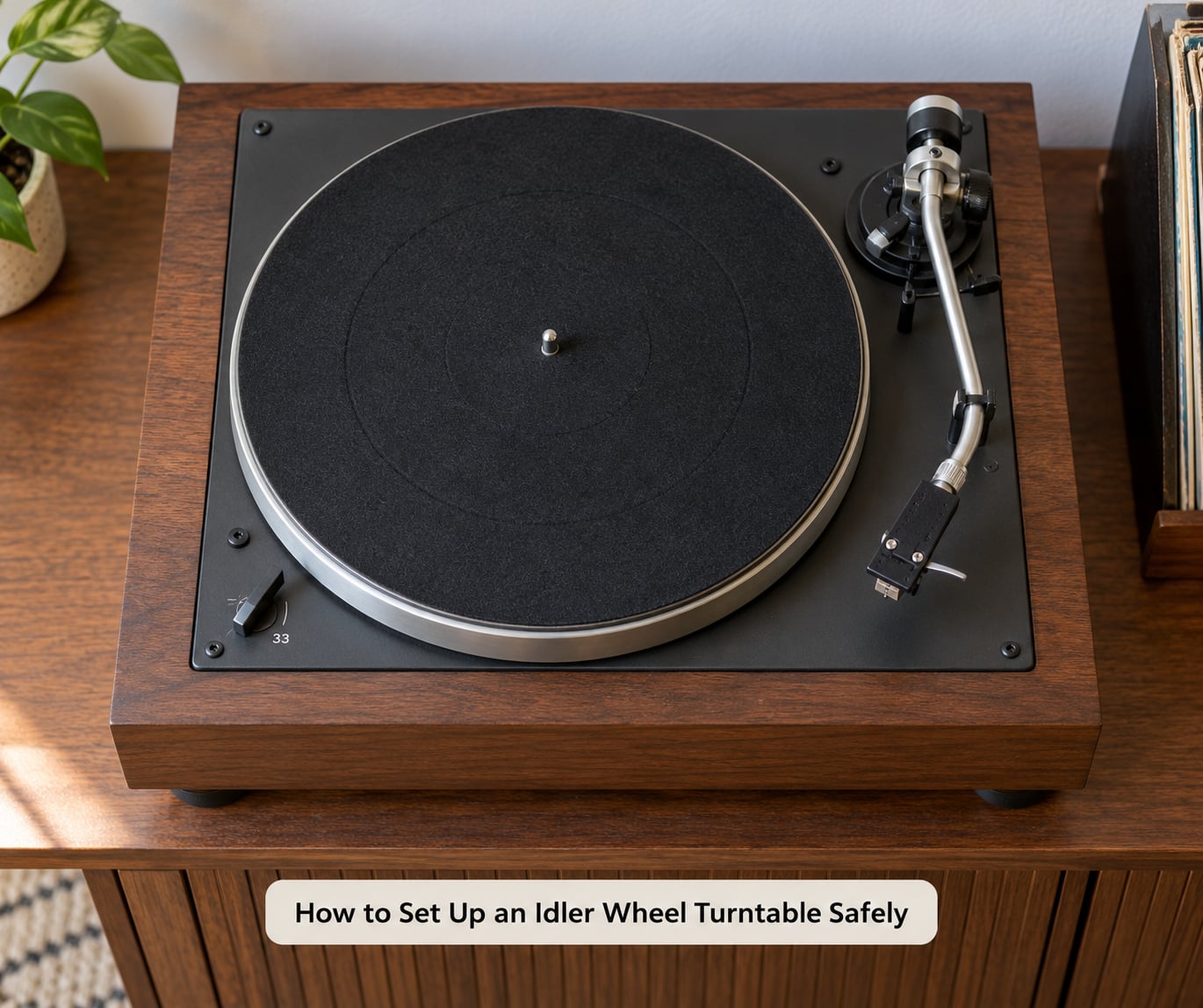
Follow the manufacturer’s instructions for your model, and use this sequence as the shape of the process.
- Choose stable support. A heavy deck on a weak shelf will never hold speed. Put it on a firm, level surface at roughly waist height.
- Level it. Adjust the feet until the platter sits level in all directions. An idler deck at an angle puts uneven pressure on the wheel and the arm spring.
- Check the drive surfaces. Make sure the wheel and the platter rim or inner rim are free of dust and old cleaner residue before you assemble anything.
- Seat the mat. The mat should sit flat and fully inside the platter lip with no daylight at the edge. Pinched or offset mats drag and slow the deck.
- Refit the idler wheel correctly. Slide it on the arm the way it came off, note which face points to the platter, and confirm the arm spring brings it firmly into contact.
- Set the speed lever for the record you plan to play, then engage the platter before lowering the tonearm.
- Align the tonearm using the rest and the tracking weight as the manual describes, and check tracking with a small spirit level or a record weight if you have one.
- Listen before you judge. Play a track you know well and note any hesitation at the start. A brief hesitation from cold is the motor warming up and usually clears within a minute.
Always unplug the deck before you put a hand anywhere near the drive train, and never reach under a spinning platter.
How to Clean and Maintain the Idler Wheel
Maintenance on an idler deck is short and unglamorous. Do it every few years, or whenever you notice a change in speed or tone.
Cleaning the wheel and the platter rim
- Unplug the turntable and remove the platter mat.
- Take the idler wheel off its arm and wipe the rubber tyre with a cloth lightly dampened with plain water or a little non-granular cleaner recommended for the material.
- Wipe the platter rim or inner rim the same way, turning the platter by hand as you go.
- Let both dry completely before reassembling.
Never use petroleum solvents, thinner, or alcohol-based cleaners on rubber. They swell the tyre and craze it faster than leaving it alone would have. Abrasive powders and scouring pads are just as bad, because they scratch the contact surface and the scratch becomes a slip point.
Replacing perished rubber
When cleaning will not restore speed or torque, the tyre has gone. Refurbished wheels for the common models are usually available, and fitting one is a modest job on most decks. Do not attempt to glue a loose repair onto a perished tyre; the failure tends to show up as the wheel spinning free while the platter sits still.
The rest of the service
While the deck is open, check the idler arm spring holds firm, confirm the platter spins freely by hand with no rough spot, and follow the manual on oiling the main bearing. Keep the lubricant off the drive surfaces, since oil on the rim will glaze the wheel.
One useful habit: before you dismantle anything for cleaning, take a photo of where the idler wheel sat and which way round it faced. Half of all restoration confusion comes from parts going back in the wrong orientation.
Frequently Asked Questions
Why do idler wheel turntables not need a belt?
Because a spinning wheel can transfer rotation by friction alone. The idler wheel is pressed against both the motor pulley and the platter, so the motor spins the wheel and the wheel spins the platter with no loop connecting the two. That also means there is no belt to stretch or fray, and the coupling is positive the moment the switch is closed. The cost is that the wheel’s rubber perishes with age instead.
Does the idler wheel touch the record?
Never. The idler wheel only ever contacts the motor pulley and a drive surface on the platter itself, such as the outer edge or an inner rim on the underside. Records sit on top of the platter on a mat, physically above anything the wheel touches. You would have to strip the deck apart and lose the wheel before a record could ever come near it.
How does an idler wheel change the platter speed?
It changes the ratio of the two wheels in contact. Sliding the idler toward the centre of the platter makes the effective driving radius smaller, so it must turn faster and the platter speeds up. Sliding it outward does the reverse. Deck designers also add stepped diameters to the motor pulley, so one motor speed becomes two or three platter speeds depending on which step the arm engages.
Can I adjust the speed manually on an idler wheel turntable?
Most decks give you coarse speed selection through a lever, plus a fine pitch control on a slider, a locking washer, or an eddy brake on better models. Locking washers hold the wheel precisely where you put it, and the eddy brake on load-sensitive motors adds drag to stabilise the reading. Adjust with the platter running and check with a strobe or a pitch app, since you are tuning a mechanical geometry rather than a digital setting.
Is it normal for an idler wheel turntable to make more motor noise?
Some hum and buzz is normal, especially in the first minute or two from cold. Shaded pole motors are built around a spinning eccentric mass, so they never sound silent, and they warm up before they settle. A dramatic change in noise is not normal though. A perished idler tyre, a hardened lubricant in the main bearing or a warped platter will all change the character of the sound noticeably.
Conclusion
Understanding how an idler wheel turntable works comes down to one short chain of friction: motor, capstan, rubber wheel, platter. Every behaviour worth knowing follows from that chain, including the counter-rotation, the manual speed selection and the deck’s appetite for maintenance.
If your platter runs slow or drifts, start with the three things that cost nothing. Watch the idler wheel while the deck runs and check it is actually touching the platter. Clean the rubber tyre and the rim or inner rim. Then confirm the mat is seated flat and the platter turns freely by hand. Nearly every complaint I have seen traced back to one of those three, and only when all three look healthy is it worth thinking about the arm spring or the motor.
Everything above is general. If you are working on a specific model, the service manual for that deck is the authority on how it should come apart.