No, not all of them, and the phrase is a bit unfair. An all-in-one record player is only bad for your vinyl when its tonearm presses too hard on the grooves or its cartridge is too crude to track cleanly, and plenty of models avoid both. The real limitation is a fixed, non-adjustable tonearm, not the format.
The fairer complaint is about sound. Small speakers bolted to the same cabinet as the platter cannot give you much separation or bass, and that is where enthusiasts and beginners tend to point when they say cheap all-in-ones are bad for vinyl.
So the honest answer splits in two. As a record-care question, most all-in-ones are fine for casual listening and only risky for valuable collections. As a sound-quality question, almost all of them are a compromise, and a turntable plus separate speakers beats the built-in pair every time once you care about the sound.
Table of Contents
- Are All-in-One Record Players Bad for Vinyl?
- What Does an All-in-One Record Player Include?
- How Do the Built-in Speakers Affect Sound?
- Does the Fixed Tonearm Reduce Record Wear?
- Are All-in-One Record Players Less Worthy of Collecting?
- When Is an All-in-One Record Player a Good Choice?
- When Should You Choose Separate Turntable Equipment?
- How to Tell Whether an All-in-One Player Is Worth Buying
- Which Specifications Matter Most?
- How Do You Set Up an All-in-One for Best Results?
- Frequently Asked Questions
- Are budget all-in-one record players bad for your records?
- Can I connect better speakers to an all-in-one record player?
- Is a Bluetooth-enabled all-in-one record player suitable for vinyl listening?
- Should I buy an all-in-one or a turntable with separate speakers?
- What is the difference between a phono preamp and a line input?
- Can I upgrade the cartridge in an all-in-one record player?
- Conclusion: Start With the System You Will Actually Use
Are All-in-One Record Players Bad for Vinyl?
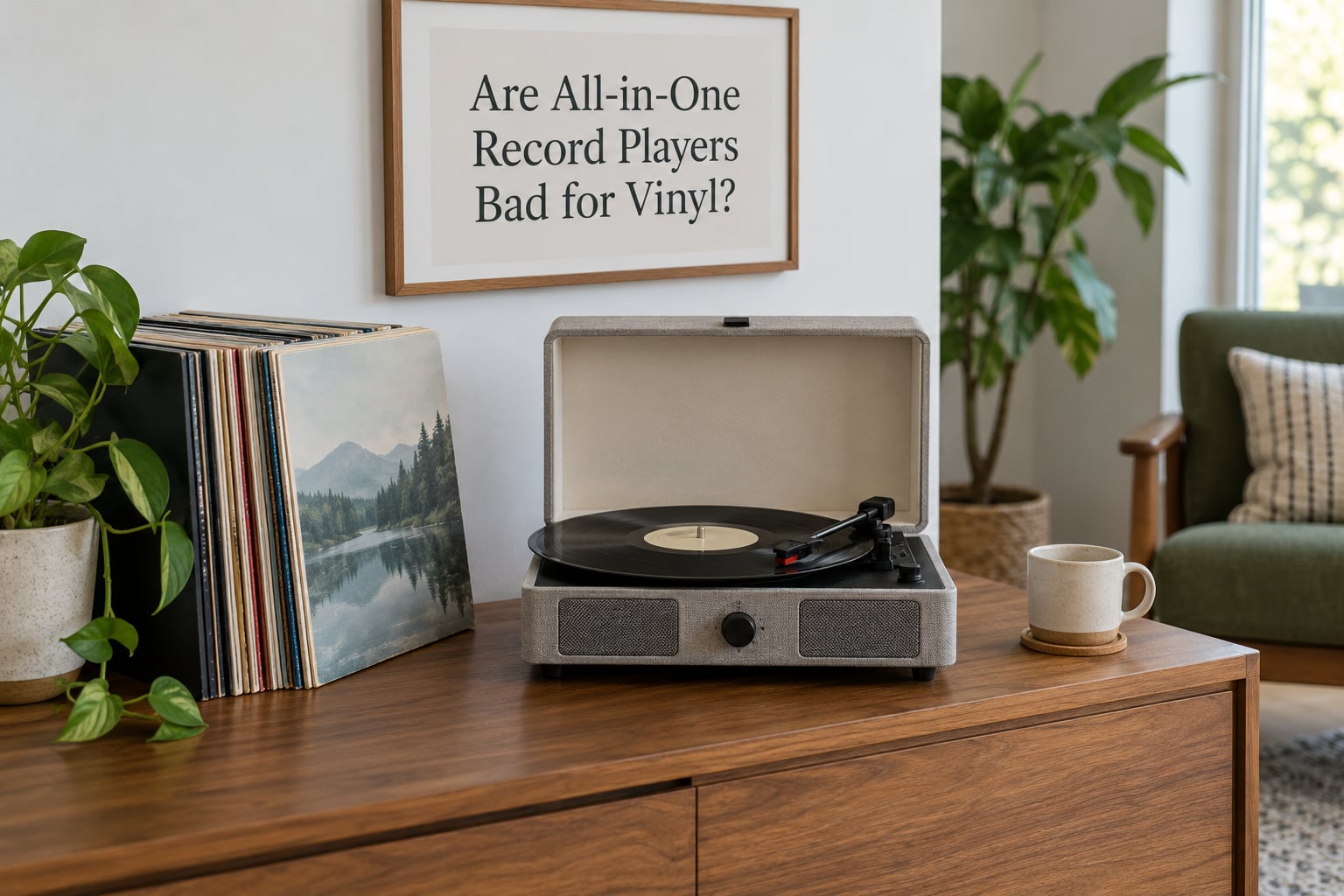
It depends on which all-in-one you bought and what you put on it. A cheap model with a ceramic cartridge and a tonearm you cannot adjust tracks at roughly 5-7 grams, which is heavier than the 1.5-2.5 grams a record is comfortable with. A better unit with a moving-magnet cartridge and a counterweight sits in the safe band and will not hurt anything.
There is also a persistent confusion worth clearing up early, because it drives half of the arguments you will read online. Sound quality and record damage are two separate problems. A player can sound terrible and leave your vinyl untouched, and a player can sound fine and slowly wear a groove.
For a first record, a gift, or a bedroom setup where you will play an album a handful of times, an all-in-one is a reasonable buy. For a collection you care about, or for 78s and other fragile pressings, buy something with an adjustable counterweight instead.
What Does an All-in-One Record Player Include?
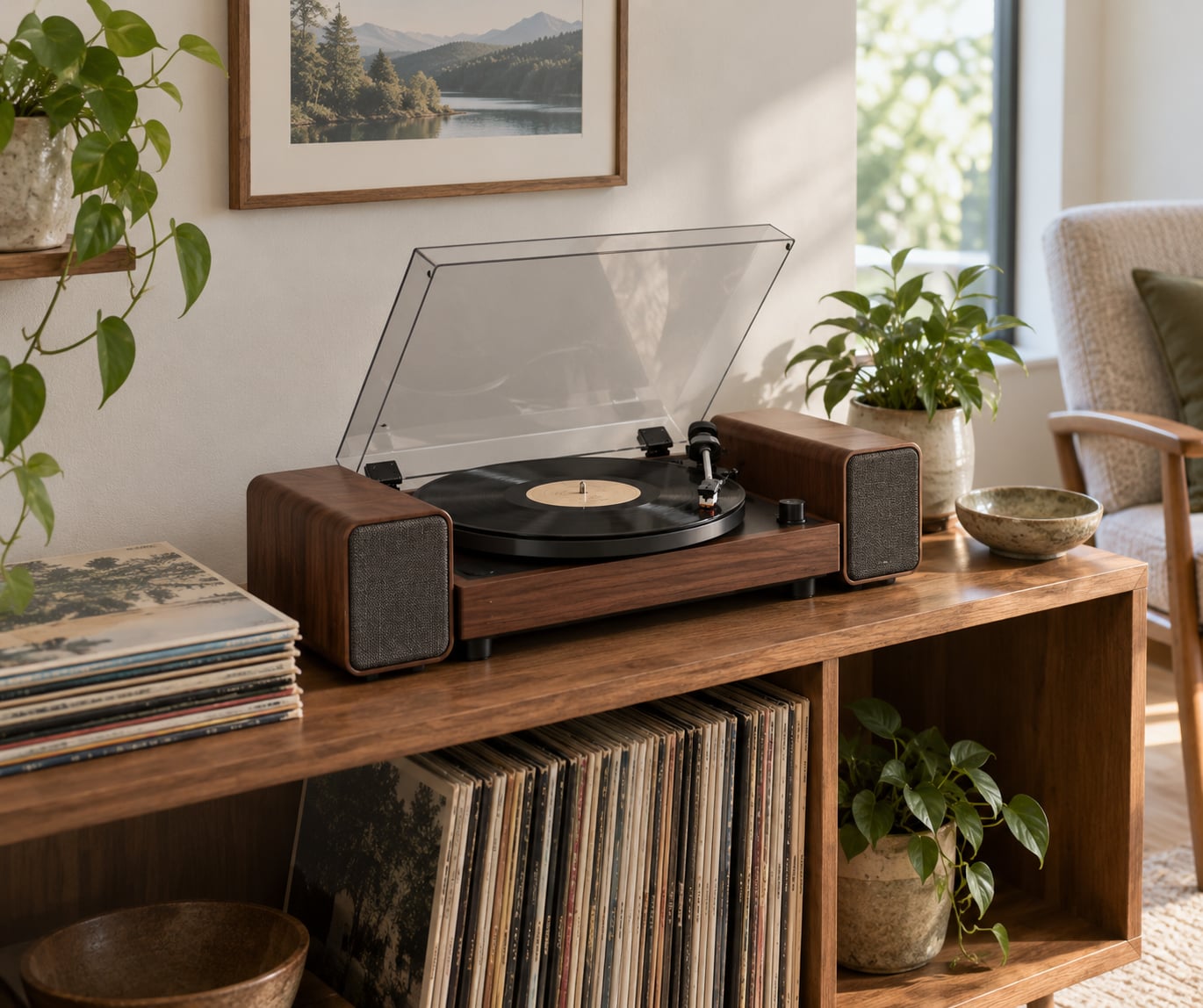
Typically four things in one cabinet: a turntable, a cartridge and tonearm, a small phono preamp, and a pair of speakers. Some models are a suitcase you carry by a handle, others are a shelf unit with the speakers on either side of the platter. A record store conversion with a CD slot, cassette deck or radio is the same idea with more features tacked on.
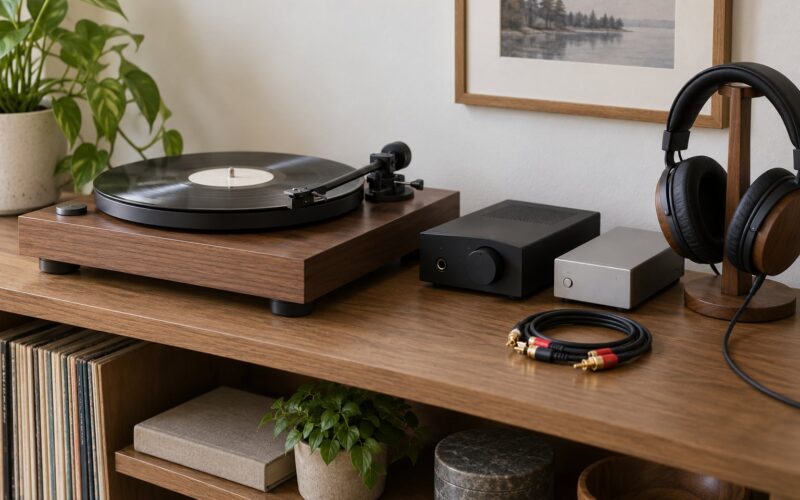
A handful of models skip the built-in speakers entirely and give you line-level output through RCA cables instead, so you can plug in your own stereo. Those are sometimes marketed as all-in-ones too, which is why the label is less tidy than it sounds.
Check which kind you are actually looking at before you compare. A unit with RCA line output is a much better starting point than one that only feeds its own speakers.
How Do the Built-in Speakers Affect Sound?
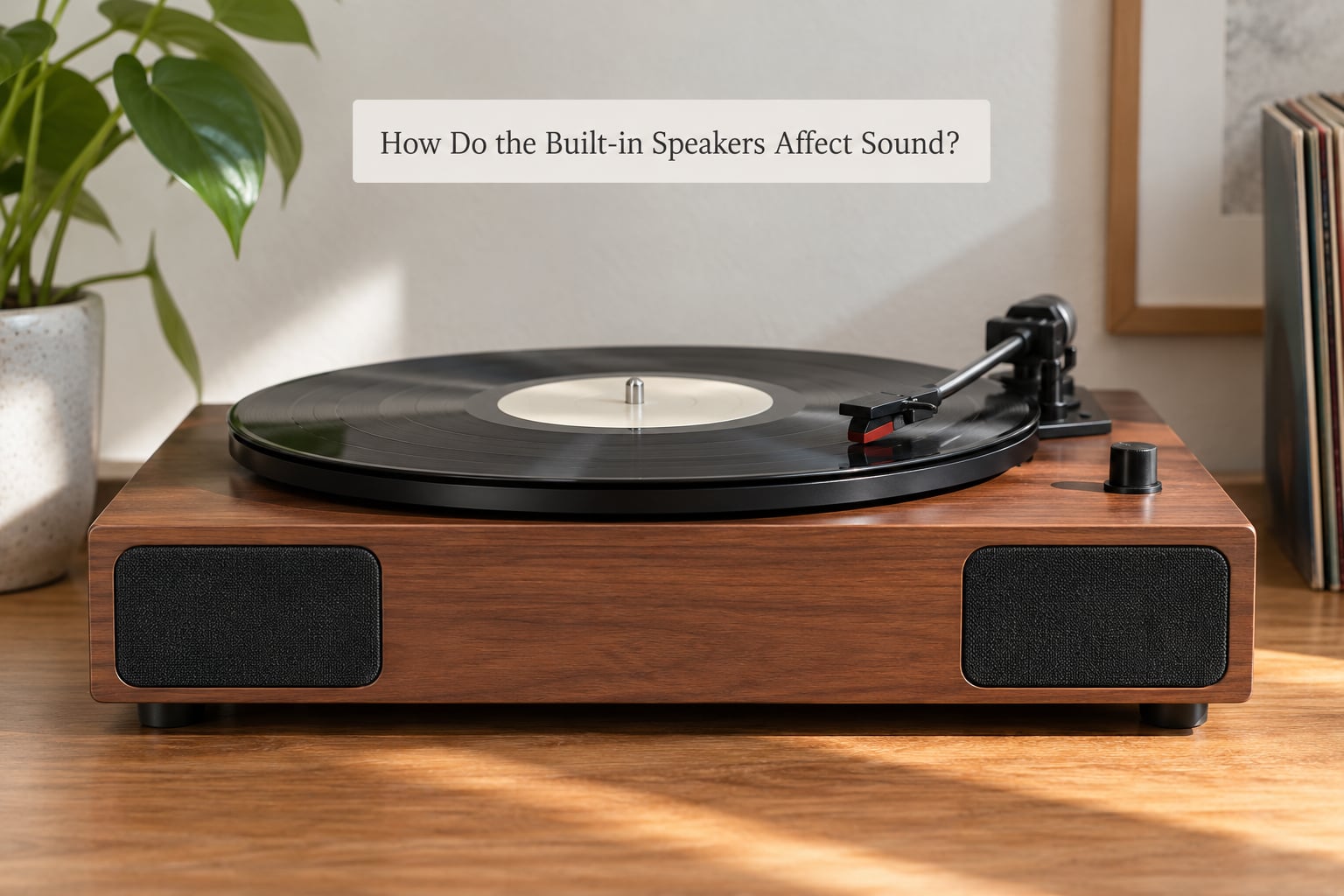
The speakers are the weak link, and they have nothing to do with record safety. Two small drivers in a plastic cabinet sitting inches from the tonearm produce very little channel separation, because both left and right signals reach your ears from nearly the same spot. Bass extension is limited by cabinet size, and the midrange is where small speakers usually sound thin.
That matters more in some rooms than others. Sitting close to a desk or a turntable on a bookshelf, near-field listening actually flatters small speakers, and many people are perfectly happy. In a larger room with friends across the couch, the same speakers sound thin and directional.
There is a second issue people miss. In many all-in-ones the speakers sit on the same board as the motor and the platter, so each bass note shakes the tonearm slightly. That is not record damage, but it is the mechanical cause of a lot of the skipping and warble people blame on their records.
Does the Fixed Tonearm Reduce Record Wear?
No. A fixed tonearm is usually the biggest reason to worry, because you have no way to reduce the force it applies.
Four things determine how hard a stylus sits in a groove. The tracking force is the downward pressure, usually set by a counterweight at the back of the arm. The vertical tracking force is that same pressure measured at the stylus. Anti-skate applies a tiny sideways push to stop the arm dragging inward as it travels. And the cartridge has to be able to follow the groove wobble without the arm fighting it.
A counterweight you can slide lets you dial the force down into the safe 1.5-2.5 gram range. A tonearm with no counterweight is preset at the factory and usually lands somewhere between 5 and 7 grams. That is not instantly destructive, but it is a few times more than the record needs, and vinyl does not heal.
Ceramic cartridges are the other half of the problem. They are cheap, rigid and often poorly aligned, so they push the stylus sideways and scuff the groove walls rather than reading them cleanly. A moving-magnet cartridge, the kind most people consider the safe benchmark, is springier and tracks more gently.
You can check a player safely before trusting it with anything valuable. Look for a counterweight and a small scale or dial near the base of the arm. If there is one, set the force to about 2 grams, lower the cueing lever, and watch the stylus sit at the start of the record. If the arm has no counterweight, assume it is heavier than you want and keep the player off your better records.
Are All-in-One Record Players Less Worthy of Collecting?
Collecting is not affected by the player at all, and the “ruining your records” framing is bigger than the evidence supports. Wear is cumulative. Records played on a light, well-adjusted player for years still play; records left in a hot car or stacked face-to-face in a humid flat do not.
Independent wear tests collected on r/Beginner_Turntables, drawing on channels including Record-Ology, CT1660 and Record Raid, found no visible wear after 10 plays on a Crosley Keepsake, virtually no audible wear after 50 plays on a Crosley Cruiser, a minor increase in noise after 50 plays on a Victrola suitcase player, and a small noise rise with almost no distortion rise on a GPO Stylo. A 100-play test on a similar unit showed more distortion, still nowhere near unlistenable.
That is the scale to hold on to. A heavy fixed force does not scratch a record in one play. It shaves a little off the groove wall each time, and after a few dozen plays you might hear slightly more surface noise. Owners of a cheap all-in-one who play one record a week are talking about years before they could hear it, and most of them will upgrade long before then.
The forum consensus is split for a reason. On r/vinyl the objection leads with wear, on the grounds that every play degrades a record. On r/unpopularopinion the counter-argument is that the suitcase format serves its intended audience perfectly well. Both are describing the same slow process and disagreeing about whether it matters.
When Is an All-in-One Record Player a Good Choice?
It suits a first-time buyer who wants to open a record tonight rather than research a system for a month. Plug it in, put the record on, done. That is a real benefit and the format deserves credit for it.
It also suits a small room, a dorm or a bedroom, a gift for someone who is not technical, and casual collecting where you own a few dozen records and know which ones you will actually play. If you mostly want to listen, the built-in speakers are a reasonable way to avoid four boxes and a tangle of cables.
Placing it well matters more than people expect. Keep it off the floor, off heavy furniture that creaks, and away from a speaker that pumps bass in the same cabinet. A firm surface at roughly waist height does more for these players than any amount of fiddling with settings.
When Should You Choose Separate Turntable Equipment?
Choose separates when the speakers are the weak point, because a turntable feeding a real amplifier and a pair of proper speakers is the single biggest jump in sound quality available. Everything else is secondary to that.
Separates also make sense if you want to upgrade one piece at a time rather than replace a whole cabinet, if your records are worth protecting and you want a counterweight you can set precisely, or if you plan to play 78 rpm pressings that need a different stylus. Moving magnet plus adjustable arm plus line output is the configuration worth waiting for.
The common pattern owners report is buying an all-in-one, getting bored with it after a few months, then moving to a turntable with separate speakers and keeping the original as a second system. Treat it as a stepping stone rather than a mistake.
How to Tell Whether an All-in-One Player Is Worth Buying
Ask these questions in the shop or read them off the spec sheet, and the decision makes itself.
- Is the tracking force adjustable? Look for a counterweight and a marked scale. No counterweight means you are stuck with the factory setting.
- Which cartridge is fitted? A named moving-magnet cartridge is a good sign. An unnamed ceramic cartridge is a reason to keep it off your nicer records.
- Is there a switchable phono and line input? This matters if you ever want to connect an external amplifier or a projector.
- Can you add better speakers later? Line-level RCA output is what you need. Some all-in-ones also support Bluetooth output, which is a different thing entirely.
- Does it have auto-stop? A record spinning to a silent halt does not wear a groove, but it does stress the bearings over time.
- What is the warranty and can the stylus be replaced? Stylus replacement is the cheapest upgrade in the whole hobby. If the part is unavailable, the player is close to finished.
- What is the return policy? A player that skips on your first record should be able to go back without an argument.
Which Specifications Matter Most?
Most published specs for all-in-ones are noise. Here is the short version of what an ordinary listener can actually use.
| Specification | Comfortable range | Worrying range |
|---|---|---|
| Tracking force | 1.5-2.5 grams, adjustable | Fixed, above 4 grams |
| Cartridge | Moving magnet, named model | Unnamed ceramic |
| Anti-skate | Adjustable or correctly set at the factory | No anti-skate at all |
| Drive system | Belt drive | Direct drive with a cheap motor |
| Platter and platter weight | Metal platter, felt mat | Light plastic platter, bare slip mat |
| Output | RCA line out plus built-in speakers | Speakers only, no output |
| Wow and flutter | Under 0.3 percent | Over 0.5 percent, audible wobble |
Tracking force, cartridge and anti-skate decide how your records are treated. Drive system and wow and flutter decide how they sound, with direct drive adding motor vibration that belt drive largely isolates. Output options decide how hard the upgrade path is later.
Ignore a quoted signal-to-noise ratio with no units and no test standard. It tells you nothing a listening comparison would not tell you better.
How Do You Set Up an All-in-One for Best Results?
Put it on a solid, level surface at roughly ear height when seated. Plinths and speaker stands made for record players help on wobbly furniture, and they cost little.
Level the feet. A player sitting at a slight angle makes the tonearm track badly, which is the usual cause of skipping blamed on the record. Check the platter spins evenly with no wobble before you cue anything.
Clean your records. Dust is the single most common reason a stylus skips, and a soft brush plus a proper fluid removes it in a minute. It also removes the argument about whether the player damaged the record.
Set the tracking force to around 2 grams if the arm allows it, set anti-skate to match, and start the volume low before lowering the needle. Let the platter reach full speed, then cue.
One warning: never adjust the counterweight, anti-skate or cartridge while a record is playing. Move the arm to its rest first, or you will drop the stylus straight into a groove at full weight.
Finally, place the speakers as far from the platter as the cabinet allows and keep the player off any surface that shakes. Those two fixes resolve most of the skipping and bass distortion complaints in this category.
Frequently Asked Questions
Are budget all-in-one record players bad for your records?
Budget models are only a problem when the tonearm has no counterweight, which usually leaves it pressing at 5-7 grams instead of a safe 1.5-2.5. That wear is cumulative, not instant, and wear tests found no visible groove wear after 10 plays and little audible change after 50. Keep them off valuable or vintage pressings and use them for the records you play most.
Can I connect better speakers to an all-in-one record player?
Only if the model offers a line-level output. RCA line out and a switchable phono and line input let you feed an external amplifier and speakers, which is the biggest single sound improvement available. If the player only drives its own built-in speakers, there is no official way out, so check the outputs before you buy.
Is a Bluetooth-enabled all-in-one record player suitable for vinyl listening?
It depends on the direction of the Bluetooth. Bluetooth output sends the turntable’s audio to headphones or speakers, which is useful but adds compression. Bluetooth input does nothing for records, since the turntable is the source. Vinyl playback is best through a wired line output or the built-in speakers.
Should I buy an all-in-one or a turntable with separate speakers?
Buy the all-in-one if this is your first player, your room is small, and you want something that works the moment you open the box. Choose a turntable with separate speakers if the sound quality matters to you, you want to upgrade one component at a time, or you own records worth protecting with a precisely adjustable tonearm.
What is the difference between a phono preamp and a line input?
A phono preamp takes the very small signal a cartridge produces and applies the equalisation vinyl needs before it can drive speakers. A line input expects a full-strength signal that has already gone through that stage. Plugging a phono signal into a line input gives thin, quiet, wrong-sounding audio.
Can I upgrade the cartridge in an all-in-one record player?
On some models, yes. If the headshell unscrews and the tonearm is balanced, a moving-magnet cartridge such as the Audio-Technica AT-3600L is a straightforward swap. Many budget players use press-fitted or glued cartridges with no standard mounting, so check before you buy a replacement part.
Conclusion: Start With the System You Will Actually Use
So, are all in one record players bad for vinyl? Only in specific cases: a fixed tonearm pressing above 4 grams, an unnamed ceramic cartridge, and records you care about going through both. Used casually on the albums you play often, the same player is a perfectly reasonable way in.
What you do first is simple. If you are starting out, buy the most dependable all-in-one you can find with a counterweight and a moving-magnet cartridge, put it on a firm surface, and enjoy the records. When you decide the built-in speakers are the part you keep turning up the volume to escape from, move to a turntable with separate speakers and you will not look back.