Record store etiquette for beginners comes down to three habits: ask before you pull a record, handle it by the edges with clean dry hands, and put it back exactly where you found it. Get those right and the rest is ordinary common courtesy. Here are the twelve rules worth learning before your first visit, and the reason behind each one.
Most of these are not written anywhere. You pick them up from watching regulars, and the unwritten version usually arrives as a sharp look from behind the counter. A few minutes of reading now saves you that.
Table of Contents
- Record Store Etiquette for Beginners at a Glance
- 1. Ask Before Handling Any Record
- 2. Handle the Sleeve and Vinyl Together
- 3. Use the Listening Station Respectfully
- 4. Don’t Monopolize the Listening Station
- 5. Put Records Back in the Correct Section
- 6. Keep Store-Specific Requests Clear
- 7. Don’t Bring Food or Drinks into the Browse Area
- 8. Leave Records and Merchandise in Their Proper Place
- 9. Respect the Store’s Requesting System
- 10. Ask Questions Without Expecting Free Research
- Record store etiquette for beginners: when to ask and when to wait
- 11. Be Considerate About Phone Calls and Conversations
- 12. Thank Staff and Shop Independently
- Frequently Asked Questions
- What does VG+ mean on a used vinyl record?
- What is the record grading scale?
- How long can I use a listening station at a record store?
- Can you open a sealed record at a record store?
- How do I tell if a used record is playable before buying it?
- What should I do if I scratch or drop a record in the store?
- Conclusion
Record Store Etiquette for Beginners at a Glance
This table is the whole guide in one view. If you only remember three rows, make them 1, 2 and 3.
| Rule | Why it matters | What to do |
|---|---|---|
| 1. Ask before handling | Records in unsorted bins are hard to refile, and staff grade each copy individually | Pull one, stack it in your arms, take it to the counter or a listening deck to inspect |
| 2. Handle sleeve and vinyl together | Fingerprints, ring dents and sleeve splits follow sloppy handling | Two hands on the edges, record inside its sleeve, no bare fingers on the playing surface |
| 3. Use the listening station properly | There are usually one or two decks and a queue behind you | Three or four records at a time, about fifteen minutes, then return them |
| 4. Don’t monopolize the deck | Waiting people read your entire listening habit as rudeness | Browse first, listen second, step aside when someone is clearly waiting |
| 5. Refile correctly | A record in the wrong bin is lost stock, not tidiness | Match the catalog or bin label, ask staff when it is unclear |
| 6. Be specific about requests | Staff answer precise questions faster than vague ones | Name the artist, pressing, genre or budget rather than “something good” |
| 7. Keep food and drinks out | One spill can ruin a crate of sleeves | Save the coffee for the break, or the cafe next door |
| 8. Don’t leave records lying about | Unsold items on a table are how shops lose track of stock | Hand it back to staff or use the hold ticket system |
| 9. Use the requesting system properly | Want lists only work when everyone follows the same process | Write it down, ask once, don’t camp on a title that hasn’t arrived |
| 10. Ask questions, keep them short | Staff are working, not on your payroll | Two or three specifics, then thank them and let them go |
| 11. Keep calls and conversations considerate | A phone call in a quiet room is the loudest thing you can do | Step outside for long calls, quiet voice in the aisles |
| 12. Thank staff and buy from the shop | Independent stores run on repeat customers | Learn a name, buy in-store, come back next week |
1. Ask Before Handling Any Record
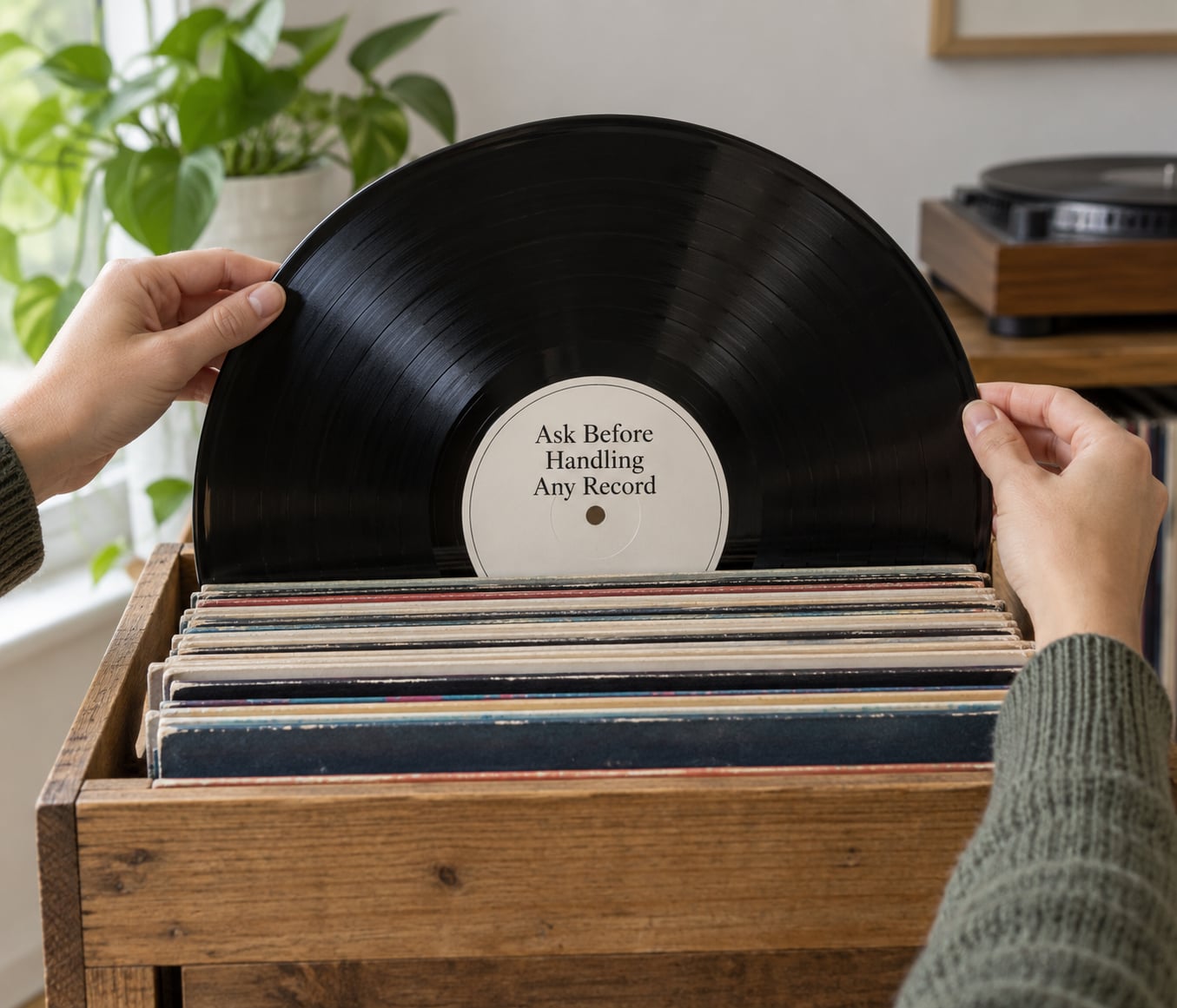
Ask first, then handle. In most independent shops you are welcome to pull records out of a bin yourself, but not every store works that way. Chains and shops that grade copies one at a time often ask you to bring the record to the counter instead.
The polite version costs you nothing: “Can I take a look at these?” or “Is it all right if I pull a few?” One collector on an r/vinyl thread put it well, asking the clerk about a record’s condition and playability is always acceptable and usually encouraged.
Once you have permission, work in small batches. Pull three or four, hold them against your chest or under one arm, flip through them there rather than standing in the aisle with an armful of vinyl. That one habit solves the “am I blocking the bin” problem before it starts.
Signs of a no-handling shop are easy to spot: locked cases, records behind glass, a “please ask” sign on the counter, or staff who hover near the new arrivals bin. In that situation, name the record and ask them to pull it for you. Nobody thinks less of you for asking.
2. Handle the Sleeve and Vinyl Together
Two hands, edges only, and the record stays in its sleeve while you look. Most beginners hold a record by the label and let the outer sleeve dangle from one finger, which is how corners crease and inner sleeves split.
Dry, clean hands are the other half. Vinyl picks up oil and salt fast, and that film attracts dust that plays as crackle. Wash before you go in, skip the hand cream for the day, and if it is raining, let your pockets dry before you start digging.
Looking at the label, the runout area and the track list does not require pulling the disc out at all. Only take it out when you need to check the surface for scratches or to put it on a deck, and slide it back into its sleeve before you put the sleeve back on the shelf.
At home the same habit matters. Store records upright, not stacked flat, and keep them out of direct sun, near a radiator or under a window. Heat and sunlight are what warp sleeves and flatten discs over years.
3. Use the Listening Station Respectfully
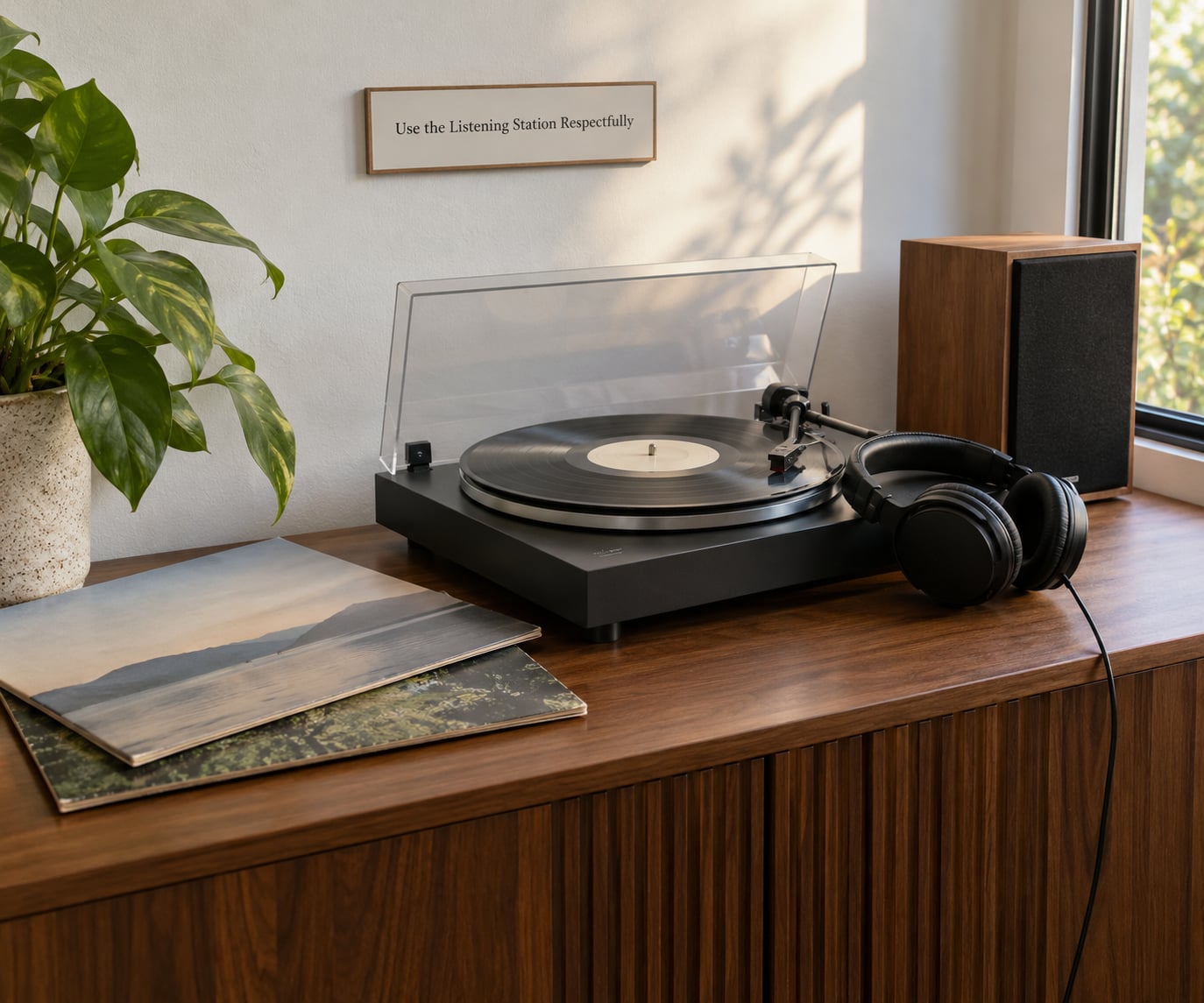
A good default: three or four records at a time, about fifteen minutes at the deck, then take them back. Those numbers show up again and again in collector advice, and they exist because a shop with one deck cannot serve a Saturday crowd otherwise.
Put the record on before you skip to the track you care about. Skipping around on a used copy is the fastest way to damage it, and the person waiting behind you will hear the needle dragging through the whole quiet groove. Crank the volume only as far as you need, since louder is not better on a shop deck and the store chose that volume for a reason.
Check whether the shop expects you to log your time or ask for a token. Some have posted time limits, and a small card with a number on it is not decoration. If someone is clearly waiting, finish the side you are on, not the whole album.
4. Don’t Monopolize the Listening Station
One deck and four people who want it is the normal Saturday scene. The person who loses patience is not usually the one asking, it is the one queueing. Say out loud, early, “Do you need the deck when I’m finished?” It costs nothing and settles the room.
Time also goes the other way. Do not skip a full side on a record you barely looked at, and do not run three records back to back while somebody holds a dubplate they have been hunting for a month.
One more thing: a heavily scratched record from the dollar bin is not a listening station guest. Rough surfaces chew through styli and drag noise across the room for everyone. Ask the clerk to play it instead if the shop has a separate test setup, or accept that some cheap copies are not worth the risk.
5. Put Records Back in the Correct Section
When you are done, the record goes back in the crate it came from, in the right place in the stack, with the spine facing out the same way as the rest. Albums go back on the shelf, singles back in the bin.
Shop systems vary. Some use bin dividers with a code, some file alphabetically by artist, some separate new arrivals from used. Match what the neighbours are doing rather than guessing from the album art, and when a used copy has no divider card, hand it to staff rather than inventing a home for it.
Worth saying plainly: browsing for two hours and leaving without buying is completely normal. Staff do not think you owe them anything. What they mind is records appearing on a table at the end of the day that nobody can identify.
6. Keep Store-Specific Requests Clear
“What should I listen to?” is the hardest question a record shop clerk gets all day. Specific requests get better answers, so split the difference by telling them where you are starting from.
Try something like: “I like early punk and garage, nothing too polished, and I’d rather spend under twenty dollars.” Artist, era, mood and rough budget is a complete brief. Add “nothing I’ve heard on Spotify” if that’s true, because it removes a whole layer of back-and-forth.
Know the difference between wanting a recommendation and wanting one specific record. A title request is a five-second question about whether it is in stock. A recommendation request is a real conversation, and it deserves a moment of the staff member’s time when the shop is quiet, not during a rush.
7. Don’t Bring Food or Drinks into the Browse Area
Water in a coffee cup on top of a crate is a sleeve-ruining accident waiting for a wobble. Condensation rings form on cardboard jackets, and one sticky fingerprint means that record gets pulled from sale and priced as a VG instead of a VG+.
Most shops post a no-food rule near the counter for the same reason, so the store’s policy and your common sense usually agree. Eat at the small table by the door if there is one, and take drinks to the counter area or outside.
Independent shops near a market or a food hall usually have a neighbouring cafe within a minute. Take the record home, eat something, come back. That also protects the sleeves of everything you bought in the meantime.
8. Leave Records and Merchandise in Their Proper Place
Hiding a record you intend to buy is rude and it rarely works. Shops price and file what they can see, so a jacket poking out of a rack in the jazz section does not get held for you; it just confuses the next person looking for the same artist.
Same with anything else that leaves the shelf: band shirts, posters, turntable boxes. If you take something off a display to look at it, either put it straight back or ask staff where they want it.
If you have found a record and genuinely want to reserve it, ask how the shop does holds. Some use a ticket, some write your name on a slip and file the disc in a behind-counter box, some simply hold items at the register for a day. Using their system is the difference between a reservation and a mess.
9. Respect the Store’s Requesting System
Want lists and request slips exist because a small shop cannot chase down every back-catalogue title. Many keep a bound notebook near the counter where you write artist, title, format and any pressing detail you care about. Staff check it when distributors deliver.
Write it clearly and once. “Buzzcocks, Spiral Scratch, UK pressing” gets results; a scribbled half-title does not. Some shops follow lists on their own website too, so ask which channel they actually read before you fill in three of them.
A request is a request, not a claim on stock. Do not ask every visit whether your title has come in, and do not put your name on a title you have not listened to. Staff notice both habits, and they notice the collectors who show restraint too.
10. Ask Questions Without Expecting Free Research
Record store etiquette for beginners: when to ask and when to wait
Ask at the counter, between customers, and keep it to the thing you cannot work out yourself. “Is this one warped?” or “Have you had this pressing before?” take five seconds. A full discography breakdown of a regional post-punk band does not.
Condition questions are the easiest win. Tell staff what you already know: “This is VG+ but the sleeve has a seam split, does that change anything for you?” Collectors generally report that staff are glad to explain their own grading, because it saves a return later.
Second easy win is asking about playability on a dollar-bin copy. Nobody expects you to spot a warp by eye, and staff play test them constantly. The awkwardness people feel here is mostly imagined. The staff member you interrupted was probably mid-conversation with someone else, so a short wait and a “sorry, when you have a second” is the politest version of the question.
What you should not do is lecture. Correcting a clerk about matrix numbers or pressing plants is not a favour to them, and it is a good way to lose the recommendation habit that makes shops worth visiting.
11. Be Considerate About Phone Calls and Conversations
Phones go on silent, and long conversations happen outside or at the edge of the shop. Record stores tend to be quiet spaces where people are concentrating, and a ringing phone resets that for everyone.
Volume matters as much as the call itself. Two people discussing a reissue at full volume three feet from the new arrivals bin is the most common thing I hear beginners get called out for. Keep it down, or keep walking while you talk.
Price checking on your phone in front of staff is the version that lands badly. One store owner described it the way a restaurant chef talks about a diner checking reviews at the table. If you genuinely want to know whether a copy is a good deal, ask. Staff know the going rate for the format and condition, and they will usually tell you straight.
12. Thank Staff and Shop Independently
Say hello on the way in, say thanks on the way out, and learn a name once you have been a few times. That is not politeness for its own sake. Independent record shops run on thin margins and repeat trade, and the staff member who knows your taste is the reason you hear about a crate of imports before anyone else.
Buying in-store when you could have found it cheaper online matters too. A record shop survives on people who browse for two hours, buy three things, and come back next week. Looking up a price on a laptop screen in front of the person who just helped you is the fastest way to seem uninterested in their business.
If you want to support a shop without a big purchase, buy a used copy instead of a new one, trade in what you no longer play, or order through their site if they run one. Any of those keeps money in the same local business.
Frequently Asked Questions
What does VG+ mean on a used vinyl record?
VG+ is Very Good Plus: the record plays cleanly with only a trace of surface noise, usually audible in quiet passages rather than over the music. The vinyl itself shows no obvious wear under a light, though there may be a faint sleeve scuff. Sellers and staff grade the disc and the sleeve separately, so a VG+ disc can still come in a VG jacket.
What is the record grading scale?
The standard collector scale is M, NM, VG+, VG and G, running from sealed mint down to well-played copy. In short: M is new and sealed, NM looks nearly untouched, VG+ plays clean with light noise, VG has noticeable noise that music covers, and G means audible wear throughout. Grades are for the disc and the sleeve separately, and no two sellers are identical.
How long can I use a listening station at a record store?
Most shops expect roughly fifteen minutes and three or four records at a time, and some post a strict limit. Listen to a full side rather than skipping tracks, keep the volume moderate, and check whether the shop uses tokens or a sign-up sheet. If someone is waiting, say so out loud before you finish rather than after.
Can you open a sealed record at a record store?
Not without asking, and the honest answer is usually no. A sealed record is ungraded and ungraded means staff cannot tell you its condition, so opening it puts the shop’s grading reputation on your say-so. If you want to know what is inside, ask whether they have an already-opened copy of the same pressing to play for you.
How do I tell if a used record is playable before buying it?
Look for a wobble when you hold the disc by the edges, check the runout area and the label for scratches that catch a fingernail, and look down the sleeve for a bow. That catches warps and bad scratches but not light surface noise. For anything you cannot judge by eye, ask staff to play it, or buy it as a low-grade gamble you are happy to own.
What should I do if I scratch or drop a record in the store?
Tell the person at the counter straight away, before you leave the shop. Most staff would much rather hear it from you than find it on a return, and they will usually price it down or refuse the sale rather than argue about it. Taking it to the counter for inspection is exactly why they ask you to handle records at the counter in the first place.
Conclusion
On your first visit, do three things: say hello, ask before you pull anything, and keep the record in your hands rather than the bin while you look at it. Everything else on this list you can learn over a few weeks of browsing. The shops worth going back to are the ones where the staff remember your name, and that starts with treating the place like a shared listening room instead of a warehouse.