Why does my record player hum? In almost every case it is the same electrical problem: the turntable’s cartridge puts out a few millivolts of signal, and any 50 or 60 Hz field from your mains wiring, any loose ground, or any speaker shaking the cabinet gets amplified along with the music. The hum you hear is that interference, not a fault in your records or your needle.
The good news is that most of it is fixable in about ten minutes with a screwdriver and no spending. Work through the steps in order, from the ground wire outward, and stop when the noise stops. I checked the guidance below against what owners describe on r/turntables and the audio forums, where the same handful of causes keep coming up. Everything here was re-checked for 2026 model gear.
Table of Contents
- What Makes a Record Player Hum?
- Why Does My Record Player Hum When the Motor Is Running?
- How to Tell Hum from Other Record Player Noise
- How to Fix a Humming Record Player
- Turntable Grounding and Cable Connections
- Cartridge, Stylus, and Speed Problems
- When to Stop Troubleshooting and Check the Equipment
- Frequently Asked Questions
- Is it normal for a record player to hum?
- Why does my record player hum only when I touch the tonearm?
- Can bad speakers cause a record player to hum?
- How do I fix a buzzing turntable without opening it?
- Does a dirty record cause humming or crackling?
- Should I stop using my turntable if it is buzzing?
- Start With the Ground and Signal Connections
What Makes a Record Player Hum?
Hum is a steady, unchanging low note that does not move when you raise or lower the volume of the turntable’s own controls, only when you change the amplifier’s volume. That stability is the giveaway: a needle problem changes with the music, an electrical problem does not.
Four causes account for the overwhelming majority of cases, and they are worth knowing in order because they are also the order you should test them:
- A loose or missing ground connection. The single most cited cause across every forum thread on this topic. The ground wire on the back of the turntable is either dangling, attached to the wrong screw, or attached but loose under the nut.
- A ground loop. Your turntable, preamp, amplifier and powered speakers are all plugged into different outlets or different strips, and the mains earth runs through the audio cables between them. The hum gets worse when more components join the chain, which is the tell.
- Electromagnetic interference. A power cord running alongside an RCA cable, or a cheap switching power supply sitting on the same shelf, and the signal cable turns into an antenna.
- Acoustic and microphonic feedback. Speakers on the same surface as the deck vibrate the plinth, the plinth shakes the cartridge, and the cartridge carries the bass back into the amplifier. This one builds during loud passages rather than sitting still.
Anything beyond those four is rarer, and it usually means a fault inside the deck or amplifier rather than a setup problem.
Why Does My Record Player Hum When the Motor Is Running?
If the hum begins the instant the platter starts spinning, with the needle still parked on its rest, you can rule out the record, the stylus, and most cartridge damage. What is left is the motor and its power supply radiating into the signal path, or the internal preamp circuit sitting too close to that motor.
You can test which one it is without opening anything. Power down, unplug the ground wire from the amplifier, and put the stylus back down. If the hum stays exactly the same, the grounding path was never the problem and the noise is being generated downstream of the ground. If the hum drops noticeably with the ground disconnected, it is a grounding or ground loop issue after all.
On belt-drive decks from the 1970s and 80s, a failing motor capacitor or a dry motor bearing can also add a low growl that rides along with the hum. On direct-drive models, hum that scales with platter speed points at the motor drive electronics. Both are real faults, and both are worth a bench check rather than a weekend of recabling.
How to Tell Hum from Other Record Player Noise
Matching your symptom to a cause saves most of the guesswork. Find the row that sounds like your setup and do the first fix before you touch anything else.
| What you hear | Likely cause | First thing to try |
|---|---|---|
| Steady low hum, always there, changes only with amplifier volume | Ground fault or ground loop | Seat and tighten the ground wire at both ends |
| Hum starts the moment the platter engages, needle off the record | Motor or internal preamp interference | Disconnect the ground wire and compare |
| Hum gets louder as you raise the volume, inaudible at low levels | Normal noise floor, or a marginal ground | Check the ground, then evaluate whether it matters at your real listening level |
| Hum changes level when you move the RCA cables with your hand | Cartridge acting as an antenna, or a poor shield | Reroute cables away from power cords and the wall |
| One channel only | A loose RCA plug, a split cable, or one bad ground pin | Reseat both RCA plugs firmly into the sockets |
| Roaring hum that grows during loud bass passages | Speakers coupling to the deck | Move the speakers onto separate stands |
| Crackle and pops scattered through quiet music | Dirt in the grooves, or a worn stylus | Clean the record, then inspect the stylus under magnification |
| Hum follows the amplifier, not the turntable | A fault in the amplifier or its power supply | Test another source on the same input |
Frequency tells you something the ear alone cannot. Mains in North America is 60 Hz, so a grounded 60 Hz throb is normal for a fault; Europe, the UK, Australia and much of Asia run 50 Hz. The second harmonic at 120 Hz sounds thinner and a bit higher, and often means a half-loose connection rather than a clean ground fault. Broadband hiss that has no pitch at all is a different problem entirely, usually the preamp or an unshielded cable.
Two quick physical tests narrow things down further. Tap the plinth gently with a knuckle while the system is playing: if the hum changes or briefly spikes, you have a microphonic or loose ground connection. And place a hand on the plinth while the hum plays: if holding it noticeably reduces the noise, the current is finding a path through your body, which means the grounding is incomplete.
How to Fix a Humming Record Player
Work top to bottom. The early steps are free and take under a minute each, and they solve the majority of reported cases.
- Power down everything and unplug it. Do not work on a live signal path, and do not open a powered deck. Unplugging matters even when the system is off, because many amplifiers keep a hot side live.
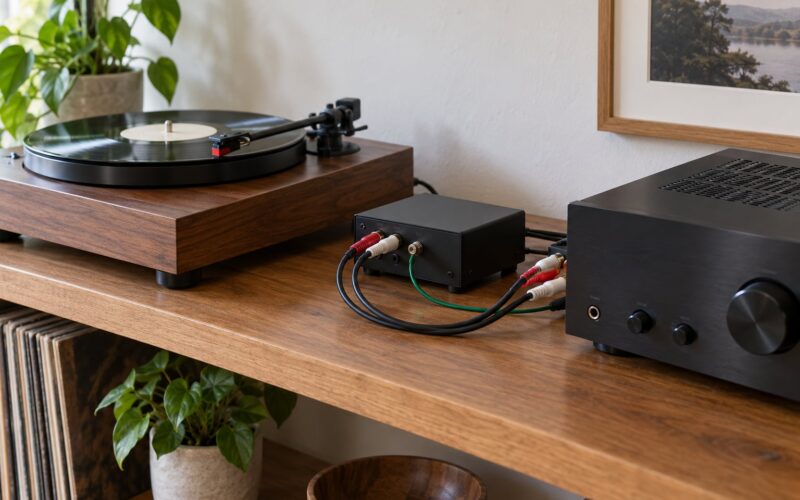
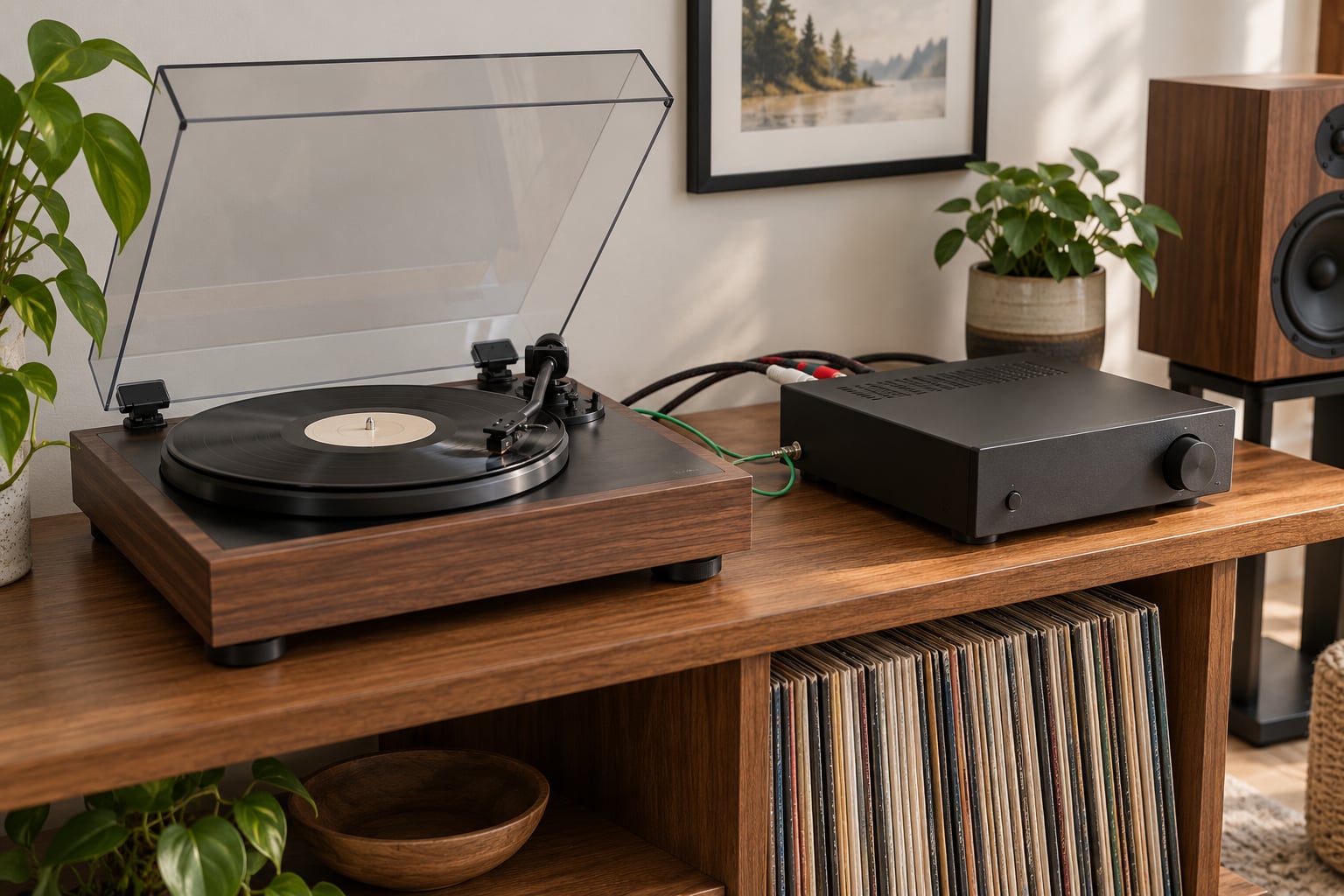
- Find the ground wire. It is the thin bare or green-sheathed wire with a spade connector or a small lug, usually near the RCA output sockets on the back of the turntable. If your deck has one, it is your first suspect.
- Seat it firmly at both ends. The turntable end goes on the GND terminal or chassis screw marked ground. The other end goes to the amplifier or preamp ground post. Tighten both until the metal is bright under the lug.
- Check the ground chain. With an external phono preamp in the chain, the usual order is turntable to preamp, then preamp to amplifier. Only one ground wire per link. Two grounds in one chain is a ground loop you have just built by hand.
- Inspect and reseat the RCA plugs. Push each one in until it clicks. Look for a plug that is only half-way in, a cable that has been sharply bent right at the plug, or one channel wired to a different pair.
- Route signal cables away from power. Run RCA cables along a different side of the shelf from the power cord, and where they must cross, cross at a right angle rather than running parallel.
- Check the input setting. A turntable with a built-in preamp and a PHONO or LINE switch must be set to LINE when feeding an amplifier with its own phono stage, and to PHONO when feeding a line input. Connecting a phono-level signal to a line input gives thin, quiet, distorted sound, not hum, so this is worth confirming rather than assuming.
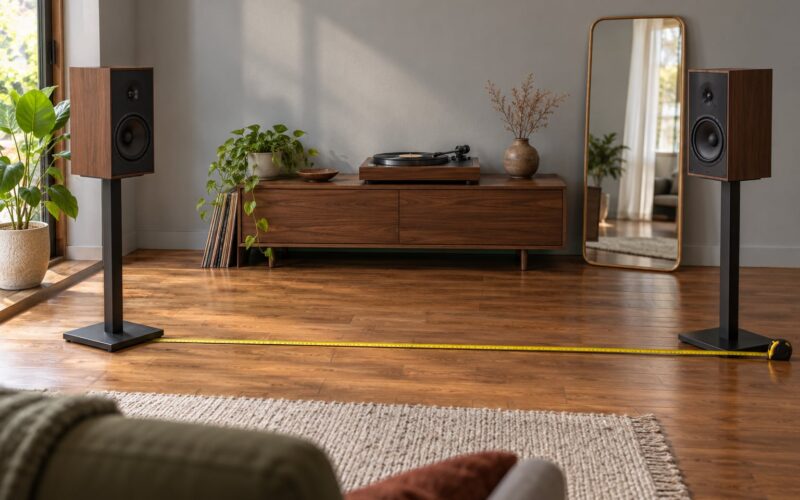
- Move the speakers. Never on the same shelf, cabinet top, or piece of furniture as the turntable. Separate stands or at minimum a foot of clearance in every direction.
- Power from one source. Plug the turntable, preamp, and amplifier into the same outlet or the same power strip. Then try plugging the turntable directly into the wall, bypassing the strip entirely, to see whether the strip itself is contributing.
- Move the suspicious electronics. Routers, game consoles, laptop bricks, phone chargers, LED dimmers and cheap switching adapters all radiate. Anything within about three feet of the turntable is worth moving to test.
- Isolate by elimination. Turn the volume down on the amplifier, then connect a phone or another source directly to the same input. Hum on the phone means the amplifier is at fault. Silence means the noise lives in the turntable side, and you can move down the chain one component at a time until it appears.
If steps one through eleven all pass and the hum remains, a ground loop isolator between the turntable and amplifier will often silence a stubborn loop. Treat it as a diagnostic as much as a fix: if it works, you know the loop was real, and it also tells you the underlying wiring is worth cleaning up properly rather than papering over.
Turntable Grounding and Cable Connections
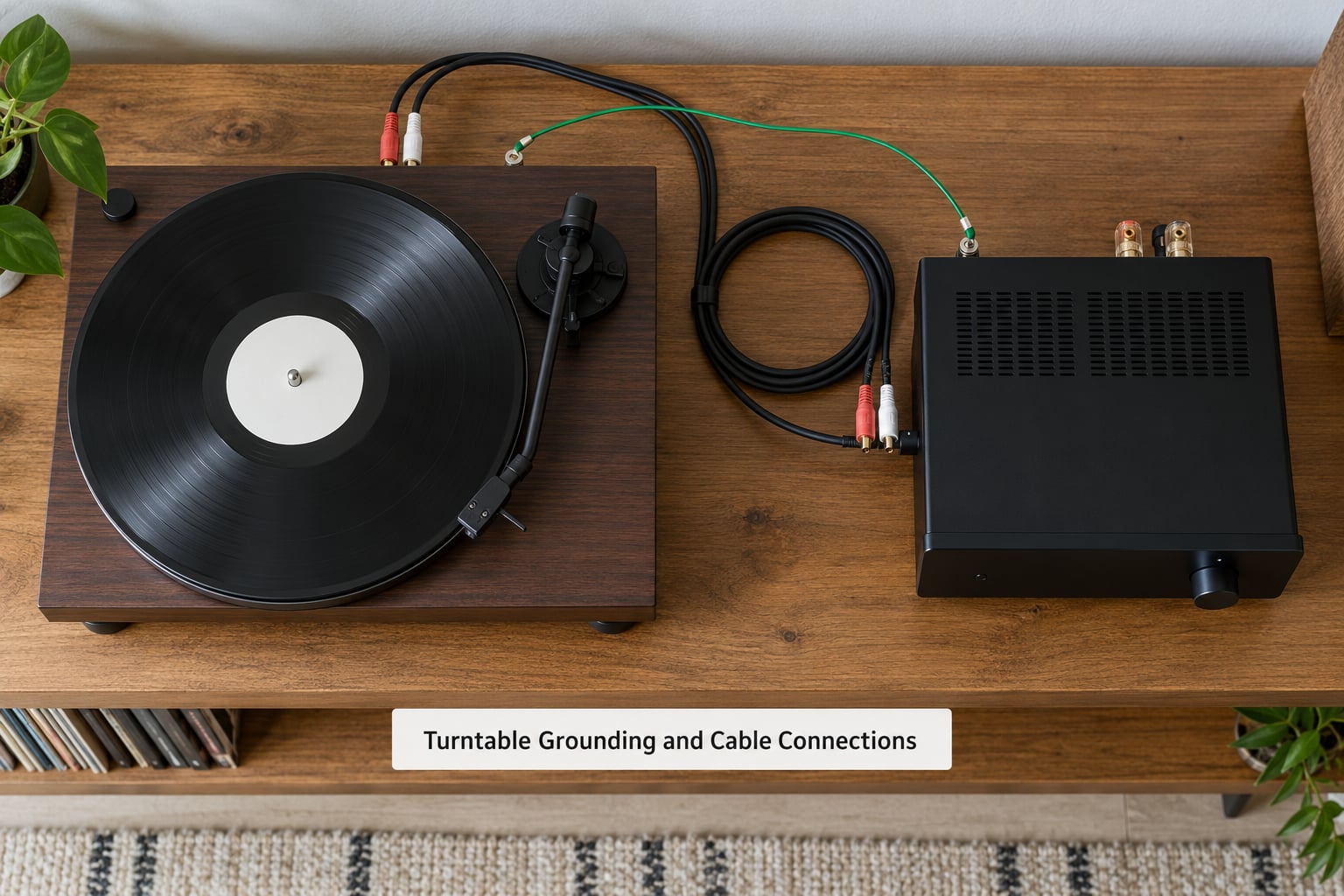
Grounding is the spine of the whole diagnosis. A turntable’s audio output is referenced to its own ground, and if that ground is floating, the output has nowhere to return to and the signal picks up whatever the surrounding wiring is radiating. Attaching the bare ground wire gives that current one defined path instead of many.
The connection on the amplifier end is where most people go wrong. Look for a knurled post or a screw marked GND, usually a cluster of them near the speaker terminals. Some modern amplifiers and powered speakers simply have no ground post at all, which is a specification choice, not a defect. In that case you are relying on the shield on the RCA cable alone, and the fix is a better-shielded cable rather than a loose wire twisted onto a random screw.
Three details matter on the RCA cables themselves. Shielded-and-grounded cables with a single conductor to a single pin are the norm; “shielded” cables with both conductors tied to shield create a ground loop inside the jacket, and cheap unshielded cables act as antennas. Make sure the cables are long enough to reach without being stretched taut, because a plug under tension slowly works its way out of a socket.
A good trick for a beginner: imagine the chain as one continuous line. Turntable ground to amplifier ground, one wire, no branches. The moment you add a second path back to mains earth, you give the current a choice, and it takes the noisier route.
Cartridge, Stylus, and Speed Problems
Most of what gets reported as hum is not hum at all. Crackle that comes and goes with the music is usually dirt, and no amount of grounding will touch it. Run a cleaning brush through the grooves with the record on the turntable, following the direction of rotation, and try a fluid and brush if you have one.
A worn stylus produces a different signature: distortion that worsens at loud passages, a slightly unfocused sound, and a treble that seems dull no matter what you do. Look at the stylus under magnification or a loupe. A blunt, flattened, or visibly hooked tip needs replacing. Never run a record player with a damaged needle against a record, and never try to reshape a tip yourself.
Two things in the tonearm assembly do produce electrical noise. Loose headshell wires, usually the green, blue and white pins, create an intermittent connection that crackles when the arm moves, and re-crimping or re-seating them fixes a surprising share of reported problems. And a misaligned or poorly tracked cartridge can feed back mechanical energy back into the plinth, though that reads as feedback squeal rather than a steady buzz.
Speed problems are pitch problems. A platter running slightly fast or slow changes the note of everything you play, and if the motor speed is unstable you may hear a faint warble underneath the music that can be mistaken for hum. Many decks have a strobe window or a software pitch control for exactly this. Check the speed before blaming the electronics.
When to Stop Troubleshooting and Check the Equipment
Some signals mean the equipment needs a technician, not another evening of recabling. Unplug it and stop if you notice any of the following:
- A burning smell, fishy hot-plastic odor, or a power supply that gets hot to the touch while switched off.
- Sparks, arcing, or a plug or outlet that discolours.
- Exposed wire, a damaged power cord, or a broken plug prong.
- Hum that continues after the ground wire is fully disconnected and the RCA cables are pulled out.
- A cartridge or headshell that has come loose, or a tonearm that no longer balances.
- Smell of burnt coil from a vintage deck’s motor or its power supply.
Two of these deserve emphasis on old equipment. A deck stored for years can have degraded insulation, and a vintage power transformer can cook itself and take the hum problem into smoke territory. If the unit is more than thirty years old and smells warm when you power it, stop using it until someone has inspected it.
None of this applies to ordinary buzz in an otherwise healthy system. Steady hum from a properly connected turntable is a nuisance, not a safety issue, and it is very nearly always something you can fix with a ground wire and better placement.
Frequently Asked Questions
Is it normal for a record player to hum?
No. A healthy system should be silent apart from the faint surface noise of the record itself. Hum that you can hear across a normal conversation, or that follows you into quiet passages, is a real fault. That said, a moving-magnet cartridge does have a measurable noise floor, and some residual hiss becomes faintly audible at high volume on entry-level gear without anything being broken. Judge it at the volume you actually listen at, not with the amplifier wide open.
Why does my record player hum only when I touch the tonearm?
Because touching the arm changes the electrical path. Your hand is providing an extra route to earth, which is exactly what a properly connected ground wire does. If the hum drops when you touch the plinth, tonearm, or headshell, the grounding is incomplete. A loose ground terminal, a missing wire, or a chain with no ground post at the amplifier end will all produce this. Connect the ground properly and the touch test should stop mattering.
Can bad speakers cause a record player to hum?
Yes, in two ways. Speakers sitting on the same shelf as the turntable shake the plinth, and that vibration reaches the cartridge and comes back as a rumble that swells during loud bass passages. Poorly shielded or badly grounded speakers can also create a ground loop when they carry their own mains earth back into your audio path. Moving speakers onto separate stands fixes the first problem and often reveals the second.
How do I fix a buzzing turntable without opening it?
Power down and unplug everything, then reseat and tighten the ground wire at both the turntable and the amplifier. Push the RCA plugs in fully, check the PHONO and LINE switch is set correctly, route cables away from power cords, move the speakers onto separate stands, and move chargers, routers, and dimmers out of the vicinity. Pull the ground wire off entirely to see whether the noise changes. These cover most cases and none of them requires opening the case.
Does a dirty record cause humming or crackling?
A dirty record causes crackle, not hum. Dust and static in the grooves produce short, scattered pops and a scratchy surface noise that follows the music. It disappears when you lift the needle. Hum behaves the opposite way: it stays at exactly the same level regardless of what is playing, and often continues with the platter spinning and no record on it. If you hear both, you are dealing with two separate issues and the dirt is the easier one.
Should I stop using my turntable if it is buzzing?
Steady hum on an otherwise healthy deck is not dangerous, so you can keep listening while you troubleshoot. Stop and unplug it immediately if you notice a burning smell, sparks, a discoloured plug or outlet, exposed wiring, or a power supply that stays hot after being switched off. Those point to an electrical fault rather than a grounding problem, and continuing to use the equipment risks damage to the deck, the amplifier, or your home wiring.
Start With the Ground and Signal Connections
Power everything down, plug the turntable directly into a wall outlet, and trace one ground wire from the deck’s GND terminal to the amplifier’s ground post. Tighten both ends. Then reseat the RCA plugs and confirm the PHONO and LINE switch matches what your amplifier expects.
While it is unplugged, move the speakers off the turntable’s shelf. If the hum survives all of that, play a phone through the same amplifier input: noise on the phone means the fault is in the amplifier, and silence means it is still somewhere in the turntable side.
Do not buy cables or a power conditioner first. In most cases the whole problem is one loose lug, and it is sitting behind the deck where you have not looked yet.