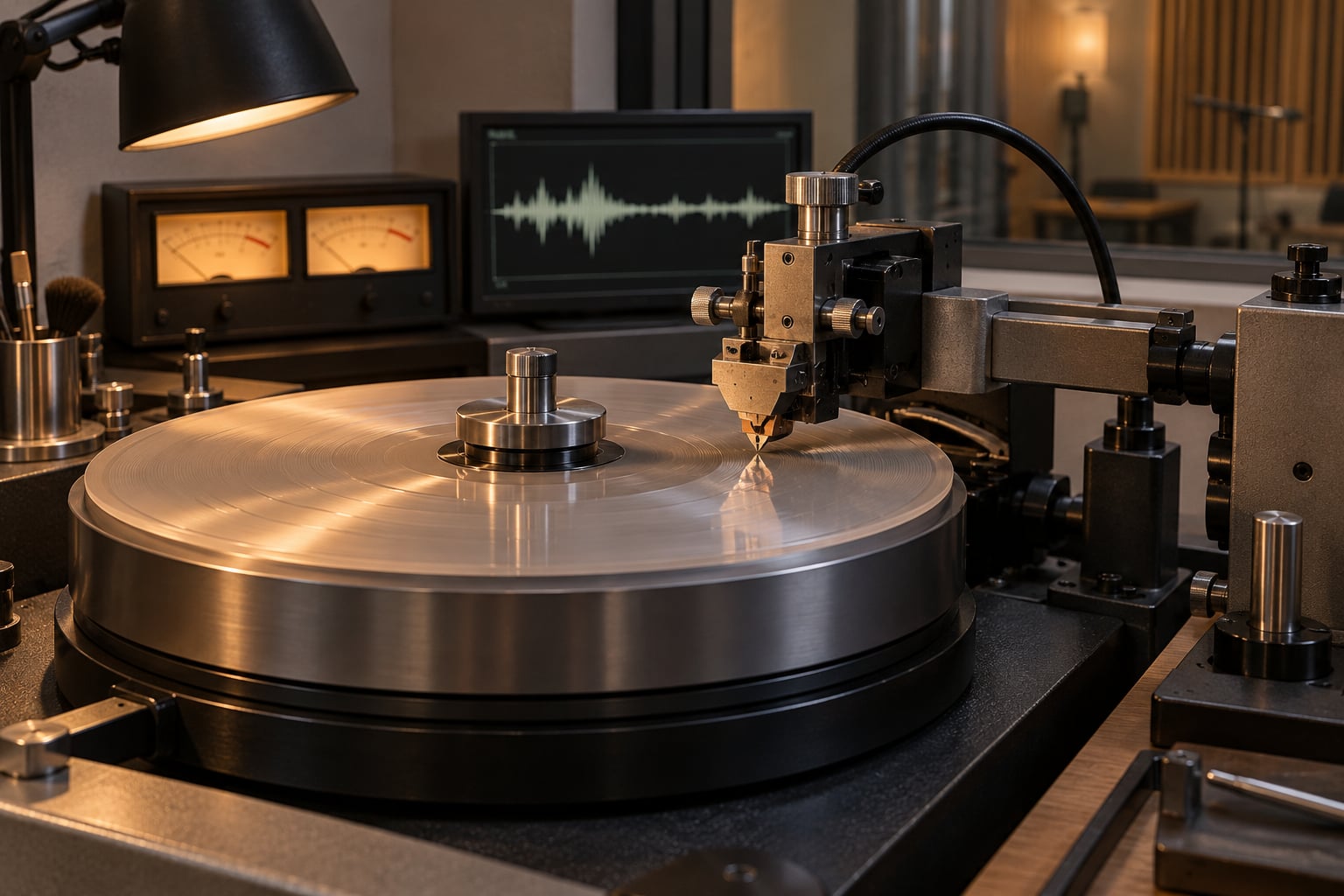
Half-speed mastering is a vinyl cutting technique where the mastering lathe turns at half its normal speed — 16 2/3 RPM for a 33 1/3 RPM record — while the audio feeds into the cutting head at half speed too. The slower cut gives the cutting head twice as long to carve high frequencies, and the finished record still plays at normal pitch and tempo on an ordinary turntable.
Quick answers before we go deeper:
- What is it? The lacquer disc that every vinyl record is pressed from is cut at half the usual speed, with the audio slowed to match.
- Does it play slowly? No. The record is pressed normally and spins at 33 1/3 RPM on any standard turntable.
- Why do it? High frequencies move into the midrange, where vinyl reproduces them more accurately.
- Is it always better? No. It costs bandwidth, and a badly prepared source can come out thin or bright.
Table of Contents
- What Is Half Speed Mastering?
- Why Does Half-Speed Mastering Sound Better?
- What half-speed mastering cannot do
- How Does the Half-Speed Mastering Process Work?
- 1. Source preparation
- 2. The half-speed cut
- 3. Plating and pressing
- 4. Quality control and packaging
- What Is the Difference Between Half-Speed and Regular Vinyl Mastering?
- How to Tell If a Record Was Half-Speed Mastered
- Is Half-Speed Mastering Worth It for Vinyl Collectors?
- Frequently Asked Questions
- Does half-speed mastering make a record louder?
- Are half-speed mastered records more durable?
- Does half-speed mastering work for punk and garage rock?
- Can I tell if a record was half-speed mastered just by listening?
- Is a half-speed master the same as an audiophile mastering engineer?
- Should I buy a half-speed pressing over a standard reissue?
- Conclusion: Start With the Label and Pressing Details
What Is Half Speed Mastering?
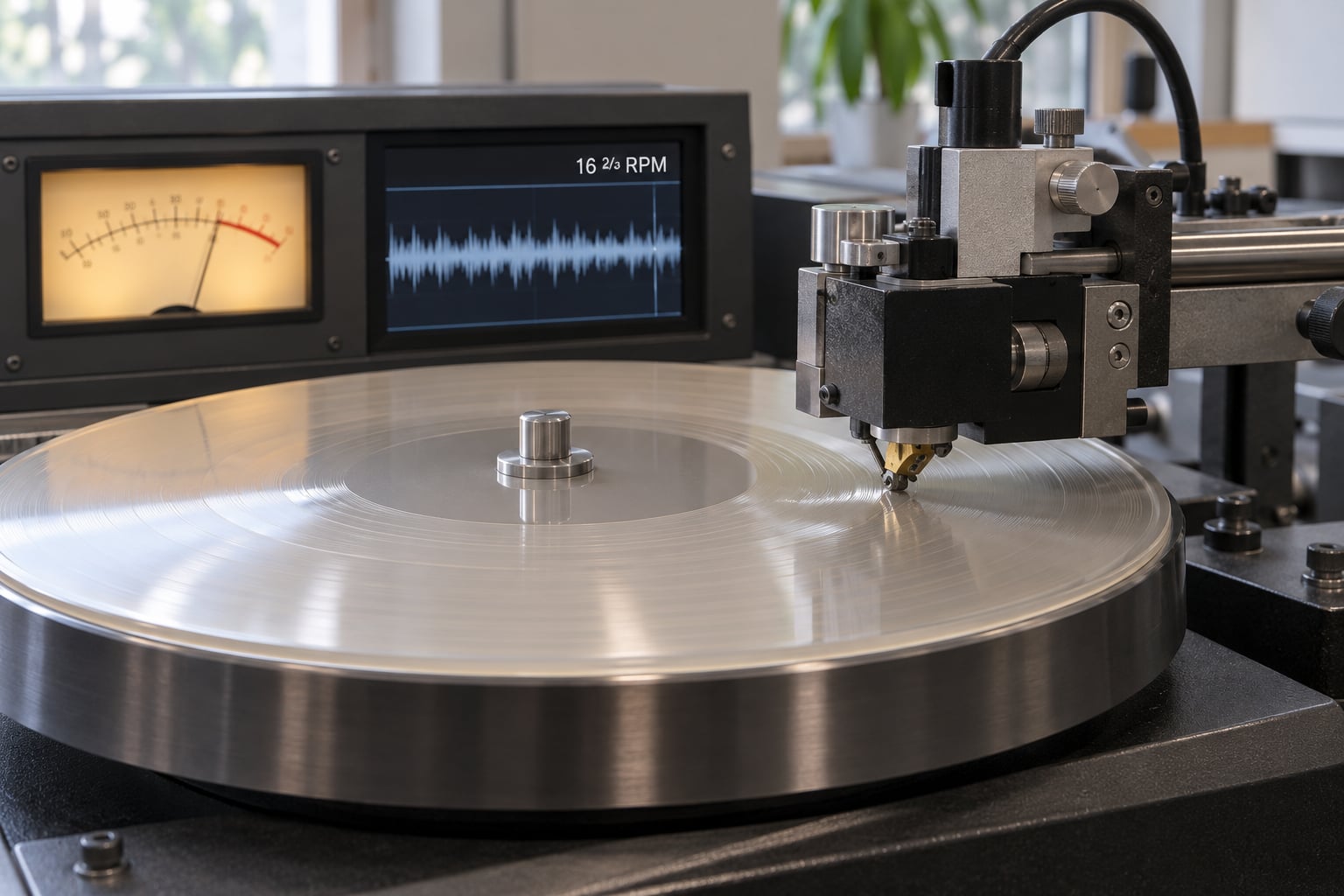
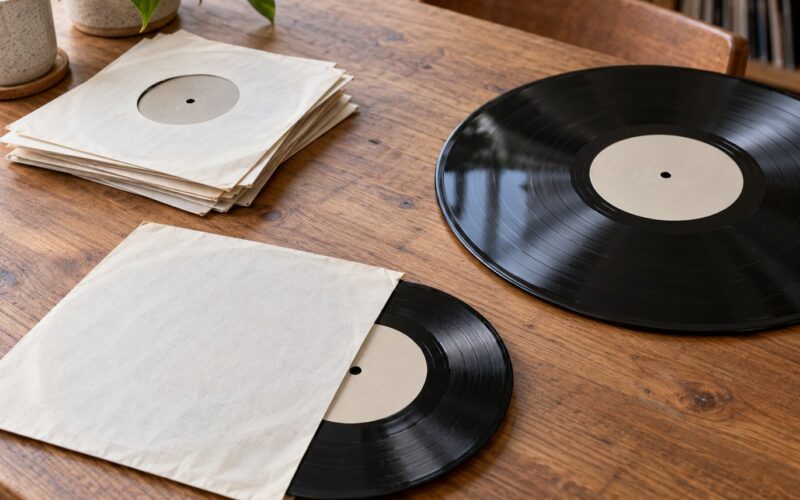
Every record you own starts life as a thin, soft disc of acetate lacquer. A mastering lathe holds a lacquer under a vacuum, spins it at a fixed speed, and floats a vibrating cutting stylus on its surface. That stylus cuts a spiral groove, and the microscopic wiggles in the groove walls are the music. A metal stamper is later electroformed from the lacquer, and that stamper presses copies of the record in a factory.
Half-speed mastering changes one variable in that chain: the platter speed. A 33 1/3 RPM lacquer is normally cut at 33 1/3 RPM, with the music fed in at 1x speed. In a half-speed cut, the platter turns at 16 2/3 RPM and the audio is fed in at half speed as well, which keeps pitch and tempo correct on the finished record. Everything downstream — plating, pressing, packaging — is identical to a normal record.
Two things this is not. It is not a record that plays slowly, and it is not a record mastered by a machine with better software. The only stage that changes is the cut itself.
Why Does Half-Speed Mastering Sound Better?
Vinyl has a bandwidth ceiling. Treble above roughly 15 to 16 kHz is where the format starts to fight itself: the groove wiggles get small and rapid, the cutting head and playback stylus have to track fast lateral movements, and the signal either compresses or distorts. This shows up most in the inner grooves, the last few minutes of each side, where the stylus sits at a shallower radius and has to work harder. The result is the familiar inner groove distortion, where hi-hats and cymbals lose their shape.
Slowing the lathe moves the problem down the spectrum. A 10 kHz cymbal, played into the cutting head at half speed, is recorded into the groove as if it were 5 kHz — right in the midrange where vinyl is comfortable. When the record plays back at normal speed, the slower-cut waveform resolves correctly and that cymbal comes back as 10 kHz again, with more accuracy and less distortion. Two minutes of audio also fits into a groove half as tall, so the cutting head has far more room to move and the signal level can be set lower.
Take a dense rock-and-roll mix as an example: two distorted guitars, a bass guitar, piano, drums and cymbals all riding high in the frequency range at once. Cut at normal speed, the guitars can smear into the cymbals and the top end tightens up toward the run-out. Cut at half speed, that same mix usually opens up, and the instruments separate more clearly.
What half-speed mastering cannot do
It cannot repair a bad master. If a record was recorded poorly, mixed flat, or squeezed so hard by a loudness-war limiter that the transients are gone, a slower cut re-cuts the same damaged material. What it can do is cut a decent source with more accuracy. Claims that a half-speed master carries twice the information are wrong — it carries slightly less, because the top of the spectrum may need rolling off to fit.
How Does the Half-Speed Mastering Process Work?
The process runs in four stages, and each one has an owner who can make or break the result.
1. Source preparation
The mastering engineer starts from the best source available: an original analog tape master where one survives, otherwise a high-resolution digital file at 96/24 or better. Because loudness-war-era masters arrive crushed, the engineer often decompresses, de-limits and applies corrective equalization before anything touches a lathe. The source is then pitched down or fed to the cutting chain at half speed.
2. The half-speed cut
The lacquer spins at 16 2/3 RPM while the cutting engineer rides the level and watches the meters, moving the stylus as the groove grows. Because each revolution covers half as much music, the whole side takes roughly twice as long to cut than a normal session. That time cost is where most of the premium comes from, alongside the equipment and the engineer’s fee.
3. Plating and pressing
The lacquer is tested for width, depth and symmetry, then electroformed into a metal stamper. Nothing about the stamper records the cutting speed; the process that follows is completely standard, which is why a half-speed master and a normal master of the same album look identical on a pressing plant floor.
4. Quality control and packaging
Specialist labels tend to inspect test pressings personally and pack them more carefully, so collectors often report that the physical copy feels more considered. That is a bonus of the label, not a property of the cutting speed.
What Is the Difference Between Half-Speed and Regular Vinyl Mastering?
| Factor | Standard cutting | Half-speed cutting |
|---|---|---|
| Lathe speed for a 33 1/3 RPM record | 33 1/3 RPM | 16 2/3 RPM |
| Playback speed of the finished record | 33 1/3 RPM | 33 1/3 RPM |
| Groove width | Narrower | Wider, roughly double the time per revolution |
| High-frequency headroom | Tighter against the format ceiling | More room; hard treble is cut in the midrange |
| Bass weight | Usually fuller | Can lose weight if the level is cut back to fit the top end |
| Inner groove distortion | More likely toward the run-out | Reduced |
| Time to cut one side | Standard session | About twice as long |
| Cost | Standard reissue pricing | Noticeable premium for the extra cutting time and handling |
| Suits best | Most reissues, newer masters, anything on a tight budget | Dense vintage rock, punk, garage, rockabilly, critical listening |
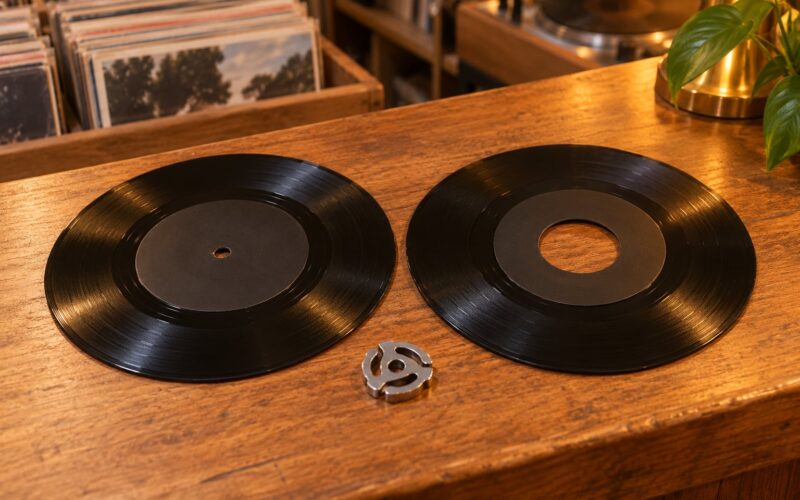
It also sits alongside another approach worth naming: 45 RPM cutting. A 45 RPM lacquer turns faster, the grooves are finer and there is more of the record edge to work with, so a 45 RPM cut can be cleaner still and usually plays louder before the surface noise rises. Half-speed and 45 RPM solve the bandwidth problem in opposite directions, and collectors happily own both cuts of the same album.
How to Tell If a Record Was Half-Speed Mastered
Four checks, in order of reliability.
- Read the label copy. Genuine releases say “half-speed mastered” or “half-speed master” plainly, usually near the mastering credit. Wording like “audiophile reissue” or “mastered for vinyl” alone means nothing specific.
- Look for the hype sticker and catalog number. Specialist labels — Abbey Road, Music On Vinyl, Hi-Fi Records, Analog Productions, Speakers Corner and Mobile Fidelity Sound Lab among them — use consistent catalog ranges for their half-speed series, and the number tells you which series a release belongs to.
- Check the matrix or runout etching. The etched code around the run-out groove usually carries the mastering engineer initials, the lacquer code and sometimes the cutting speed designation, for example a cut marking of AA or HS. If the etching is missing, the jacket is your only evidence.
- Listen, with scepticism. Reduced surface noise, cleaner cymbals and open transients fit a half-speed cut, but a good engineer cutting at normal speed can produce a similar result. Quiet does not prove half-speed, and a slightly brighter, looser bottom end is not proof against it either.
One more note for collectors: the same label can cut the same album as a normal master in one region and a half-speed master in another, so catalogue numbers are more reliable than a generic “deluxe edition” sticker.
Is Half-Speed Mastering Worth It for Vinyl Collectors?
The honest answer is sometimes, and the deciding factors are genre, source and what you already own.
Half-speed cuts earn their keep on dense, loud, heavily layered music from the sixties and seventies: garage and freakbeat, punk and hardcore, rockabilly, vintage rock and the heavier psychedelic and blues-rock records. Those mixes are where a normal cut tends to crowd the top end. On a thin, modern master with lots of headroom and a wide stereo field, there is far less for the technique to fix.
The other question is what sits in your collection already. If you own an original pressing that plays cleanly, a half-speed reissue is a luxury purchase, not a repair job. If the album has no decent copy at all, a half-speed cut is one of the better upgrades on the shelf. It also helps to have a system with a decent cartridge and a clean stylus, because the improvement is a matter of a few percent of detail, not a different record.
Enthusiasts genuinely disagree here, and the disagreement is worth hearing rather than smoothing over. Collectors who own both cuts often report one as spacious and airy with defined bass, and others as bright with loose low end. The safest approach is to judge the individual release instead of the badge.
Frequently Asked Questions
Does half-speed mastering make a record louder?
No. Half-speed mastering is a precision technique, not a loudness one. Because the cutting head has twice as long per revolution, the engineer can keep the level lower so the hardest high frequencies fit under the format ceiling. A half-speed cut may strike you as more open and forward, but that is cleaner treble and lower distortion, not more volume.
Are half-speed mastered records more durable?
No. Durability comes from the vinyl compound, the pressing weight and quality control at the plant, not from the cutting speed. A heavier half-speed pressing and a lighter standard pressing of the same album wear the same way. If the edition is also pressed heavier and carefully graded, you get better vinyl as a bonus, but that is the label’s doing.
Does half-speed mastering work for punk and garage rock?
Yes, and it is one of the genres where the technique has the most to offer. Distorted guitars, fast drums and cymbals all riding high at once is exactly the material that crowds the bandwidth range on a normal cut. Slower cutting gives that top end more room, so guitars separate from the cymbals instead of smearing into them.
Can I tell if a record was half-speed mastered just by listening?
Sometimes, but never with certainty. Lower surface noise, cleaner cymbals and less smearing on dense passages are all consistent with a half-speed cut, yet a good mastering engineer working at normal speed can produce similar results. Listening narrows it down to a likely answer. Label copy and the run-out etching are what confirm it.
Is a half-speed master the same as an audiophile mastering engineer?
No, they are separate things. The mastering engineer is the person who shapes the mix for the format, at whatever speed the lacquer is cut. Half-speed mastering is a choice about how that lacquer gets cut. Some releases pair the two, which is why the terms get tangled, but an expert engineer cutting at normal speed is not a half-speed master.
Should I buy a half-speed pressing over a standard reissue?
It depends on what you already own. If you have an original pressing that sounds good, a half-speed reissue is a luxury rather than a fix. If the album has no decent pressing in your collection, or the best source is an old tape master with a narrow top end, a half-speed cut is one of the better upgrades available. Judge the release, not the badge.
Conclusion: Start With the Label and Pressing Details
Half-speed mastering is a cutting decision, not a guarantee. Start with the mastering credit on the sleeve, the label and catalog number, and the run-out etching; those three tell you more than any amount of listening alone. Then decide on the release: dense vintage rock and punk tend to gain the most, a well-mastered album you already own gains the least, and any pressing with a poor source or a careless cut can sound worse than the standard version.