45 rpm LPs often sound better because the record spins about 35% faster, so the stylus travels roughly 35% further through the groove for every second of music. That extra groove velocity means wider grooves, more room for bass and dynamics, less strain on the stylus near the label, and a quieter, more open sound. Mastering, pressing quality and your turntable still decide the outcome.
The rest of the answer matters as much as the speed, so here is the short version before the detail:
- Higher groove velocity. The stylus covers more physical groove per second, so the same information is spread out over more vinyl.
- Wider grooves. A 45 rpm cut needs less groove pitch, which leaves room for larger lateral excursion, and larger excursion is what bass needs.
- Less inner-groove distortion. The tight groove near the label is where 33 1/3 rpm records fall apart. At 45 rpm that zone arrives much later in the side.
- Quieter surface noise. The same programme information is spread over more groove length, so hiss from the vinyl itself is spread thinner.
- Cleaner high frequencies. Treble sits at the top of the groove wall, and a wider wall gives the cutting lathe and the stylus more room to cut and read it cleanly.
None of that is a guarantee. A cheap 45 rpm cut of a badly mastered tape loses to a 33 1/3 rpm half-speed master, and a warped 45 rpm disc will skip regardless of how well it was engineered. The rest of this guide covers both sides of that.
Table of Contents
- Why 45 RPM LPs Sound Better: The Short Answer
- How Record Speed Changes the Sound
- The Technical Reasons 45 RPM LPs Sound Better
- Wider grooves and lower groove pitch
- Fewer audio waves per inch of groove
- Less inner-groove distortion
- Room for dynamics and a quieter surface
- Better behaviour in bass-heavy music
- Does 45 RPM Always Sound Better Than 33 1/3 RPM?
- Why 45 RPM LPs Can Sound Worse
- How to Judge a 45 RPM LP Before Buying
- Check the label and matrix information
- Look at the run-out groove before playing
- Play-test the outer and inner grooves
- Look for warping, weight and pressing evidence
- Read the reissue notes critically
- Set the turntable up before judging
- Frequently Asked Questions
- Do 45 RPM LPs have better bass?
- Does 45 RPM automatically mean higher fidelity?
- Why do 45 RPM LPs cost more than 33 1/3 RPM versions?
- How can I tell if a vinyl record is 33 or 45 RPM?
- How do I A/B test 45 RPM and 33 1/3 RPM at home?
- Which albums are worth hunting down in 45 RPM?
- What to Do First
Why 45 RPM LPs Sound Better: The Short Answer
45 rpm LPs sound better primarily because groove velocity is the limiting factor in vinyl playback, and 45 rpm raises it across the whole record. At 33 1/3 rpm a 12-inch LP plays at roughly 20 inches per second at the outer edge and around 8.5 inches per second near the label. At 45 rpm those figures become roughly 27 inches per second and about 11.5 inches per second.
That last number is the one collectors notice. A 33 1/3 rpm record spends its final minutes at a stylus speed that starts to sound strained, with bass and treble losing definition at the same time. Push the same master to 45 rpm and the side ends while the groove is still comfortable to read. Everything else follows from that one fact: bigger lateral swings for bass, finer resolution for treble, and less mechanical stress on the stylus.
The history explains why the format felt strange. CBS introduced the 12-inch 33 1/3 rpm LP in 1945, built around Peter Goldmark’s long-groove idea, and RCA Victor answered two years later with the 7-inch 45 rpm single. Two companies, two philosophies. Collectors who grew up on 7-inch 45s often assume 45 rpm always belonged on an album, when in reality most 12-inch 45 rpm LPs are a later revival built on audiophile labels rather than a standard 1950s format.
How Record Speed Changes the Sound
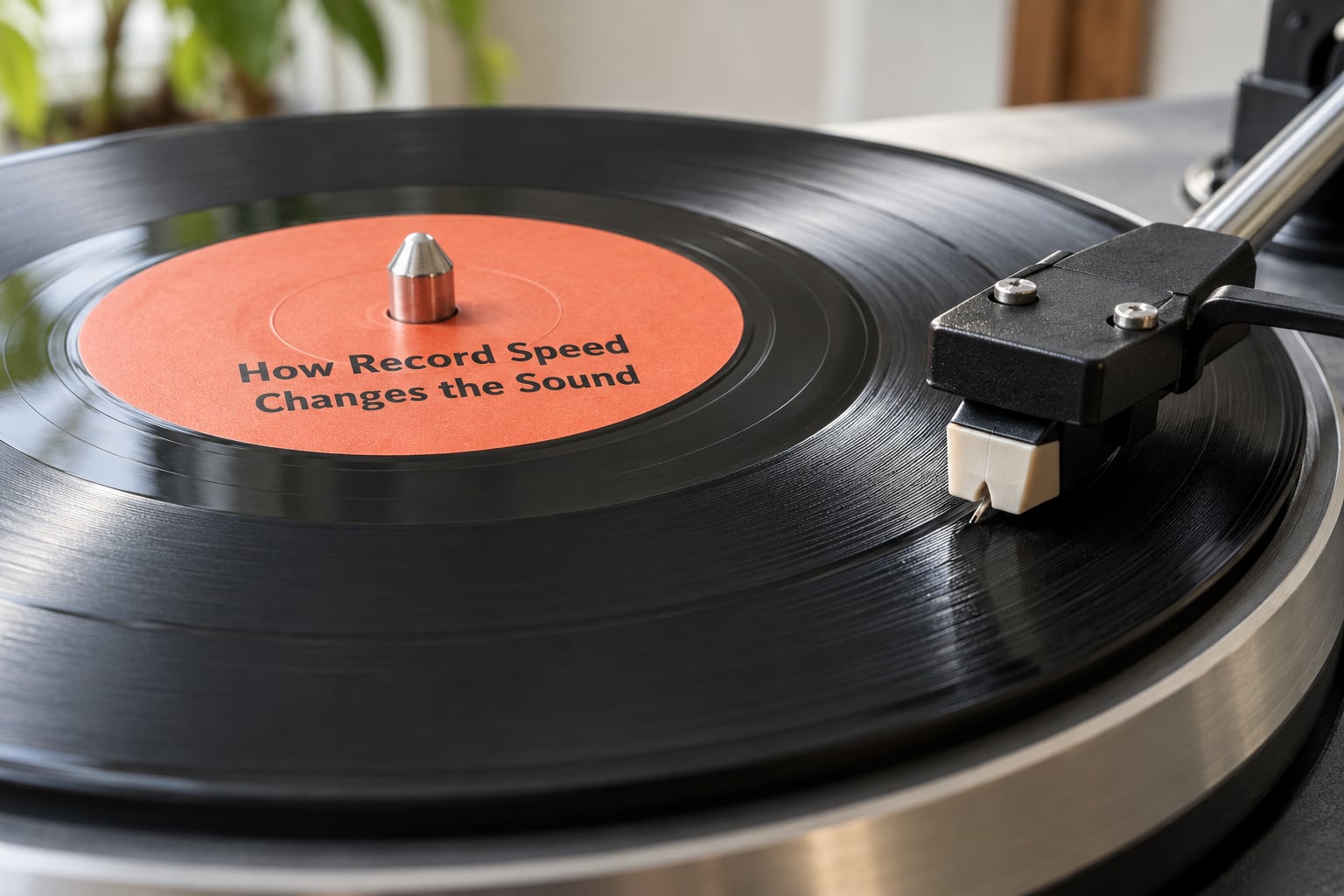
Speed on a record is not a quality setting like a bass boost. It changes the amount of physical space the recording has to live in, and everything else follows from that geometry.
A disc spins at a fixed rate, and the groove is a spiral cut from the outside edge toward the label. The stylus moves inward as it plays, which means groove velocity drops continuously from the first track to the last. What changes with speed is the top of that range and the whole curve above it.
| Factor | 33 1/3 RPM | 45 RPM |
|---|---|---|
| Rotational speed | 33 and a third turns per minute | 45 turns per minute, about 35% faster |
| Typical minutes per side | 20 to 25 minutes | 14 to 17 minutes |
| Groove velocity at outer edge | About 20 inches per second | About 27 inches per second |
| Groove velocity near the label | About 8.5 inches per second | About 11.5 inches per second |
| Typical groove pitch | Around 0.18 mm | Around 0.11 to 0.13 mm |
| Inner-groove strain | Audible in the last few minutes | Mild or absent across a normal side |
| Main trade-off | More music per side | Quieter, wider sound, shorter sides |
The trade-off is straightforward arithmetic. A 45 rpm side holds roughly two-thirds of the music a 33 1/3 rpm side does on the same diameter, so labels either split the album across two discs or accept shorter, sometimes oddly shaped, track listings. That is also why dead space and short run-outs are so common on 45 rpm LPs, a point worth remembering when you judge one in person.
It is not that 45 rpm holds more music per second. It holds less. What improves is the resolution of what is there.
The Technical Reasons 45 RPM LPs Sound Better
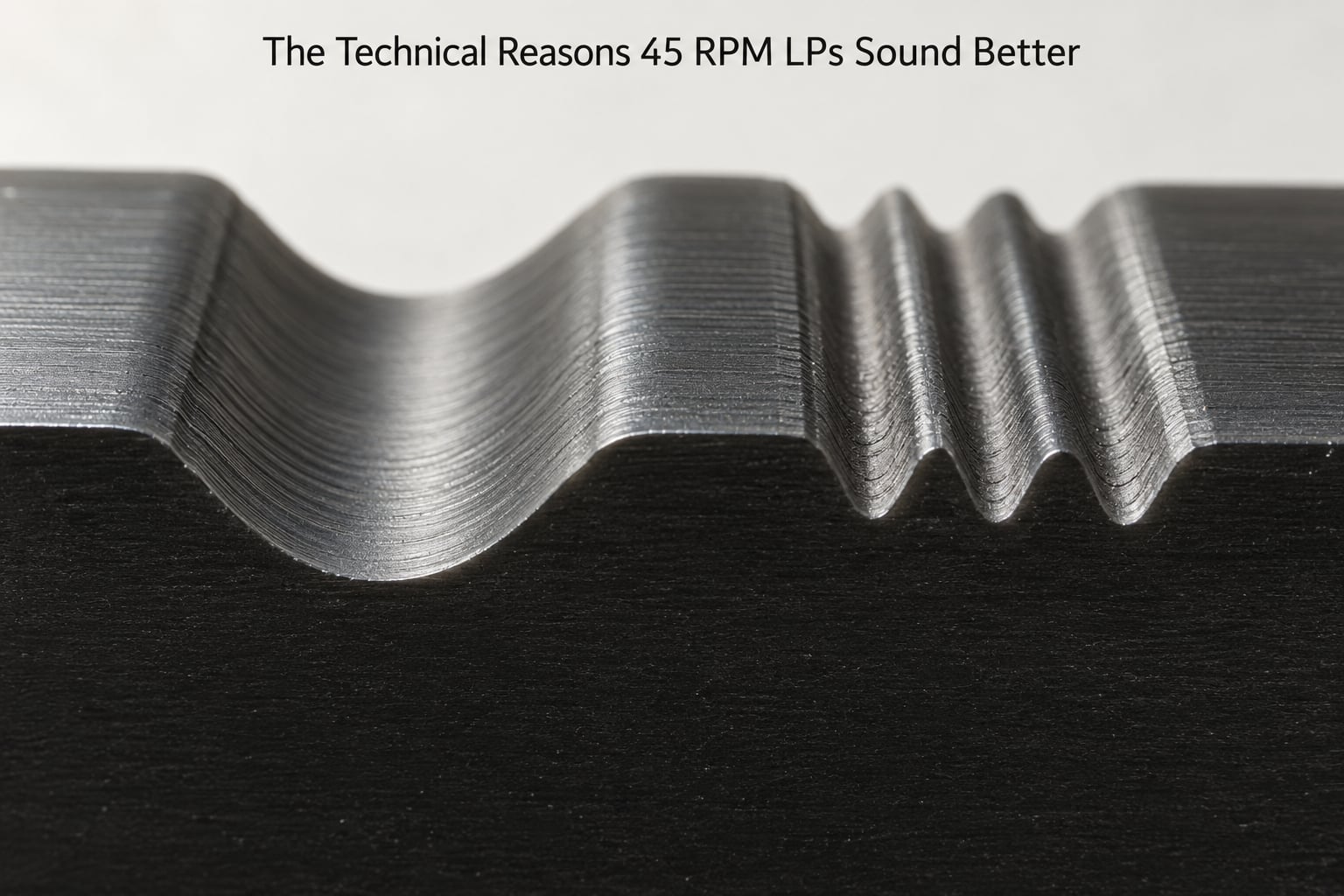
The reasons below are mechanical and measurable, which is why they survive arguments. Each one is an engineering possibility rather than a promise, but they all point the same direction.
Wider grooves and lower groove pitch
Groove pitch is the distance between adjacent groove windings, and it is the budget the cutting engineer has to spend. A record playing for 22 minutes at 33 1/3 rpm has to pack that programme into a much thinner layer of vinyl than a 15-minute 45 rpm side, so the pitch tightens and the modulation has less room between windings.
On a 45 rpm cut the pitch drops to roughly 0.11 to 0.13 mm, and the freed-up space becomes the difference between a bass note that fits and one the lathe has to squeeze in. Bass costs excursion, excursion costs space, and space costs minutes. That trade is the whole story of why 45 rpm sides are short.
Fewer audio waves per inch of groove
Because the same music passes the stylus over a longer distance, each inch of vinyl carries less audio. Luthiers and engineers have compared the two ends of a 33 1/3 rpm side to the difference between a 96 kHz and a 22.05 kHz sample rate, and the analogy is roughly right even if it is not exact. More distance per second of music means the high frequencies are not crowded against the groove wall as tightly.
Less inner-groove distortion
Inner-groove distortion is the specific failure of slow LP playback. As the stylus travels inward, the groove narrows, the stylus sits closer to the bottom of the V, and the geometry needed to follow the modulation starts to break down. Bass sags, treble dulls, and at the very end the whole thing goes vague.
Raising the speed pushes that failure zone outward and past the run-out. On a 45 rpm side the music finishes while the groove is still in its comfortable range, so the listener never hears the collapse. Collectors consistently say the difference is most obvious in the final minutes of a side, which matches the physics exactly.
Room for dynamics and a quieter surface
Vinyl noise comes from the material and the pressing, not from the programme, so noise sits under every signal at a fairly constant level. Spread the programme over more groove length and that same noise floor is divided across more of the side. Many owners say the practical difference they notice first is a quieter record rather than a prettier one, and that matches how surface noise behaves.
Dynamic range benefits too. RIAA equalisation gives bass and treble a lot of gain on playback, and the loudness the engineer can safely cut depends on how much groove width the speed allows. More width means the master can be cut with more level, which is the other half of why a 45 rpm record often feels more open.
Better behaviour in bass-heavy music
Genres with wide, slow bass modulation, including dub, reggae, soul and funk, gained the most from wider 45 rpm grooves, and that is exactly why some of those catalogues were among the first to be reissued at 45 rpm. Rock benefited for a different reason: 45 rpm sides hold shorter songs, so there is less compressed midrange crammed into each side.
On the Steve Hoffman forums, long-running 45 rpm threads tend to converge on the same description, more open and natural, some listeners add relaxed or more realistic, alongside the honest admission that the difference is real but not dramatic. That is roughly the right expectation to bring to a comparison.
Does 45 RPM Always Sound Better Than 33 1/3 RPM?
No, and the exceptions are worth knowing before you spend extra on an edition. Speed raises the ceiling; it does not guarantee you hit it.
| Factor | Favours 45 RPM | Favours 33 1/3 RPM |
|---|---|---|
| Groove density | Wide, loosely packed modulation | Tighter packing, longer sides |
| Track spacing | More separation on short sides | Full album on one disc |
| Surface noise | Quieter, when the pressing is good | Thicker pressings often quieter still |
| Bass behaviour | Room for large excursion | Fine when the master is restrained |
| Mastering | Cut from a high-quality tape | Half-speed mastered from the same tape |
| Pressing | Heavy, well-aligned stamper | Thick 180 g D-records with less warp |
| Transfer and playback | Clean analogue or excellent digital cut | Good reissue with mastering notes |
The row that unsettles 45 rpm loyalists is mastering. A 45 rpm disc is usually cut from the same tape or digital master as its 33 1/3 rpm sibling, so a slightly louder and more compressed cut can turn the extra headroom into a worse record. Half-speed mastering is the clearest counter-case, and it works the opposite way to speed.
Half-speed mastering means the tape is played at half its intended speed during the transfer, so the cutting lathe has twice as much groove length to work with for the same programme. The result is a 33 1/3 rpm record cut at 15 inches per second, with wider grooves than a 45 rpm cut of the same material. It costs real time, which is why it shows up on small audiophile runs rather than mainstream catalogues. Collectors who own both formats will tell you a half-speed 33 can beat the 45 version of the same album, and they are usually right.
Why 45 RPM LPs Can Sound Worse
Plenty of 45 rpm records are worse than the 33 1/3 rpm pressing they were meant to improve on. The common causes are not exotic.
- Thin pressings that warp. Fewer grams of vinyl per album, more discs, thinner platters. A warped 45 rpm disc tracks worse than a flat 33, and warping is the most common complaint in collector threads about two-disc 45 rpm sets.
- Rushed cuts. A side that must run close to full length gets a tighter pitch and less dynamic headroom, which can leave bass sounding compressed or squeezed.
- Heavy audiophile pressings with bloated bass. Some 180 g editions are described by owners as thick and opaque, because the wider groove budget went into bass level rather than clarity.
- Poor transfers. A hi-fi cutting engineer working from a mediocre master or a damaged tape cannot invent detail that was never captured.
- Run-out noise and dead space. When the side ends early, the run-out groove and lock groove can be surprisingly noisy, and a record that stops three inches before the label can feel badly made even when it sounds good.
- A turntable that cannot keep up. Speed accuracy matters more as pitch climbs. A platter running 2% slow turns a 45 rpm record into a 44 rpm record, and the pitch drift is far more noticeable on a format where the music already occupies less groove length.
The most common mistake is assuming an expensive 45 rpm edition must be better. Price tracks pressing weight, mastering time, mastering engineer reputation and how few copies a label pressed, none of which guarantees the finished record sounds good. Half of a 45 rpm reissue’s value is the presentation, the gatefold and the sleeve, not the audio.
Two other myths are worth clearing up. 45 rpm is not louder, it is more spacious, and the perceived loudness difference usually comes from the mastering. And 45 rpm is not a cartridge upgrade, since a good cartridge tracks either speed; a stylus that struggles on an inner groove at 33 1/3 rpm will simply hit that same strain later at 45 rpm.
How to Judge a 45 RPM LP Before Buying
Use the label, the run-out and the play test. In that order.
Check the label and matrix information
Most 45 rpm LPs say so on the label or the back sleeve, often next to the running time. A side that plays 15 to 18 minutes on a 12-inch disc is almost certainly 45 rpm, while a 20 to 25 minute side points to 33 1/3 rpm. A note reading half-speed mastered, lacquer cut or the name of the cutting engineer tells you the mastering side of the story.
Look at the run-out groove before playing
Hold the disc up to a light and find where the music ends. A 45 rpm record often has a wide dead band between the last note and the run-out, because nobody needed the remaining vinyl. That gap is not a defect, although it is a useful clue.
Play-test the outer and inner grooves
Skip to the final track of side one before buying if the seller allows it. If the treble dulls and the bass thins on the last couple of minutes, the disc is either 33 1/3 rpm or poorly cut, and that is the whole argument in one test.
Look for warping, weight and pressing evidence
A disc that looks dished in daylight, or one you can flick with a fingernail and hear, is a skip waiting to happen. Thinner pressings are more exposed, so check for edge damage and any scuff that reaches the groove surface.
Read the reissue notes critically
Good sleeve notes tell you who mastered and cut the record and whether the source was tape or digital. If the notes describe the session rather than the mastering, you are buying a nice record without much information about the part that matters.
Set the turntable up before judging
Check the 45 rpm speed setting, use a tracking force matched to your cartridge, and confirm the platter is stable. A level-matched comparison, matched loudness rather than raw volume, is the only way to hear the difference the speed is supposed to make.
Handling matters too. Clean the record before you play it, use a proper brush, and hold the edges rather than the surface. Wipe with the grain, in circular motions, and keep fingers off the grooves, since skin oil traps dirt and dulls exactly the treble that 45 rpm is supposed to improve.
Frequently Asked Questions
Do 45 RPM LPs have better bass?
Not automatically, but they can hold it better. Bass needs large lateral groove excursion, and a 45 rpm cut spends fewer minutes per side, leaving wider grooves and more space for that excursion. A half-speed mastered 33 1/3 rpm LP often holds bass more naturally than a 45 rpm version, because the extra cutting space is spent on width rather than level.
Does 45 RPM automatically mean higher fidelity?
No. Speed raises the ceiling, but the cutting engineer, the source master and the pressing decide how close a record gets to it. A 45 rpm cut from a clean tape usually beats a rushed 33 1/3 rpm cut of the same album. A half-speed mastered 33 can beat a 45 rpm cut from the same source, which is why experienced collectors compare pressings rather than formats.
Why do 45 RPM LPs cost more than 33 1/3 RPM versions?
Because an album that would fit on one 33 1/3 rpm disc often needs two 45 rpm discs, and audiophile labels add heavy pressings, meticulous half-speed or all-analogue mastering, and small production runs. Those are real costs, but they buy mastering effort and vinyl weight rather than speed alone, so the sound difference is usually subtle rather than dramatic.
How can I tell if a vinyl record is 33 or 45 RPM?
Check the running time first. A 12-inch side of roughly 20 to 25 minutes is 33 1/3 rpm, while 14 to 17 minutes points to 45 rpm. Look for a dead band between the last note and the run-out, since 45 rpm discs often end well before the label. The sleeve usually states the speed too, and your turntable has a 45 rpm setting that makes the difference obvious.
How do I A/B test 45 RPM and 33 1/3 RPM at home?
Play both records back to back on the same system and match the volume by ear, since louder playback is easy to mistake for better playback. Listen to the start and the last two minutes of each side, which is where groove velocity matters most. If you cannot tell which is which when the levels are matched, the difference is real but small on that particular pressing.
Which albums are worth hunting down in 45 RPM?
Start with records that are bass heavy or heavily percussive, since wider grooves help low frequency content, and with albums where a famous mastering engineer is credited. Blue Note jazz, soul and funk catalogues have been reissued at 45 rpm repeatedly, as have rock and punk titles with dense midrange. Check whether a half-speed 33 1/3 rpm version exists before paying more for the speed.
What to Do First
Start by checking what you already own. Play the last two minutes of side one on a 33 1/3 rpm record and listen for the moment the treble dulls and the bass thins. That strain is the whole reason collectors ask why 45 rpm LPs sound better, and once you have heard it, the comparison explains itself.
Then pick one album you know well, find both a 33 1/3 rpm and a 45 rpm version, and level-match them on a clean, stable setup. Judge the pressings, not the format, because a half-speed mastered 33 will win more often than the speed suggests. That honest result is what makes the 45 rpm records worth owning rather than just worth talking about.