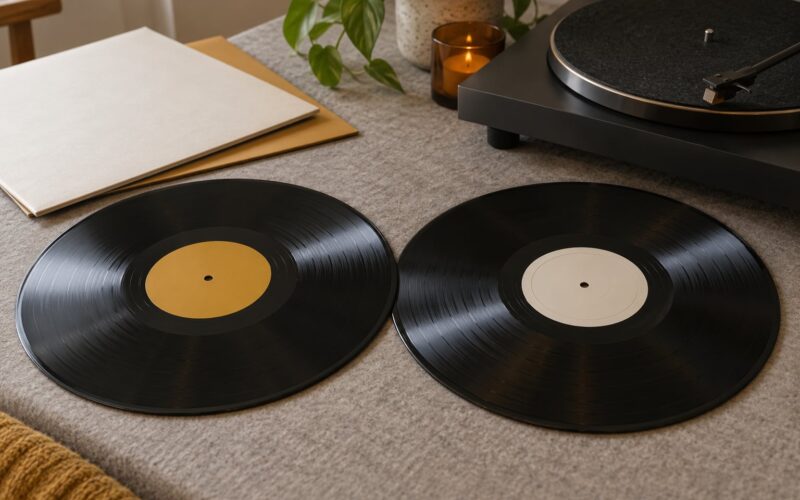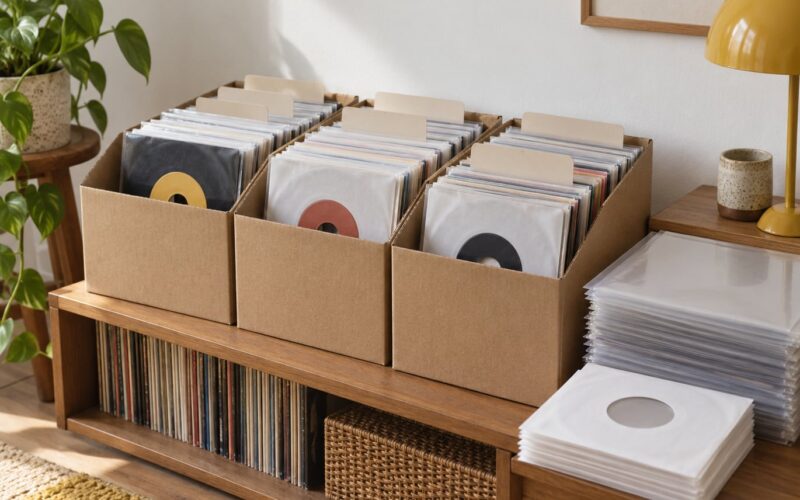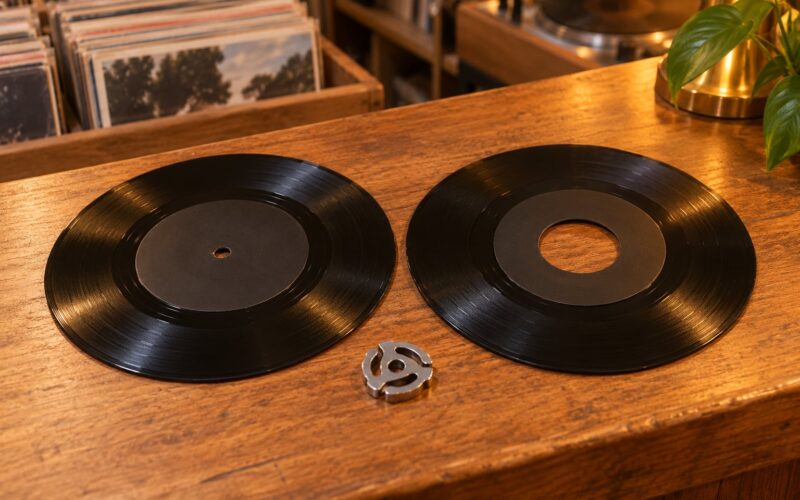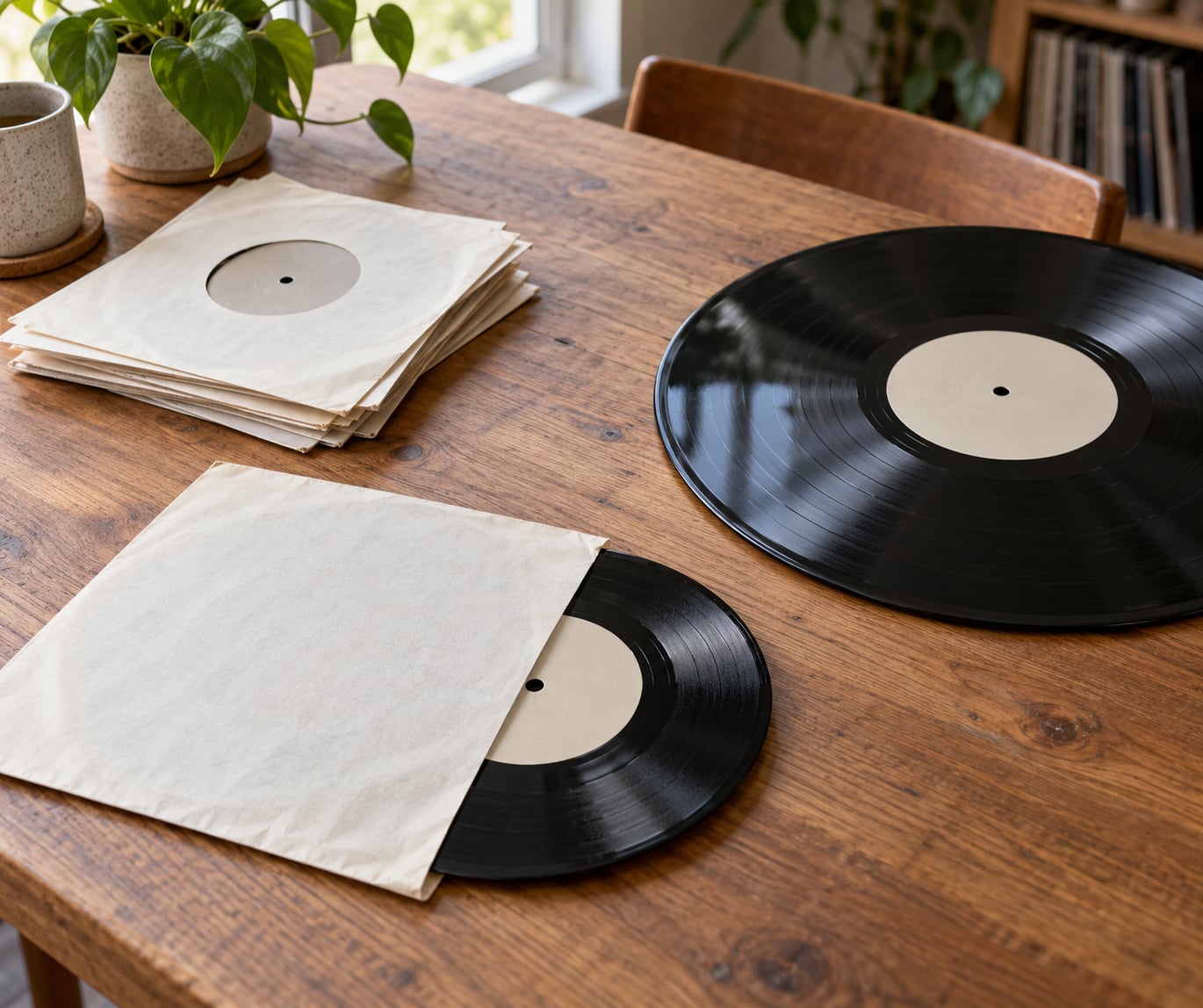
A 7 inch single is a small vinyl record, roughly 18 centimetres across, that spins at 45 rotations per minute and carries one song on each side. The A-side holds the song everyone bought the record for; the B-side holds the follow-up track or the flip. Almost every one came in a thin paper sleeve about 18 cm square.
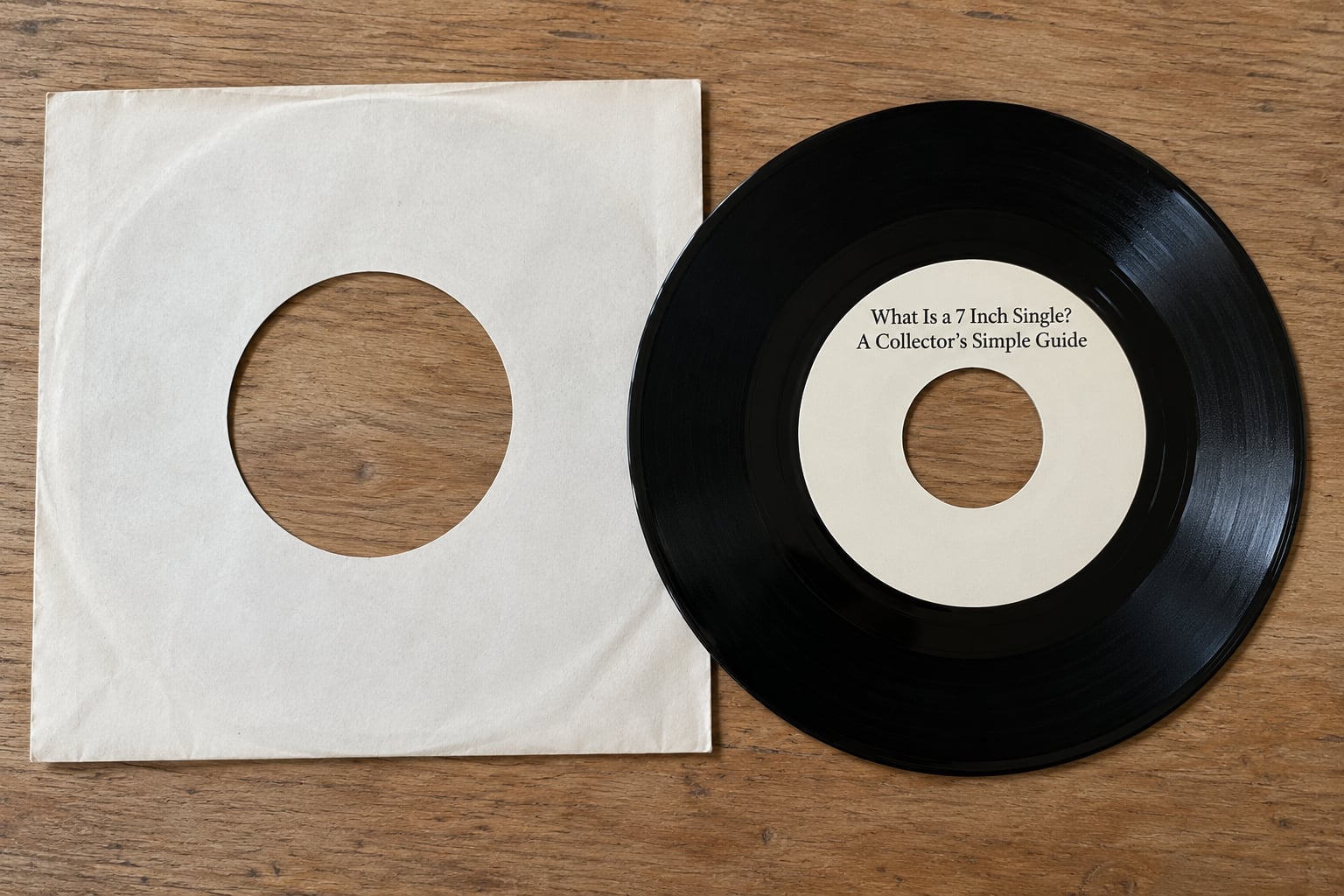
If you have been reading record listings, you have already met the same object under three different names. Collectors say 45, sellers say 7-inch, and a sleeve will often print one or the other. They all mean the record described above, and getting comfortable with the vocabulary is the fastest way to stop second-guessing what a crate of records actually contains.
Table of Contents
- What Is a 7 Inch Single?
- Why is a 7 inch single called a 45?
- What are 7 inch vinyl records called?
- How Big Is a 7 Inch Single?
- What Is the Difference Between a Single, an EP and an Album?
- What Does a 7 Inch Single Sleeve Show?
- Why Are 7 Inch Singles Important to Collectors?
- How Can You Tell If a 7 Inch Single Is Rare?
- Frequently Asked Questions
- Are 7 inch vinyls 33 or 45?
- Is a 45 the same as a 7 inch single?
- How do I play a 7 inch single on a modern turntable?
- What 7 inch singles are worth money?
- What are the 7 inch vinyl records called?
- Is there a market for 7 inch vinyl?
- Conclusion
What Is a 7 Inch Single?
The format arrived in 1949, when RCA Victor introduced the small high-speed disc alongside the slow 12-inch long play that Columbia Records had launched the year before. The two formats settled into permanent roles: the LP for albums, the 7-inch for one hit song. That division lasted for decades, and it is still the reason a 7 inch single is instantly recognisable in a room full of records.
| Feature | Standard 7 inch single |
|---|---|
| Diameter | 18 cm, 7 inches |
| Playing speed | 45 RPM |
| Tracks per side | One |
| Playing time per side | Around 2 to 4 minutes |
| Centre hole | 1.5 inch, large enough for a 45 RPM adapter |
| Typical weight | Around 40 grams, heavy reissues up to 180 grams |
| Material | Polyvinyl chloride, commonly called vinyl or PVC |
Why is a 7 inch single called a 45?
Because it turns 45 times every minute. RCA Victor’s original trade name was the 45, and the number stuck so completely that most people say 45 when they mean the record and 33 for the large LP. The number describes the speed, not the size, so the two labels describe the same object from different angles.
What are 7 inch vinyl records called?
Five terms cover almost everything you will find in a crate or on a listing, and the boundaries between them are fuzzy in practice:
- Single — one song per side on a 7-inch disc at 45 RPM. This is the default meaning of the format.
- 45 — the same physical record, named after its speed. A 45 and a 7 inch single are the same thing.
- Maxi-single — a 7-inch carrying more than two tracks, usually four to six, common in the UK, Japan and Australia.
- EP — originally a 10-inch disc at 33 and a third RPM, now often a 7-inch or 12-inch with four to eight tracks.
- Mini-LP — a 7-inch or 10-inch playing at LP speed with album-length running time, so the tracks are not squeezed into two short sides.
How Big Is a 7 Inch Single?
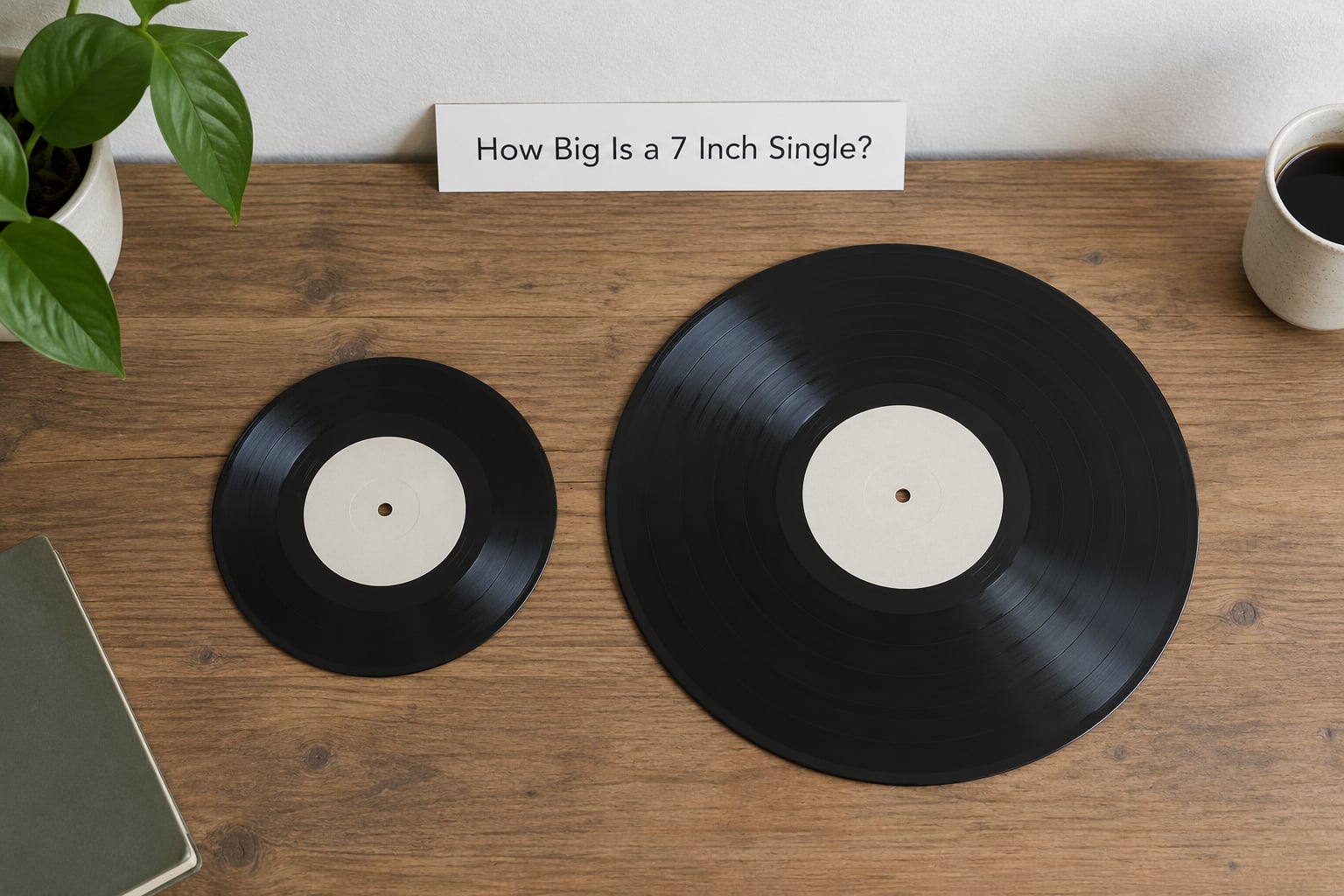
An 18 cm disc feels tiny next to a 12-inch LP, and that small diameter is exactly why so much music fits on one side of a 45. A 7-inch single usually holds a single song of two to four minutes, while a 12-inch LP at 33 and a third RPM holds thirty minutes or more. Same material, same principle, very different amount of music per rotation.
| Format | Diameter | Speed | Typical track count | Total running time |
|---|---|---|---|---|
| 7 inch single | 18 cm | 45 RPM | 2 | 4 to 8 minutes |
| 7 inch maxi-single or mini-LP | 18 cm | 45 or 33⅓ RPM | 4 to 8 | 10 to 25 minutes |
| 10 inch EP | 25 cm | 33⅓ RPM | 4 to 8 | 12 to 22 minutes |
| 12 inch LP | 30 cm | 33⅓ RPM | 10 to 20 | 30 to 50 minutes |
The comparison that confuses newcomers most often is size against speed. A 7 inch single is 45 RPM. There is also a small but real family of 7-inch discs that play at 33 and a third RPM as mini-LPs, so the diameter alone does not tell you the speed. Read the sleeve or the label: the small disc at 45 RPM is the standard single.
Sleeve sizes vary too. Most are 18 cm square, but 7-inch records from certain years and regions came in die-cut or shaped sleeves that are slightly wider, and jukebox copies were sometimes pressed slightly larger to survive the mechanism.
What Is the Difference Between a Single, an EP and an Album?
The difference is a mix of size, speed and how many tracks fit on a side, and no single rule covers every release ever made. As a working definition: a single is one song per side, an EP is a short group of tracks on a small disc, and an album is a full-length record on a 12-inch disc at 33 and a third RPM.
| Single | EP | Album | |
|---|---|---|---|
| Usual size | 7 inch | 7, 10 or 12 inch | 12 inch |
| Usual speed | 45 RPM | 33⅓ or 45 RPM | 33⅓ RPM |
| Track count | 2, one per side | 4 to 8 | 10 to 20 |
| Typical length | Under 10 minutes | 12 to 25 minutes | 30 minutes or more |
| Purpose | Sell one song, sit in a jukebox | Sample a band, or a cheap album | The full record |
The practical collector’s shortcut: count the tracks on the label. If it says one song on each side, it is a single. If it says four or more, you are looking at an EP or a maxi-single, whatever the diameter. Sleeves labelled 7-inch single with four tracks are a real category too, usually UK or Japanese releases, and they are frequently the more interesting find.
What Does a 7 Inch Single Sleeve Show?
Most of what you need to identify a 7 inch single sits on the front and back of the sleeve, and reading it takes about a minute. Start with the label name and catalogue number, then work outward to the details that separate one pressing from another.
- Artist and song title — usually front and centre, with the A-side title sometimes larger than the B-side.
- Label name and logo — the pressing company, not always the company the band signed to.
- Catalogue number — a short code such as a label prefix plus digits. This is the single most useful thing for identification, and it is the number to type into a Discogs search.
- Country of pressing — often a small code or the word stereo, mono, or a country name on the back. A UK release of a US hit carries a completely different catalogue number from its American counterpart.
- Format wording — 7 inch single, 7 inch EP, maxi-single, or a price code that tells you the market it was sold into.
- Promo markings — not for sale, sample copy, DJ copy or a plain white label. Promos were pressed in small numbers and are worth checking every time.
- Sleeve condition — original sleeves with the period artwork add real value even on a common record, a point collectors on r/vinyl make repeatedly.
Then turn the record over. Between the last music groove and the label there is a smooth band, the runout groove, and inside it the dead wax, an unprinted area where the cutting engineer etched matrix numbers. Those etchings tell you which master was used, and a different master means a different sound and often a different pressing. Two nearly identical copies can have completely different matrix numbers, and that difference is exactly what a collector is looking for.
Why Are 7 Inch Singles Important to Collectors?
The 7-inch single is the format that made pop music cheap. Before 1949 a home recording was a handful of shellac 78s; after it, a new song cost less than a meal and fitted in a coat pocket. Jukeboxes turned that into a business, and for twenty years the single was how most people heard current music first.
For punk, garage, rockabilly and independent-label collectors, the format carries weight of a different kind. These scenes were never well served by albums, because a first pressing, a regional version and a different B-side could all exist in the same week. A 7-inch is small, cheap to press and cheap to trade, which is exactly the conditions under which a scene keeps its own artefacts.
Regional variants reward the curious:
- US two-track singles — one song per side, the standard format.
- UK four-track singles — two songs per side, and often a jukebox-only release with four tracks. The same hit could exist in both versions, and collectors want both.
- Maxi-single — four to six tracks on a 7-inch, standard in the UK, Japan and Australia.
- Flexi-disc — a thin, flexible 7-inch, usually sold with a magazine or in a card sleeve.
- Picture disc — the picture printed on the record itself rather than the sleeve, common on cheap gift releases and holiday singles.
The format is not a historical footnote. Major labels still put out 7-inch singles, independent labels release them constantly, and Record Store Day has turned the format into a twice-yearly event. A r/hiphopvinyl thread recently noted that 7-inches remain a current commercial format, not just a reissue market.
How Can You Tell If a 7 Inch Single Is Rare?
Rarity and value are not the same thing. A record can be genuinely scarce and still worth little, because demand decides what scarcity is worth. Work through these six checks in order, and stop treating a copy as special until the evidence says so.
- Identify the artist and the song. Demand starts with who is on the record. A regional one-off by an unknown band is not automatically better than a common single by a band everyone wants.
- Look up the catalogue number. Type it into Discogs and read the entry. It will show you the country, the year, the label variations and how many versions exist. This one lookup settles most arguments.
- Check the pressing country. A UK-only release with a different B-side, or a Japanese issue with an insert, is a separate collectible from its US counterpart. Look for a country code on the sleeve or the label edge.
- Read the matrix numbers and dead wax. A first pressing usually carries a hand-etched or different-font matrix and may show a different tax code or label variant on the sleeve. Later pressings repeat the same number and use a standard typeface.
- Grade the condition honestly. Condition vocabulary like VG+ or NM is the language buyers trust. A clean VG+ copy with a strong sleeve beats a mint disc in a torn sleeve more often than beginners expect.
- Check what copies actually sell for. Look at completed sales rather than asking prices. A high asking price on a common reissue tells you what a seller hopes, not what the record is worth.
Goldmine’s expert column shows the pattern in miniature: an ordinary Monarch pressing of a Beatles single sold in a modest range, while a mislabelled Tollie copy with a different catalogue number changed hands at a figure roughly four times higher. Same band, same song, different evidence on the label.
Frequently Asked Questions
Are 7 inch vinyls 33 or 45?
Almost all of them play at 45 RPM. The confusion comes from a small family of 7-inch mini-LPs that spin at 33 and a third RPM with album-length running time, and from people calling any vinyl record a 45 regardless of speed. If the label lists one song per side, you are holding a standard 45 RPM single.
Is a 45 the same as a 7 inch single?
Yes, they are the same physical record. 45 refers to the speed, 45 rotations per minute, and 7 inch refers to the diameter of about 18 cm. RCA Victor’s 1949 disc carried both descriptions, and collectors use them interchangeably. A 7-inch single at 45 RPM is simply a 45.
How do I play a 7 inch single on a modern turntable?
You need two things: a 45 RPM setting and a centre adapter, because the 1.5 inch hole is much wider than the 7 mm spindle. Many turntables switch between 33 and 45 with a button. If yours is speed-fixed at 33, a cheap external 45 RPM adapter puck sits under the disc and does the same job. Quartz-strobe models are the easiest to set accurately.
What 7 inch singles are worth money?
Look for these first: first pressings with hand-etched matrix numbers, promos and white-label test pressings, label errors and spelling variations, regional releases with unique B-sides, coloured vinyl, and picture sleeves from the right period. The artist matters as much as the scarcity. Value follows demand, so check completed sales on Discogs or Popsike before assuming a common reissue is worth more than it asks for.
What are the 7 inch vinyl records called?
Most people call them 45s, which refers to the 45 RPM speed, or 7-inch singles, which refers to the diameter. Collectors also say 45, single, maxi-single for a 7-inch with more than two tracks, and mini-LP for a 7-inch playing at 33 and a third RPM. The terms overlap heavily and the sleeve usually settles the argument.
Is there a market for 7 inch vinyl?
Yes, in two distinct parts. The replay and reissue market is large, with major labels and indie labels still releasing 7-inch singles and Record Store Day driving twice-yearly demand for new pressings. The collectible market runs on originals: first pressings, promos, regional variants and anything with an unusual B-side, where completed sales set the price rather than the asking price.
Conclusion
A 7 inch single is an 18 cm vinyl record that plays at 45 RPM with one song on each side, and the names 45, 7-inch and single all describe that same object. The format won because it was cheap, fast to press and small enough for a jukebox or a pocket, and those same qualities are why it still turns up in new releases today.
When you pull one from a crate, look at the sleeve first. Catalogue number, pressing country, promo markings and the condition of the original artwork tell you most of the story in a few seconds. Then flip it over and read the dead wax: a hand-etched matrix number is the clearest sign that you are holding a first pressing rather than a later reprint. That is the first inspection to make before you decide anything else about a copy.