A dinked center is a 7 inch record whose middle has been knocked out to make a large hole, so it will fit a big spindle. Collectors also call it a large center hole, a knockout center, or a dinked centre. It is a deliberate variation, not damage.
If you have found a 45 with a hole big enough to drop your finger into and no idea why, this is the short version. The record works exactly as it was pressed. The center was either designed that way at the factory or cut out afterward, usually so the record would drop onto a jukebox spindle.
Table of Contents
- What Is a Dinked Center on a 7 Inch Record?
- Why Do Some 7 Inch Records Have a Dinked Center?
- What Does a Dinked Center Look Like?
- Is a Dinked Center Rare or Valuable?
- How Do You Identify a Dinked Center on a 7 Inch Record?
- Dinked Center vs. Other Center Variations
- How Should Collectors Grade and Describe It?
- Frequently Asked Questions
- Is a dinked center the same as a 45 RPM record?
- Does a dinked center affect how a 7 inch record plays?
- Are all dinked-center records rare or valuable?
- Should a dinked center be listed as damaged?
- How can I tell a dinked center from a pushout or pop?
- Does a dinked center appear on both sides of the record?
- Conclusion: Start with the Center, Then Check the Whole Record
What Is a Dinked Center on a 7 Inch Record?
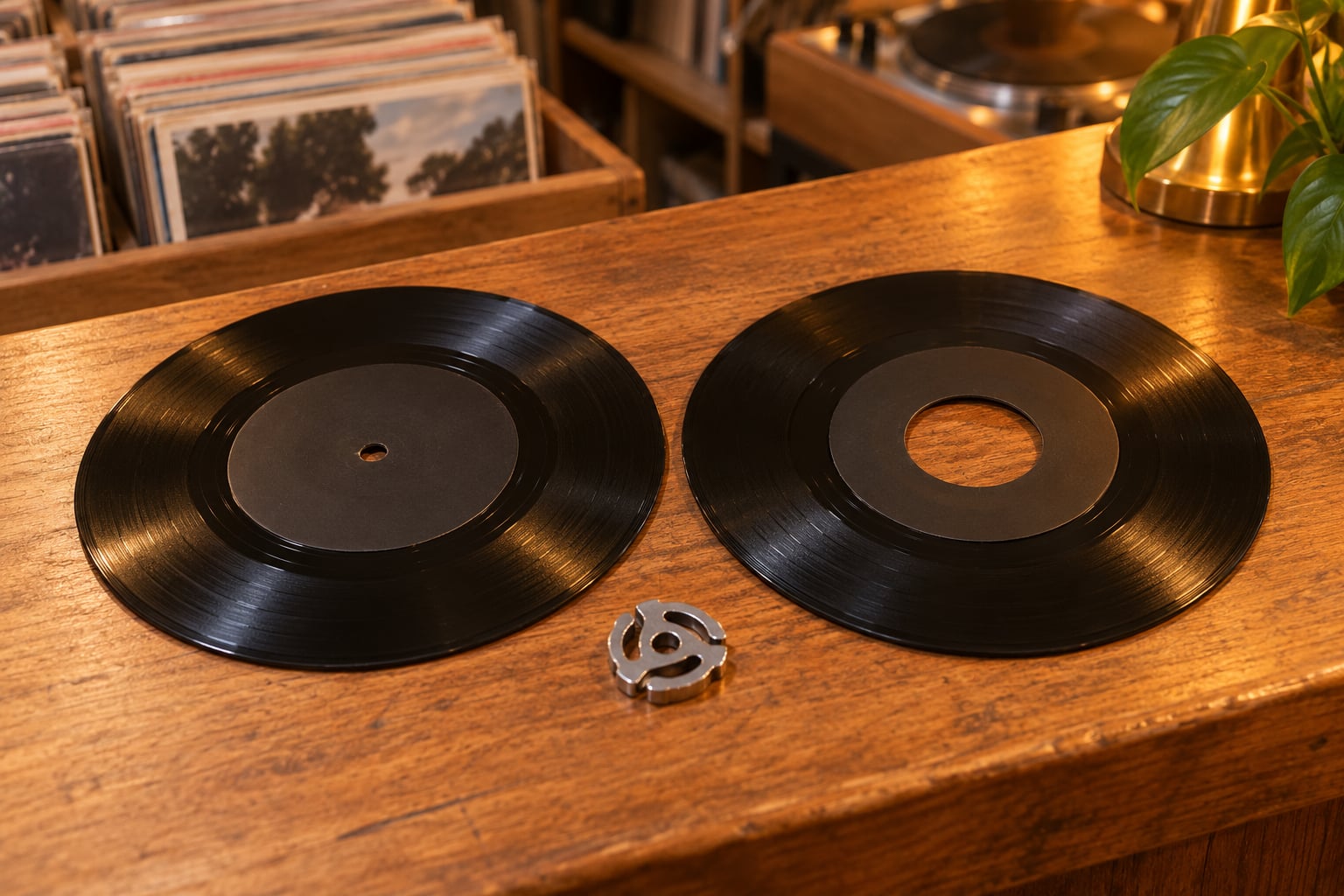
A dinked center is a large center hole on a 7 inch, 45 RPM single, produced when the solid or push-out middle of an otherwise small-hole pressing is removed with a circular die. The trade names for it are large center hole, big hole, knockout center, and in British usage dinked centre. A US record that comes this way is called a dinked center or large center 45; UK collectors reach for dinked single.
Most 7 inch singles sold outside the United States have a small center hole, roughly three-eighths of an inch, sometimes with a removable push-out plug held by three or four lugs. A dinked record has none of that. The middle is simply gone, cut clean through the plastic and the paper label, leaving a hole you can see daylight through at the edge of the disc.
The important thing to know before you go further: a dinked record is a normal, playable record. Collectors who own a lot of them report that dinked UK singles play perfectly well. Nothing about the hole affects the sound, because the groove is untouched.
Why Do Some 7 Inch Records Have a Dinked Center?
Two reasons, and they are not the same thing. One is a factory decision made at the pressing stage. The other is someone with a die cutting the center out of a finished record long after it left the plant.
Factory dinking goes back to RCA Victor and the 7 inch 45, launched in 1949 with a deliberately large center hole. The idea was to keep the two formats of the late 1940s format wars separate, RCA’s 7 inch 45 against Columbia’s 1948 vinyl microgroove LP at 33 and a third rpm, and a big center that would not fit a standard turntable spindle was a cheap way to do it. BMRR, posting on the VinylEngine turntable forum in September 2025, argues the large hole was deliberate lock-in to RCA playback hardware, and that adapters appeared fast enough to blunt it.
What could not be blunted was the jukebox. America had jukeboxes everywhere, and retrofitting thousands of them was not worth the money, so US and German presses stayed large hole. German 45s were all big holes, as one collector on that same forum puts it. UK presses went the other way, as did Australia, which is why an Australian collector there owns a handful of large hole singles and cannot say where any of them came from. The map is not simply US against UK, which is the part most glosses get wrong.
The second reason is jukebox compatibility at the dealer level. ozboyz on the Discogs jukebox singles thread remembers UK singles sold loose in newsagent stands as clearance or ex-juke box stock. Those were frequently converted after pressing rather than made that way, which is where the collector arguments start.
The third reason is the label and sleeve. On a paper-labeled UK single, a large hole eats the middle of the design. Collectors on the Discogs forum point out that on some large hole versions the band name is simply gone, cut away with the plastic. That is a strong hint the record was converted, because a plant would have reprinted the label around the hole.
Modern labels also use the word as a selling point. Dinked Records, launched in September 2015, puts out licensed remastered 7 inch records with big holes by design, and indie labels use dinked edition on limited pressings. It is marketing language attached to the same physical feature, just deliberate rather than scavenged.
What Does a Dinked Center Look Like?
A clean round hole, noticeably bigger than the small hole or the ring of lugs left by a push-out plug. The edge should be circular, not ragged, and it will usually run through the paper label if there is one, which is the giveaway people miss.
For forensic detail, swagski on the Discogs centre-hole thread points to two things. First, lip marks: where the die bit into the plastic, a small raised lip transfers to the reverse side of the disc, visible under angled light. Second, the lug recesses. A push-out center is held in place by three or four lugs, which leave small recessed marks around the inside of the hole, described in the thread as being like sprues. They are evidence of how the missing center came out, and their presence points to a post-manufacture cut rather than a factory hole.
Tarantxon makes the matching distinction in the same thread: some push-out centres were distributed after being dinked at source, so a dinked center is not automatically a home conversion. You need the labels, the sleeve, and the runout to tell.
None of this tells you age or rarity on its own. A hole that looks sharp may have been cut last month. What dates the record is the label design, the matrix number in the runout groove, and the sleeve, not the shape of the center.
Is a Dinked Center Rare or Valuable?
Not by itself. A dinked center is a notable variation, not a rare one, and it does not move value on its own. What moves value is the label variant, the artist, the pressing country, the condition of the vinyl, and whether collectors in that market want that particular record.
Where it gets complicated is the jukebox copy. A factory jukebox pressing, with its own label and sleeve, is a legitimate variant that people genuinely hunt. A record someone cut at home is not. baytree37 on the Discogs forum makes the point sharply: the database is full of items labelled jukebox that are, in that poster’s words, post-manufacture adaptations which would not qualify for inclusion, and most of the questionable ones come from sellers with a copy to sell. Discogs guideline 1.4.3 covers exactly this, items altered after release do not count as unique releases.
So the useful question when a seller calls something a rare jukebox variant is simple: does the label design account for the large hole? If the label printing runs right up to a clean circle with artwork laid out around it, it was pressed that way. If text is sliced mid-word, someone cut it later.
One more piece of market context, from the same VinylEngine thread: large hole UK 45s on the Collectables label were going for about double what other vinyl was selling for, largely because they were all mint. That gap came from condition and scarcity of that particular series, not from the hole itself.
How Do You Identify a Dinked Center on a 7 Inch Record?
Put the record on a flat surface and look straight down at it first. A small hole is about three-eighths of an inch. A dinked center is several times that, and either the middle is entirely absent or a ring of plug remains with three or four lug marks around it.
Then tip the record up under a raking light. Swagski’s lip marks show up as a faint raised ring on the side opposite the cut. If you can see lug recesses, you are looking at a converted or push-out-derived center rather than a purpose-pressed hole.
Next, read the label and the sleeve together. Check whether the artwork is designed around a big circle, and compare it with the standard small hole version of the same release if you can find one. Discogs forum users recommend exactly this, pairing a suspected jukebox copy against its regular counterpart.
Finally, note where the damage sits. If the hole cuts through paper, say so in your notes. If the hole is off-centre, that is a different problem, and it is worth measuring. An off-centre cut is not a variation, it is a defect, and off-centre play causes wow, which vinyl people notice fast.
Dinked Center vs. Other Center Variations
Most of the confusion at the center of a 7 inch record comes from mixing up things that look similar. This table sorts them.
| Variation | What it is | How to identify it | Does it affect play |
|---|---|---|---|
| Dinked center | Large hole cut or pressed for a big spindle | Wide round hole, no plug, often with lug recesses or lip marks inside | No, provided the cut is centred |
| Small (standard) hole | Normal 7 inch center hole for most UK and Australian singles | Roughly three-eighths of an inch | No |
| Large (US) hole | Factory-pressed large hole on US and German 45s | Wide hole with no damage, label designed around it | No |
| Push-out center | Removable plug held by three or four lugs | Ring of plastic in the middle, three or four small lug marks | No, if seated properly |
| Tri-centre / 3-lug | Three attachment points, a UK trade term | Three lug marks at roughly 120 degrees | No |
| Quad-centre / 4-lug | Four attachment points | Four lug marks at 90 degrees | No |
| Raised center bump | Label or plastic pushed up around the hole | Raised lip on the label surface near the center | Usually no |
| Pop | Small surface blister from a pressing fault | Rounded bubble, often off-centre, feels like a pimple | Can cause a click or skip |
| Tear | Radial rip from the hole outward | Split in the plastic or paper running from the edge of the hole | Risk of the disc snapping on playback |
| Worn hole | Standard hole enlarged by years on a spindle | Irregular, slightly oval edge, no clean cut line | No, but check the spindle fit |
| Off-centre hole | Hole not aligned with the spindle axis | Measure from the hole to the outer edge in several places | Yes, causes wow |
One naming note before you search listings. The trade terms overlap and the authorities disagree. Discogs uses 3-lug, Record Collector uses tri-centre, and Goldmine is looser still. dinked, big hole, and large hole are the plain-language versions, and they are the ones most collectors actually use when talking to each other.
How Should Collectors Grade and Describe It?
Describe it, do not damage it. A dinked center on a copy that was pressed or officially released that way is a variant, not a defect, and calling it damage misleads the next person who handles the record.
Use neutral condition language. Say large center hole, dinked at source, or post-manufacture dinked depending on the evidence you have. If you have not confirmed which, say so. Collectors trade on trust, and an honest I cannot tell if this was cut by hand reads better than a confident guess.
Where it does matter is playability. A centered, clean cut plays like any other record, and owners say so directly. A cut that is slightly tight is a real problem for a jukebox, where the gripper arm can catch the edge and fling the record across the turntable into the stylus. For grading, note the diameter fits, whether the hole is centered, and whether the cut crosses the label.
Photograph it before you list it. Angled-light shots of the lip marks and lug recesses document your identification far better than a description line, and they settle arguments later.
Frequently Asked Questions
Is a dinked center the same as a 45 RPM record?
No. A 45 RPM record describes the speed, which applies to almost every 7 inch single whether its center is small, large, or push-out. A dinked center describes the size of the hole. You can have a small hole 45, a large hole 45, and a dinked 45, and all three play at 45 RPM. The two terms describe different things about the same object.
Does a dinked center affect how a 7 inch record plays?
Not by itself. The hole is cut outside the groove area, so a clean, centered dinked record plays exactly like a standard copy. The two exceptions are an off-center cut, which causes wow, and a cut slightly too tight for a jukebox spindle, where the gripper arm can catch and fling the record. For listening on a turntable, a clean dinked 45 sounds normal.
Are all dinked-center records rare or valuable?
No. A dinked center is a notable variation, not a rare one, and on its own it does not raise value. What matters is the label variant, artist, pressing country, condition, and collector demand for that specific release. A genuine factory jukebox pressing with matching label and sleeve is sought after. A home-converted copy is a modified copy of an ordinary record, and Discogs guideline 1.4.3 does not treat it as a unique release.
Should a dinked center be listed as damaged?
Only if the hole itself is the problem, for example an off-centre cut that causes wow or a torn edge. A clean dinked center on a record pressed or officially released that way is a variant, not damage, and listing it as such misleads the next buyer. Describe it plainly as a large center hole, and say whether it was dinked at source or converted afterward if you can tell.
How can I tell a dinked center from a pushout or pop?
A pushout is a removable ring of plastic still seated in the middle, held by three or four lugs, and a pop is a small rounded blister on the record surface. A dinked center leaves a wide, empty, cleanly cut hole with no plastic in it. Look under raking light for lip marks on the reverse side and lug recesses around the inside of the hole, both described by collectors on the Discogs centre-hole thread.
Does a dinked center appear on both sides of the record?
Yes. A dinked center is a hole through the whole disc, so you see the same opening on both sides. A 7 inch record is pressed one groove per side, and the center is cut through the entire piece, not just the top face. The lip marks left by the die, however, are usually clearest on the reverse side where the plastic was pushed rather than trimmed.
Conclusion: Start with the Center, Then Check the Whole Record
When you pick up a 7 inch single with a big hole, check three things in order. Look at the label to see whether the artwork was designed around the hole or has been sliced through it. Look at the inside edge under angled light for lip marks and lug recesses, which point to a post-manufacture cut. Then look at the sleeve, runout matrix number, and label variant, because that is what actually dates the record and carries the value.
A dinked center is a variation, not a fault. It tells you something about how the record was pressed, sold, or converted, and that is genuinely interesting to anyone collecting 45s.