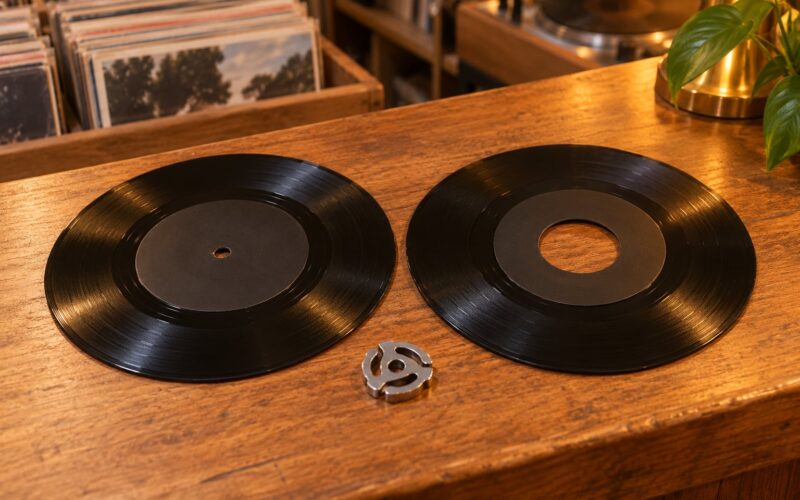
Direct metal mastering (DMM) is a vinyl mastering technique where a diamond cutting head engraves the audio groove straight into a copper-plated metal disc instead of a soft lacquer-coated aluminium disc. Because the metal disc is already a working master, the plating chain that normally takes three generations gets cut in half, and the finished pressing tends to have cleaner transients and less pre-echo than a standard lacquer cut.
That single sentence covers most of what matters. The rest — how the lathe works, why the sound is brighter than people expect, and how to spot a DMM pressing in a used record shop — is detail that a lot of listings skip. I have pulled records with DMM in the runout groove more times than I can count, and the label tells you very little about which one sounds best.
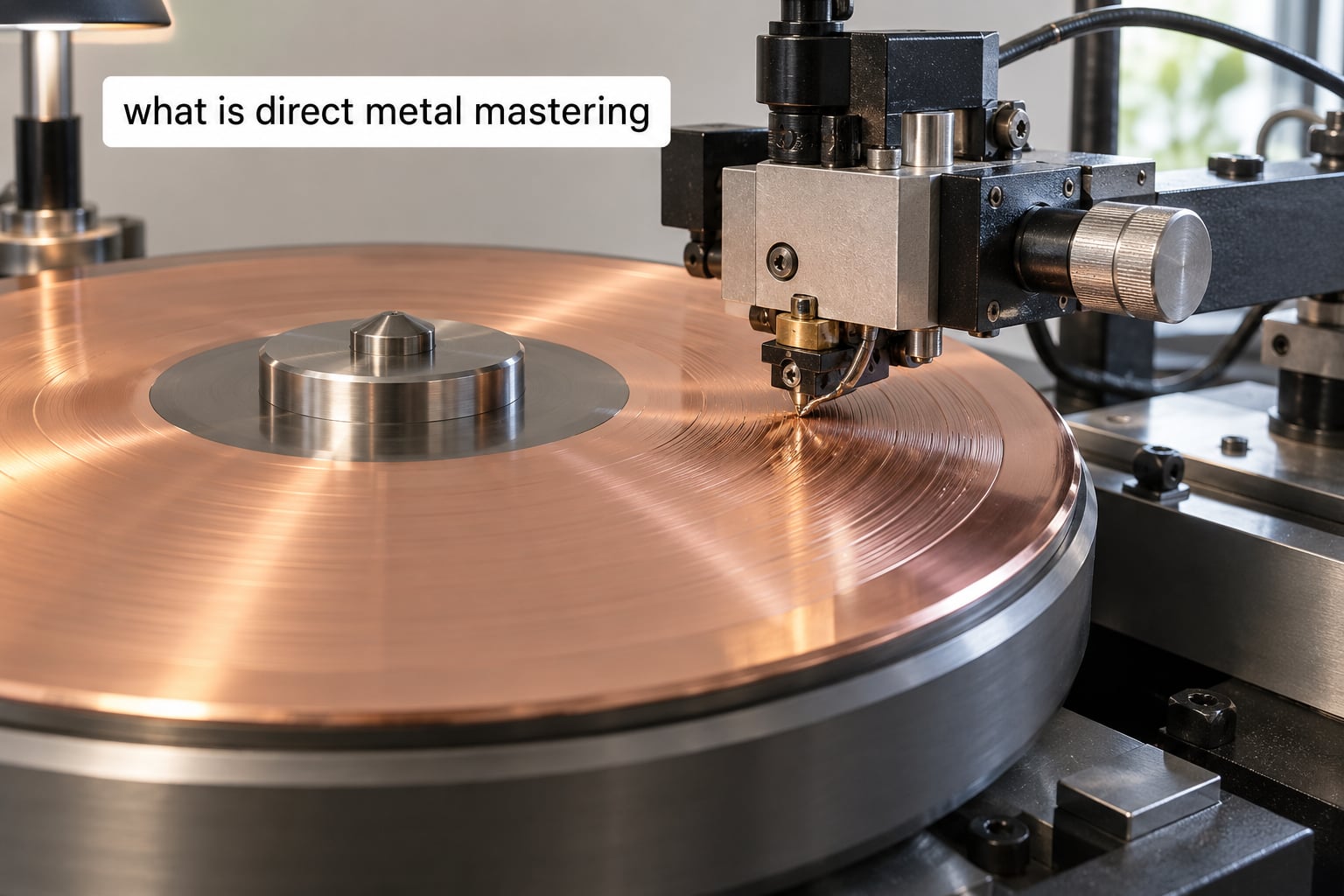
Table of Contents
- What Is Direct Metal Mastering?
- How Does Direct Metal Mastering Work?
- The father, mother and stamper chain in plain English
- Why the cutting angle is the real reason DMM sounds different
- What Is the Difference Between Direct Metal and Conventional Mastering?
- Does Direct Metal Mastering Sound Better?
- Why Do Collectors Care About Direct Metal Mastering Records?
- How to Tell If a Record Was Direct Metal Mastered
- Frequently Asked Questions
- What does DMM mean on a vinyl record?
- Is direct metal mastering better than lacquer cutting?
- How do I know if my record is DMM?
- Why does DMM sound brighter and more forward?
- Does DMM avoid pre-echo?
- Are DMM pressings worth more to collectors?
What Is Direct Metal Mastering?
Direct metal mastering is the practice of cutting the master lacquer equivalent directly into metal. Normally a mastering engineer cuts the programme into a soft, nitrocellulose lacquer coating on an aluminium blank, and that lacquer disc is shipped to a plant. With DMM, the same audio goes into a copper-plated disc on the lathe instead, and the metal disc itself becomes the master from which stampers are made.
It is worth separating DMM from three other things that get confused with it constantly.
- Lacquer cutting is the standard route, where the groove is cut into a soft coating that then has to be electroplated, silvered and replated before a stamper can be made from it.
- Digital mastering describes where the audio came from, not what it was cut into. Plenty of DMM records were mastered digitally and then cut to copper, and plenty of lacquer records were cut from tape.
- Ordinary pressing is the moulding stage that turns a stamper into a record. Every record on your shelf was pressed, whether it was cut to lacquer or to metal.
The one-line version: DMM is about the material the master is cut into. Everything else about the record — the recording, the mix, the mastering engineer, the pressing plant — can be identical between a DMM release and a lacquer release of the same album.
How Does Direct Metal Mastering Work?
The signal path is short enough to walk through step by step, and once you see why the steps exist the whole process makes sense.
- Recording and mixing. The finished, approved master arrives at the cutting room as a high-resolution file or as analogue tape. Nothing about this step changes for DMM.
- High-resolution mastering. The mastering engineer sets levels, trims, applies the final EQ and decides the running time. DMM has no tolerance for a hot master, because a fixed solid disc cannot be cut any deeper than the stylus geometry allows.
- Platter transfer and cutting. The lathe holds the copper-plated disc on a vacuum spindle, and a sapphire or ruby stylus rides it while the audio modulates the vibration. The groove is modulated at a high-frequency carrier so the stylus can follow fast transients.
- Metal stamper production. The cut copper disc, the father, is electroformed directly into a negative stamper. Because the metal is rigid and already conductive, this takes one plating generation instead of the three a lacquer master needs.
- Pressing. Vinyl compound is placed between the two stampers, compressed, cooled, trimmed and packed. This stage is identical for DMM and lacquer.
The father, mother and stamper chain in plain English
Every mastering chain uses these words and the vocabulary confuses people for years. A father is the cut disc itself, the positive you can look at. A mother is the metal copy grown from the father by electroforming, and it is the negative that becomes the stamper. A stamper is the hard nickel shell the vinyl is actually pressed against.
With lacquer, the lacquer disc has to be silvered first to make it conductive, then plated to make a mother, and then plated again to make a usable stamper. With direct metal mastering, the cut copper disc is already conductive and already hard, so you skip straight to the stamper.
Why the cutting angle is the real reason DMM sounds different
This is the part most explainers leave out. A stylus cutting a metal disc sits at a near-zero cutting angle because metal will not let the stylus cut at a steep angle without either gouging or chattering. But your cartridge plays that groove back at a typical playback angle of somewhere around 15 to 22 degrees.
Mismatch the two and you lose high frequencies, because the treble energy is spread across the groove wall at an angle your stylus is not tracking. So the cutting engineer applies electronic high-frequency compensation, boosting the top end during the cut to cancel the loss on playback. That boost is what collectors hear as the bright, forward or slightly steely DMM signature.
It is a correction, not an improvement. The record plays back correctly against a normal cartridge, but it is not a neutral signal chain.
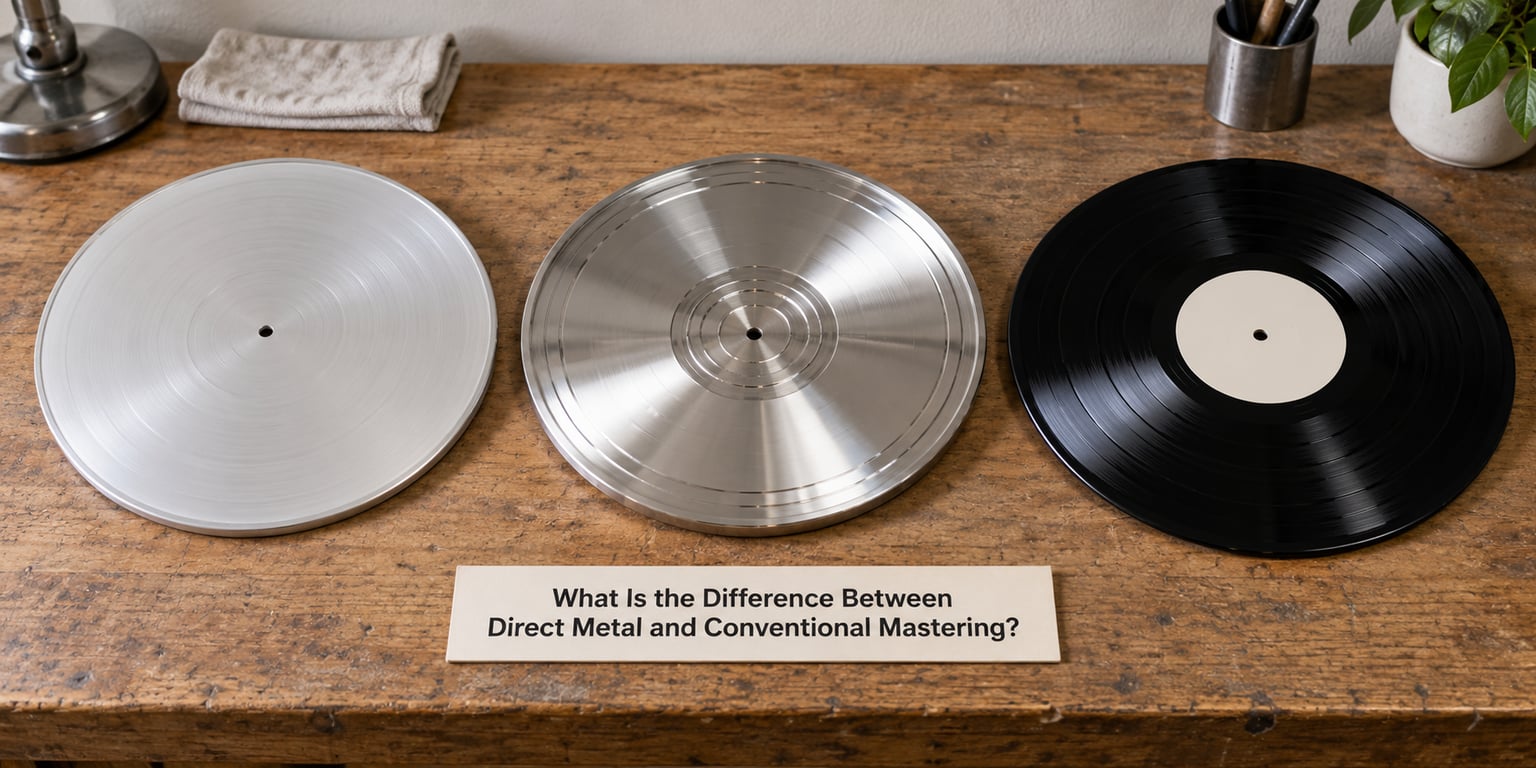
What Is the Difference Between Direct Metal and Conventional Mastering?
| Factor | Lacquer cutting | Direct metal mastering |
|---|---|---|
| Material cut | Nitrocellulose lacquer on aluminium | Copper-plated metal disc |
| Cutting angle | Steep, close to the playback angle | Near zero, with electronic treble compensation |
| Plating generations | Three, after silvering the lacquer | One, straight from the cut disc |
| Pre-echo | Present, worst on quiet and high-frequency passages | Greatly reduced |
| Surface noise | Higher, from dust trapped in soft lacquer | Lower |
| Master durability | Soft, can deform and needs care in transit | Hard, will not warp |
| Editing flexibility | Flexible, the cut is one of several stages | Rigid, every cut is final |
| Cost | Lower, cheaper to run at scale | Higher per master, fewer facilities |
| Typical character | Warmer, smoother, more forgiving | Brighter, more forward, more detailed |
The practical difference that matters most to a collector is rigidity. A lacquer master is soft enough that a fingerprint, a speck of dust or a shipping bump can damage a track. A metal master is not going to be scratched by the mail, and it does not need to be refrigerated in transit, which is why the process took off when records were being shipped across continents.
Does Direct Metal Mastering Sound Better?
Honestly, not on its own. The measurable gains are real — less pre-echo on quiet intros, lower surface noise, cleaner transients, a master that cannot be damaged between the cutting room and the plant. On a well-recorded, well-mixed album with a careful engineer, a DMM cut is a genuinely better-made record.
The catch is that DMM gets blamed and praised for things the cutting method did not cause.
- Pre-echo. A lacquer disc is soft, so when a loud beat cuts ahead of a quiet passage the soft material ahead of the stylus deforms and the quiet passage bleeds backwards into it. Metal does not deform, so the effect largely disappears. This is the clearest objective win.
- Surface noise. Dust that settles into a soft lacquer groove during handling becomes a permanent defect. There is nowhere for it to hide in a rigid metal cut.
- High-frequency clarity. Better in principle, but that is the same characteristic that makes DMM records sound bright, and bright is not the same as correct.
- Editing flexibility. There is essentially none. A cut into metal cannot be redone, so the level discipline has to happen before the lathe.
Here is the part that gets glossed over. Owners of 1980s Blue Note DMM reissues on collector forums frequently describe them as hard, two-dimensional and cold next to Japanese or Music Matters editions — but those Japanese editions were digital remasters, so the comparison is confounded. One owner on Audiokarma described a DMM-marked Dvorak release from EMI as having a very wide dynamic range, a very low noise floor and high-frequency detail that was defined without being harsh. Other collectors on the same forum said plainly that DMM records sound clean but cannot be definitively compared to non-DMM versions of the same title.
So the honest answer for a collector: judge the mastering engineer, the source material and the pressing plant before you judge the metal. A great lacquer cut beats a poor DMM cut most weeks of the year.
Why Do Collectors Care About Direct Metal Mastering Records?
DMM has a history that makes it collectible independent of how it sounds. Teldec and Georg Neumann jointly developed the technique in the late 1960s for a laser-disc video format, where a rigid disc profile was non-negotiable. That engineering requirement became the vinyl process once the video project was dropped.
Neumann sold its cutting machine division in the 1980s and stopped building lathes, so the number of DMM-capable machines ever made is small and it is not growing. The United States lost its last DMM facility in the middle of the 2000s. What remains is a limited set of plants that cut in-house, mostly in Europe, and audiophile and classical labels that still specify it.
Three reasons collectors keep hunting for them:
- Historical weight. Paul Simon’s Graceland and several Talking Heads releases are routinely used as DMM reference titles, so the format has landmark records attached to it.
- Audiophile positioning. Jazz, classical and small progressive rock releases were where DMM was specified most often, which makes it a useful filter when sorting a crate.
- Pressing variations. A single album can exist as a lacquer cut in one territory and a metal cut in another. The two behave differently enough that serious collectors treat them as distinct versions.
On value, be realistic. A DMM pressing is not automatically rare, and collectors who pay a premium for the label alone regularly report hearing no audible difference, or worse. The runout, the engineer credit and the pressing plant tell you more than the sticker.
How to Tell If a Record Was Direct Metal Mastered
Work down this list from most reliable to least. Not every genuine metal cut announces itself, which is the whole problem.
- Read the runout groove. DMM is usually inscribed in the dead wax between the last track and the label, often with the matrix number, the mastering engineer’s initials and the cutting facility. A record marked DMM, DMM mastering or with a metal-cut facility name is your strongest single piece of evidence.
- Identify the plant from its etching style. Optimal runouts are stamped rather than etched, which gives them a flatter, cleaner look. Record Industry etchings look zig-zagged when you hold them up to a light. GZ Media and Abbey Road cuts carry their own recognisable signatures.
- Check the mastering credit. A named mastering engineer is often the single best predictor of how the record sounds, whatever the cut was made from.
- Look at the sleeve and label. Some labels put a DMM or direct metal mastering logo on the sleeve or a sticker on the disc. Only some copies in a run carry the sticker, so its absence proves nothing.
- Inspect the lead-in and lead-out grooves. Reddit collectors check these against a spotlight, and metal cuts show flatter, less raised groove edges than lacquer. It needs a decent light and steady hands, and it is easy to fool yourself.
- Ask what the source was. A record advertised as DMM may be a digital remaster of a mediocre tape transfer. If the notes credit a remastering engineer rather than an original mastering engineer, that changes the comparison.
One last piece of forum lore to ignore: the idea that a 60 kHz ultrasonic carrier makes a metal cut audibly worse. That carrier exists so the stylus can physically follow the audio. The tone people heard from cutting lathes was cutter-head and lathe mechanical vibration, not the carrier itself.
Frequently Asked Questions
What does DMM mean on a vinyl record?
DMM stands for direct metal mastering. It means the master groove was cut straight into a copper-plated metal disc rather than into a soft lacquer coating on aluminium. The metal disc is already a usable master, so the plating chain is shorter and the master cannot be scratched or deformed in transit. You will usually see it in the runout groove or printed on the sleeve.
Is direct metal mastering better than lacquer cutting?
It is more precise, not automatically better. DMM cuts have less pre-echo, lower surface noise and a master that cannot be damaged in transit. What you get out of that depends almost entirely on the recording, the mix and the mastering engineer. A great lacquer cut will beat a careless DMM cut, so judge the credit on the sleeve before you judge the metal.
How do I know if my record is DMM?
Start with the runout groove in the dead wax between the last track and the label, where plants usually etch DMM along with the matrix number and engineer initials. Next identify the etching style, since Optimal stamps its runouts and Record Industry etches in a zig-zag. Sleeve logos and stickers help, but only some copies in a pressing run carry them.
Why does DMM sound brighter and more forward?
The cutting head has to cut metal at a near-zero angle, while your cartridge plays the groove back at roughly 15 to 22 degrees. That mismatch loses treble, so the cutting engineer applies electronic high-frequency compensation to cancel the loss on playback. The result is the bright, forward or slightly steely character listeners associate with metal cuts.
Does DMM avoid pre-echo?
It largely does. Pre-echo happens because a loud passage deforms the soft lacquer ahead of the stylus, letting the following quiet passage bleed backwards. A rigid metal disc cannot deform that way, so the effect is greatly reduced. Quiet acoustic intros and cymbal decay are where the difference is easiest to hear.
Are DMM pressings worth more to collectors?
Sometimes, but the metal cut is not what sets the price. What moves value is scarcity, condition, the pressing plant, the mastering engineer credit and whether the copy is the first or a later cut in the run. Many DMM-marked releases were digital remasters from mediocre sources, and collectors who paid a premium for the label alone often heard no difference.
If you are standing in front of a crate right now, turn the record over and read the dead wax before you read anything else on the sleeve. A runout with a matrix number and an engineer credit tells you far more than a DMM sticker, and it tells you who to trust with the rest of your money. Buy on that evidence, then judge the sound with your own ears.