Collectors prefer mono pressings for three reasons that rarely have much to do with audio format snobbery. The mono mix was usually the one the musicians and producer approved, stereo versions of the same era were often patched together afterwards, and a mono cartridge plays old discs more quietly. Which of those matters most depends entirely on the record in front of you.
This guide covers how mono pressings were made, what they actually sound like, how to identify one in a stack of records, and where the format stops being the better choice. If you are just starting out and want to know what to hunt for first, start with our vinyl collecting guides.
Table of Contents
- Why Do Collectors Prefer Mono Pressings?
- The mix the band actually approved
- Stereo versions that were bolted on afterwards
- Quieter playback on an old record
- What Is a Mono Vinyl Pressing?
- What Makes Mono Pressings Sound Different?
- The source mixdown
- Early stereo techniques that did not age well
- Phase cancellation
- How mono behaves on a stereo system
- Is Mono Always Better Than Stereo?
- How Does Mastering History Affect Collector Preference?
- Why Do Collectors Value Original Mono Pressings?
- How Can You Tell If a Record Is Mono?
- What Should You Look for When Buying a Mono Pressing?
- Mono Pressings for Different Music Styles
- Frequently Asked Questions
- Are mono vinyl records better for listening?
- Why does a mono record sound wider on a stereo system?
- Is a mono pressing automatically a first pressing?
- Can mono records be played on a modern turntable?
- How do I know whether a mono pressing is a genuine original?
- Should collectors pay more for mono pressings?
- Conclusion
Why Do Collectors Prefer Mono Pressings?
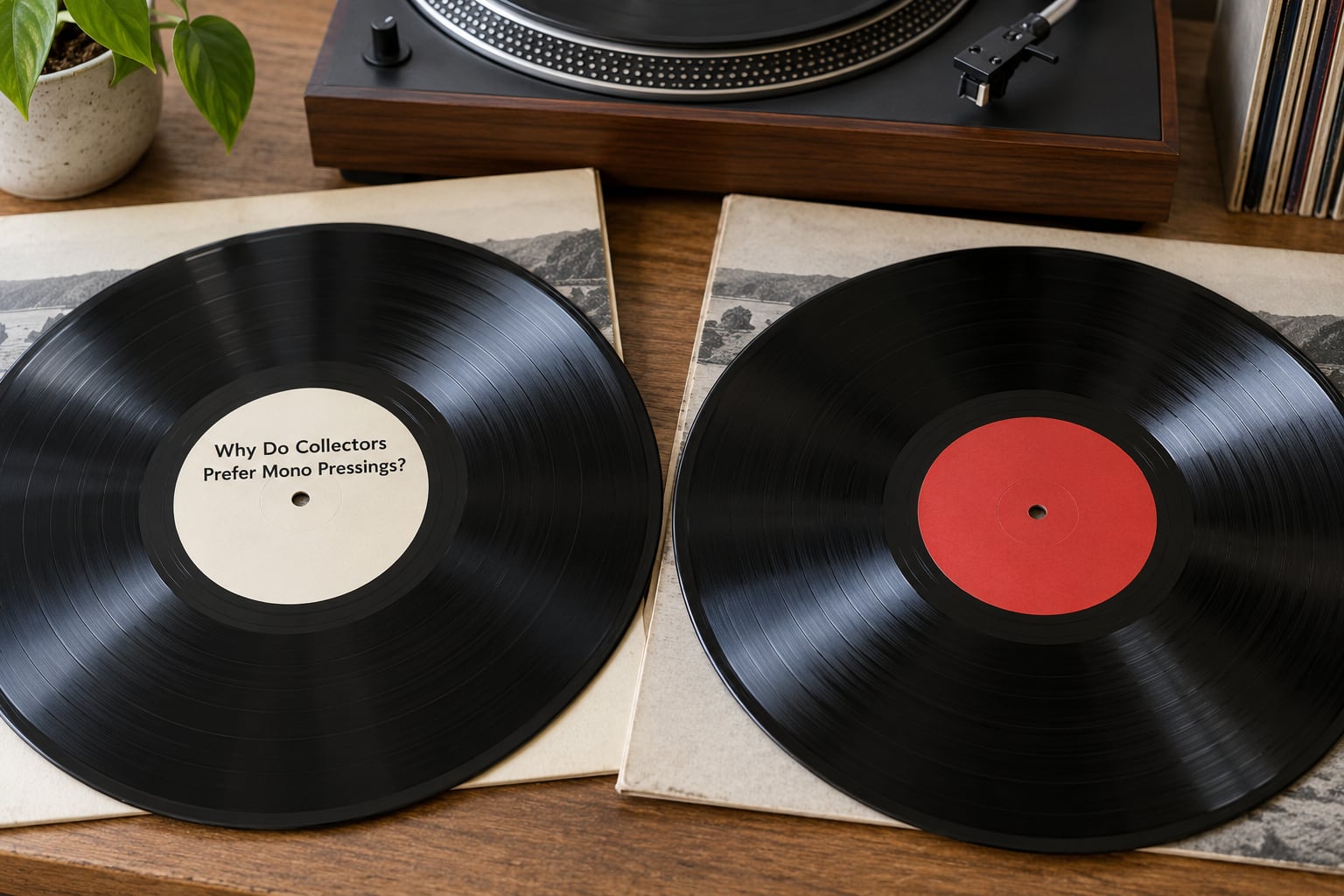
Collectors prefer mono pressings because the mono mix was the artist’s canonical version, because many early stereo mixes were rushed afterthoughts, and because mono records are physically quieter to play. The preference is strongest for albums recorded before stereo became the default, and it fades sharply after about 1970.
The mix the band actually approved
Between roughly 1958 and 1968, most labels issued an album in both mono and stereo. Producers often cut the mono first, monitor it, approve it, and then have the stereo version assembled later from the same multitrack tapes. That mono approval is why collectors treat it as the definitive version: it is the mix somebody in the room signed off on while the band was still in the chair.
Stereo versions that were bolted on afterwards
Early stereo mixes placed instruments at the extreme edges of the speaker field with almost nothing in the middle. Drums and bass would sit off to one side, vocals would jump somewhere else entirely. Listeners describe the result as a hole in the middle of the soundstage, and on headphones it can be genuinely unpleasant.
Quieter playback on an old record
A stereo cartridge playing a mono record has to move the stylus sideways to read lateral groove modulation, and that movement picks up more rumble and surface noise. A mono cartridge moves in one plane only and hears noticeably less of it. For a scratched 1958 Blue Note, that difference is not subtle.
What Is a Mono Vinyl Pressing?
A mono vinyl pressing carries one audio channel across the whole disc. The signal is recorded as lateral modulation only, meaning the groove wiggles side to side. When a stereo system plays it, the same signal feeds both speakers, so you get a single centred image rather than two separate channels.
It helps to separate three things people mix up. A mono mixdown happens in the studio, where a multitrack session is summed to one channel. Mono mastering happens after that, shaping the finished signal for cut. A mono disc simply means the lacquer that was cut from contained one channel, so it reflects whatever the mixdown and mastering decisions were.
A mono record plays perfectly happily on a modern turntable through stereo speakers. You do not need mono-specific equipment to enjoy one, and nothing special has to be switched on at the back of the amplifier.
What Makes Mono Pressings Sound Different?
The difference starts at the mixing desk and ends in the groove. Here is where the audible change actually comes from.
The source mixdown
In a mono mixdown, every instrument lands on one channel. Levels have to be balanced by ear, because there is no panning to hide a mistake. Engineers would ride faders carefully and often used compression to keep the whole band sitting in one place. The result is dense and centred, with less space between instruments but a stronger sense of the group playing together.
Early stereo techniques that did not age well
Ping-pong stereo, where a mono track was bounced alternately to one side and then the other, produced instruments that jumped across the middle with each bar. Hard panning, where anything not a lead vocal was shoved to an outer edge, left a gap where the rhythm section should have been. Both were quick solutions to a brand new format with no rules yet.
Phase cancellation
Play a stereo record through one speaker and you are hearing a sum and difference of the two channels. Anything out of phase between them partially cancels, which is why fold-down mono sounds thin and hollow on some albums. A genuine mono master avoids that problem entirely because there is nothing to cancel.
How mono behaves on a stereo system
Fed to two speakers, mono produces a centred image that can sound wider than expected. There is no hole in the middle because everything is in the middle, and instruments that sat far apart on a bad stereo mix now sit close together. Plenty of listeners find that easier to follow for rhythm-heavy material.
Is Mono Always Better Than Stereo?
No, and the honest answer is that it rarely depends on the format. It depends on the record, the year, and the mix. A clean 1957 mono jazz session has a strong argument behind it. A 1971 stereo album has almost none.
| Factor | Mono pressing | Stereo pressing |
|---|---|---|
| Channel information | One channel, centred image | Two channels, separate placement |
| Typical era of advantage | Before stereo became default, roughly pre-1965 | From the late 1960s onward |
| Risk of a bad mix | Low, everything sits together | Higher, phase and placement problems |
| Surface noise with stereo cartridge | Louder, stylus tracks sideways | Baseline, as intended |
| Best played with | Mono cartridge for quiet | Any stereo cartridge |
| Availability now | Often harder to find clean copies | Common, including reissues |
Mono is usually the better bet on a small combo jazz record from the mid-1950s recorded in a room without a good microphone technique yet, where a later stereo pass often picked up obvious level jumps between channels. Stereo makes more sense for anything recorded after a label had its own stereo facility and the engineers had stopped guessing.
There is also a third category worth knowing about. Some albums were mixed in mono, then a stereo version was created electronically by splitting or duplicating the mono signal across both channels. That fake stereo has no information the mono mix did not already have, and collectors pass on it.
How Does Mastering History Affect Collector Preference?
Mastering history is where a mono pressing stops being a format choice and starts being a specific object. Two records with the same catalog number can be cut from entirely different master tapes.
First pressings are usually cut from a fresh lacquer made from the best available tape. Later runs reuse an older lacquer, which wears with each generation and loses a little bandwidth and level each time. On a heavily circulated album the difference between the first and fifth cut is easy to hear.
The identification details live in the runout groove, the un-grooved band between the last track and the label. That area carries a matrix number and sometimes letters indicating the mastering engineer or the lacquer facility. Collectors check these rather than trusting the label text, because mono and stereo labels were sometimes swapped between the two discs of a set. If the label says stereo and the etched code says otherwise, believe the code.
Source tape history follows the same logic. The closer a pressing is to the original session tape, the fewer losses sit between the band and the listener.
Why Do Collectors Value Original Mono Pressings?
Original mono pressings are valued for the same reason any early pressing is: they are the closest physical object to the moment the record was made. Beyond that, mono originals have three specific advantages.
Mono was often discontinued early. Once stereo took over, mono press runs stopped, so surviving copies came out of much smaller original quantities. Clean copies are the harder problem. Mono was the cheap format for decades, and cheap records got played, sat on shelves, got dragged around in car boots and got used as coasters.
Sleeve and label variations add to it. Different label generations exist for the same catalog number, with differences in logo, print shade and paper. A first pressing with the right sleeve and the correct deep-groove or shallow-groove format matters to people building a specific shelf.
There is an era-reference value too. A 1958 mono copy tells you something concrete about how the music was delivered at the time, in a way a later reissue cannot.
How Can You Tell If a Record Is Mono?
Check in this order and you will usually have an answer within a minute.
- Look at the label. Mono pressings usually say MONO somewhere on the label, often on the back near the catalogue number or in small print near the spindle hole. Stereo labels tend to say STEREO, though not all of them bother.
- Read the catalogue number. Labels used different prefixes and suffixes for each format. The pairs below cover most of what you will meet in a used record shop.
- Read the runout groove. The etched code in the dead wax tells you the matrix and the stereo or mono designation directly, and it overrides the label if they disagree.
- Watch the groove while it plays. A mono record moves the stylus side to side only. If you put a light on the tonearm and the stylus wiggles diagonally, it is stereo.
- Compare the sound. Play an identical track from a mono and a stereo copy and listen for instruments jumping side to side. That is stereo placement, and its absence is the giveaway.
The catalogue decoder covers the main labels, though it is not exhaustive:
| Label | Mono prefix | Stereo prefix |
|---|---|---|
| Blue Note | BLP | BST |
| Parlophone | PMC | PCS |
| Columbia | CL | CS |
| Capitol | T | ST |
| RCA Victor | LPM | LSP |
| Decca | LK | SKL |
| Verve | MGV | MGVS |
| Prestige | Various mono numbers | PRL and later stereo series |
| Motown | ML | MS |
| Atlantic | 8000 and 5000 series mono | SD and 8000 series stereo |
Cross-check the catalogue number against a discography before you commit to a purchase. Mismatched labels and matrices are a known problem on early pressings, and the presence of a suspicious combination tells you something useful about how carefully the record was handled before it reached the shop.
What Should You Look for When Buying a Mono Pressing?
Condition beats everything else on mono records, because clean copies are scarce and the good ones are obvious from the first track.
Check for deep, even grooves and listen for a strong, even signal rather than a thin one. A worn cut sounds thin and dull at the edges, and no amount of cleaning will bring the top end back. Look at the runout area for deep scratches that reach the groove, and run a fingertip along any visible groove line to see whether it feels raised.
Sleeve and record should be graded separately. A clean record in a split spine is a far better buy than the reverse. Check the label for writing, seam splits, ring wear and any pressing faults such as an off-centre hole or a record that sits visibly warped.
Verify the pressing details before paying: catalogue number, matrix, country of manufacture and label variant. Where two versions of the same album differ, compare actual sold listings for the exact pressing rather than a general album price. And play it before buying whenever the shop allows it, because pressing quality varies far more between copies than format does.
Mono Pressings for Different Music Styles
Mono preference is not spread evenly across genres, because the format overlapped differently in each scene.
- Punk and hardcore. Most of the interesting punk came after 1976, when stereo was the default, so mono originals are rare and usually Japanese pressings that some collectors prize for their loud, saturated sound.
- Garage and rockabilly. Plenty was issued in both formats in the late 1950s and early 1960s. The mono copy tends to be cheaper, and buying one for the mix rather than the pressing rarity is a perfectly good reason.
- Early rock and roll and rhythm and blues. Mono is the original format for almost all of it. Play both sides of the debate by owning one of each for a favourite album.
- Surf and exotica. Instrumental music recorded for stereo placement usually benefits from it, though mono copies are easier to find and often cheap.
- Small combo jazz. The strongest case for mono lives here. Sessions from the 1950s on Blue Note, Prestige, Riverside and similar labels were mixed mono first and monitored as such.
- Classical. Generally favour stereo. Multi-microphone techniques and the direction of instrumental placement meant stereo carried real information that mono could not.
A workable rule: before about 1965, lean mono. Between 1965 and 1968, listen to both before deciding. After 1968, buy the stereo copy unless a specific album tells collectors otherwise.
Frequently Asked Questions
Are mono vinyl records better for listening?
It depends on the record rather than the format. For albums recorded before about 1965, the mono mix was usually the approved version and many early stereo mixes were rushed. After the late 1960s, stereo carries information mono never had, so it wins. A mono cartridge also plays old pressings more quietly.
Why does a mono record sound wider on a stereo system?
Because one signal feeds both speakers, the image sits dead centre and has no gaps in it. Listeners often perceive that even, unbroken centre as wider than a stereo mix with instruments pushed to the outer edges. It is a perception effect rather than extra channel information, but it does make rhythm-heavy material easier to follow.
Is a mono pressing automatically a first pressing?
No. Labels kept issuing mono numbers for years, sometimes long after the stereo version appeared, so an early stereo album can have mono pressings that came out after several stereo runs. Read the matrix and runout etching and check the discography for that specific catalogue number to date a copy properly.
Can mono records be played on a modern turntable?
Yes. A modern stereo cartridge reads mono records without any adjustment, and both speakers play the same signal, so you get a centred image. You do not need mono-specific gear to enjoy one. A dedicated mono cartridge only reduces noise and distortion on worn or very old records.
How do I know whether a mono pressing is a genuine original?
Start with the label text and catalogue prefix, then confirm with the etched matrix in the runout groove. Check the country of manufacture and label variant against a discography, and look for a sleeve design that matches that issue. If the label and the etching disagree, treat the copy as suspect until the discography settles it.
Should collectors pay more for mono pressings?
Only when the condition, the mix and the pressing details justify it. Mono copies of well-known albums often trade higher than stereo because fewer were pressed and fewer survive in good shape. That premium only means something if the copy plays well, so grade the record before you look at what the format is worth.
Conclusion
Collectors prefer mono pressings because the mono mix was usually the version the musicians approved, because the competing stereo mixes were often hurried, and because mono discs play quietly. Start by identifying the pressing through the label, catalogue prefix and runout etching, then judge the copy on its sound and condition rather than on format alone.