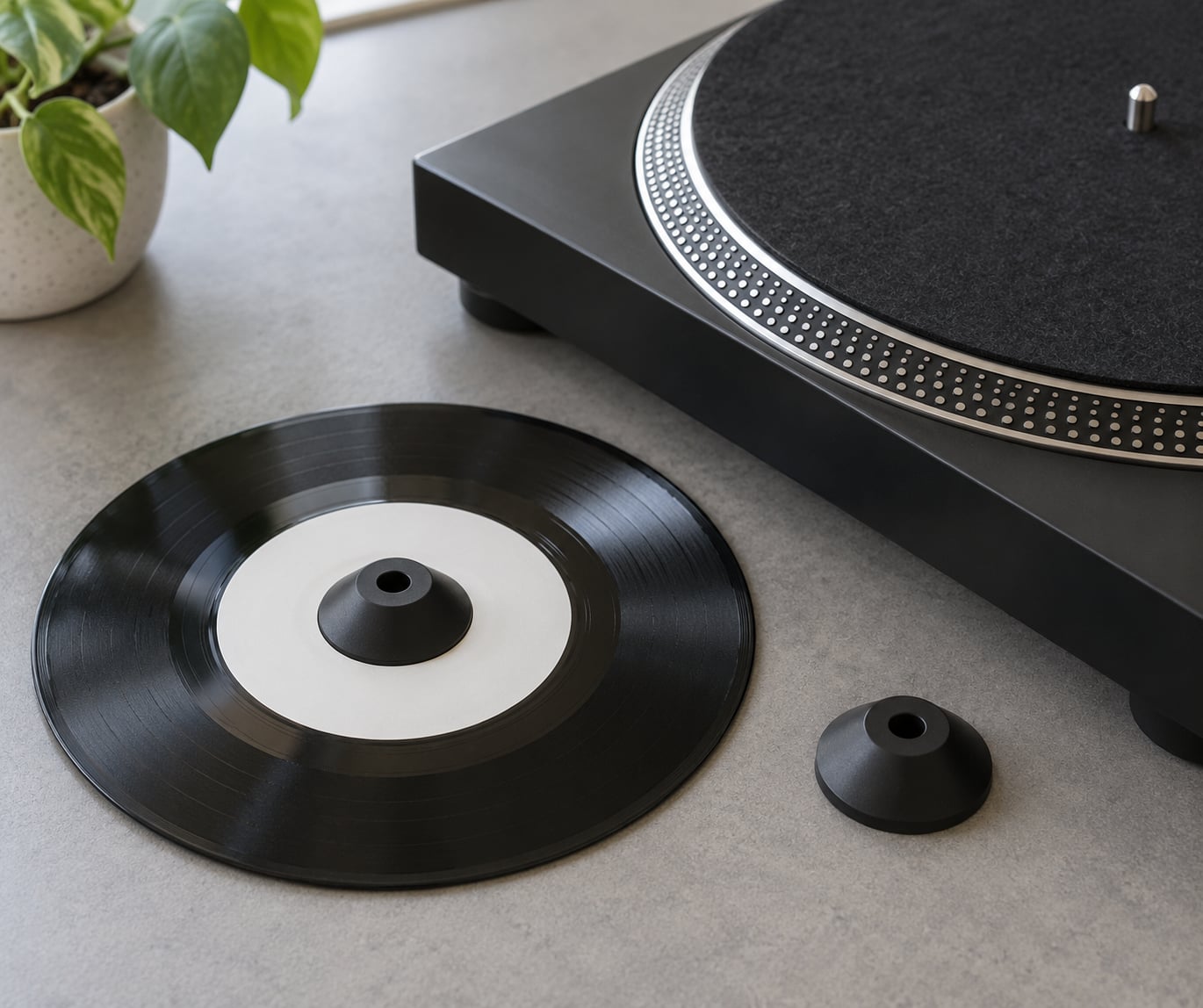
A 7 inch record adapter is a small plastic or metal insert that fits inside the oversized 1.5 inch center hole of a 45 RPM single, so the record can sit on a standard 0.25 inch turntable spindle. Without one, the record wobbles, slips, and plays at the wrong speed.
That definition covers most of what you need. What trips people up is everything around it: which 7-inch singles actually need one, whether your turntable can take them at all, and why the cheap flat insert sometimes ends up stuck inside the record when you pull it off. Updated for 2026, here’s the short version of all of it.
Table of Contents
- What Are 7 Inch Record Adapters?
- Why Would You Need a 7 Inch Record Adapter?
- Do 7-Inch Records Play at 45 or 33 1/3 RPM?
- Why Do Some 7-Inch Records Have a Big Hole and Others Don’t?
- What Are the Main Types of 7 Inch Record Adapters?
- Flat snap-in insert
- Spider or three-finger grip insert
- Rubber-lined adapter
- Weighted aluminum dome
- Over-the-spindle cup adapter
- What Is the Difference Between a 7 Inch Record Adapter and a 7 Inch Jukebox Adapter?
- Will Any 7 Inch Record Adapter Work on My Turntable?
- How Do I Check My Spindle Size?
- How Do You Put a 7 Inch Record Adapter on a Turntable?
- How to set up a 7 inch record adapter without misalignment
- Why Does My 7 Inch Record Skip, Float or Sit Too High?
- How Do You Choose the Right Adapter for a Record Collection?
- Frequently Asked Questions
- Do 7 inch record adapters change the sound quality?
- Can I use a jukebox adapter for a regular 7 inch record?
- What size spindle should a 7 inch record adapter fit?
- Can I play 7-inch records on a turntable without 45 RPM?
- Should I buy a weighted 7 inch record adapter?
- How do I keep a 7-inch record adapter clean?
- Conclusion
What Are 7 Inch Record Adapters?
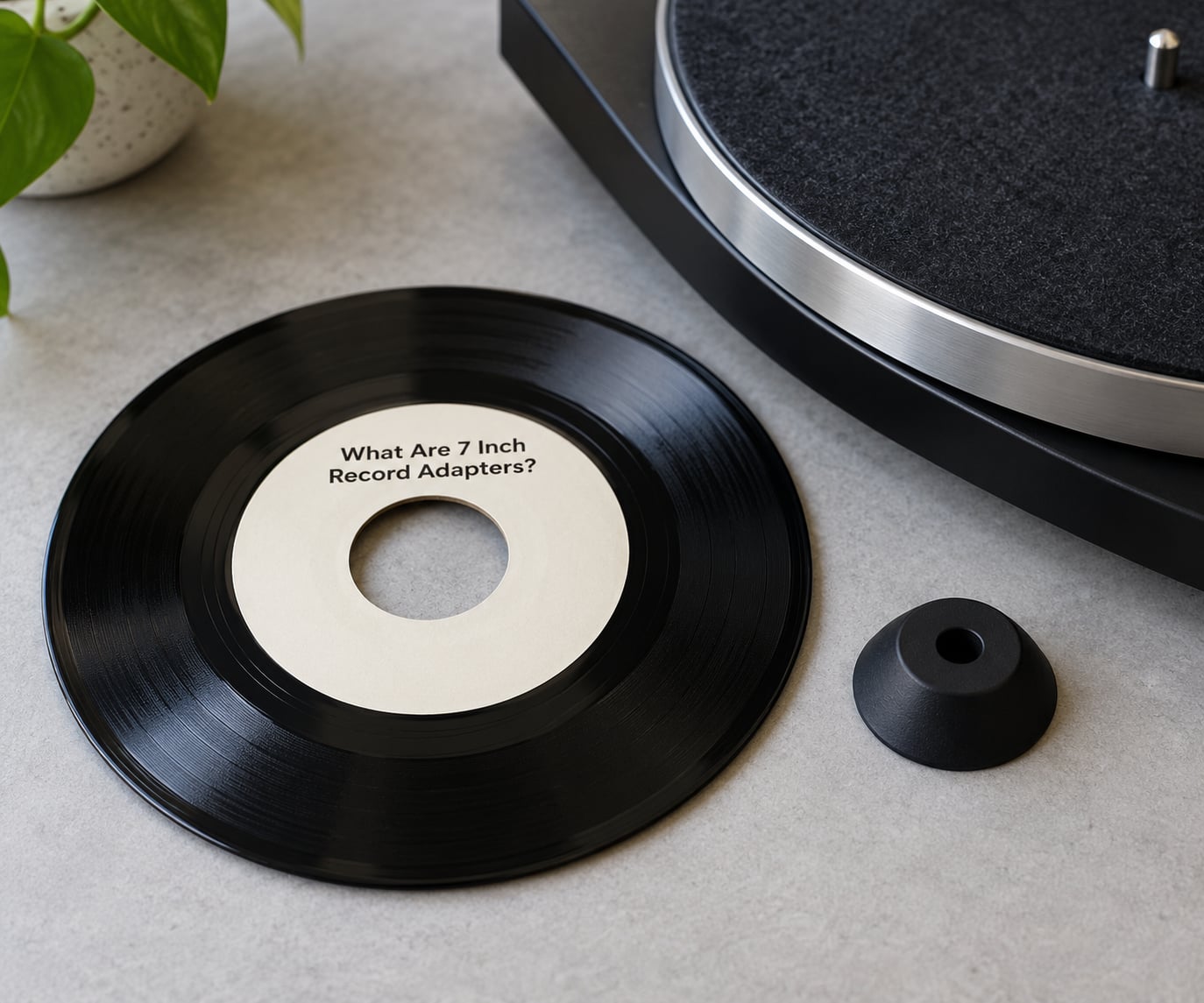
There are two ways to describe what a 7 inch record adapter is, and both are correct. Either it’s an insert that snaps into the record’s big center hole, so the record and adapter drop onto the spindle together as one piece. Or it’s a piece that fits over the spindle itself, widening it until the record’s hole can slide down onto it.
Either way, the dimensions are fixed by history rather than by design taste. A US 7-inch single has a center hole of roughly 1.5 inches. A standard turntable spindle measures about 0.25 inch across. An adapter bridges that gap, and a well-made one measures 1.5 inch across the outside with a hole of exactly 0.25 inch inside.
The most common type is a flat, slightly dished plastic disc. It looks almost nothing like the small record it supports, which is exactly why collectors lose them. Snapping one into a single and then dropping the whole thing onto the spindle is the mechanism most people picture when they hear the term “45 rpm adapter.”
Why Would You Need a 7 Inch Record Adapter?
The reason comes down to one design decision RCA Victor made in 1949 when it introduced the 45 RPM single in the United States. That record had a deliberately oversized 1.5 inch center hole. In Britain and much of Europe, the competing single format used a small hole sized to the spindle, closer to what a 12-inch LP uses.
So the same nominal format ended up with two incompatible hole sizes depending on where the record was pressed. That’s the whole reason a 7 inch record adapter exists, and it’s also why collectors in the UK frequently play US imports without any adapter at all while their American counterparts cannot.
Do 7-Inch Records Play at 45 or 33 1/3 RPM?
Almost all 7-inch singles play at 45 RPM. The exception is rare 12-inch records mastered at 45 RPM, which need no adapter because they have a standard-sized hole but do need the turntable set to 45. Some very early European 7-inch pressings were issued as 33 1/3 RPM singles, and those exist too.
The speed is usually marked on the label near the run-out groove, or printed on the sleeve. If the label is worn past reading, the track spacing gives it away: a 45 has a shorter playing time per inch of groove.
Why Do Some 7-Inch Records Have a Big Hole and Others Don’t?
Almost always the country of origin. UK, European, Australian and Japanese 7-inch singles typically have a hole close to 0.25 inch and slide over the spindle unaided. US pressings, and a good number of Japanese and Latin American issues, use the 1.5 inch hole and need an adapter.
How to check in two seconds: press a finger against the hole. If it swallows your fingertip, it’s the big hole and you need an adapter. If the opening barely clears a pencil, it’s already spindle-sized.
What Are the Main Types of 7 Inch Record Adapters?
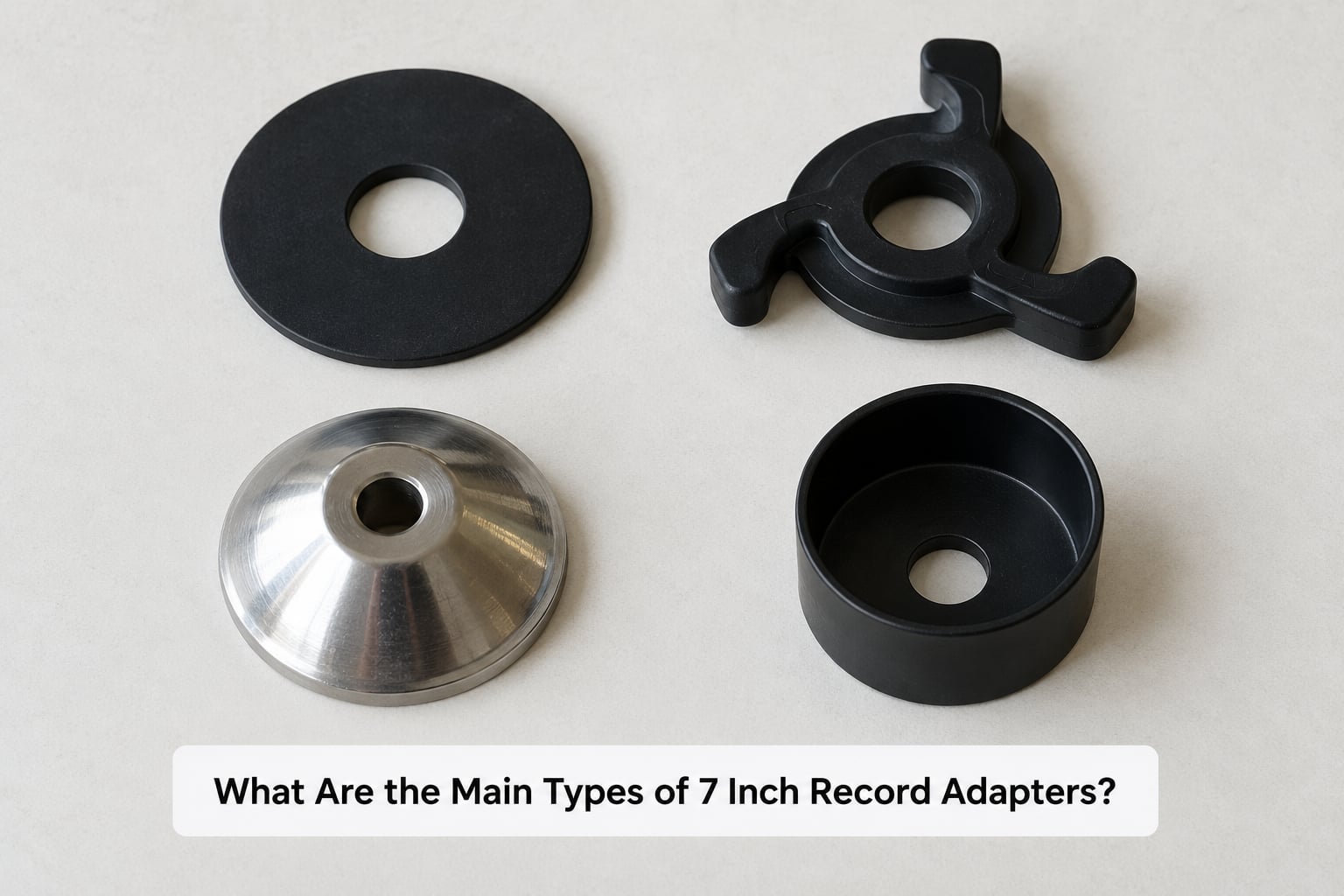
Every one of these solves the same physics problem. They differ in how they hold the record, in what they’re made of, and in how they behave when you try to get them off again.
Flat snap-in insert
The baseline. A shallow dish of plastic or thin pressed metal, often with a lip on the back that catches under the edge of the record hole. It’s the cheapest option and the one most often supplied with an inexpensive turntable. It works fine until you try to remove it, which is the sticking problem described later in this guide.
Spider or three-finger grip insert
Same job, different body. A wider plate with three raised arms gives your fingers something to grip so you can lift it straight off the record instead of prying at the rim. Most collectors who have burned their thumb once switch to this shape and never look back. The extra material costs almost nothing to add in the moulding.
Rubber-lined adapter
A plastic core with a soft ring on the inside face that meets the record. It adds grip, which helps on a platter with a slippery mat, and it cushions the contact point rather than letting hard plastic scrape the label area. The ring does collect dust and needs occasional cleaning.
Weighted aluminum dome
A turned metal body with a stepped cone and a wide base. The weight and the stiffness keep the record flat and the rotation steady, and the base spreads the load across the spindle head. This is the type collectors tend to prefer for jukebox spindles and for heavier records. The weight affects stability only; it does not change the sound.
Over-the-spindle cup adapter
This one never enters the record. It slips down over the spindle post and stands on the platter, forming a new 1.5 inch spindle that the record drops onto. It’s the design some turntable manufacturers recommend, and it’s the easiest type to remove since nothing is trapped inside the vinyl.
What Is the Difference Between a 7 Inch Record Adapter and a 7 Inch Jukebox Adapter?
They’re solving different problems, and using the wrong one is a common and frustrating purchase mistake. A standard 7 inch record adapter goes inside the record’s center hole and centres it on a normal turntable spindle. A jukebox adapter is a larger support disc with no center hole at all, designed for the heavier no-center-hole style of record common in jukeboxes from the 1940s and 50s.
| Feature | 7 inch record adapter | 7 inch jukebox adapter |
|---|---|---|
| Center hole in the record | 1.5 inch, adapter fills it | None at all |
| Adapter outside diameter | About 1.5 inch | Roughly 2.5 to 3 inch |
| Adapter center hole | 0.25 inch, fits standard spindle | No hole; rests on the spindle head |
| Records it is built for | Ordinary 7-inch 45 RPM singles | Heavy jukebox records with no center hole |
| Typical setup | Home turntable, all-in-one player, DJ deck | Jukebox or converted jukebox deck |
The reverse also fails. A jukebox adapter is far too large to pass through a 1.5 inch hole, so it cannot substitute for a standard adapter. If you collect jukebox records, you need one of each for the two record types, and it’s worth keeping them in separate sleeves because they’re easy to mix up in a drawer.
Will Any 7 Inch Record Adapter Work on My Turntable?
No, and the reason matters. An adapter can only help if the turntable underneath it can actually play a 7-inch record at all. Four things have to line up: the platter has to fit the record, the spindle has to accept the adapter, the tonearm has to reach the outer groove, and the speed control has to include 45.
| Turntable type | Adapter needed? | What to check |
|---|---|---|
| Standard belt-drive or direct-drive turntable | Yes, if the record has a 1.5 inch hole | Spindle diameter and whether a 45 rpm setting exists |
| All-in-one player such as a Victrola-style deck | Often yes | Many ship with 33 only; the manual states whether 45 is available |
| Jukebox | Depends on the record | Jukebox records with no hole need a jukebox adapter, not this one |
| DJ deck | Yes | Platter size, spindle fit, and 45 rpm capability |
| Record cleaning machine | Depends on the machine | Cleaning machines often use their own 7-inch or 10-inch size adapter instead |
| Turntable with removable or adjustable spindle | No | The spindle can be resized for 7-inch records directly |
A few players arrive with a small-diameter spindle or an adapter already in the box, and a handful of models ship with a spindle sized for small records, which means an adapter is unnecessary. The manual is the fastest answer here. If it doesn’t list a 45 rpm position, adding an adapter won’t create one.
How Do I Check My Spindle Size?
Most home turntable spindles are around 0.25 to 0.285 inch, and the 0.25 inch figure in the spec sheet of an adapter refers to that inner hole. An adapter that feels loose in the spindle is usually a worn adapter rather than an unusual spindle, and a snug but not forced fit is what you want.
If the spindle is short, the record can end up sitting above the platter surface instead of flat against it. That changes the effective geometry the cartridge sees and is a common cause of skipping on an otherwise fine setup.
How Do You Put a 7 Inch Record Adapter on a Turntable?
This takes about fifteen seconds once you’ve done it twice. The order matters more than the technique.
- Check the speed first. Set the turntable to 45 RPM before the platter starts. If you find the speed switch after the record is already spinning, you’ll hear it.
- Clean the spindle. A felt sleeve or a dry cloth removes dust and old lubricant. Grit on the spindle is a common reason records sit off-center.
- Fit the adapter into the record. Push the outer edge of the insert into the 1.5 inch hole and press the record down onto it until it seats flat. The back of the record and the label area should end up parallel.
- Lower the record over the spindle. Hold the record by its edges, guide the adapter onto the spindle, and let it drop as far as it will go. A small twist as it seats usually centers it.
- Confirm it’s centered. Look from above: the hole in the adapter should sit directly over the spindle with no visible gap on either side. Correct this now rather than after the first skip.
- Cue the tonearm and let it play. If the arm cannot reach the outer edge without hitting the adapter, stop and check the geometry rather than forcing it.
- Remove it in reverse. Lift the tonearm first, then lift the record and adapter together off the spindle. If they resist, see the removal step below.
How to set up a 7 inch record adapter without misalignment
Alignment is a seating problem, not a technique problem. Wipe the inside of the record hole, drop the adapter in, and press the record flat against a table surface with your palm so the insert seats evenly all the way round. Then check it on the platter by looking straight down the spindle.
If the record still sits high or tilts, look for a warped record rather than a bad adapter. A bowed disc will rock no matter how well fitted the insert is, and forcing an adapter into a cupped hole can crack the vinyl.
Why Does My 7 Inch Record Skip, Float or Sit Too High?
Work through these in order, easiest and most likely first. It stops you blaming the cartridge for a setup problem.
- The record is warped or dished. A single that has been stored upright in a tight sleeve for decades develops a curve. It will wobble visibly and skip regardless of the adapter. Play it through or accept the skips.
- The adapter is loose or the wrong fit. If the record shifts on the spindle between grooves, the insert’s inner hole is too big or worn. Test it by pushing it straight onto the spindle with the record attached; it should need gentle pressure, not a shove.
- Spindle clearance is insufficient. If the record rests above the platter rather than flat on it, the spindle is too short for that adapter body. A thinner flat insert solves it.
- The tonearm can’t reach the outer groove. Some short-arm players reach the edge of a 12-inch record and stop. If the arm hovers over the label area of a single, that deck isn’t suited to 7-inch playback.
- Tracking force is too high. A single has far less mass than an LP, so a counterweight set for 12-inch records can push the stylus hard into the groove. Reduce it and re-cue.
- The cartridge alignment is off. If a record plays fine on another deck and skips on this one, the stylus geometry is the place to look.
If the adapter is a flat snap-in type and it stays behind in the record hole when you lift the record away, press the record face down onto a flat table and push the adapter out from underneath with a thin edge. Twist it gently rather than pulling straight, and if it resists, warm it slightly with your hands. Dome, spider and over-the-spindle designs do not have this problem, which is the main practical argument for them.
One more confusion worth clearing up: an adapter is not a record weight or stabilizer. Weights clamp the center label to flatten a record and cut wobble. An adapter only centers the record on the spindle. Buying a weighted mat expecting it to solve a centering problem is a frequent and expensive misunderstanding.
How Do You Choose the Right Adapter for a Record Collection?
Start with your turntable, because no adapter makes an unsuitable deck suitable. Once you know the deck can play a single, the choice narrows quickly.
Turntable geometry sets the ceiling. Platter diameter and tonearm reach decide whether 7-inch playback is viable at all, and the spindle diameter decides which adapter inner size you need. Check the manual for all three before shopping.
Record weight is the next factor. Thin, light 1950s pressings barely notice a flat plastic insert. Heavier records and jukebox issues respond better to a weighted metal body or a stepped adapter that holds the record flat rather than letting it rest on its rim.
Playing frequency matters less than people expect. A casual listener who puts on one single a week will be perfectly served by the basic flat insert. Someone playing through a crate of forty singles at a listening session will notice the difference between a spider grip and a flat disc when it comes to removing them cleanly.
Storage is where collectors lose money. These things are small, unbranded and easy to leave behind at a friend’s house. Buying a small multipack and keeping one in each sleeve with the record is the habit that solves it.
Material matters less than fit. An aluminum adapter that fits your spindle exactly will beat a poorly sized plastic one every time. What metal genuinely adds is rigidity and weight at the contact point; what plastic genuinely loses is mostly durability, since a thin insert can crack or flex if you drop it. Neither material improves the sound itself.
Finally, don’t forget that the word “adapter” gets used for at least three different things: 7-inch single adapters, jukebox support discs, and the size adapters used on record cleaning machines. Buying the wrong one is the most expensive mistake here, and it usually isn’t obvious until the record won’t fit.
Frequently Asked Questions
Do 7 inch record adapters change the sound quality?
Not directly. The adapter has no moving parts and sits at the center of a rotating disc, so it contributes nothing to the audio signal. What it does change is stability: a well-centered record spins true, keeps a steady speed, and tracks without the jumps you get from wobble. That improvement is real but mechanical, not tonal. An adapter cannot fix a worn stylus, a misaligned cartridge or a warped record.
Can I use a jukebox adapter for a regular 7 inch record?
No, and it will not go in. A jukebox adapter is a support disc built for records with no center hole at all, so it has no 0.25 inch hole of its own and is far wider than a 1.5 inch opening. Trying to fit one to an ordinary single simply fails. You need one of each if you collect jukebox records alongside standard US 7-inch singles.
What size spindle should a 7 inch record adapter fit?
A standard home turntable spindle is about 0.25 inch in diameter, and an adapter’s inner hole is sized to match it. Most quality inserts specify a 0.25 inch center hole and a 1.5 inch outside diameter to fill the record’s oversized hole. If your turntable has an unusually short or narrow spindle, measure it with calipers or check the manual before buying.
Can I play 7-inch records on a turntable without 45 RPM?
Only if your turntable runs 45 rpm at a different labeled setting, which some models do, or if you have a working external speed control. A deck with no 45 rpm position at all will play a single at the wrong speed: it will sound slow and deep, and the stylus will sit in the wrong part of the groove. Check the manual or the speed markings on the deck before buying an adapter.
Should I buy a weighted 7 inch record adapter?
Buy one if you play heavier records, use a jukebox spindle, or notice wobble on light pressings. The extra mass and rigidity help a record sit flat and rotate steadily, which is useful for older, heavier issues. For a light 1950s single played occasionally, a well-fitting plastic or spider insert is plenty. Weight improves stability, not the sound itself.
How do I keep a 7-inch record adapter clean?
Wipe it with a dry microfiber cloth or a slightly damp cloth if it has a rubber lining, and let it dry fully before fitting it to a record. Dust on the spindle face is a leading cause of off-center seating, so give the turntable spindle a wipe too. Keep adapters in a small pouch or in the record sleeve so they don’t disappear, which is the more common problem over time.
Conclusion
Start with the turntable, not the adapter. Confirm in the manual that it plays 45 rpm, that the spindle is around 0.25 inch and tall enough to hold the record flat, and that the tonearm reaches the outer edge of a 7-inch disc. Then measure the center hole on a single from your collection. A 1.5 inch opening needs a standard 7 inch record adapter sized to about 1.5 inch across with a 0.25 inch center; a smaller opening needs nothing at all. That five-minute check prevents every problem described above.