The short version: how humidity affects vinyl records matters mostly through the paper, not the disc. The vinyl itself shrugs off ordinary damp, but jackets, inner sleeves, and labels are made of paper pulp, and paper takes on moisture. Sustained high relative humidity feeds mold, softens adhesives, and swells sleeves until the record no longer fits its jacket. Heat, not humidity, does most of the actual warping.
I have moved more boxes between damp basements and climate-controlled rooms than I care to admit, and the pattern never changes: the discs that warp are the ones that lived somewhere hot, and the collections that fall apart are the ones that lived somewhere wet. Different failure, different fix.
Table of Contents
- How Humidity Affects Vinyl Records
- Humidity, Heat, and Vinyl: What Actually Causes Warping
- The Science Behind How Humidity Affects Vinyl Records
- What High Humidity Does to Sleeves, Jackets, and Labels
- Safe Humidity Levels for a Vinyl Collection
- Warning Signs of Humidity Damage
- How to Protect Records from Humidity
- Humidity Problems in Basements, Attics, Garages, and Closets
- How Quickly Should You Act When Records Are Damp?
- Frequently Asked Questions
- Can humidity warp vinyl records?
- What humidity level is safe for vinyl records?
- Does vinyl mold mean the record is ruined?
- How do you remove a record stuck to its sleeve because of humidity?
- Should vinyl records be stored in a basement or attic?
- What To Do First
How Humidity Affects Vinyl Records
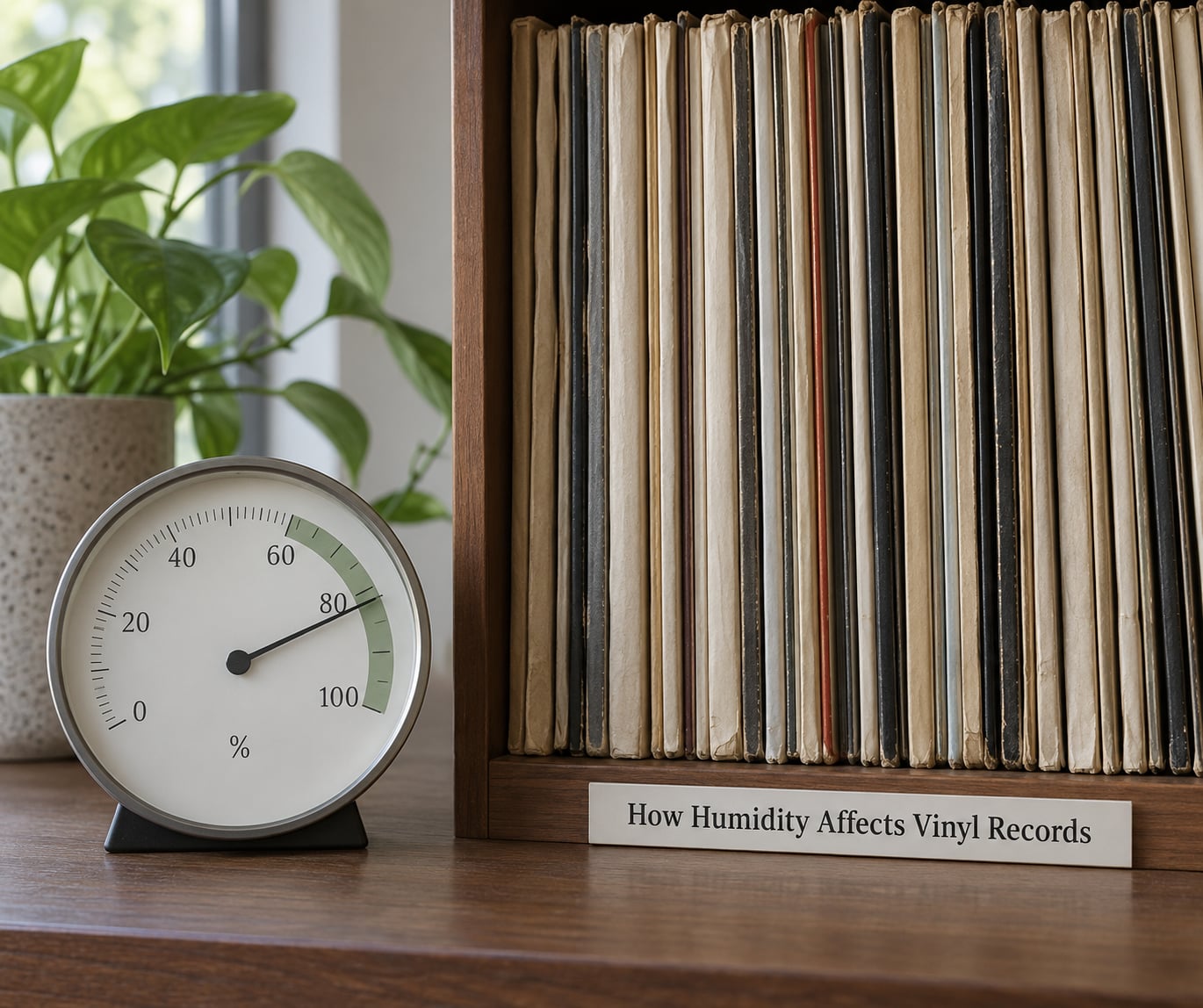
Humidity affects vinyl records in four distinct ways, and only one of them is the one most people picture. Damp air wets the paper parts, which is what causes mold, sleeve swelling, ink bleeding, and stuck discs. Dry air does the opposite, making paper brittle and vinyl prone to cracking. Heat warps the disc. Repeat cycles of all three do more damage than any single steady condition.
Worth stating plainly, because it clears up a common mix-up: moisture alone rarely bends a record. A disc stored flat in a humid closet can sit there for years without a ripple. A record left in a car in July can be visibly warped in a week even if the air is fairly dry.
The order of failure matters for anyone deciding what to save. Jackets and inner sleeves go first, then labels, then the disc. A moldy sleeve does not mean a ruined record, but a record sitting in that sleeve is now living in a small moldy box.
Humidity, Heat, and Vinyl: What Actually Causes Warping
Vinyl is polyvinyl chloride, a rigid plastic that expands when it warms and contracts when it cools. That is the whole warp story. Storage in a warm space, a car, an attic, or a spot near a heating vent gives you the expansion. Laying a record flat under weight at a warm temperature locks in the curve.
Humidity enters the picture indirectly. Moist air feels warmer to us than dry air at the same reading, and collectors often crank a dehumidifier and a heater at once, which swings the record through temperature cycles rather than settling it. Records also fog or frost coming out of a cold unit into warm air, and moisture in that frost layer is a separate hazard from the plastic itself.
The Science Behind How Humidity Affects Vinyl Records
Two materials are doing different jobs in a record package. The disc is plastic and largely non-reactive. The jacket, inner sleeve, and label are cellulose fiber, and cellulose is hygroscopic: it pulls water out of the surrounding air whenever the air is wetter than the paper, and gives it back when the air dries.
As that paper takes up moisture, the fibers swell and the sheet grows. Swelling is not even across the sheet, so the spine and the seam, where the paper is folded and stressed, move differently from the flat panels. That is where jackets first split.
Mold spores are present in almost every room a collection lives in. What humidity changes is whether they stay dormant. The widely cited threshold for active growth on paper is around 60% relative humidity, which is where collectors in damp basements start noticing a musty smell in a box they thought was merely musty-old.
Stability beats precision. A room holding a steady 52% will serve a collection better than one bouncing between 38% and 66% week to week, because every swing is another wet-and-dry cycle through the paper.
What High Humidity Does to Sleeves, Jackets, and Labels
The paper components fail first and fail quietly. Here is what to look for across a shelf.
- Mold and mildew. White, gray, green, or black speckling on a jacket, especially in corners and along the bottom edge where the sleeve sits against the shelf. Black or green patches mean it has been growing a while.
- Musty odor. The giveaway. If opening a sleeve makes you think of a damp basement, that is the smell of microbial activity in paper pulp, not old cardboard.
- Ink bleeding. Colored text or artwork that looks soft, smeared, or has feathered into the paper grain, usually on cheap card stock jackets.
- Failed adhesives. The glue holding a gatefold closed, or the seam of a flipback jacket, goes first. The jacket starts opening itself.
- Paper deformation. Bulging, rippling, or a permanently wavy surface, and jackets that no longer square with the disc inside.
- Sleeve sticking. The record bonds to the inner sleeve in humid conditions and takes a torn corner of paper with it when pulled.
- Label damage. Center labels discolor, curl, or let go of the disc, and paper labels on older pressings are often glued, so they can lift and slide.
Collectors tend to learn the same lesson twice. Everything that can absorb moisture will absorb it, and mold that has been active long enough shows up as a smell before it shows up as a stain. Plenty of people only notice a mold problem during playback, when the musty sleeve and the surface noise make it obvious.
Safe Humidity Levels for a Vinyl Collection
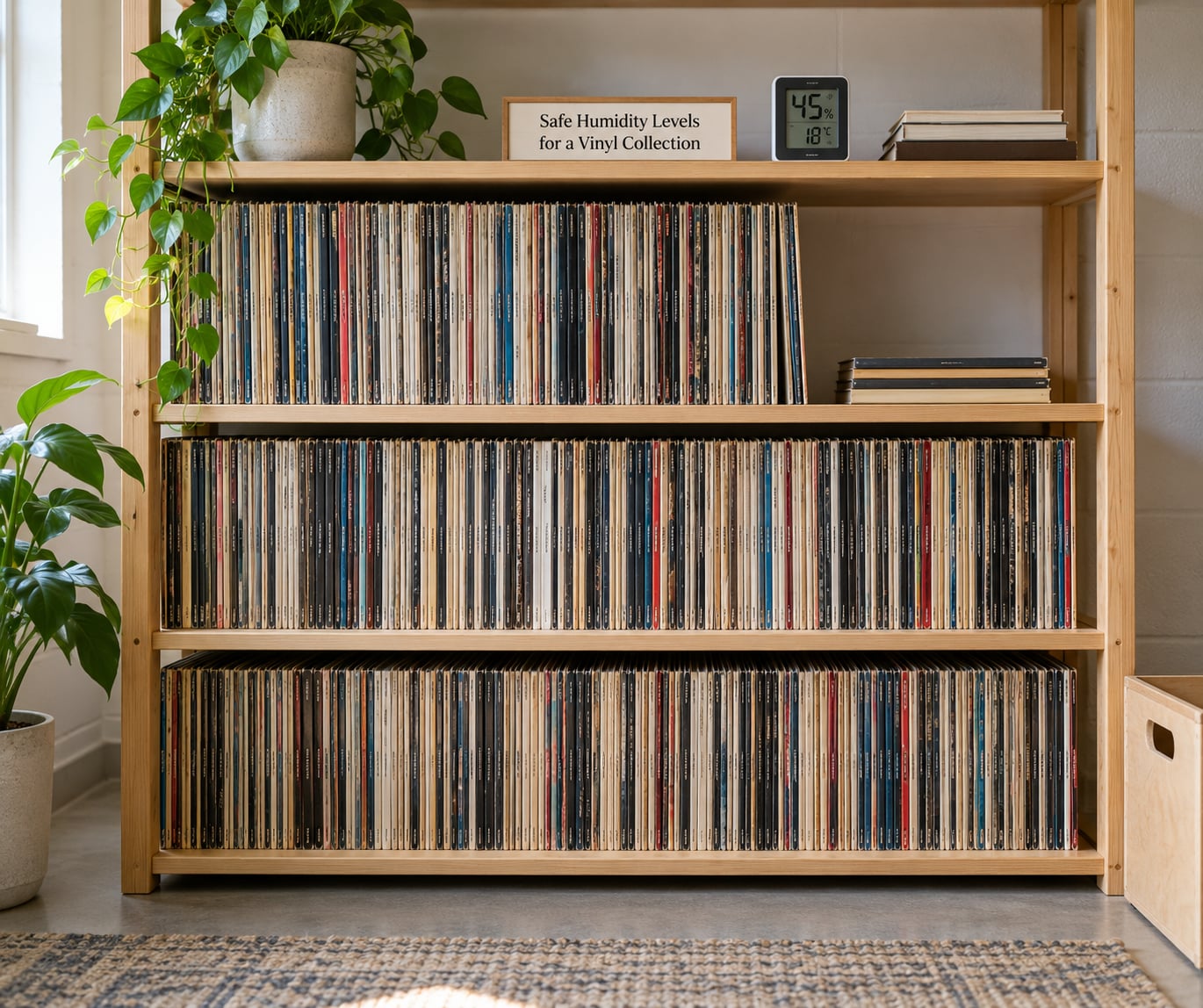
Aim for 35% to 50% relative humidity, and treat anything sustained above 60% or below 30% as a problem worth fixing. Below about 30% is rarely a problem for the paper, but it is bad for vinyl, which becomes stiffer and more crack-prone, and it drives static that attracts dust onto the record surface.
| Relative humidity | What it does | What to do |
|---|---|---|
| Below 30% | Brittle vinyl, paper cracks along folds, heavy static, jackets split at the spine | Add moisture, check HVAC, consider a humidifier for winter |
| 30% to 50% | Target band. Paper stays dimensionally stable, vinyl stays flexible | Monitor seasonally with a hygrometer and leave it alone |
| 50% to 60% | Paper slowly absorbs moisture, jackets swell a little, sleeves begin to cling | Watch the trend rather than a single reading, improve airflow |
| 60% to 70% | Mold spores become active, musty smell, ink bleeding, adhesive failure | Dehumidify the space, isolate suspect sleeves, upgrade to archival sleeves |
| Above 70% | Visible mold, swollen jackets, records sticking, seam and spine failure | Treat as a remediation job, not a storage tweak |
For turntables, the number that circulates is higher: cartridge makers have recommended an operating range near 58% to 60% relative humidity at 22 to 23C, a figure that has been repeated across audio forums for years. That is a playback specification for a delicate moving part, not a storage target, and it sits above the band you want your paper in.
Warning Signs of Humidity Damage
Catch these early and you are talking about cleaning sleeves. Catch them late and you are talking about disposal.
- Any musty, sour, or damp-cardboard smell from a box, shelf, or single sleeve.
- Speckling, fuzzy patches, or discoloration on jacket surfaces, particularly in corners and along the bottom third of the sleeve.
- Jacket spines that are bowed, split, or no longer square with the back cover.
- Records that will not slide out of their inner sleeves, or that take paper with them.
- Adhesive failure: gatefolds popping open on their own, corner splits on flipbacks, labels lifting at the edge.
- Paint or dye on colored vinyl that looks hazy, dull, or tacky in patches rather than evenly.
- Corrosion on any metal in the stack: paper clips, divider tabs, or hardware from a component record.
- White powder or grit on a sleeve that will not brush off, which can be dried-out mildew residue.
Also inspect secondhand buys on arrival. A bag of records that came from a damp basement can carry mold spores into a dry shelf, and a little spot on one jacket spreads to neighbors through contact and shared humidity. Quarantine new arrivals for a week before filing them.
How to Protect Records from Humidity
Protection is a sequence, and the order matters. Measure before you buy anything.
- Measure first. Put a hygrometer on the middle shelf of your actual record storage, not against a wall and not near a window. Leave it a week and write down the range, not the average. A room that reads 45% at noon and 68% at 3am has a problem an average will hide.
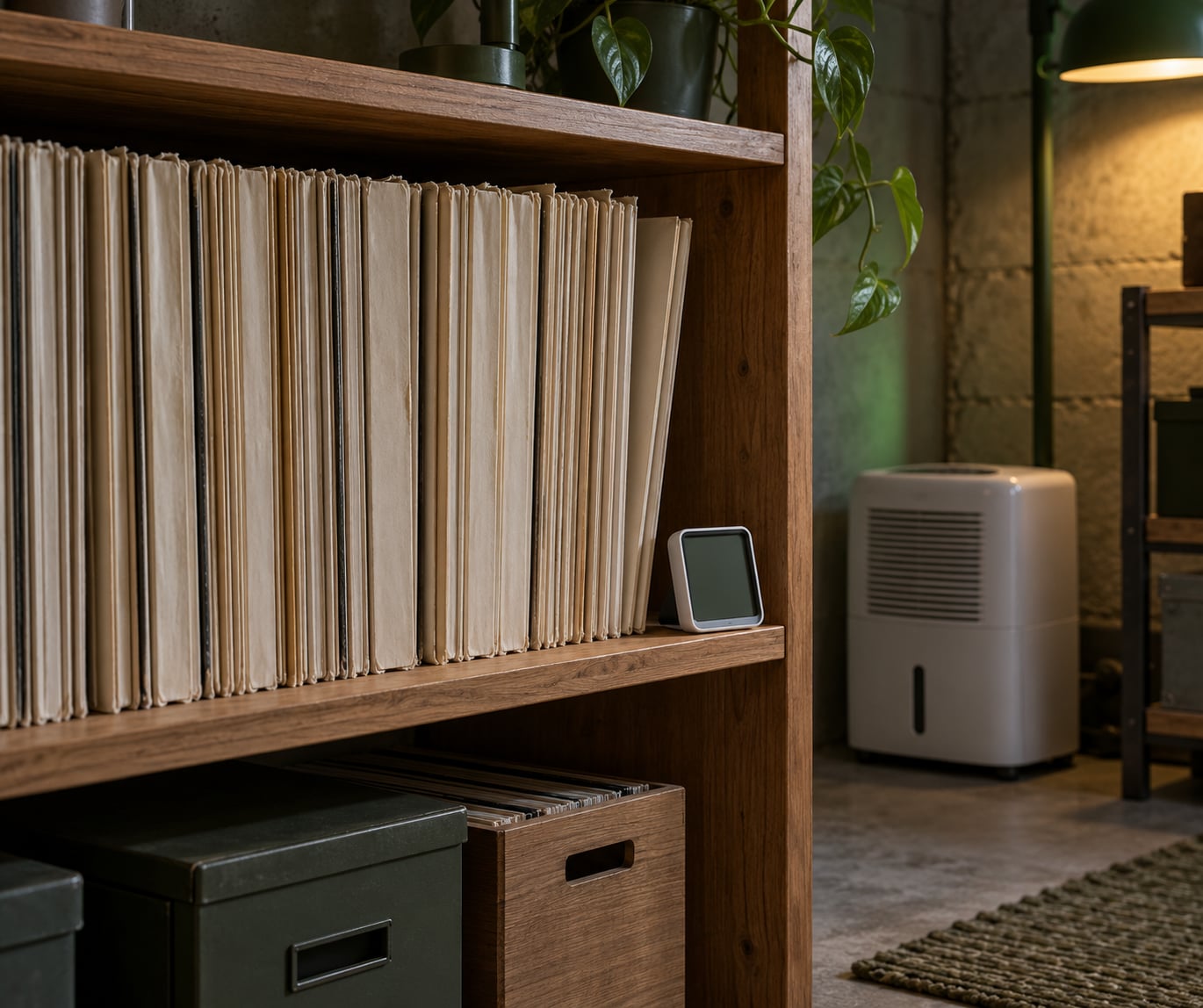
- Choose the right space. Interior closets and finished rooms beat basements, garages, and attics almost every time. If you must use a basement, pick the driest finished corner, keep records off the concrete floor, and get a dehumidifier running before the season turns.
- Improve airflow. Records packed shoulder to shoulder in a closed cabinet airlock. Leave an inch or so between the top of the stack and the shelf above, keep the cabinet doors cracked, and run a fan if the room is still.
- Use passive moisture control. Passive desiccant containers in closets and storage boxes pull moisture out of a sealed volume and need no power. Collectors in humid climates rely on them most in closets and plastic storage boxes, because they are far easier than running multiple dehumidifiers. They are a stopgap that buffers swings, not a substitute for controlling the room, and they need regular checking and drying out.
- Run a dehumidifier when readings justify it. A small compressor unit in a closed basement is the workhorse. Keep the intake clear and the room closed so the moisture it pulls out does not wander back.
- Use air conditioning as a system, not a fix. Cooling lowers the air’s capacity to hold moisture and often brings the reading down with it, but an air conditioner cycling a damp room can be worse than doing nothing.
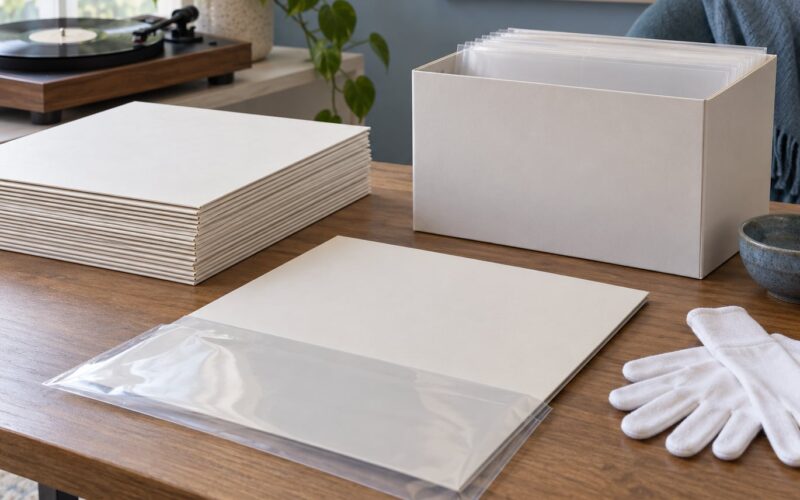
- Upgrade the sleeves. Replace poly-lined outer sleeves with archival-quality, acid-free paper sleeves, keep the records sleeved, and store everything upright with the spines facing out so you can spot problems early.
- Re-check seasonally. Log readings monthly. Basements in temperate climates usually peak in late summer, and coastal homes track the outdoor humidity almost exactly.
Low humidity needs its own answer. A room sitting under 30% wants a shallow pan of water near the heat source or a small humidifier run in short bursts, and the plastic bin trick works here too, since a sealed bin raises the local humidity around the records inside it.
Humidity Problems in Basements, Attics, Garages, and Closets
Each storage location fails in a different way, and the reason is usually the same underlying fact: the outside air connects to it.
| Location | Main risk | Reasonable approach |
|---|---|---|
| Finished interior closet | Seasonal drift and dust, usually manageable | Best option. Hygrometer, archival sleeves, upright storage |
| Basement | Sustained damp, condensation on pipes, flood risk | Dehumidifier, off the floor, moisture barrier under shelving, desiccant bins |
| Garage | Temperature swings that dwarf the humidity changes | Poor choice. Use a tote in a conditioned room instead |
| Attic | Extreme heat, which is a warp problem rather than a mold one | Avoid unless insulated and conditioned year round |
| Coastal or tropical home | Outdoor humidity passes straight through | Closed closet plus desiccant, dehumidifier on a timer, air conditioning |
There is no equipment that rescues a garage in summer. Heat there routinely exceeds what a record can take, and no humidity device fixes a 100-degree shelf. If a garage is your only option, an airtight tote in a conditioned room is the honest answer.
Moving a collection between climate zones deserves its own warning. Cold records meeting warm humid air can pick up condensation, and water sitting on a sleeve is the mold condition arriving in a single afternoon. Let boxes sit closed until they reach room temperature before opening them, and skip moving boxes on a humid day.
How Quickly Should You Act When Records Are Damp?
Speed of response is the difference between a cleanup and a loss. The guideline is simple: air dry at normal humidity, control the space, and bring in a professional when the mold is established or the records are valuable.
Spread everything out, sleeves included, in a dry, ventilated room at normal temperature, and let air move across the jackets. No heat, no hair dryer, no oven. Warm air speeds things and drives moisture deeper into paper, and those remedies are exactly what turns a damp sleeve into a warped one.
For surface mold on a disc, some collectors dab carefully with a barely damp cloth and a small amount of isopropyl alcohol, keeping liquid away from the label and the grooves. Others skip chemicals entirely and isolate the records first, which is the safer order of operations: handle the spores, not the stain.
Ventilate, wear gloves, and never mix cleaning agents. If a closet smells musty when you open the door, the mold is in the room, not just on the jackets, and cleaning records without fixing the room means doing it again next season.
Records with structural mold, fused or stuck sleeves, warped discs, or a musty smell that does not lift after drying are usually beyond saving. For expensive sleeves or rare pressings, a paper conservator is the right call, and it is far cheaper than the record it saves.
Frequently Asked Questions
Can humidity warp vinyl records?
Rarely on its own. Vinyl is PVC, and moisture does not make it bend; heat and temperature swings do that. Humidity contributes indirectly when damp rooms are also warm, or when condensation forms on a cold record moved into humid air. If your records are sitting in a 70% RH room, fix the moisture anyway, because the jackets and labels will suffer long before the discs warp.
What humidity level is safe for vinyl records?
Aim for 35% to 50% relative humidity and hold it there. Treat anything sustained above 60% as a mold risk for paper jackets and inner sleeves, and below 30% as a risk for brittle vinyl, cracking sleeve folds, and static. Stability matters as much as the number: a steady 52% is easier on a collection than a room swinging between 38% and 66%.
Does vinyl mold mean the record is ruined?
Not always. Light surface spotting on a jacket can often be cleaned and the record inside is often fine. Fused sleeves, warped discs, a musty smell that lingers after thorough drying, and mold across a large share of a collection usually mean the damage is not reversible. Isolate any suspect records first, then judge them individually rather than binning a whole shelf.
How do you remove a record stuck to its sleeve because of humidity?
Do not force it. Let the record and sleeve acclimate to a dry room, then work the edges gently with a thin plastic card, opening the seam a few millimeters at a time. Pulling hard tears paper off the disc and damages the groove surface. If the sleeve is mold-damaged or the record is warped, stop and assess the disc before continuing.
Should vinyl records be stored in a basement or attic?
A conditioned interior closet beats both. Basements carry sustained damp, condensation, and flood risk, which is a mold problem. Attics carry extreme heat, which is a warping problem that no humidity device solves. If a basement is your only option, run a dehumidifier, keep records off the floor, and monitor the room with a hygrometer for a full week before trusting it.
What To Do First
Put a hygrometer on the shelf where the records actually sit and let it log for a week. Write down the high and low, not the average, because a room that swings is a room that keeps wetting and drying the paper.
Then look for condensation and temperature swings. If there are both, the fix is usually a sealed, conditioned space rather than a bigger machine. Move exposed records somewhere stable now, and address a sustained moisture problem before next season rather than after the musty smell starts. How humidity affects vinyl records is decided almost entirely by what you do in the boring weeks before anything visibly goes wrong.