A perzine is a small, self-published booklet about the maker’s own life, art, or scene, and it is usually photocopied and stapled together. What is a perzine, exactly, in music terms? It is the most personal corner of the DIY print world: one person deciding what a record, a show, or a reissue means to them, then handing you a copy.
Music perzines have been turning up in record shops, gig posters and zine fairs for decades, and the format has never really gone away. Here is what the term actually covers, how it differs from a fanzine or a magazine, and how to put one together yourself.
Table of Contents
- What Is a Perzine?
- What Is a Perzine in Music Culture?
- What Does a Music Perzine Usually Contain?
- How Do Perzines Differ from Magazines and Blogs?
- Why Do Music Perzines Matter?
- How Do You Make a Perzine?
- 1. Pick one subject and one audience
- 2. Gather more material than you think you need
- 3. Draft in plain text first
- 4. Lay out readable pages
- 5. Export a print-ready file
- 6. Fold, staple, and distribute
- Where the first issues usually go wrong
- Where to put the copies
- Frequently Asked Questions
- Is a perzine the same thing as a music magazine?
- How long should a music perzine be, and how many copies should it have?
- What topics can a perzine cover besides punk and hardcore?
- Are perzines worth collecting if they are not professionally printed?
- How can I start and distribute a perzine without a large budget?
- Conclusion: Start with One Clear Idea
What Is a Perzine?
A perzine is a self-published zine made by one person about their own life, feelings, art, or experiences. The word is short for personal zine, and you will also see it written as per-zine. Unlike a fanzine, which covers someone else’s band, label, or subculture, a perzine’s subject is the person making it.
Three things have to be true for a zine to be a perzine. One person controls the whole thing, nobody else edits it, and the subject is a life rather than a scene, an art form, or a genre.
The word is not as widely used as zine itself, which is why the type boundaries get fuzzy. Editors and zine makers tend to sort the format like this:
| Zine type | Who makes it | What it covers | Typical length |
|---|---|---|---|
| Perzine | One person, unedited | Their own life, work, taste, diary | 8 to 40 pages |
| Fanzine | One person or a small group | A band, label, show, or subculture | 8 to 64 pages |
| Art zine | Usually one person | Illustration, comics, photography, design | 16 to 48 pages |
| Poetry or prose zine | One or several writers | Writing, sometimes with open submissions | 8 to 32 pages |
| Chapbook | A poet or small press | A short run of one author’s work | 8 to 40 pages |
| Micro-zine or minizine | Anyone, often beginners | Whatever fits, often one idea | 1 to 8 pages |
Overlaps are normal. A perzine about a garage band scene is still a perzine if the maker is writing from the inside rather than reporting from outside.
What Is a Perzine in Music Culture?
Zines came out of the same do-it-yourself instinct that drove punk, hardcore, and the underground press: no editor, no permissions, no budget. Punk and hardcore scenes made the format famous because photocopiers were cheap and arguments were loud. Garage, rockabilly, and psych communities printed their own thing too, often in the plain black-and-white form that survives to this day.
Music perzines are how people document a scene from the inside. Nobody writes about your local rehearsal room or your favourite DIY label run because it is a big story. Someone prints 100 copies, staples them, and gives them out, and that is the record. If you came up through independent music, someone in your scene probably handed you a photocopied booklet at some point.
What Does a Music Perzine Usually Contain?
Contents follow purpose, but the recurring components are fairly consistent. A working perzine usually runs some mix of the following.
- Release reviews — new records, reissues, demos, and anything pressed in small numbers that a store would not stock.
- Interviews — usually recorded on a phone at a show or in a rehearsal room, which is why they read the way they do.
- Concert reports — first-hand accounts of a gig, a hall, a touring band that stopped routing through your town.
- Label histories — how a run started, who pressed it, what went wrong.
- Record store features — a shop’s shelf, its owner, the town it sits in.
- Classifieds and trades — want lists for the hard-to-find stuff, and space for readers to swap zines.
- Artwork and photographs — hand-drawn pieces, photocopied flyers, live photos pasted in at whatever quality they printed.
- Playlists and submissions — what the editor has been listening to this month, plus reader mail-in pieces.
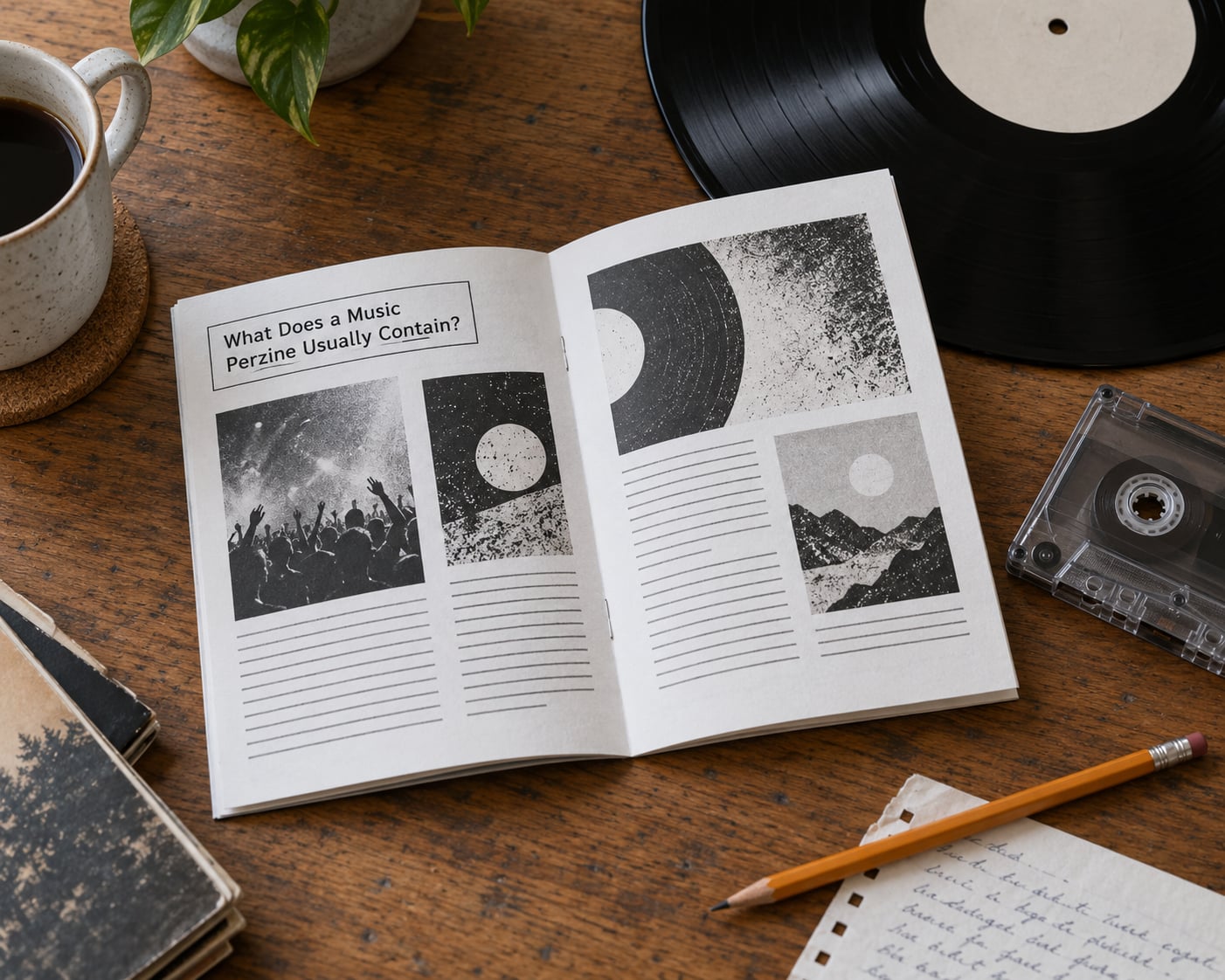
The best ones have a shape that repeats. Someone who publishes a monthly perzine needs a predictable mix, otherwise every issue becomes an excuse to redesign from scratch and nothing ever ships.
Runs are serial rather than one-off. A monthly issue, numbered and dated, builds the sort of archive a magazine cannot match at this scale.
How Do Perzines Differ from Magazines and Blogs?
Not much in subject matter. The difference is in scale, speed, and who gets to decide.
A magazine has an editorial structure: an editor, a submission process, a publication schedule, advertising, and a distributor. A perzine has a stack of photocopies and a stapler. A blog posts the same day and gets read on a phone; a perzine sits on a shelf or in a crate and gets flipped through at a show.
Because a perzine is not distributed by strangers, it can be opinionated in a way a magazine cannot. The maker can call out a label, skip a genre entirely, or print something badly on purpose. That is not sloppy, it is the point of a personal format.
That difference shows up in five places.
- Production scale — one person, one copier, one afternoon, against a team, an editor, and a printer.
- Tone — a perzine can take sides, ignore genres, and sound like a person. A magazine smooths that out.
- Permanence — a stapled booklet stays on a shelf for decades. A blog post gets buried the week after it goes up.
- Audience participation — a perzine audience is made of people you can name, and they write back in the next issue.
- Speed — a blog is instant and searchable; a perzine is slow and has to be found.
The trade is real. A blog reaches more people and finds them for you. A perzine reaches fewer people and keeps them.
Why Do Music Perzines Matter?
Record collecting history is thinner than it should be. Labels fold, bands break up, and the only trace of a scene’s inner life ends up in a photocopied booklet that somebody kept for forty years. Perzines are how that gets recorded without waiting for a publisher to agree it matters.
They are also how records get found. A review in a perzine points you toward a label you have never heard of, a show you would not have travelled for, or a reissue that only got pressed in 400 copies. Collectors tend to trust these recommendations more than a store display, because the recommendation came from someone who made the thing by hand.
How Do You Make a Perzine?
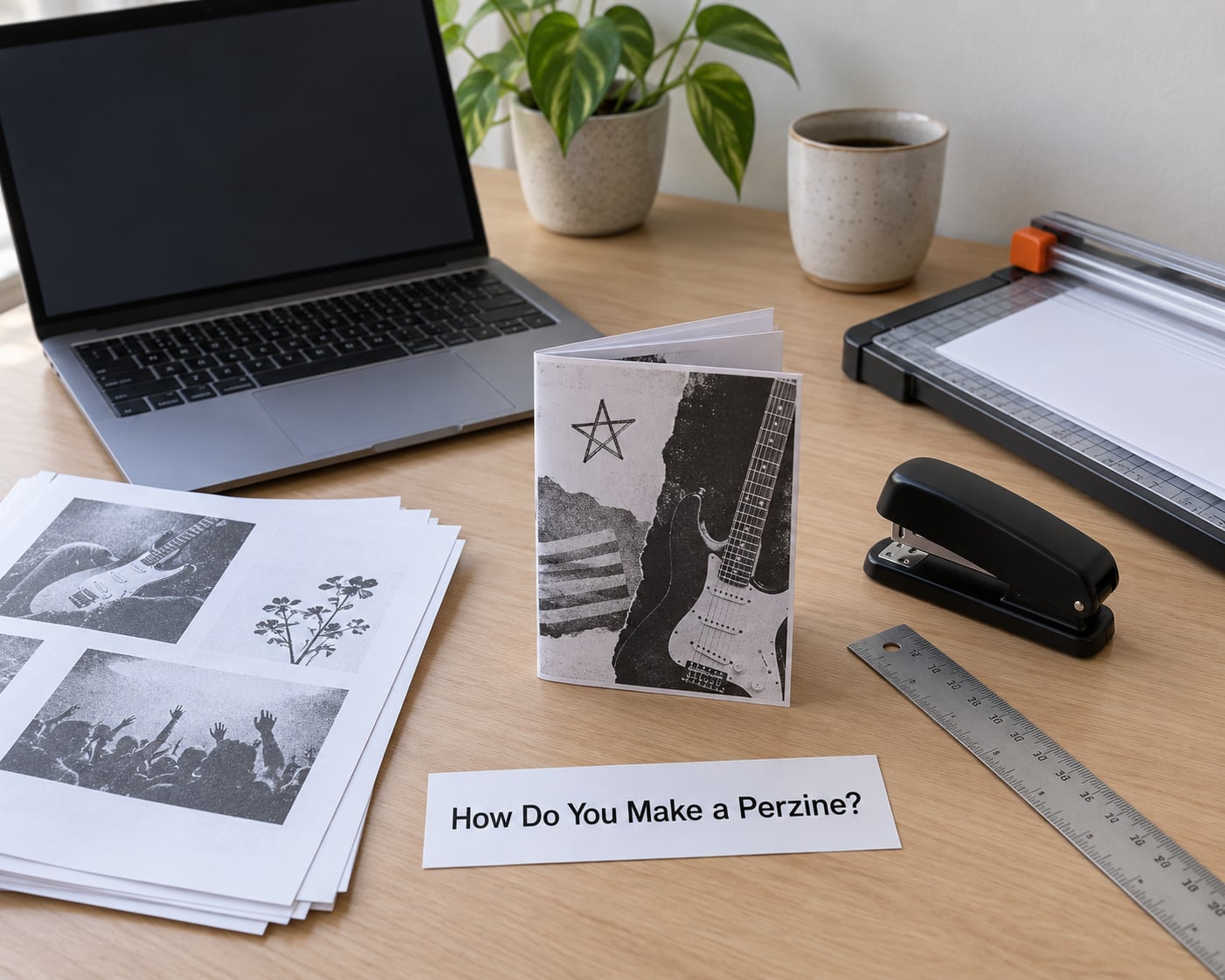
You need some content, a way to print pages, a stapler, and 30 minutes of folding. Everything else is preference.
1. Pick one subject and one audience
A first perzine fails when it tries to be about everything. Name the thing and the reader in one sentence, then check whether you can fill the page count with it.
2. Gather more material than you think you need
Diary entries, photographs from a phone, photocopies of flyers, drawings, a list of every record you bought this year. Pulling from your own archive is faster than writing from scratch, and it is more honest.
3. Draft in plain text first
Type it, do not design it. Then read it out loud and cut whatever you would skip if a friend said it to you.
4. Lay out readable pages
Two columns of body text, one image per spread, margins wide enough to staple without covering the words. Free tools do everything you need.
5. Export a print-ready file
Export as a print-ready PDF at 300 DPI, which is the resolution standard zine makers on Reddit’s r/zines agree on, and take the file to a copy shop. Black and white on plain paper is the traditional look and the cheapest way to print.
6. Fold, staple, and distribute
Keep the page count low, around 8 to 16 pages for a first issue, since each folded sheet adds four pages. Print runs of 50 to 100 copies are plenty to start. Leave a note offering trades if you want other zines back, and remember the first run is not a business.
Where the first issues usually go wrong
Beginners on r/zines repeat the same mistake: they spend weeks on layout software instead of writing anything. The general advice from people who have done it is to start with a rough draft and keep what you like rather than perfecting a template first.
Print-run anxiety is the other one. Fear of wasting paper stops more first issues than writer’s block does. Fifty copies that actually exist beat five hundred that are still on a hard drive.
A perzine about people you actually know carries its own risk. Read it over with a friend before you print, and give them a chance to say no.
Where to put the copies
Leave them in record shops that let you, hand them out at shows, put them in the free pile, and trade with people you meet. Posting a full PDF in r/zines or a zine Discord is how beginners find a scene fast, and collectors there will tell you what they are missing.
Leaving one copy somewhere surprising works better than it has any right to. Someone will find it.
Frequently Asked Questions
Is a perzine the same thing as a music magazine?
No. A magazine has an editor, a submission process, a schedule, and usually advertising. A perzine is one person writing about their own life or scene, printing it themselves, and handing it out or trading it. The subject matter can be identical, but the production and the editorial control are completely different.
How long should a music perzine be, and how many copies should it have?
Eight to sixteen pages is a normal first issue, which is two to four folded sheets stapled together. Print runs of 50 to 100 copies are standard for a beginner, since most of them get handed out, traded, or left behind in record shops. Nobody expects a first issue to sell out, so keep the run small and the cost low.
What topics can a perzine cover besides punk and hardcore?
Almost anything. Music perzines are written about garage, rockabilly, psych, folk, electronic, jazz, or a single label run, and plenty cover writing, drawing, photography, or daily life instead of records. Punk and hardcore made the form famous, but the personal angle is the only real requirement, not the genre.
Are perzines worth collecting if they are not professionally printed?
That is exactly why collectors want them. A stapled photocopy with a crooked cover is more collectible than a glossy magazine because it was made by one person for a small audience. Values depend heavily on the maker, the run size, and whether the issue is still findable, so look for zines with strong artwork or a documented scene behind them.
How can I start and distribute a perzine without a large budget?
Write the pages in free software, export a PDF at 300 DPI, and print black and white at a copy shop rather than a printer. Stay at 50 to 100 copies, leave room for trades, and give copies away at shows, in record shops, and to friends. Zine fairs and local community groups are also good places to plug into a scene quickly.
Conclusion: Start with One Clear Idea
A perzine is a self-published booklet about your own life, taste, or scene, made by one person with no editor in the way. The format is still cheap, still fast, and still one of the better ways to keep a musical corner of your life on paper.
Start narrow. Pick one thing you already obsess over, a favourite label, a local scene, a record store, or a run of independent releases, and write sixteen pages about it. Print fifty, staple them, and put one in the hands of somebody who stands in the same room as you do.