Short version, because the honest answer has two parts: use a soft carbon fiber brush before every play, and wet clean only when dirt is actually stuck in the grooves or after roughly 10 to 20 plays on a record you rotate heavily. If you have ever wondered how often should you clean your records, those two cadences cover almost everything. Dust removal takes seconds; a wet clean takes ten minutes plus a few hours of drying.
That split is the whole answer, and most of the confusion around record cleaning comes from mixing the two up. Dry cleaning is maintenance. Wet cleaning is a repair job for a surface that brushing cannot fix, and doing it too often adds risk instead of removing it.
Below is the routine I use, the trigger signals that tell me a record has moved from one to the other, and what I do about labels and sleeves. Updated for 2026.
Table of Contents
- What You Need for Safe Record Cleaning
- Step-by-Step
- How often should you clean your records?
- Step 1: Inspect the record and choose the least aggressive cleaning method
- Step 2: Remove dust with a soft brush
- Step 3: Deep-clean only the contaminated playing surface
- Step 4: Dry, inspect, and store the record correctly
- Common Mistakes
- How Often Should You Clean? It Depends on Handling and Storage
- Can You Clean Record Labels and Sleeves?
- Frequently Asked Questions
- Can I clean a CD-bound or glued-together record?
- Is compressed air safe for cleaning vinyl records?
- How do I remove sticky residue or adhesive from a record?
- What is the safest way to clean sleeves, inserts, and record jackets?
- Can I play a record that still feels slightly damp after cleaning?
- Conclusion
What You Need for Safe Record Cleaning
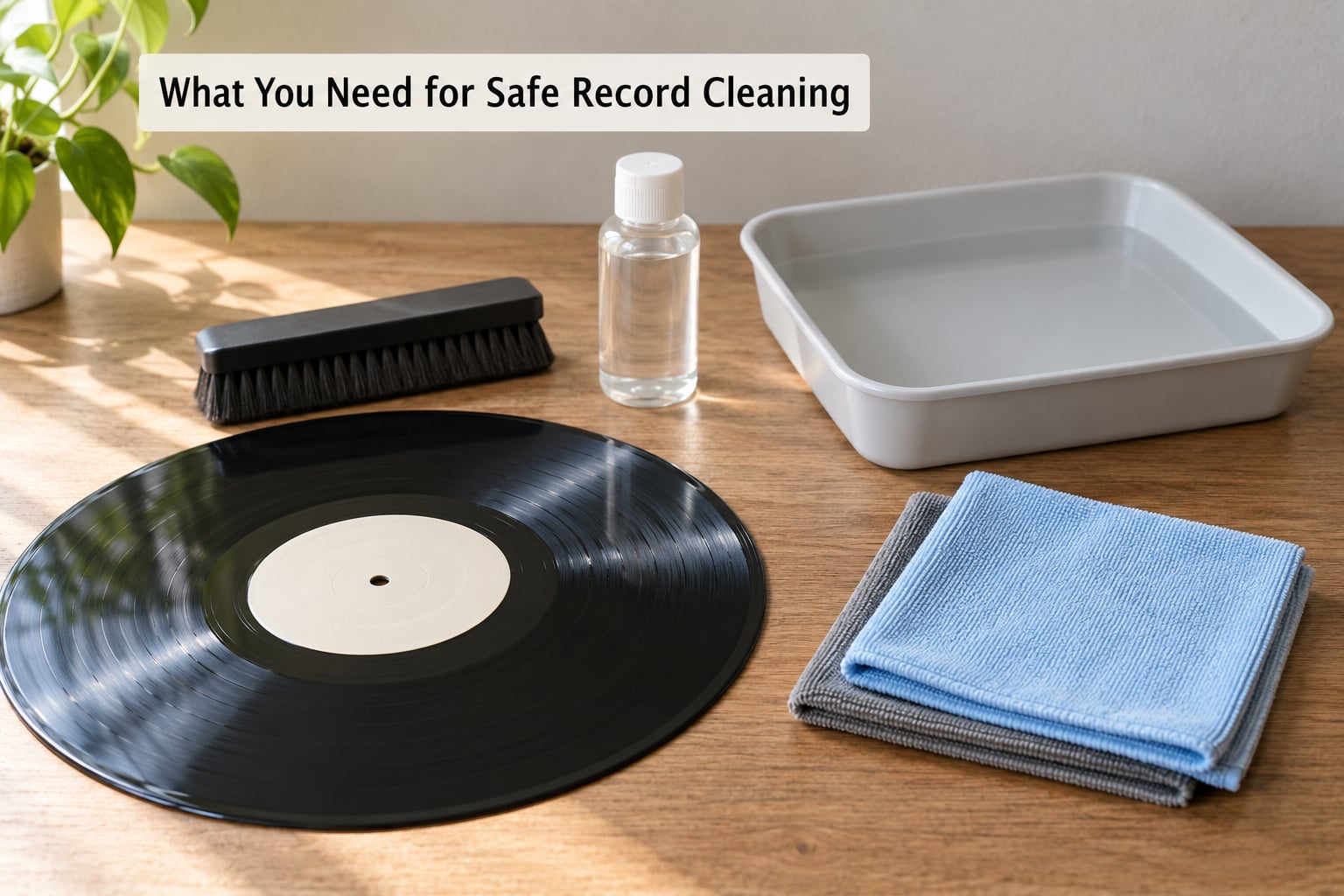
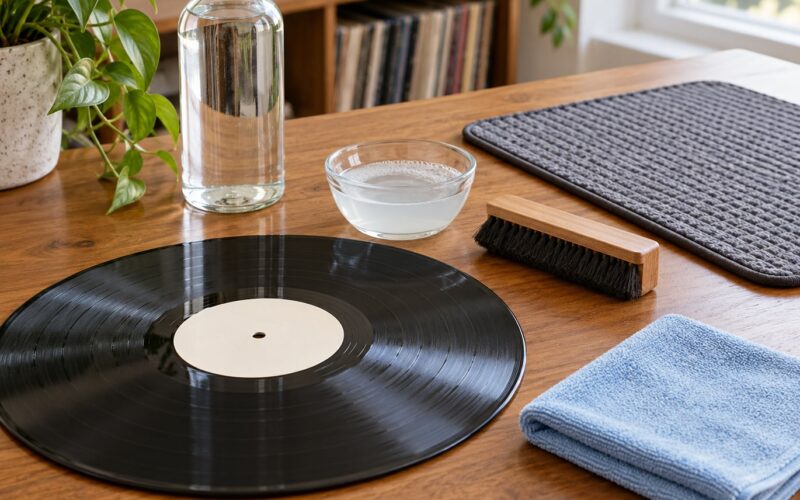
Two separate kits, really. For the brush work you need very little, and keeping it minimal is what stops cleaning becoming a chore you avoid.
- Anti-static carbon fiber brush. The single most useful tool here. Its fine fibers lift dust out of the groove walls and dissipate static charge at the same time.
- Microfiber cloths. Squares, not the kind that shed lint. One for drying, one that never touches anything else.
- Vinyl-safe cleaning fluid. A surfactant meant for records, used sparingly. You want a fluid that lifts grime and rinses out clean, not one that leaves a film.
- Filtered or distilled water. Needed for rinsing, and for the gentlest wet method on lightly soiled vinyl.
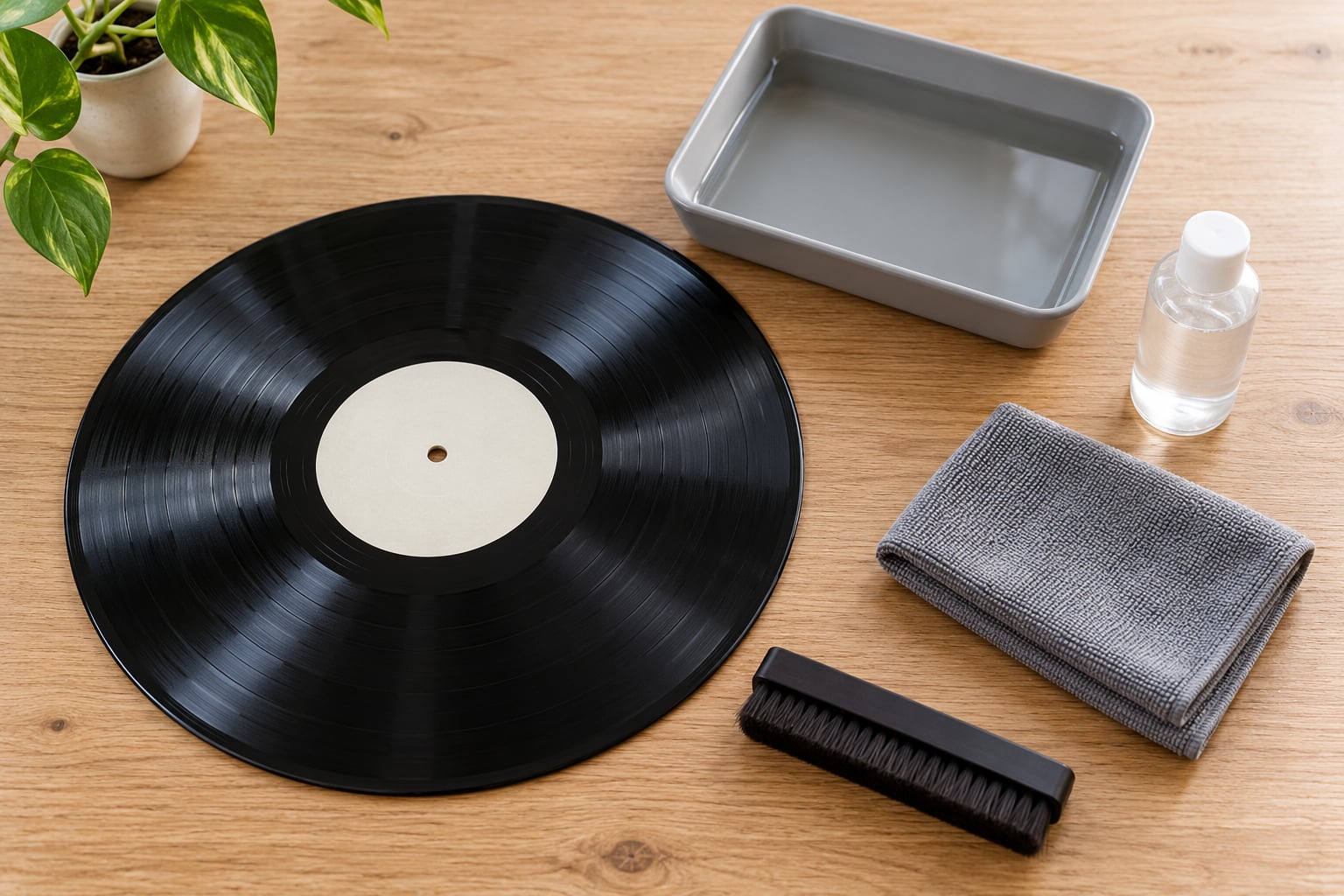
- A shallow washable tray or basin. Big enough for a 12-inch LP but shallow enough that the record stays supported. A dish rack turned on its side does the job.
- Nitrile gloves. Optional, worth having for valuable sleeves and for anything with mold.
What to leave out matters as much as what you buy. Skip paper towels, which shred on the groove walls and deposit fibers. Skip household sprays, dish soap and tap water for washing. Skip stiff-bristled brushes of any kind, and skip compressed air, which drives particles into the grooves where they grind.
Set up somewhere flat, well lit and away from the turntable electronics. Give yourself about two feet of clear space, wipe it down, and put the tray on a towel so a wet record never touches bare counter.
Step-by-Step
How often should you clean your records?
Check the visible surface of your collection every few weeks if it sits on an open shelf. For records you actually play, brush before each listening session, which for most people means about once a month. Save wet cleaning for the moment you notice fingerprints, sticky residue, a cloudy or hazy surface, or crackle that brushing did not remove.
As a working number, wash a heavily rotated record every 10 to 20 plays. A record you pull off the shelf once a season needs a wash when it gets dirty, not on a schedule. Newly bought used records get a wash before the first play, usually because you do not know how they were stored.
Step 1: Inspect the record and choose the least aggressive cleaning method
Hold the disc up at an angle to a light source and tilt it. Groove-drawing light across the surface shows loose dust as a fine sparkle and shows embedded dirt as dull patches or a film you can almost feel.
Look at the label and the sleeve while it is out. Look for mold spotting, water staining, ring wear from a drink, and sleeve splits. Any of those change the plan, because the sleeve needs work and the disc may need work at a different level of aggression.
Loose dust and light fingerprint smudges respond to a dry brush. Embedded dirt, nicotine film, sticky label adhesive, oil, and anything that squeaks or crackles continuously under the brush is a wet-clean job.
Step 2: Remove dust with a soft brush
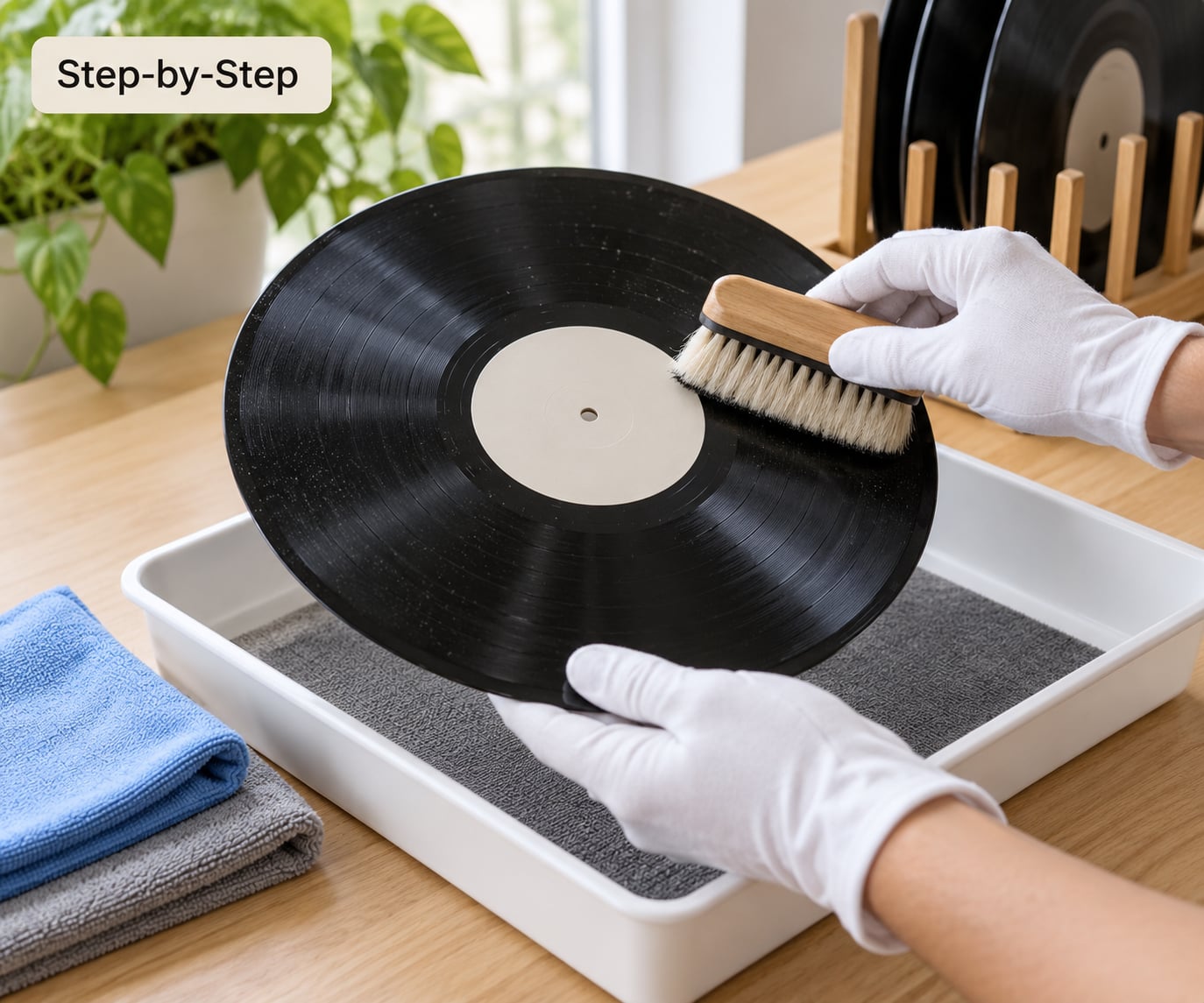
Hold the record by the edges with one hand and support the opposite edge underneath. Never grip the playing surface between your fingers, and never hold it by the label with fingers resting on the vinyl.
Sweep the brush along the grooves in the direction the record spins, using a light touch. On a standard LP that is clockwise viewed from above, so you move from the outside toward the label as the record turns. Cross-groove scrubbing is what creates the swirl marks people mistake for scratches.
Work in overlapping passes around the disc, then lift the brush and tap off the dust it has collected into a bin or onto a cloth away from your setup. When the brush feels gritty or the passes stop looking clean, that is the signal to move it aside and clean the bristles with a small brush, or set it aside for a full cleaning later.
A record is dry-clean when a tilted light shows no sparkle in the groove area and the brush comes up clean on its last pass. That is the whole check.
Step 3: Deep-clean only the contaminated playing surface
Put the record in the tray on its edge. Apply a small amount of vinyl-safe fluid, or use the fluid’s instructions for dilution. The goal is a barely damp surface, not a soak.
Work the surface with a very soft brush or a clean microfiber cloth in the groove direction, using short overlapping strokes. The dirt should lift visibly rather than smear. If it smears, you are moving too fast or using too much fluid, so stop and reassess.
Keep liquid away from the label and the spindle hole. If you can, cover the label area first with a protective film, or work in from the outer edge inward and stop before you reach the center. Rinse with a few drops of distilled water spread over the surface if the fluid directions call for it, then catch the runoff in the tray.
Two rules keep this safe. Never do it over a turntable or near any powered equipment. And never submerge the record, because water works its way into the label, under the seam of the sleeve, and eventually into the vinyl itself.
Step 4: Dry, inspect, and store the record correctly
Stand the record upright in a drying rack or between two clean, absorbent cloths so air moves around both faces. A fan on low, pointed across the discs, speeds things along. A record that feels even slightly cool or damp is not ready.
When it is fully dry, hold it to the light again and check for streaks, cloudy patches, or a damaged label. Streaks mean you went on too heavy with fluid or did not rinse. Cloudy patches usually mean residue, which means another careful pass rather than more scrubbing.
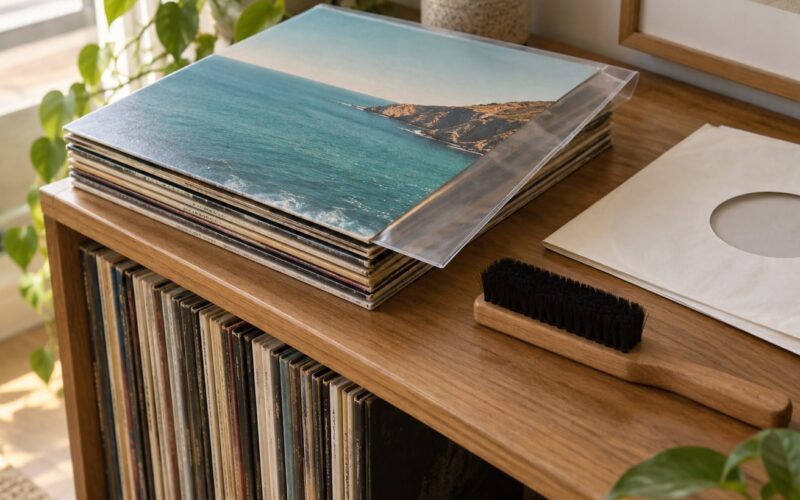
Put the record into a clean anti-static inner sleeve, then into the outer sleeve. Both should be replaced if the original inner sleeve is worn, scratched on the inside, or has ever been wet. Store the collection vertically, never stacked flat, in a space where the sleeves are not crushed.
Common Mistakes
Over-cleaning. The most common error, and the one collectors worry about most. Dry brushing every play is not a risk. Repeated wet washing without a reason is, because every soak is another chance for fluid to reach the label and the seam. Brush freely; wash deliberately.
Scrubbing across the grooves. Fix: turn the disc over on your work surface once and match the brush to the rotation direction every time.
Using household cleaners. Windex, WD-40 and Dawn all show up in forum threads, and none of them belong on a playing surface. Alcohol-based glass cleaner can craze PVC sleeves outright. Fix: one vinyl-safe fluid, used sparingly.
Using tap water. Hard water leaves mineral deposits that dull the surface and collect dust faster. Fix: distilled or filtered water only.
Soaking the label. Fix: work from the outer edge inward, keep the label covered, and never let a record sit in fluid.
Drying records flat or wedged upright. Both trap moisture or bow the disc. Fix: upright with air on both faces.
Ignoring the stylus. Cleaning the record and skipping the needle is odd, since the needle is the thing most exposed to every bit of dirt. Clean the stylus after every session with a proper stylus cleaner, always from back to front.
Cleaning the disc while ignoring storage. A shelf in direct sunlight, near a radiator, or in a room with a smoking habit will undo your work faster than any cleaning schedule can build it back up.
How Often Should You Clean? It Depends on Handling and Storage
Cadence is not a personality trait, it is a consequence of how the record is handled and where it lives. The same LP in two houses needs two different routines.
| Situation | Dry clean | Wet clean |
|---|---|---|
| Daily listener, one or two records a day | Before every play | Every 10 to 20 plays, or when crackle appears |
| Weekend listener | Before each session, so weekly | Every few months |
| Newly bought used record | Not needed first, wet clean first | Before the first play |
| Sealed, unplayed collector copy | Only when you inspect it | Only when you decide to play it |
| Heavy rotation or DJ-style use | Before every side | Every 10 plays, more if the surface is sticky |
| Open shelf, pets, sunlight, smokers in the room | Every few weeks, check more often | As soon as you see a film or haze |
| Shellac 78s | Dry brush only, gently | Rarely, and only with a conservator or an experienced cleaner |
Records in a climate-controlled cabinet or archival outer sleeves genuinely need less attention. Records on an open shelf in a room with pets, direct afternoon sun, or anyone who smokes nearby need attention every few weeks whether or not they are played, because the damage arrives from the air rather than from the turntable.
Inherited or attic collections are the exception to the calendar rule. Inspect before you clean, isolate anything with mold, and clean in batches rather than all at once.
One thing that genuinely cannot be cleaned out: groove wear. Dust comes off and crackle drops. Clicks from a scratch through the groove wall, a warped disc, or a cloudy chemical haze stay exactly where they are. When a record still crackles after a careful wash, more cleaning will not help.
Can You Clean Record Labels and Sleeves?
Keep the disc and its paper apart, because they need different things and the wrong fluid on either one causes damage that is difficult to undo.
Vinyl. Wet-cleanable, as described above. Keep every liquid off the label and out of the center hole.
Labels. Do not wet-wash them. A little surface grime on a paper label is cosmetic and safer than soaking it. Lift loose dust with a dry soft brush, and use a cotton swab barely dampened with distilled water for stubborn spots on a common modern pressing. Do not use anything on a vintage label where the ink or paper is already flaking. If the label is peeling, cracked or water-stained, stop; a conservator is the right call for anything rare.
Inner sleeves. Poly-lined anti-static sleeves are the standard and can be replaced cheaply. Never clean a wet record with a paper sleeve still in it. Discard sleeves that have been wet, torn, or scratched on the inside, and replace them while the record is still out.
Outer sleeves and jackets. These are paper or card and are cleaned separately, dry, or with a material-appropriate product used sparingly on a soft cloth. Never let record cleaning fluid or alcohol-based spray touch artwork, and test any cleaner on a hidden corner first. Valuable sleeves, autographs, inserts and gatefolds are handled the same way you would handle a paper collectible: minimal contact, controlled moisture, dry quickly.
Mold. Do not clean a moldy record in your living room. Work outside or in a well-ventilated space, wear gloves and a mask, and isolate the affected discs from the rest of the collection until they are handled. Bag them separately while you deal with them.
Frequently Asked Questions
Can I clean a CD-bound or glued-together record?
No, not by wet cleaning. The glue and solvents involved will not dissolve in record cleaning fluid, and soaking can spread the adhesive or damage the label. Keep the disc dry, brush the exposed playing surface, and handle it only at the edges. If the two halves are structurally sound, a collector or repair specialist can sometimes separate them, but that is bench work rather than home cleaning.
Is compressed air safe for cleaning vinyl records?
No. Compressed air blasts loose dust across the surface and drives particles down into the groove walls, where they stay and grind the stylus. It can also condense moisture from the air onto the vinyl. An anti-static carbon fiber brush removes dust while dissipating static charge, which is exactly what air cannot do. If you use air on a turntable, keep the nozzle well clear of the record.
How do I remove sticky residue or adhesive from a record?
Try a vinyl-safe cleaning fluid applied sparingly to a soft cloth first, worked in the groove direction and rinsed with distilled water. Never use alcohol, thinner or household sprays, and never soak the label. If residue came from a sleeve stuck to the vinyl, a professional cleaning service with solvent filtration is the safer route, especially for a rare pressing.
What is the safest way to clean sleeves, inserts, and record jackets?
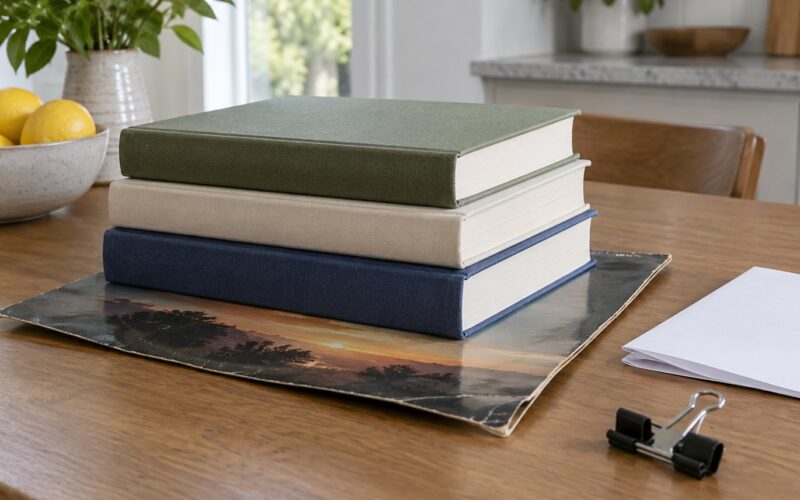
Keep cleaning fluid and alcohol-based sprays away from artwork entirely. For cardboard jackets, dry brushing or a soft cloth barely dampened with distilled water works, tested on a hidden corner first. Wipe gatefolds and inserts separately and dry them flat under weight. Valuable or autographed sleeves should be handled minimally and, if dirty, taken to a paper conservator.
Can I play a record that still feels slightly damp after cleaning?
No. Vinyl is rigid and does not stretch, but a damp disc can carry moisture to the groove walls and then onto the stylus, and it risks chemical clouding or ring wear as it dries. Let it stand upright with air moving across both faces until it feels room temperature and completely dry to the touch. That usually takes a few hours rather than minutes.
Conclusion
Most collections need far less cleaning than their owners assume. A carbon fiber brush before every play, a look at the record every few weeks if it sits on an open shelf, and a wet clean when dirt is genuinely embedded or roughly every 10 to 20 plays on a heavily rotated record will cover almost everything.
Start by pulling out one record and holding it to the light. If it sparkles, brush it and put it back. If it is dull, filmy or sticky, that is the one that deserves a wash, and it is worth knowing in advance that it needs a few hours of drying time before you can play it.