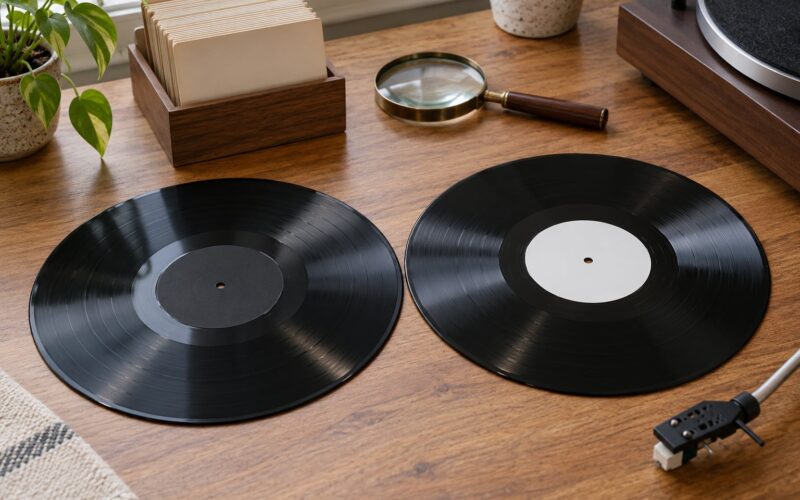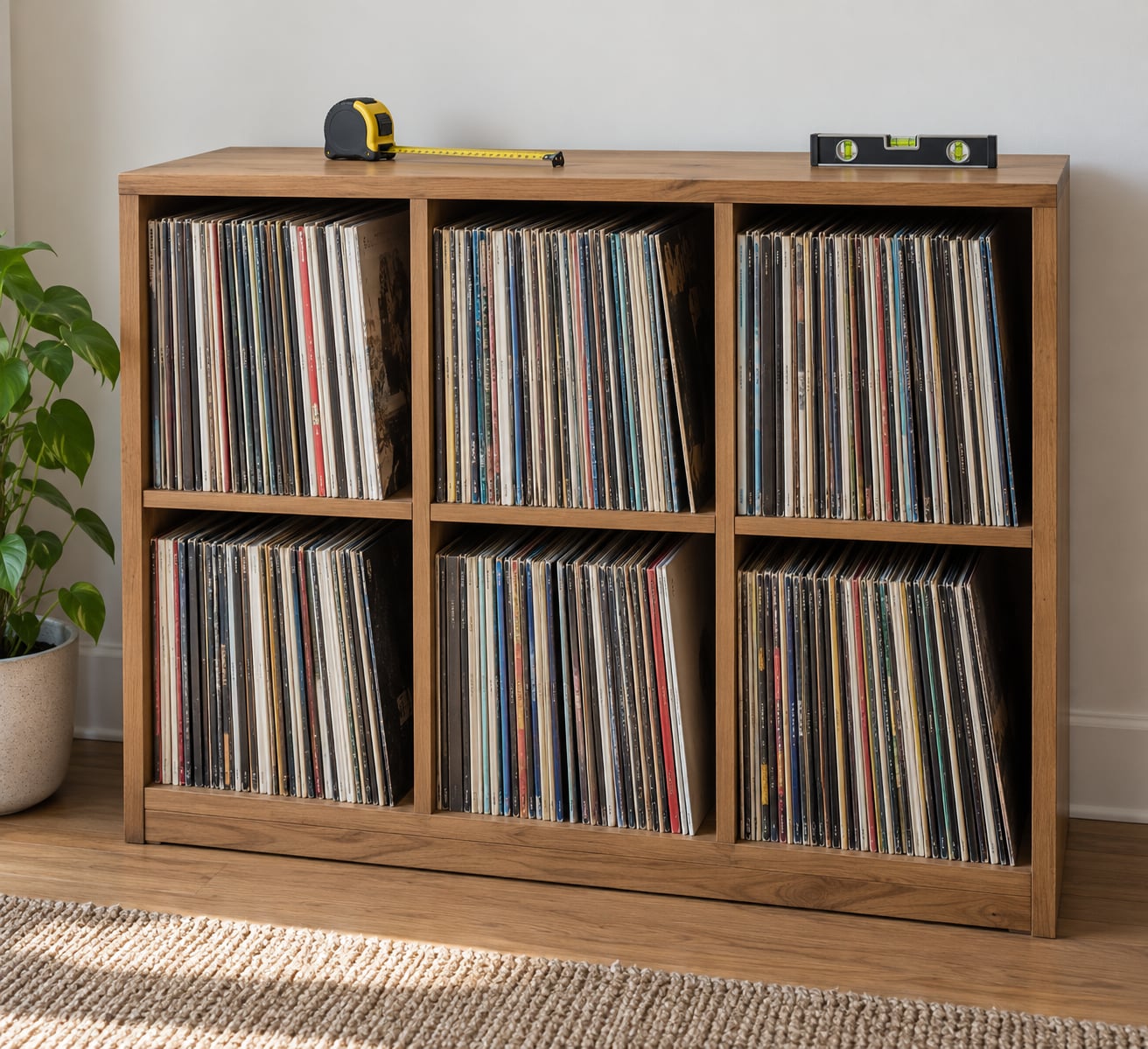
An average 12-inch LP with its jacket weighs about 8 to 10 ounces (230 to 290 grams), so a standard record shelf holding 45 to 60 albums is already carrying roughly 30 to 40 pounds. Stay at or below 50 to 70 percent of the shelf’s rated load, spread the weight across every shelf, and anchor tall units to the wall.
That is the working answer to how much weight can a record shelf hold, and almost nobody gives it cleanly. Instead you get a quoted number (“the IKEA one says 29 lb”) with no explanation of what that number means in albums. For a question that is fundamentally arithmetic, that is a strange gap.
So here is the method, worked end to end: what a record actually weighs, what a shelf is actually rated for, how to compare the two, and what to do when the manufacturer printed nothing at all.
Table of Contents
- What You Need
- How Much Weight Can a Record Shelf Hold?
- Step-by-Step: Calculate and Safely Load Your Record Shelf
- Step 1: Find Your Record Shelf’s Rated Capacity
- Step 2: Estimate the Weight of Your Records
- Step 3: Check the Shelf Structure and Supports
- Step 4: Distribute the Load Safely
- Common Mistakes
- Frequently Asked Questions
- How many vinyl records fit on one shelf?
- Is vinyl heavier than books?
- How much weight can a record shelf hold before it sags?
- Are floating shelves strong enough for vinyl?
- What if the manufacturer gives no weight rating?
- How heavy are 300 vinyl records?
- Conclusion
What You Need
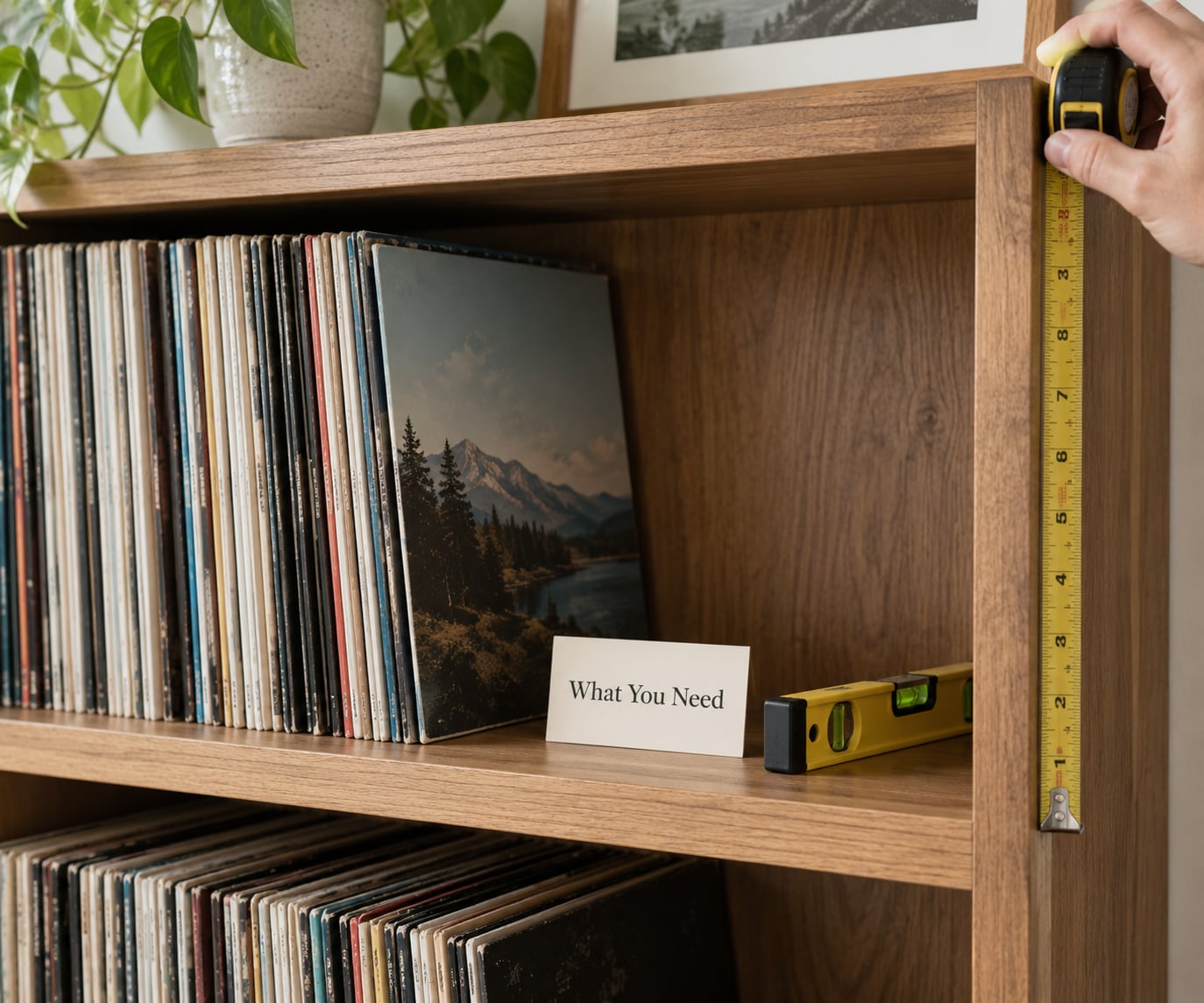
Three things, and none of them expensive.
- The shelf’s own specification. The model number, the assembly instructions, or a printed load rating on a sticker under the shelf or on the back panel. This matters more than any number you find on a forum.
- A rough count and format mix. How many albums, how many are 7-inch singles or 10-inch EPs, and whether the collection leans toward 180 gram reissues. Format changes the weight per record more than most people expect.
- A tape measure and a level. You are measuring shelf depth for capacity and span for deflection risk. The level tells you whether an already-loaded shelf has started to bow.
A kitchen scale is a nice extra. Weighing ten albums you already own gives you your own per-record number instead of a borrowed average, and it takes about five minutes.
The reason this list starts with the shelf’s paperwork is simple. Generic online estimates of “how much weight can a record shelf hold” assume a decent board with decent fasteners. Your shelf may be a flat-pack cube with 5 mm particleboard and four plastic pins, and those two things are not the same object.
How Much Weight Can a Record Shelf Hold?
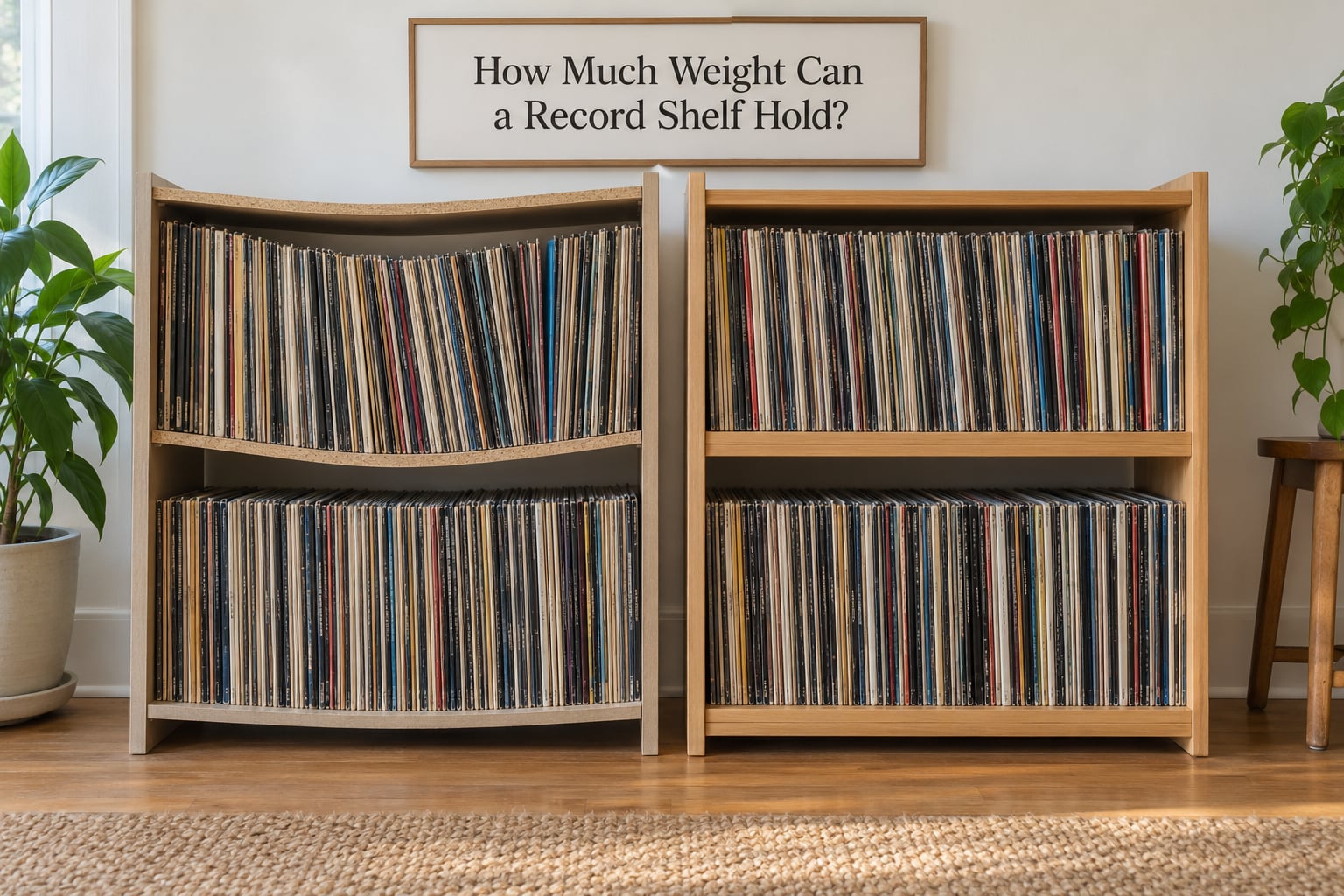
Working ranges, not a single universal figure. The number that matters is not the rating on the box, it is the rating multiplied by about 0.6.
First, the weight side of the equation. Figures vary by source because pressing weight genuinely varies, so treat these as the middle of the range rather than gospel.
| Record type | Approximate weight | In ounces |
|---|---|---|
| 12-inch LP disc only | 140-200 g | 5-7 oz |
| 12-inch LP with jacket (measured, shipped) | 280-290 g | 10 oz |
| 12-inch LP, seller’s default shipping estimate | 230 g | 8 oz |
| 180 g reissue with jacket | 320-350 g | 11-12 oz |
| Double album, two discs plus jacket | 400-450 g | 14-16 oz |
| 10-inch EP or single with sleeve | 120-150 g | 4-5 oz |
| 7-inch single with sleeve | 60-70 g | 2-2.5 oz |
| Box set, five discs plus outer box | 1.4-1.8 kg | 49-63 oz |
Disc-only weights are quoted anywhere from 40 to 180 grams depending on speed, size and pressing, which is why collectors disagree with each other about how heavy a record is. The number that matters for a shelf is the jacket one, because the jacket is what stands on the shelf.
Now the shelf side. IKEA’s KALLAX is rated at 29 lb (13 kg) per cube. IKEA’s BORGSJÖ is quoted at 66 lb across the unit. Owners of a different unit describe its ratings as 45 lb on the bottom shelf, 35 lb in the middle and 30 lb up top, and call those figures optimistic. Those are the numbers collectors actually argue about.
| Shelf or unit | Rated load | Working load at 50-70% | Albums at that load |
|---|---|---|---|
| IKEA KALLAX cube | 29 lb (13 kg) | 15-20 lb | 30-40 |
| IKEA BORGSJÖ (whole unit, four shelves) | 66 lb | 33-46 lb | 65-90 total |
| Standard bookcase shelf, engineered board | Often unrated | 20-25 lb assumed | 35-50 |
| Particleboard cube unit | Often unrated | 15-20 lb assumed | 25-40 |
| 3/4 in plywood shelf, mid-span | 60-100 lb | 30-70 lb | 50-135 |
| Solid wood shelf, 1 in thick | 50-80 lb | 25-55 lb | 45-105 |
| Steel wire shelving, 12 in deep | 100 lb and up | 50-70 lb | 85-135 |
The last four rows are working estimates rather than manufacturer figures, and they swing with span, fasteners and how the board is cut. Short, well-supported shelves carry far more than long ones. Treat them as a starting point to be tested, not a spec.
A note on method: the IKEA ratings are stated by the manufacturer and checked against IKEA’s published load specifications. The per-record weights come from weighing discussions among record sellers and collectors, including threads on Discogs where shipped albums measured 280 to 290 g. The per-unit estimates in the lower half of the table are derived from board thickness, span and typical fastener capacity. Last checked in October 2026; re-check your own unit’s manual before buying.
Step-by-Step: Calculate and Safely Load Your Record Shelf
Step 1: Find Your Record Shelf’s Rated Capacity
Start with the paper. The load rating is usually printed on a sticker on the underside of the shelf, on the back panel, or on the assembly instructions, and flat-pack manuals state it in both kilograms and pounds. The KALLAX figure of 13 kg per shelf is the reference number most collectors measure everything else against.
If the rating is missing, treat the shelf conservatively rather than optimistically. A bookcase bought for a general living room was usually engineered for books spread across a shelf, not 40 pounds of concentrated load in the middle.
It helps to know the difference between a rated load and a working load. The rated load is a test figure the manufacturer stands behind. Your working load is what you actually put on it day after day, and the gap between them covers deflection, uneven loading and the slow fatigue of a board that has been loaded for years.
Step 2: Estimate the Weight of Your Records
Count your albums, multiply by the per-album weight, and divide by 16 to get pounds. Using 9 ounces as a working average for a 12-inch LP in its jacket:
300 records x 9 oz = 2700 oz, divided by 16 = about 169 lb.
Gatefold sleeves, inserts and hype sheets add a little. So does a collection leaning on 180 gram reissues, which run closer to 12 ounces per album. A box set is the outlier people forget: one five-disc set can weigh as much as fifteen singles.
| Collection size | Approx. total weight at 8-10 oz each | Cubes needed at 35 lb per cube | Shelves needed at 60 lb per shelf |
|---|---|---|---|
| 100 records | 50-63 lb | 2 | 1-2 |
| 300 records | 150-188 lb | 5-6 | 3-4 |
| 350 records | 175-219 lb | 5-7 | 3-4 |
| 500 records | 250-313 lb | 8-9 | 5-6 |
| 1000 records | 500-625 lb | 15-18 | 9-11 |
| 1200 records | 600-750 lb | 18-22 | 10-13 |
One collector building a cabinet for about 1200 pieces estimated roughly 1200 pounds of media alone, which is why shelf count matters so much more than shelf strength at that size. When you are past several hundred records, you are buying a floor plan, not a shelf.
Now compare. A cube rated at 29 lb with a working load of about 18 lb takes 35 albums at 9 ounces, which is 22 lb. Slightly over the working load, comfortably inside the rating, and roughly where most people end up anyway.
Step 3: Check the Shelf Structure and Supports
This is the step that decides whether your shelf lasts, and it has almost nothing to do with the label. Span does. A board that flexes in the middle pushes its load onto the shelf pins, and the pins are usually plastic.
Look for four things.
- Sagging boards. Run your hand along the front edge. A shelf that dips in the middle has already been overloaded, and adding records will only speed up the failure.
- Pin and bracket condition. In BORGSJÖ units, collectors point at the Step 16 shelf-mounting hardware as the weak point rather than the shelf itself. A 66 lb rating is meaningless if the supports carrying it flex.
- Particleboard and MDF. These compress and creep under sustained load. A wide unsupported span in particleboard is the single most common reason a record shelf gives up. Plywood and solid wood hold their shape far longer.
- Uneven legs. A unit rocking on a half-loaded shelf puts a bending moment through every joint. Level it before you load it.
Also check spacing between records. LPs stored on their edges need roughly 0.2 inches of linear shelf each. Anything tighter and you are squeezing jackets, which deforms spines over time and makes the records harder to pull.
| Shelf depth | Approx. albums per shelf | Usable for 12-inch LPs? |
|---|---|---|
| 12.25 in | 55-60 | Tight, minimal clearance |
| 13 in | 60-65 | Standard fit |
| 14 in | 65-70 | Comfortable, room for dividers |
| 16 in | 75-80 | Best access, longest span |
Anything under about 12.25 inches deep is really a book shelf. That depth is the constraint most collectors hit before weight ever becomes an issue.
Step 4: Distribute the Load Safely
Use every shelf the unit was designed with. A five-shelf unit carrying 200 albums should have roughly 40 per shelf, not 120 on the bottom two and empty up top. Spreading the load keeps every shelf inside its working limit at the same time.
Put your heaviest items, box sets and double albums, across the lower shelves rather than stacking them all at eye level. That keeps the center of gravity low, which matters enormously for tip-over risk on a six-foot-tall unit.
Leave working space at the front of each shelf so you can pull a record out without levering a dozen neighbours with it. And keep records vertical, not leaned in bins, because leaning shifts the load onto the front few albums and warps the spines facing the air.
If you want to fill a shelf past its stated rating, the reinforcements that help most, in order, are a backing board screwed to the rear edge, a plywood shelf replacing the factory board, extra shelf pins sharing the load, cross-bracing between the sides, and a wall anchor at the top. For structural work like anchoring into studs or joists, follow your wall’s specifications or use a qualified contractor.
Common Mistakes
Treating an unrated shelf as unlimited. No rating usually means nobody tested it, not that it holds anything. Assume the conservative row of the table above and add a margin.
Concentrating weight in one area. Forty albums stacked on the left side of a shelf bends the board asymmetrically. Fill shelves evenly and start at one end only once the shelf is fully populated.
Ignoring the center of gravity. A tall unit loaded heavily at the top is a different problem from one loaded heavily at the bottom. Both may exceed the shelf rating, but only the second one is stable.
Loading above head height. Heavy shelves at head level are a hazard in a different way from a heavy shelf on the floor. If you need that much storage, put the weight low and keep the top shelves for lighter formats.
Leaving a freestanding unit unanchored. A loaded cube is not a tip-over candidate if it is 12 inches tall, and it is a serious one if it is not. Anchor tall units to studs where you can.
Confusing the rating with the plan. The most common structural surprise is not a failing shelf, it is running out of shelf space mid-collection and adding a second unit in a hurry.
Skipping the load test on a secondhand shelf. If you bought it used and it has no rating, add load gradually over a couple of weeks and watch the front edge and the pins. A shelf that was already sagging will tell you quickly.
Frequently Asked Questions
How many vinyl records fit on one shelf?
On a standard 12 to 13 inch deep shelf, roughly 55 to 65 sleeved LPs fit side by side. Each album needs about 0.2 inches of linear shelf, so a 13 inch shelf with half an inch of clearance gives you about 62 albums. That count weighs roughly 45 to 55 pounds, which is why shelf depth is the first thing to check and rated load is the second.
Is vinyl heavier than books?
Per item, yes. A hardback book runs close to a pound, and a shelf of books spreads that weight across a long row of small contact points. An album with its jacket weighs about 8 to 10 ounces but presents one solid 12-inch face to the shelf board. Concentrated load on a smaller area makes vinyl far harder on a shelf than the raw weight comparison suggests.
How much weight can a record shelf hold before it sags?
A well-built plywood or solid wood shelf with a short span can carry 60 to 100 pounds before it visibly deflects. Particleboard and MDF in a wide span often start bowing between 25 and 30 pounds. The visible dip is not the failure point, though. Deflection loads the shelf pins continuously, and the pins usually give out before the board does.
Are floating shelves strong enough for vinyl?
Only with the right hardware. A floating shelf on concealed steel brackets carries a typical rating of 40 to 70 pounds when properly lagged into studs, which is enough for 50 to 80 albums at a safe working load. Mounted into drywall anchors alone, or into a long unsupported span, the same shelf will droop. Studs, not anchors, are what you want here.
What if the manufacturer gives no weight rating?
Work it out yourself and stay conservative. Measure the board thickness and the unsupported span between supports, then assume a working load of 15 to 25 pounds for engineered board and 40 to 60 for solid wood or plywood. Load it in stages and watch the front edge. If you cannot tell what the shelf is made of, upgrade before you fill it.
How heavy are 300 vinyl records?
About 150 to 188 pounds, using 8 to 10 ounces per sleeved album. That is roughly five to six KALLAX cubes at a safe working load, or three to four shelves rated near 60 pounds. If your collection leans toward 180 gram reissues, gatefolds or box sets, add 15 to 20 percent and re-check the span on whatever you are putting them on.
Conclusion
Start with the shelf’s rated capacity and its construction, then estimate your collection’s weight at about 9 ounces per album and keep the result under half to two-thirds of that rating. That margin is what separates a shelf that lasts a decade from one that bows in a year.
If your collection is a few hundred albums and your unit is unrated or made of particleboard with a wide span, move to solid wood, plywood, or steel wire shelving, and anchor anything tall to the wall. Get the arithmetic right first and the shopping decision makes itself.