A bootleg record is an audio recording released without the knowledge or permission of the artist or their label. Usually that means an unreleased concert, a studio outtake, a rehearsal or a broadcast, cut onto vinyl or disc by an outside party and sold outside the artist’s official catalogue.
That one sentence covers the technical answer. The interesting part is what happens after it, because bootlegs sit in an uncomfortable middle ground: they are illegal to produce and sell, often cheap and badly packaged, and yet a small, stubborn part of the record-buying world treats them as essential.
This guide covers what a bootleg record is, where the word comes from, how the main categories differ from one another, and how to inspect one before you commit money. It is written for anyone who has picked up a record with a rubber-stamped sleeve and wondered what they were actually holding.
Table of Contents
- What Is a Bootleg Record?
- Why Do People Make Bootleg Records?
- Bootleg vs. Counterfeit vs. Reissue
- What Is a Bootleg Record in Listing Terms?
- How to Tell If a Record Is a Bootleg
- Check the disc in your hands
- Research the release before you buy
- Compare listings and watch the wording
- What Are the Most Common Types of Bootleg Records?
- How Much Is a Bootleg Record Worth?
- Are Bootleg Records Legal to Buy?
- Frequently Asked Questions
- Is a bootleg record illegal to buy in the US?
- How can I tell whether a vinyl record is a bootleg?
- What is the difference between a bootleg and a counterfeit record?
- Are bootleg records worth collecting?
- Are bootleg vinyls good quality?
- Can an official reissue be confused with a bootleg?
- Bottom Line: Identify Before You Collect
What Is a Bootleg Record?
A bootleg record is an unauthorized release of a recording. Nobody in the artist’s organization approved it, commissioned it or was paid for it. What makes it a bootleg is the absence of permission, not the quality of the sound or the thickness of the vinyl.
Two distinctions matter here. The first is between the performance and the object. A show taped from the mixing desk in 1977 may have been recorded by a tour manager who owned the tape, sold to a friend, and copied a hundred times. The performance is real; only the copies are bootlegs.
The second distinction is between the recording and the release. Plenty of great music has never had an official release, and the tape circulating among fans might be the only copy in existence. Bootleg culture exists because official catalogues are conservative.
Collectors use a more precise term when nobody is certain where a recording came from: ROIR, a Recording of Indeterminate Origin. The video equivalent is VOIO. If a seller uses ROIR, they are telling you the disc has a genuine performance on it but no verifiable provenance, which is a different problem from an obvious fake.
Why Do People Make Bootleg Records?
The word comes from Prohibition, when illegal liquor was hidden in the leg of a boot. Music bootleggers borrowed the phrase because they were doing something similar: moving product past the gatekeepers who controlled supply. It is a cheerful word for an act that usually is not legal.
Motivations have shifted over the decades, but they have never been complicated. Fans want to hear a performance the label never released. Dealers want an item they can sell twice, once as a record and once as a curiosity. Artists on the road want a souvenir or a way to test material for free. Labels themselves have used unofficial or semi-official live releases to compete with the bootleg trade, which has happened repeatedly with Grateful Dead and other tape-trading bands.
Collectors on record forums draw a hard line between the historic pressing and the modern reproduction. A board taped in 1971 and cut by a small pressing plant is a document of the era. The same board cut in the 2010s from a lossy file, wrapped in a photocopied sleeve with a fake catalogue number, is a commodity dressed up as history.
Bootleg vs. Counterfeit vs. Reissue
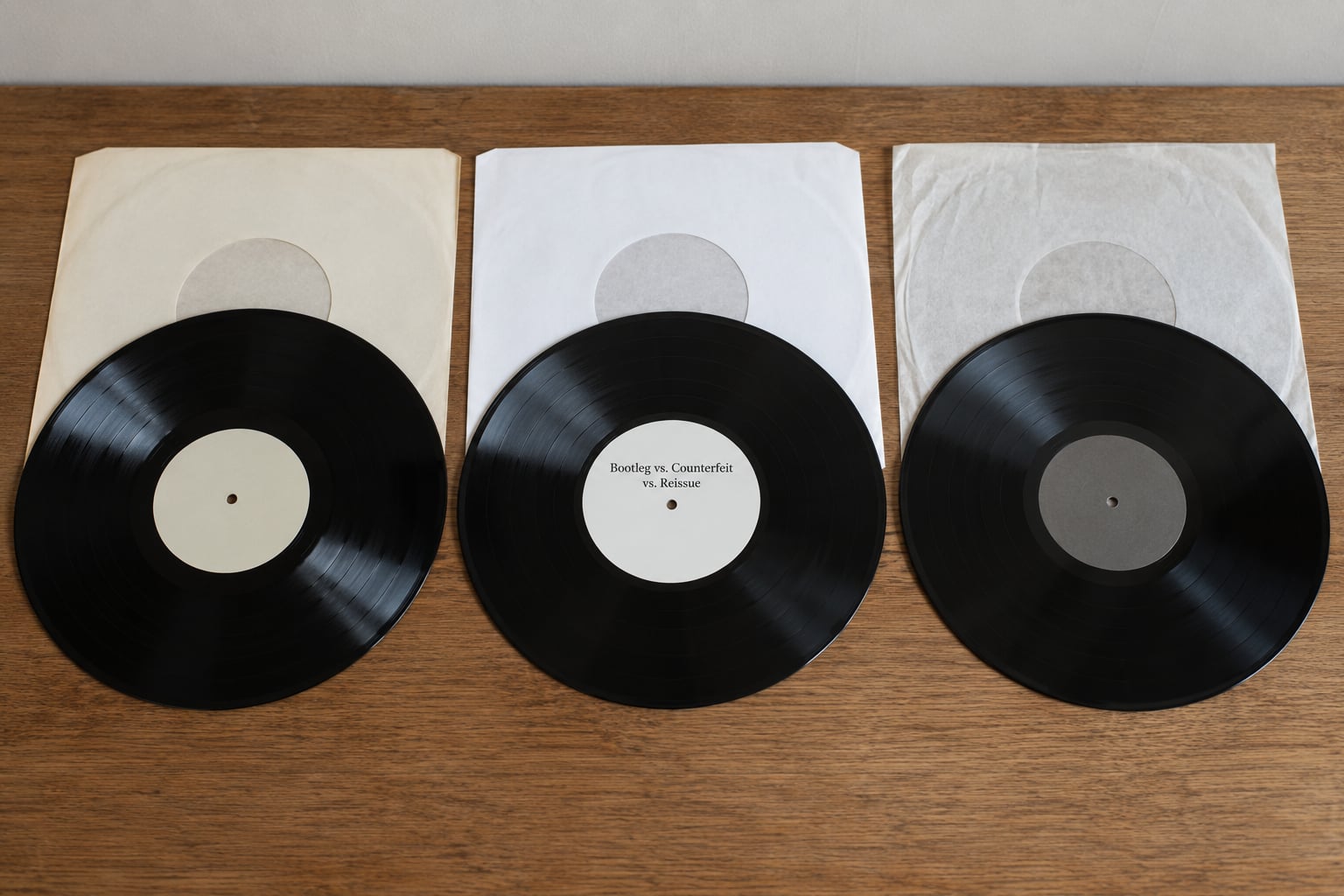
Most confusion at record fairs comes from four categories being treated as the same thing. They are not. A bootleg carries real music without permission, a counterfeit imitates a genuine release that does exist, a reissue is authorized but newly manufactured, and an import is simply an authorized pressing released in another territory.
| Category | Authorization | Why it was made | Packaging | Collector view |
|---|---|---|---|---|
| Bootleg | None | Performance or material the label never released | Blank or homemade label, plain sleeve, sometimes rubber-stamped | Historically interesting, quality varies wildly |
| Counterfeit | None | To imitate and pass off a genuine release | Copies the real artwork, often down to the runout | Worthless, occasionally criminal to sell |
| Authorized reissue | Full | To meet renewed demand for an old catalogue title | Official sleeve, new catalogue number or reissue suffix | Legitimate, valued for mastering and condition |
| Import | Full, in another region | Released for a specific country’s market | Original artwork with regional catalogue number and licensing text | Legitimate, premium depends on scarcity |
The same song can exist in all four forms. Take a 1968 album track that later appeared on an official compilation: the authorized reissue is documented in the discography, an import pressing of the compilation is legitimate in its home territory, a counterfeit copies the sleeve artwork to fool buyers, and a bootleg of the original album gives you a track that most fans never heard.
One practical test separates counterfeit from bootleg. If the record claims to be something official that you know exists, and the artwork, catalogue number and runout are all copied carefully, you are looking at a counterfeit. If the record has no real catalogue identity at all and openly looks homemade, you are probably looking at a bootleg.
What Is a Bootleg Record in Listing Terms?
Marketplace language is inconsistent, and sellers know it. Asking “what is a bootleg record” in a listing title gets you everything from a genuine 1970s tape transcription to a burned CD with a scanned cover pasted on the front.
- Live import – a description chosen to avoid the word bootleg. It may describe a real authorized pressing released abroad, so check the catalogue number.
- ROIR – Recording of Indeterminate Origin. The audio is real, the source is unverified.
- Trademark of Quality, or TMOQ – a blank label with no company name. The label design belongs to no one, which is why it appears on so many different unofficial records.
- White label – a plain white test pressing, normally with a catalogue number that does not match an official release.
- Test pressing – a pre-release copy made to check the cut. Genuine ones usually have a specific number struck into the runout.
- Promo – a promotional copy sent to radio or reviewers. Sometimes official, sometimes not, and often the only legitimate way to obtain a track.
- Dub – a mixing style, not a bootleg category. It tells you how the audio was treated, not whether it was authorized.
- Repress – a new pressing of an existing edition, authorized or not.
- Pirate copy – usually mass-manufactured reproductions sold commercially, a close cousin of the counterfeit.
Forum regulars are blunt about the euphemisms. The advice that comes up again and again at record fairs is simple: if a seller will not say the word bootleg out loud, assume it and ask directly.
How to Tell If a Record Is a Bootleg
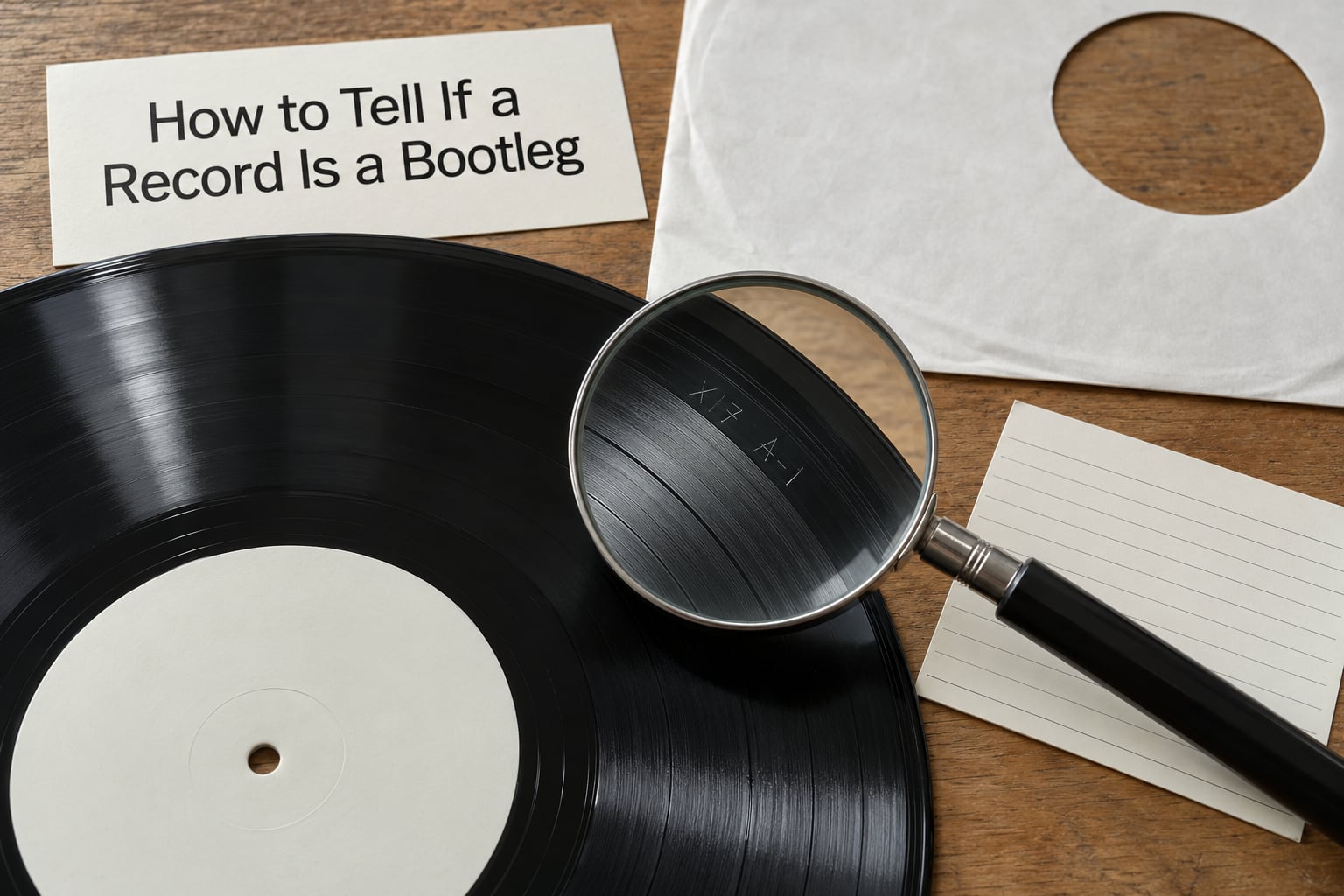
You can spot most bootlegs in about five minutes if you know where to look. Work through the disc first, then the paperwork, then the research. Most counterfeits fail at the last step, because the runout and catalogue data do not match anything in the official discography.
Check the disc in your hands
- Look for a catalogue number. Official records have one on the label, the sleeve or both. Bootlegs often have none, or a number that belongs to nothing.
- Read the label design. Blank labels, unprinted paper, or a hand-typed sticker all point one way.
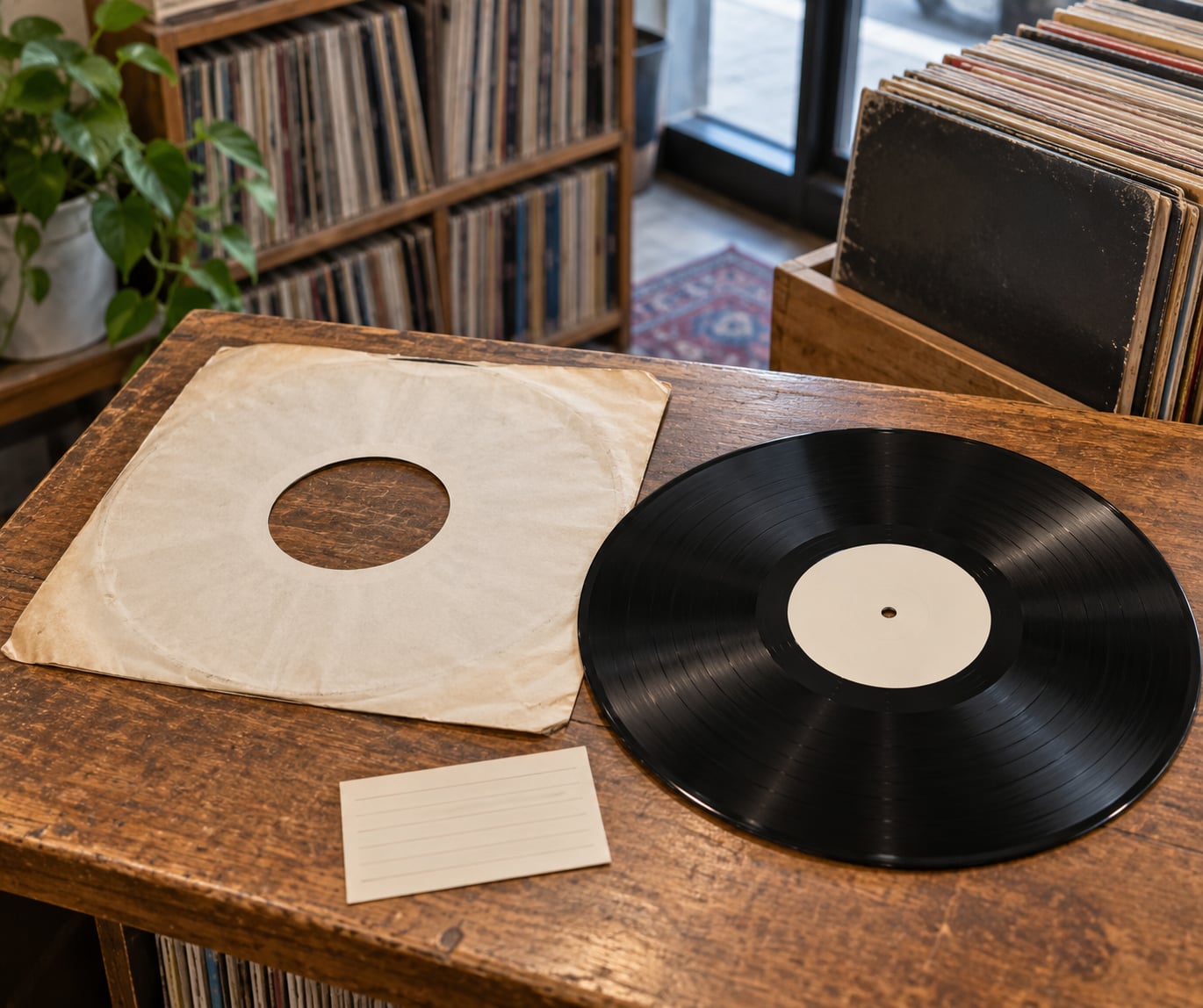
- Inspect the runout, the etched area near the label edge, with a light at the right angle. Genuine pressings carry a matrix number. A smooth or featureless runout is a warning sign.
- Note the weight and the vinyl colour. Heavy 180-gram pressings and coloured or splatter vinyl have become common in the modern bootleg trade, so neither proves anything on its own.
- Look at the sleeve. A rubber-stamped title, a photocopied cover or a paper insert instead of a printed inner sleeve is a classic sign.
- Check the track list. Bootlegs often include dates, venues and discographic detail that official releases leave out.
Research the release before you buy
Take the catalogue number or track list and search it against a discography database. If the release does not appear in the artist’s official catalogue, or if the matrix does not appear in the runout listings, you have your answer. Discogs entries are community-maintained, so cross-check anything that matters against a second source such as the artist’s own discography or a reference book.
Compare listings and watch the wording
Search for the exact track list and look at how other sellers describe the same record. If most listings call it a bootleg and one calls it a “limited edition pressing”, ask what makes it limited and which company made it. If the listing mentions a country of manufacture but no licensing text or rights holder, treat that as ordinary import wording rather than proof of anything.
One warning deserves repeating, because collectors get burned on it repeatedly. A well-made counterfeit can pass a casual look entirely. Copy sleeves have gone from photocopies to scanned high-resolution prints, and runout etchings are replicated. Treat the word bootleg, not the packaging, as your evidence.
What Are the Most Common Types of Bootleg Records?
Live recordings make up the bulk of what circulates, but they are not the only category. Knowing which type you are holding tells you what to expect from the sound and how much collectors will care.
- Audience recordings – taped from a seat in the venue. Honest, sometimes wonderful, frequently marred by crowd noise and dropped levels.
- Soundboard and broadcast recordings – taken from the mixing desk or off a radio feed. Cleaner, closer, and the ones most sought after.
- Unreleased studio material – outtakes, demos and early versions. Highly prized because there is no other way to hear them.
- Test pressings and promos – pre-release copies, sometimes genuinely official and sometimes not.
- Limited artist issues – small runs put out by bands themselves, sometimes as an unofficial favour for fans.
- Dub and cassette transfers – sourced from cassettes, DATs or files rather than the original tape, which is where modern quality problems usually start.
- Counterfeit and reproduction editions – commercial copies of genuine releases, which are a legal problem rather than a collector category.
Sound source decides quality more than anything else. A mixing desk feed, then a broadcast recording, then a well-placed audience tape, then anything sourced from a lossy file. Forum posters who compare the same show across sources usually reach the same conclusion: the popular “def sounds better on mp3 than on the bootleg vinyl” complaint is almost always about the transfer, not the pressing.
How Much Is a Bootleg Record Worth?
There is no fixed price guide for bootleg records, and anyone selling you one with confidence in a single number is guessing. Value moves with a handful of variables instead.
Age and scarcity come first. A hand-numbered 1972 tape of a small venue show with a documented source is a different object from an unnamed 2010s pressing of the same band. Documentation is the second variable: a copy with a known board operator, a verifiable date and a matching matrix runout will always be easier to resell than an anonymous one.
Recording quality, condition and artist demand do the rest of the work. Colour vinyl, clean sleeves and an intact inner sleeve raise interest in the modern trade, though they tell you nothing about the audio. And collector taste shifts: material that was common in the tape-trading era can be unremarkable now, while the same performance in a documented pressing can draw a crowd.
Two warnings fit here. A cheap record is not automatically genuine, and an expensive one is not automatically rare. Sellers at fairs will happily price an unofficial pressing like an original pressing because nobody corrected them.
Are Bootleg Records Legal to Buy?
This is general information, not legal advice, and the law varies by country and changes over time. The practical answer is that owning a physical bootleg in the United States is treated very differently from making, selling or importing copies.
In the United States, unauthorized copies are generally infringing works. Federal law covers the recording, the performance, the artwork and the composition, and an infringing copy can be seized and destroyed in an enforcement action. Collecting is not the same activity as distributing, and enforcement has historically focused overwhelmingly on people who copy and sell rather than on private collections.
Importing is the riskiest area for ordinary buyers. Packages arriving from overseas have historically been inspected, and imported infringing items may be detained at the border. Selling bootlegs exposes you to a different set of problems, including commercial-scale copyright claims and, for counterfeiters, criminal liability.
If you want material that no label will release, look for artists who publish it themselves. Several acts now release archival or tape-trading material officially, sometimes under open licences that allow anyone to press it. That route gives you the performance without the legal grey area.
Frequently Asked Questions
Is a bootleg record illegal to buy in the US?
Generally, owning a physical bootleg is not something buyers are prosecuted over in the United States. The risk sits with making, selling and importing copies, where federal copyright law applies to the recording, the performance and the artwork. Rules differ by country and change over time, so treat this as general information rather than legal advice.
How can I tell whether a vinyl record is a bootleg?
Start with the label and sleeve, then check the runout etchings with a light held at an angle. Official pressings carry a catalogue number and a matrix number, and searchable discography entries list the matrix. Blank labels, rubber-stamped covers, photocopied artwork, no catalogue number and a featureless runout are the classic warning signs.
What is the difference between a bootleg and a counterfeit record?
A bootleg carries real music that nobody authorized, usually unreleased live material or outtakes, and does not pretend to be an official release. A counterfeit imitates a genuine commercial edition, copying the artwork, catalogue number and sometimes the runout so it can be passed off as the real thing. One is unauthorized material, the other is fraud.
Are bootleg records worth collecting?
They can be. For performances no label ever released, a documented bootleg may be the only copy in existence, and the tape-trading era leaves behind genuinely scarce objects. The catch is quality and honesty: bad transfers, flimsy packaging and unclear provenance frustrate collectors who feel they paid too much for a photocopy.
Are bootleg vinyls good quality?
It depends entirely on the source. A mixing desk feed usually sounds better than a radio broadcast, which beats a well-placed audience tape, and anything cut from a lossy file will disappoint. Modern pressings can be thick, coloured or well-mastered, so heavy vinyl and pretty packaging tell you nothing about how the recording sounds.
Can an official reissue be confused with a bootleg?
Rarely, if you know what you are looking at. An authorized reissue carries an official sleeve, a documented catalogue number and matrix runout, and licensing text on the packaging. Imports also look legitimate and carry a regional catalogue number. If those details are missing or untraceable, it is not a reissue, whatever the listing says.
Bottom Line: Identify Before You Collect
Start by treating the packaging as a lead, not a verdict. Read the label, find the catalogue number, look for matrix runout etchings with a light at the right angle, and note anything odd about the sleeve.
Then check it against the artist’s official discography. If the catalogue number and matrix do not appear anywhere, or the listing’s description dodges the word bootleg, assume it is unofficial until proven otherwise. Ask sellers to say plainly what the record is, and cross-check Discogs against a second source for anything you care about.
Treat unusually cheap records and unusually expensive claims with the same suspicion. Cheap can mean a bad transfer or a counterfeit; expensive can mean the seller thinks it is an original pressing. Where a performance matters and no official release exists, look for the artists who publish their own archival material now. That gives you the recording without the legal grey area.