Record Store Day is a twice-yearly celebration of independent record stores, held on the third Saturday of every April and again on Black Friday in November. Record labels press limited runs of vinyl, CD and cassette editions exclusively for the event, and participating shops sell them in person, in store, on the day.
Chris Brown, the co-founder who ran Bull Moose Music in San Jose, has said the idea was never really about the records. It was about getting people through the door of their local record shop on a day when the shop could not possibly lose money. That framing explains almost everything about how the event works, from the queue outside a big store to the store-wide discount that runs all weekend.
Whether you are a collector chasing coloured pressings or someone who has just bought a first turntable, this guide covers what happens, how the exclusive releases work, why independent shops care so much, and how to plan a visit that is actually worth your Saturday.
Table of Contents
- What Is Record Store Day?
- How Did Record Store Day Begin?
- Why Do People Celebrate Record Store Day?
- Is Record Store Day legit? The criticism, explained
- What Happens During Record Store Day?
- Store hours, queues and lotteries
- What stores actually do on the day
- How Do You Find a Record Store Day Event?
- What Is Usually Released for Record Store Day?
- How Can You Get the Best Deals and Rarest Records?
- Decide whether you want the line or the music
- Know the store’s policy before you queue
- Bring cash and a short wish list
- Try the smaller participating shop
- Watch what arrives after the rush
- Record Store Day and Independent Record Stores
- What happens to copies nobody buys
- Frequently Asked Questions
- Is every record release available on Record Store Day?
- Why are Record Store Day records sometimes sold out?
- Do I need to buy anything at the record store to attend?
- Can I order Record Store Day releases online?
- Are Record Store Day releases collectible?
- What should I do if I miss an event or a release?
- Conclusion
What Is Record Store Day?
In plain terms: Record Store Day is an annual worldwide event created to celebrate the culture and community of independently owned brick-and-mortar record stores, centred on the third Saturday in April, with a second round of releases and store-wide discounts on Black Friday in November.
The key features of the event are the same handful of points the official site leads with, and they explain nearly every question people ask about it.
- Exclusive releases. Limited-edition pressings that exist only as Record Store Day editions, sold by participating shops and generally nowhere else.
- No pre-orders and no holds. Titles are sold in person on the day of the event, not reserved online in advance.
- In-store events. Performances, DJ sets, signings, meet-and-greets and store-wide discounts run on the day, decided by each shop.
- When it happens. Third Saturday of April, plus a Black Friday edition in late November.
- A named ambassador. Each year the event appoints an artist or music figure as Record Store Day Ambassador to promote it.
The rest of the basics fit into one short table.
| Fact | Detail |
|---|---|
| First held | 2008 |
| Main date | Third Saturday of April |
| Second date | Black Friday, late November |
| Co-founders | Chris Brown of Bull Moose Music and Eric Levin of Forced Exposure |
| Inspiration | Free Comic Book Day, which used a similar one-day indie-shop model |
| What’s sold | Vinyl, CD and cassette editions pressed for participating stores |
| Who runs local events | Each participating shop plans its own schedule |
| Related events | Black Friday edition, and later RSD Drops for missed titles |
How Did Record Store Day Begin?
Record Store Day started in 2008 as a response to how music had shifted. By then most listening happened through laptops and downloads, and the shops that had spent decades teaching people what to buy were quietly disappearing.
Chris Brown, who ran Bull Moose Music in California, and Eric Levin of the independent music retailer Forced Exposure came up with the idea separately and then together. Brown had studied Free Comic Book Day, which had solved a comparable problem for comic shops by creating a single annual day when the marginal customer shows up in force, and the two record men adapted the model.
The first event was held in 2008 with around 20 stores, and Metallica kicked things off with a performance at Rasputin Music in San Jose. The idea spread slowly at first because labels had to be convinced to press special editions for a single Saturday. Once they saw that the runs sold, the catalogue grew fast.
Today the April event runs across thousands of shops in dozens of countries, and it has grown into a weekend rather than a day. In the UK, for example, the 2026 celebration ran on Saturday 18 April with the country’s own release list, showing how the format travelled without losing its local character.
Why Do People Celebrate Record Store Day?
People show up because it is one of the few days when a physical record shop becomes an event, and because the releases on offer genuinely are not available anywhere else.
The vinyl revival is real money. If you want to understand why independent record stores care about a single Saturday in April, look at what streaming pays an artist versus what a limited LP sells for in a shop window. Record Store Day editions have repeatedly produced record-breaking weeks for the vinyl LP format, and that kind of concentrated demand is what keeps a small shop’s books balanced. Vinyl collecting has moved from a niche of older enthusiasts into something ordinary fans plan a budget around.
Then there is the atmosphere. In-store performances turn a shop into a small venue for a few hours, and it is normal to see an artist playing to 60 people standing between the jazz and the new arrivals section. Collectors say the queue itself has become part of the ritual, and community threads for individual cities regularly fill up with people reporting where it was packed and where it was calm.
Is Record Store Day legit? The criticism, explained
Yes, the event is legitimate and it does benefit independent shops, but it draws real criticism, and the complaints are worth taking seriously rather than dismissing.
The most common objection is that exclusives often feel like objects rather than music. Collectors point to limited editions of songs they already own, or variants that add a poster rather than a track. Brown’s own account undercuts the romantic version somewhat: people assume Record Store Day is about the records, when his stated aim was promoting the stores that sell them. If you are buying an edition because you love the record, you will rarely regret it. If you are buying purely to tick a box, you might.
The second objection is about who profits. Independent music shops feel that the culture of the celebration is increasingly borrowed by large labels, and that participation in the world’s biggest indie celebration looks less like independence the longer it goes on. You will hear the same criticism levelled at bookshops that run their own annual promotions.
The third is pricing. Exclusive editions are routinely resold online within hours at several times their original price, which feels like a fix to a shortage that was created on purpose. Whether that is cynical depends on why the run was short in the first place, which brings us to how the economics actually work.
What Happens During Record Store Day?
Participating stores typically open early, hold the queue on the pavement or in a side room, and bring the exclusive titles to the front as soon as doors open. Everything after that depends on the shop.
Store hours, queues and lotteries
Big stores in cities can have a queue before sunrise. One first-time collector in Denver described weighing whether to turn up at 8am at Wax Trax and Twist & Shout, or skip the crush and browse when it thinned out, and settled on arriving late because the day is no fun if you cannot dig through crates.
For high-demand titles, many shops run a lottery or a ticket system instead of a free-for-all scramble. That has become normal enough that collectors describe it as the fair method: you put your name in, you find out later that day or the next, and nobody gets trampled. Other shops set a purchase limit, usually one or two per person on the scarce titles, so the first people in the door cannot empty a stack.
Nobody has to buy anything to attend. Performances and signings are free, and a shop will happily let you stand and watch an artist play even if you leave with nothing.
What stores actually do on the day
Beyond the exclusive titles, stores run their own programming: live sets, DJ sets, album signings and meet-and-greets with artists who happen to be local, plus discounts that are entirely up to the owner. Some collectors skip the exclusives altogether and come for a store-wide sale instead, with one citing 15% off all inventory. Smaller shops often put on better events than the big city ones, and reviewers consistently report friendly staff and a relaxed atmosphere at independent shops on the day.
Photos and live posts from the day tend to show the same thing everywhere: a short queue outside, a rush in the first hour for the top title, and then an ordinary busy shop with better foot traffic than a normal Saturday.
How Do You Find a Record Store Day Event?
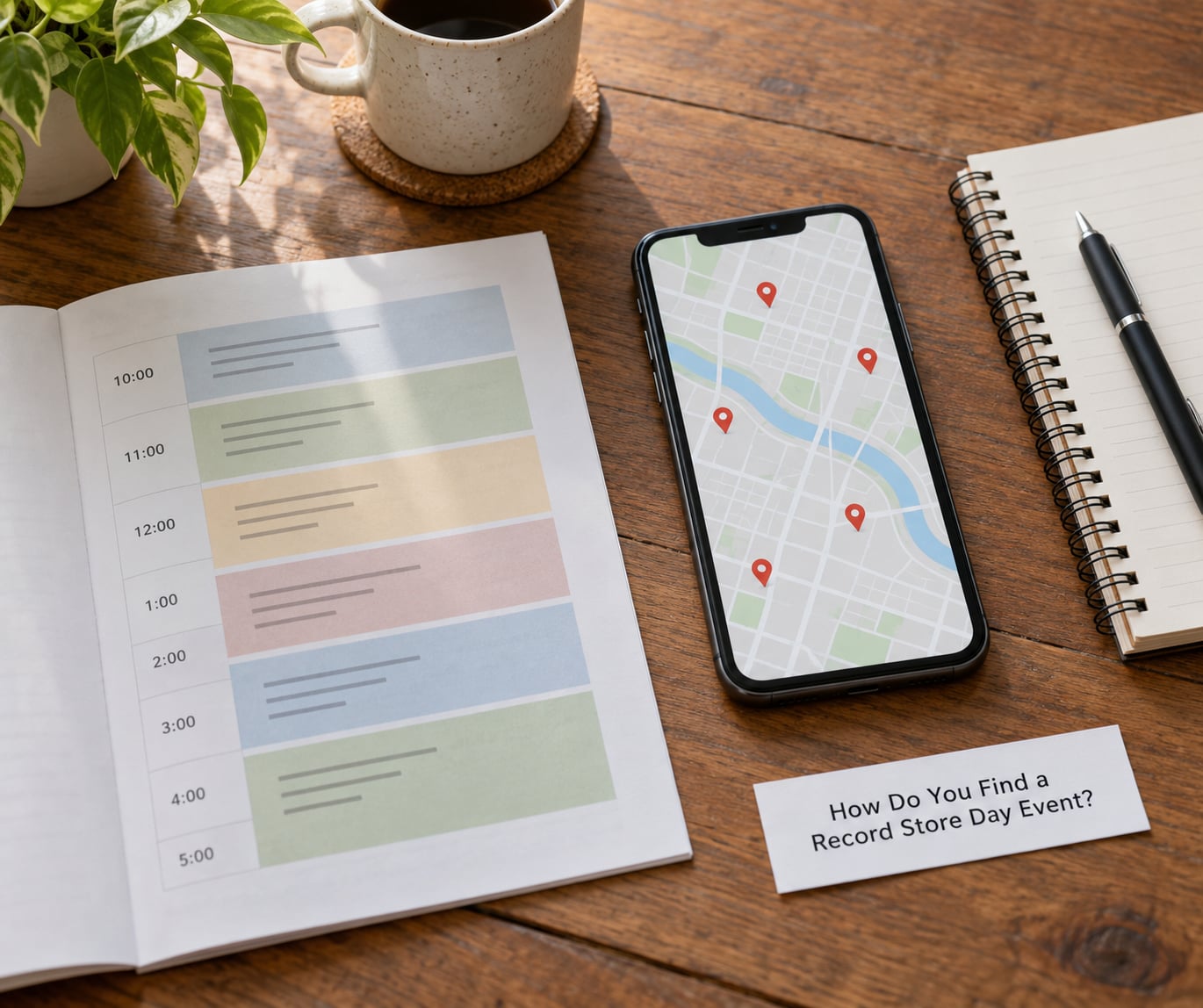
Use the official Record Store Day site. It runs a store locator and a full release list, both filtered by country, and that pair of pages answers almost every practical question.
Start with the store locator. Enter your city or postcode, look at how many shops within a reasonable travel distance are participating, and note which ones are close enough to visit more than one. Then open each store’s listing, because the event details live there rather than on the central page.
Individual listings usually confirm opening time, whether a performance is happening, whether a purchase limit applies, and sometimes whether a lottery will run. Check them a week before and again the morning of the event, since shops update their own pages and often post changes to social accounts only.
If a shop is not in the locator on the official site, it is not an official participant, and anything it sells claiming to be a Record Store Day exclusive deserves scepticism. There is more on that below.
What Is Usually Released for Record Store Day?
Most releases are vinyl, with a smaller number of CD and cassette editions. The common formats are these:
- Limited-edition LPs. Standard albums pressed for the event, often on coloured or heavier vinyl with a gatefold sleeve and an insert.
- 7-inch singles. The classic souvenir format, usually a track that was unavailable elsewhere that year.
- Picture discs and shaped vinyl. Novelty pressings that are more display piece than listening piece, often bought for the wall.
- Live recordings. Recorded at a show and cut to vinyl for the day, which is where good box sets tend to come from.
- Reissues and first vinyl pressings. Albums that have never had a proper LP edition, or anniversary reissues with restored artwork.
- Artist or label-specific editions. Some record labels build a full event out of their own catalogue, so an RSD browse can double as a deep dive into one imprint.
The common thread is exclusivity. An edition that later shows up in ordinary shops is not really an RSD exclusive, and it is not the edition the rules protect. That is why genuine event titles cannot be pre-ordered or held for later collection.
How Can You Get the Best Deals and Rarest Records?
A bit of preparation beats a long queue. Here is what works for people going for the first time.
Decide whether you want the line or the music
If you are chasing two specific releases, get there early and accept that you will not browse. If you want to hear something, talk to someone or just enjoy a record shop on its best day, arrive around ten and skip the crush entirely. Both are good days to have. Plenty of collectors treat the day as a shop browse with a side of exclusives.
Know the store’s policy before you queue
Look for a purchase limit, a lottery notice or a door schedule on the store’s listing or social account. If a lottery is running, your place in the line means nothing and you would rather know that at 8am than at noon.
Bring cash and a short wish list
Small shops often have limited card facilities when queues and crowds arrive at once, and a wish list keeps you from buying a duplicate. Rank your targets before you go so that when the good stuff comes out, you know instantly whether it matters to you.
Try the smaller participating shop
The biggest box queue is rarely the best place to shop. A town just outside the city may have the same release list, a far shorter line, a better in-store performance and staff with time to pull things for you. Expanding your radius by fifteen minutes is the single easiest way to avoid the worst of it.
Watch what arrives after the rush
Not everything disappears in the first hour. Second-tier titles and catalogue reissues often appear later, and once the initial frenzy passes, browsing becomes possible again and prices occasionally soften on the secondary market.
Record Store Day and Independent Record Stores
The reason the exclusives are limited is not mysterious, and once you understand it the sell-outs make sense.
Participating shops order the special editions on a no-return basis. Whatever a store fails to sell is a straight loss, not something that can be sent back to the distributor. Small independent retailers work on thin margins already, so an event that could cost a shop thousands of unsold units is a genuine gamble, and the practical result is that many stores deliberately order fewer copies than they could sell.
That is the mechanism behind the frustrating scenes outside big stores. The run was small, the demand was huge, and the arithmetic was decided months before anyone joined the queue. It is also why collectors discount the idea that stores are deliberately hoarding copies to resell them later; the economics make hoarding pointless.
What happens to copies nobody buys
Unsold titles usually reappear at the Black Friday edition in November, often alongside extra store-wide discounts. In the pandemic years the organisers also introduced RSD Drops, a window in which missed titles became available again outside the main event so that people who missed out or could not travel had a second chance.
Beyond the sales figures, the event gives independent shops an annual reason to become a destination rather than a transaction. Performances, queues and press attention turn a retail space into a community event for a few hours, and that kind of visibility is harder to buy than advertising. For a lot of independent record stores, it is the one day of the year when the local paper sends a photographer.
The wider revival in vinyl is what made the event possible in the first place, and the event feeds it. Collectors who start with an RSD exclusive often end up buying the original album, then the reissue, then the boxed set.
Frequently Asked Questions
Is every record release available on Record Store Day?
No. Record Store Day editions are specially pressed items sold only by official participating stores, usually alongside ordinary new releases but never instead of them. Most standard albums and singles are still available through normal shops and online retailers on the same day. The event-specific titles are the limited LPs, 7-inch singles, picture discs and cassette editions on the official release list.
Why are Record Store Day records sometimes sold out?
Because the editions are genuinely limited and shops order them on a no-return basis, meaning any copies they fail to sell cost them money. Many independent stores deliberately order below the demand they expect, which protects them from a large loss. Add a queue that forms before sunrise and the most sought-after titles are gone within the first hour, sometimes before most people reach the counter.
Do I need to buy anything at the record store to attend?
No. Performances, DJ sets, signings and meet-and-greets are free, and plenty of people spend the morning listening before buying anything. You do not need a ticket for the event itself, though a very small number of shops hold informal lotteries for scarce titles rather than selling them first come, first served.
Can I order Record Store Day releases online?
Officially, no. The whole point of the format is that the editions are sold in person at participating stores on the day, with no pre-orders and no holds. You will find listings online for supposed RSD titles, but these are usually re-listings, reissues or counterfeits rather than genuine event exclusives. If a pressing is not on the official release list, treat the online copy with suspicion.
Are Record Store Day releases collectible?
They can be, but not automatically. A limited edition appreciates when the artist is established, the run was small, and the pressing is genuinely exclusive to the event. Picture discs and anniversary variants often sell for more than a standard album and play less well. Buy the record because you want to hear it, and the collectible side is a bonus rather than a plan.
What should I do if I miss an event or a release?
Check the official site for RSD Drops, which release missed titles in a later window, and come back for the Black Friday edition in November when stores discount their remaining event stock. Local shops also often sell leftovers quietly in the following weeks. Tracking tools and community sites built by collectors are useful for spotting re-listings, though prices there are usually well above the original.
Conclusion
Record Store Day is a day when a record shop stops being a shop for a few hours and becomes the reason people leave the house. The releases are genuinely exclusive, the performances are free, and the queue outside the famous stores is mostly avoidable if you would rather dig through records than sprint for a coloured pressing.
Start with the official store locator, pick two shops within reach rather than one famous one, and read each shop’s own listing for opening time and purchase limits before you travel. Then decide whether you are queuing or browsing, bring cash, and rank your targets before the doors open.
2026‘s main event falls on the third Saturday in April, with the Black Friday edition in late November if the exclusives are not for you this time around.