A vinyl subscription box is a recurring mail-order service that sends you records chosen around a genre, an era, a theme, or a discovery level, on a fixed schedule with a set monthly price. How vinyl subscription boxes work in practice is simpler than the marketing makes it sound: you pick a service and a genre profile, they select from their catalogue, and the box lands on a predictable date. The interesting part is what happens between signup and the mailer.
I’ve read enough subscription fine print to know where people get disappointed, and it is almost never the music. It’s the cutoff date they missed, the discount-condition record nobody warned them about, or the sixth month of an “exclusive” pressing that turns out to be a reissue with a sticker. This guide walks the full cycle, then tells you who should sign up and who should just buy a record on Saturday.
Everything here was checked against what services actually publish, updated for 2026. Pricing tiers change constantly, so treat any structure I describe as a shape rather than a quote.
Table of Contents
- How Vinyl Subscription Boxes Work
- What Is Inside a Vinyl Subscription Box?
- How many records come in a box
- What the extras add
- How Vinyl Subscription Companies Choose Records
- What a curator learns from your profile
- How Vinyl Records Are Graded and Protected
- What VG, EX and NM actually mean
- What to Look for Before Joining
- The pre-signup checklist
- How Much Do Vinyl Subscription Boxes Cost?
- Are Vinyl Subscription Boxes Worth It for Collectors?
- Who gets the most out of one
- Who should skip it
- Frequently Asked Questions
- Do I get to choose the records in a vinyl subscription box?
- How often do vinyl subscription boxes arrive?
- Can I pause or cancel a vinyl record subscription?
- Are vinyl subscription boxes suitable for punk and rockabilly fans?
- What happens if my vinyl record arrives damaged?
- Are limited-edition vinyl subscription boxes more expensive?
- Where to Start With a Vinyl Subscription
How Vinyl Subscription Boxes Work
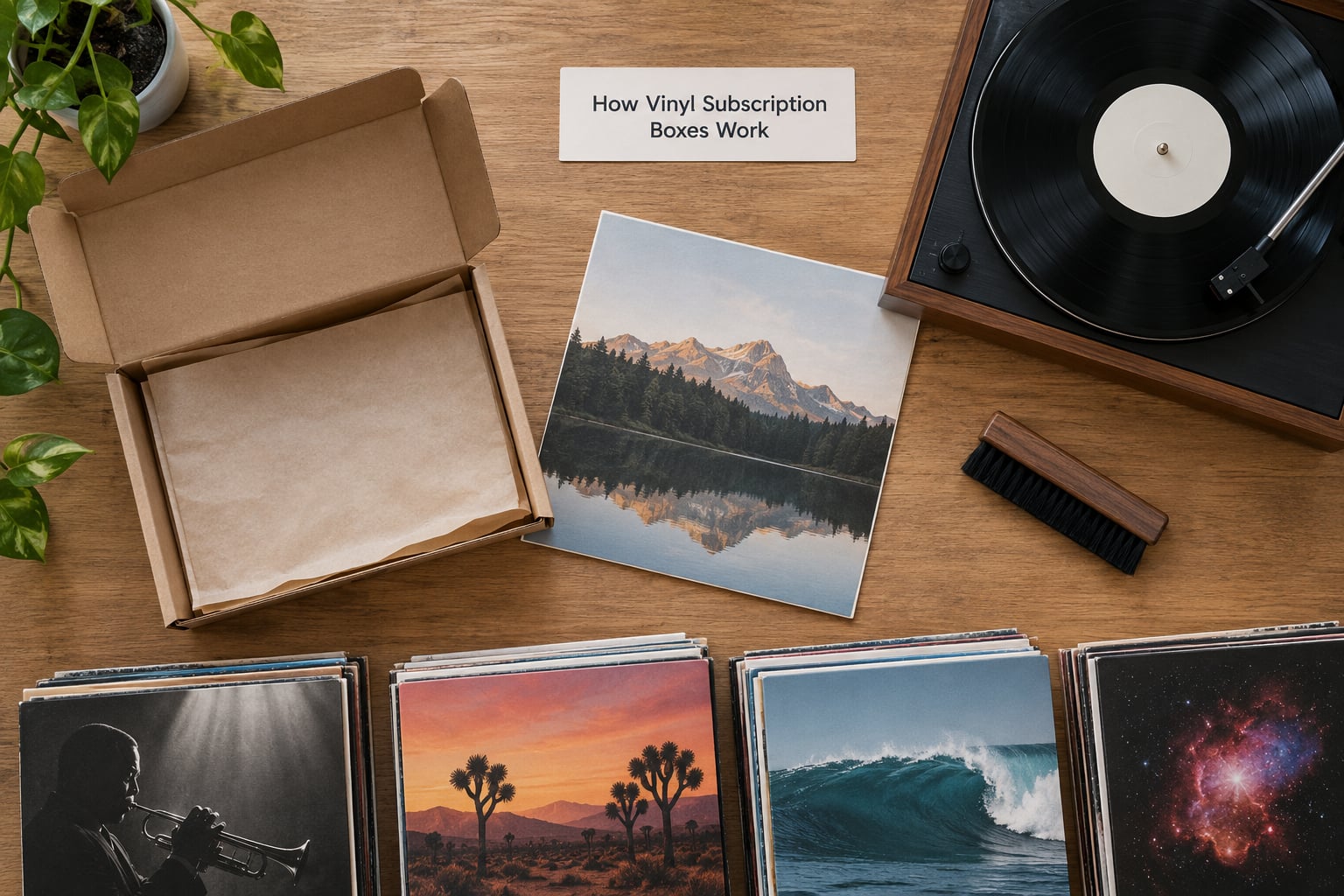
At its core, a vinyl subscription box works in seven steps, repeated every month: choose a service and tier, set your genre or listening profile, pay on a billing cycle, hit the cutoff date for swaps or skips, wait for the selection window to close, receive the box, then rate or skip for the next cycle. Every service does it slightly differently, but the loop is always the same.
- Sign up and pick a tier. You choose a genre track and a number of records per month, then pay. Most services sell monthly, three-month, six-month or twelve-month commitments rather than a rolling monthly plan.
- Build your profile. Some services ask you to rate artists, others grant read access to your Spotify or Discogs lists so curation is based on what you already play.
- Meet the cutoff date. This is the deadline for swapping a record, skipping a month, or changing your genre track. Miss it and the selection is locked.
- Selection closes. A curator or an algorithm picks the month’s titles from the catalogue, cross-checking what you have already received.
- Packing. Records are inspected, sleeved, inserted with notes or extras, and packed into a rigid mailer with stiffeners.
- Delivery. The box arrives on the service’s schedule, usually in the first or second week of the billing month.
- Renew or exit. Your account rolls to the next cycle unless you skip, pause, or cancel before the next cutoff.
One thing worth internalizing: the cutoff date, not the shipping date, is the deadline that matters. Almost every mistake people make with a subscription comes from treating it like an online order they can edit right up until delivery.
What Is Inside a Vinyl Subscription Box?
A box usually contains one to three records, and the record count is set by the tier you bought rather than by chance. A single-record tier sends one LP or one 12-inch single. Mid tiers send two. Premium tiers commonly send three, and some run four on a limited-edition track.
How many records come in a box
The common middle of the market is one LP a month. That is the format most people describe when they say “a record subscription,” and it is the model several shop-backed services use, where the record comes out of the same stock the shop sells over the counter.
Bigger boxes usually mix formats. You might get a reissue, a single, and a bonus 7-inch, or a full box set in place of a single album. Niche genre services often run one record because their catalogue is small and the margins are thin.
What the extras add
Most boxes add some context beyond the record itself. Common extras include sleeve notes or a card explaining why the curator picked the title, catalog number and pressing details, a digital mixtape or playlist, and a genre or era write-up.
Higher tiers add physical extras: posters, cleaning supplies, inner sleeves, download codes, or an interview with the artist. A few services include a turntable mat or a slipmat. The extras are marketing as much as product, but a good curator note genuinely improves the record: knowing why a pressing matters changes how you listen to it.
Some services ship the digital portion first, a few days or weeks before the physical box, so you can queue it up while you wait.
How Vinyl Subscription Companies Choose Records
Record selection is the part of the business that decides whether a subscription feels like a record store run by someone who knows music or like a warehouse clearing inventory. A credible service picks a defined niche first, sources titles from a real channel, checks physical condition, and then explains the pick in writing.
What a curator learns from your profile
Services gather preferences in three common ways. Genre tracks simply ask you to pick from a menu: rock and garage, punk and hardcore, jazz, blues, soul and funk, hip-hop, country, electronic, world, or classical.
Rating systems ask you to score artists and albums so the selection narrows over time. Connective models go furthest: a commenter on r/vinyl described one service where you supply a genre list and can grant the curator read access to your Spotify lists and Discogs collection, which is how the picks get personal enough to feel less random.
Either way, an r/vinyl thread on mystery-box services put it bluntly: when the picks are truly random, the service becomes a lottery rather than a recommendation engine. Ask any service what it actually uses to choose before you pay for a year.
After selection comes sourcing, and there are four routes. The first is in-house stock, where a shop-backed service pulls the same titles it sells across the counter. The second is a distributor relationship, buying standard catalog. The third is an exclusive pressing commissioned for members, which is the format’s genuine appeal for collectors. The fourth is used trade-ins, where titles are bought in and graded before they go out.
Exclusive pressings deserve a note of caution. A Discogs forum thread debated whether a “club edition” tag on a subscription pressing signals a real exclusive or just a standard pressing in a printed sleeve. Some club editions are genuinely different cuts, weights, or gatefold packaging. Some are reissues with a sticker. Ask what is actually different before paying a premium for it.
The services with the best reputations tend to be narrowly scoped. One record store launched a subscription limited to ambient, drone, dub, electronics, krautrock, minimalism, free jazz and similar corners, and that kind of stated boundary tells you far more about the curation than a generic “all genres” claim does.
How Vinyl Records Are Graded and Protected
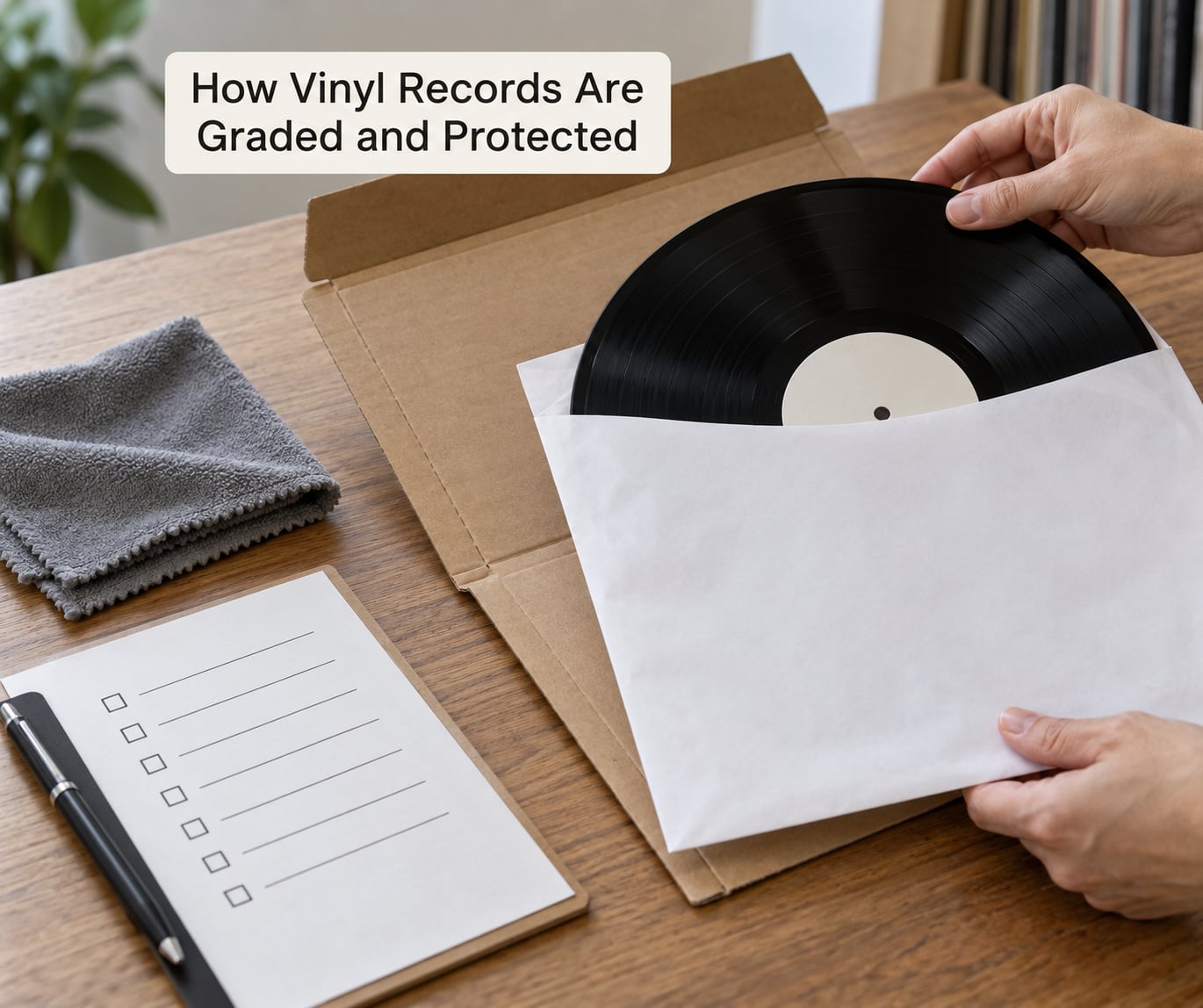
Condition is where subscription boxes and clean retail purchases differ most, because a box can arrive in a graded “discount” tier that would never be listed on a new pressing. Used-record shorthand like VG, EX and NM is not an official industry standard; it is seller shorthand that grew out of the secondhand trade, and the same letter can mean different things in different shops.
What VG, EX and NM actually mean
VG, or very good, means a played record with visible wear that does not overpower the music. Expect sleeve scuffs, light ring wear, maybe a small seam split at the spine. It plays, but it is not pristine.
EX, or excellent, is close to a clean copy with light signs of handling. NM, or near mint, is effectively unplayed, and it should be treated as a marketing term rather than a guarantee.
The honest read: any box promising near-mint used records should be believed only if it grades each copy individually and shows you the flaws. One well-reviewed service names its lower tier explicitly, disclosing corner bumps and sleeve discolouration in advance, and reviewers treat that candour as a reason to trust the higher tiers.
Beyond grading, protection is physical. Records travel sandwiched between stiff card stiffeners inside a rigid mailer with corner protection, outside any sleeve thin enough to split. Warping is the number one complaint, and it usually comes from a record packed tight against the outer box in hot weather rather than from the pressing itself. Seam splits on gatefold jackets are the second complaint, and those are almost always caused by a thin, unprotected mailer.
A 180g pressing is heavier and less prone to warping, which is one reason audiophile-oriented tiers mention weight and pressing quality rather than just album length.
What to Look for Before Joining
Most bad subscription experiences trace back to a term nobody read on the signup page. Work through this list before you enter a card number, and you will know within five minutes whether a service fits you.
The pre-signup checklist
- Genre fit. Does the catalogue match what you actually listen to, or is it a broad mix with a genre label attached?
- Record count and format. Confirm whether a “record” means an LP, a single, or sometimes either, and whether box sets count as one.
- Billing cadence. Some services only sell three-month or six-month commitments. Know the renewal date and the total before committing.
- Auto-renew rules. One widely praised detail in the roundup coverage is a membership that does not auto-renew. Plenty of others do, so find out which you have.
- Skip and swap windows. The cutoff date should be printed in your account, in writing, and it should be comfortably before delivery.
- Duplicate handling. Ask how they check against what you already own, and whether you can supply your Discogs username for matching.
- Condition disclosure. Discount tiers should be named and described, not buried.
- Shipping region. Check whether your country is served, and whether customs duties land on you. Outside the US and UK, this is the single most common reason a good service is a bad deal.
- Damage replacement policy. A record that arrives cracked should be replaced on a photo, not argued about.
- Shelf space. Twelve records a year adds up fast.
One more: check whether the service reads your streaming and collection data, and decide whether you are fine with that. It produces better picks and it hands over a genuine map of your taste.
How Much Do Vinyl Subscription Boxes Cost?
Subscription pricing has a shape rather than a number, and the shape is driven by how many records arrive and whether anyone pressed anything especially. Prices are typical US ranges that vary by region and change over time, so read the structure below and check the current figure on the service’s own page.
| Tier type | Typical contents | What drives the price | Who it suits |
|---|---|---|---|
| Single-record monthly | One LP or single, chosen from a broad genre menu | Standard catalog copies, minimal exclusivity | First-time collectors on a fixed budget |
| Curated multi-record | Two records, one often a single or bonus 7-inch | Handpicked titles, curator time, packing | Listeners who want variety and context |
| Niche genre track | One record from a narrow scene | Specialist sourcing, harder-to-find catalog | Punk, rockabilly, surf, garage and hardcore fans |
| Premium limited edition | One to three exclusive pressings | Exclusive cuts, heavier vinyl, colored variants, gatefold packaging | Collectors chasing club editions and variants |
| Label or store membership | Varies by tier, often with member-only extras | Label partnership, first access, back catalog | Fans of one artist roster who want first dibs |
What actually drives the price is straightforward: pressing exclusivity, record count, and how far the box travels. Exclusive pressings cost the label more per unit, small regional runs cost more per unit still, and international postage adds a real layer that a domestic subscriber never sees.
The number people should compute is cost per record, because a premium tier with three records can undercut a single-record tier on cost per record while costing more out of pocket. Two things cut that per-record number more than anything else: skipping months you will not listen to, and swapping out a record you already own. Both are free, and most people never open the swap screen.
Set against retail, the honest comparison is not “subscription versus record shop.” It is subscription versus the same titles bought on sale when they cycle back into stock. Subscriptions win on discovery and on access to pressings that skip the discount bin entirely.
Are Vinyl Subscription Boxes Worth It for Collectors?
Yes for a listener who wants a steady drip of music they would not have thought to buy, and no for a collector who already knows what they want. That is the whole verdict, and the rest is detail on both sides.
Who gets the most out of one
Discovery seekers are the clearest win. A box removes the decision, which is exactly what stops most people from buying the third record in a series they already own two of. If you listen to a lot but own a little, a subscription converts streaming habits into a physical library.
Narrow-genre fans benefit from dedicated tracks. Garage rock, punk, rockabilly and surf have catalogues deep enough that a specialist box beats a general one, and it beats a local shop in towns where those scenes get no shelf space.
Gift buyers get a reliable, non-awkward present that arrives on a schedule. People on a fixed budget like knowing the outlay is the same every month, which makes record spending easy to plan and hard to regret.
Long-term subscribers often point to limited editions as the reason they stayed. In a recent Blu-ray forum thread, one subscriber framed the value as being worth it specifically if you want limited editions and have the money for them. That is the clearest case for premium tiers.
And there is honest word from the other side too: an r/vinyl commenter described running a service for six months as a sort of trial, stopping, then restarting the next year because they genuinely enjoyed it. Intermittent enjoyment is the most realistic expectation. Nobody listens to every record a box delivers.
Who should skip it
Skip it if you have no turntable. Records are not a subscription you can hand to a streaming app, and boxes do not come with a deck.
Skip it if your collection is already deep and well matched. Duplicates become the main event, and one r/VinylMePlease poster found that after five months their interests were running thin against the catalogue. That fatigue is predictable, and it is not a fixable support ticket.
Skip it if shelf space is tight or the budget is tight. Twelve LPs a year is a shelf, a box of shipping weight, and a real number. If you are choosing between a subscription and a turntable with a built-in speaker, buy the turntable.
Skip it if you want a specific album this month. Mystery curation is not a weakness in every service, but it is a mismatch for anyone who has a list.
Frequently Asked Questions
Do I get to choose the records in a vinyl subscription box?
Usually not, and the answer depends on the model. Mystery box services choose everything. Genre-track and artist-curated services let you set broad preferences or rate artists, and a few let you choose one record per month from a shortlist. Connective services go the other way: you grant read access to your Spotify or Discogs lists so the curator can match titles to your actual taste.
How often do vinyl subscription boxes arrive?
Once a month in nearly every case, on a fixed schedule tied to your billing date rather than the calendar. Because the billing cycle often runs three, six or twelve months, most services stamp out a specific month ahead, which means your cutoff date for skipping or swapping can fall weeks before the box leaves. That gap is where most of the account mistakes happen.
Can I pause or cancel a vinyl record subscription?
In theory yes, in practice the terms decide how painful it is. Check three things before you sign up: whether the plan auto-renews, whether cancellation is available online or requires an email, and whether pausing is offered at all. Some memberships are sold as fixed multi-month commitments with no pause option, so cancellation means cancelling for the remainder of a block you have already paid for.
Are vinyl subscription boxes suitable for punk and rockabilly fans?
Yes, and those scenes are among the best served. Punk, rockabilly, surf and garage are deep enough that specialist tracks can source titles no local shop stocks, including reissues and label catalog that cycles in and out of print. Check the service’s stated genre boundary and whether its catalogue skews to compilations or original releases, since that varies a lot between the generalist and the specialist services.
What happens if my vinyl record arrives damaged?
Send photos of the packaging and the record to support before opening the box further, since carriers and mailers both matter to a claim. A credible service replaces a cracked or badly warped copy rather than offering store credit, and some will reship on a photo alone. This is also the practical test of a service’s condition standards: a firm replacement policy is a decent proxy for careful packing upstream.
Are limited-edition vinyl subscription boxes more expensive?
Almost always, and the gap is real rather than cosmetic. Exclusive pressings cost the label more per unit to manufacture, small runs push unit costs up further, and features like heavier vinyl, colored variants and gatefold packaging add more. Some Blu-ray.com forum subscribers said limited editions were the reason the subscription stayed worth it, so the premium tier has a clear audience if variants are what you collect.
Where to Start With a Vinyl Subscription
Pick two services and read them side by side: one affordable monthly option that pulls from standard catalog, and one curated or premium option with an exclusive pressing. Compare the record count, the cutoff date, the auto-renew terms, the condition tiers, and whether your country is served. Then choose the one whose genre scope matches how you actually listen, not the one with the biggest box.
Give it three months before judging it, and use the swap screen every time. That loop is the whole product: a filter over someone else’s catalogue, delivered monthly, priced so you never have to think about it. If the filter fits your taste, it is one of the easiest ways to build a record collection I know of. If it does not, cancel before the renewal date and buy records on your own terms.