Neither, automatically. A new receiver wins on measurement, connectivity, room correction and zero upkeep. A vintage receiver wins on phono stage quality, real tone controls, build weight and what you get per pound spent. Which one is right depends far more on the condition of the specific unit and the speakers behind it than on the year it was made.
That answer sounds tidy, and the rest of this guide explains why it holds up. Most people asking this question are vinyl collectors standing in front of a wall of used gear, wondering if a 1970s silver-face Marantz really beats the integrated amp they could buy new today. Sometimes it does. Plenty of the time it doesn’t, and the expensive lesson is usually learning that after buying.
The research behind this was pulled from enthusiast forums, service notes and published listening tests rather than spec sheets alone, and it’s current for 2026. No brand loyalty, no nostalgia discount, just what the difference actually is once you sit down and listen.
Table of Contents
- Are Vintage Receivers Better Than New Ones at a Glance?
- What Counts as a Vintage Audio Receiver?
- How Do Vintage and New Receivers Sound Different?
- Do vintage receivers actually sound better?
- Can a good vintage receiver beat a poor modern one?
- What actually changes the sound
- Which Is More Reliable: Vintage or New?
- Are Vintage Receivers Better for Vinyl?
- What Features and Connectivity Are You Missing?
- How Much Maintenance Does a Vintage Receiver Need?
- What Is the Better Value Over Time?
- Watch the badge tax
- Which Should You Choose?
- Frequently Asked Questions
- Is a vintage receiver better for playing vinyl records?
- What should I check before buying a used receiver?
- Do vintage receivers need to be recapped?
- Can a vintage receiver work with modern speakers and Bluetooth?
- Are tube receivers better than solid-state receivers?
- How much does it cost to restore a vintage audio receiver?
- Conclusion
Are Vintage Receivers Better Than New Ones at a Glance?
Here is the short version across the ten things that actually decide the choice.
| Criterion | Vintage receiver | New receiver | Better fit |
|---|---|---|---|
| Sound character | Often mellower, less analytical, forgiving of imperfect recordings | Neutral and detailed, exposes bad recordings as readily as good ones | Vintage for relaxed long listening, new for critical listening |
| Measured performance | Lower damping factor (often 16-40), higher distortion at high output | Damping factor 160 and up, cleaner at high output | New |
| Phono stage | Proper moving-magnet and often moving-coil input with loading options | Often missing entirely, or a simple fixed-load stage | Vintage, decisively |
| Tone controls | Wide-range bass and treble, loudness button, often a graphic equaliser | Minimal, or DSP presets instead of real controls | Vintage |
| Build quality | Heavy steel chassis, discrete parts, serviceable for decades | Thin chassis, surface-mount parts, glue that stops disassembly | Vintage |
| Inputs and outputs | Phono, tuner, tape, aux, headphone, sometimes quadraphonic | HDMI and eARC, USB, Bluetooth, streaming, network, multi-zone | New for features, vintage for phono |
| Power handling | Generous headroom, tolerant of low-impedance loads | Plenty of watts, but check the current limit on 4 ohm loads | Roughly even |
| Maintenance | Recap, potentiometer treatment, dial and lamp service, relay checks | None, until firmware or a failed part | New, by a wide margin |
| Service life | Already survived decades; parts and manuals may be scarce | Warranty and supply chain, but firmware dependence and planned parts cycles | Contested |
| Best for | Vinyl listening, tactile controls, repairable gear, willing ownership | Home theatre, streaming, small rooms, zero upkeep | Depends on the listener |
If you read one row carefully, read the phono stage row. That is where vintage gear still has an advantage no new budget machine has closed.
What Counts as a Vintage Audio Receiver?
A vintage receiver is a two-channel or surround amplifier with a built-in tuner, usually built between the 1960s and the 1980s, with a steel chassis, discrete transistors or vacuum tubes, real binding posts, and usually a genuinely usable phono input.
That last clause separates a receiver from the gear it gets confused with on forums and in classifieds.
- Stereo receiver — preamplifier, power amplifier and FM/AM tuner in one box, two channels, no surround decoding. This is what collectors mean by default.
- Integrated amplifier — preamp and power amp, no tuner. Often the better buy for vinyl because the money went into the amplifier, not the tuner section.
- Tube amplifier or tube receiver — valves instead of transistors, frequently a hybrid where a few tubes handle voltage amplification and transistors handle current. Warmer, more parts to age, different repair economics.
- AV receiver — the home-theatre machine with HDMI, Dolby or DTS decoding and a speaker channel count that confuses everyone. The honest answer about old AV gear is that surround decoders and their processing chips are long dead as a parts category, so a 1990s surround receiver is mostly worthless as a decoder.
- Vintage radio or console stereo — the record-changer and jukebox era. Collectible, generally not worth restoring, and rarely the sensible buy.
Silver-face versus black-face is cosmetic and mostly a regional production difference, not a sound difference. The quadraphonic models are interesting to own and awkward to run, since a full quad setup needs four speakers and discrete-quad decoding that modern receivers dropped decades ago.
How Do Vintage and New Receivers Sound Different?
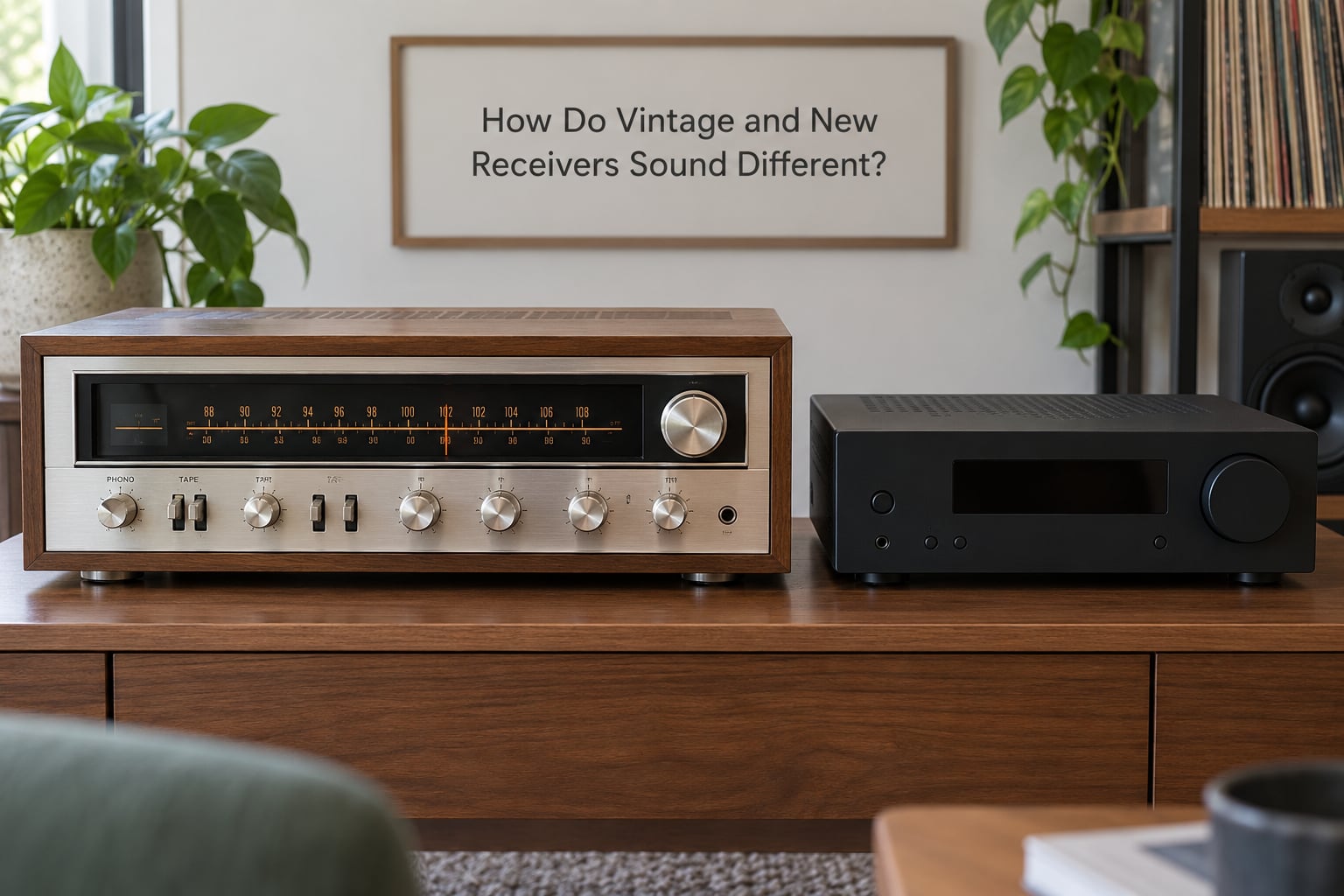
The honest answer is that vintage receivers are not automatically warmer, clearer or more detailed than new ones. What changes is circuit design, the flexibility of the preamp, how the phono stage behaves, and how much of the difference is the recording rather than the amplifier.
Do vintage receivers actually sound better?
Sometimes, and the reason is rarely the one people expect. Vintage preamps have far more flexible tone shaping, wider-range bass and treble controls, and a loudness contour that lifts the low end at low volume in a way most listeners genuinely enjoy at 11pm. Newer machines replace those controls with a flat response and DSP presets, because the design assumption is that digital sources are already mastered to a target curve.
That assumption has a flaw worth knowing about. Modern streaming and CD masters are typically around 5 dB louder on average than their 1980s equivalents, and crest factor has dropped by roughly 3 dB since the loudness war. Older amplifiers were designed for recordings with far more dynamic headroom inside the signal, so a 1970s power amp driven by a heavily limited modern master behaves more like the machine the music was mixed for. That is a real argument, and it is about mastering, not about magic in the output transistors.
On raw accuracy, new hardware wins. Damping factor in the 16-40 range on a typical 1970s receiver against 160 and up on a modern amplifier is not a small difference: it controls how tightly the amp stops the cone when the music stops. Add lower distortion into 4 ohm loads at real listening levels, and the modern machine is genuinely better at doing what a measurement microphone listens for.
The most useful piece of evidence for the vintage side is the 2013 Vancouver blind listening test, where a 1978 Pioneer SX-1980 and a 1978 Sony STR-V6 were compared against a 2009 Yamaha RX-V1800. The Pioneer took 6 of 8 votes despite clearly worse measurements. Small sample, one room, no repeat, and nobody involved was trying to prove anything. It is enough to say that “newer is more accurate” is not the same as “newer sounds better to a human in a chair”.
Can a good vintage receiver beat a poor modern one?
Yes, and this is the most important sentence in the article for anyone shopping. A well-serviced late-1970s or 1980s receiver from a brand with a healthy parts ecosystem will outplay a feature-loaded entry-level machine with DSP engaged, every time. On AudioKarma and r/vintageaudio the recurring theme is the same: condition of the specific unit matters more than the badge on the front.
The reverse also holds. A 1990s Onkyo SV-717PRO that has been recapped, cleaned and checked is a fine machine, while a 1970s receiver with leaky capacitors, cold joints and drifting output transistors is a parts donor no matter what the dial says.
What actually changes the sound
- Tone control range — the single most audible difference between old and new preamps, and the one people miss most.
- Phono stage design — matters enormously for vinyl, barely at all for streaming.
- Speaker matching — a mediocre amp driving sensitive, well-matched speakers beats a great amp driving a mismatched pair.
- Condition and service history — a documented recap and potentiometer treatment changes the sound more than any generational gap.
- Listening fatigue — owners of recapped Marantz 2270 and 2285 units and Pioneer SX-1050 and SX-1250 units commonly report all-day listening without the fatigue they get from digital chains. Subjective, repeatable in their experience, not measurable in a lab.
Which Is More Reliable: Vintage or New?
New hardware is more reliable for the first five years and possibly the first fifteen. Vintage hardware is more repairable forever. Those are different properties, and people confuse them constantly.
Age-related risks in a receiver that has been sitting in a cupboard for thirty years are predictable and mostly finite:
- Electrolytic capacitors — dried out, higher leakage, and in bad cases visibly bleeding or eating the board underneath. The single most common reason a vintage unit needs money spent on it.
- Protection relays — these click loudly and sometimes stick, or worse, open silently so one channel disappears.
- Lamp and dial problems — dial illumination bulbs, dial cords that slip, and needles that read low because the string stretched.
- Potentiometers — volume and tone controls that crackle, drop out, or get scratchy at one end of the throw.
- Wiring and connectors — brittle insulation on old hookup wire, cracked solder joints from decades of thermal cycling, cold joints that open only when the unit warms up.
- Obsolete semiconductors — and this is the expert-level trap nobody warns you about. Driver transistors can lose transconductance (Hfe) and drift out of specification while still passing a visual check and a full recap, so the amplifier delivers roughly half its rated power into clipping. A cheap old unit can sell as “working” and be quietly wrong. Counterfeit replacement parts make it worse.
- Dead tuner batteries — a failed dial light battery can leak and destroy the main board in some models. If one is there, replace it before powering anything up.
New electronics fail differently. A modern receiver can develop a dead HDMI board, a failed DSP chip, or a power supply that a manufacturer has no incentive to repair cheaply because the whole unit is uneconomical to service. Firmware dependence is its own category of obsolescence: features can be removed, streaming services can end, and a unit that needs a software update to keep working is a unit you no longer fully own. Proprietary accessories and app-only control add more.
There is also the parts-availability problem nobody can engineer around. One Sansui AU-777 owner reported three months and four shops to find a technician. Germanium transistors, proprietary knobs and jukebox mechanisms may simply not exist any more. Marantz, Pioneer, Sansui and Technics score best on parts and service-manual availability, which is a real reason to buy within those families.
Are Vintage Receivers Better for Vinyl?
Yes for most vinyl listeners, and this is where the comparison is least close. A serious 1970s receiver phono input is a properly engineered circuit with selectable loading. A moving-magnet cartridge sees a high input impedance, typically around 47k, with the right capacitance; some flagship models offer a moving-coil setting with a much lower load impedance and a step-up transformer for low-output cartridges.
Modern all-in-one machines are the opposite. Many have no phono input at all, and the ones that do often use a fixed impedance that suits one cartridge family and nothing else. There is usually no loading selector, no adjustable capacitance, and frequently no proper grounding arrangement beyond a post on the back panel.
Grounding matters more than most buyers realise. A moving-magnet cartridge produces a tiny signal, and a loop between the turntable’s ground wire and the receiver’s chassis earth introduces a hum that no amount of cleaning fully removes. A separate phono preamp lets you solve that properly, which is a real argument for the hybrid approach rather than for sticking a vintage box into a modern chain.
Where vintage wins: a moving-magnet turntable with no built-in preamp, a desire for adjustable loading, a taste for real tone controls, and a willingness to own the maintenance.
Where modern wins: a turntable with a decent built-in preamp, a need for a headphone output that is actually clean, a desire for volume control that tracks properly on a digital source, and zero interest in servicing anything.
If your cartridge is a moving-coil with low output, check the vintage unit’s specifications before buying. A moving-magnet-only stage will play it, but quietly and with too much capacitance, which dulls the top end.
What Features and Connectivity Are You Missing?
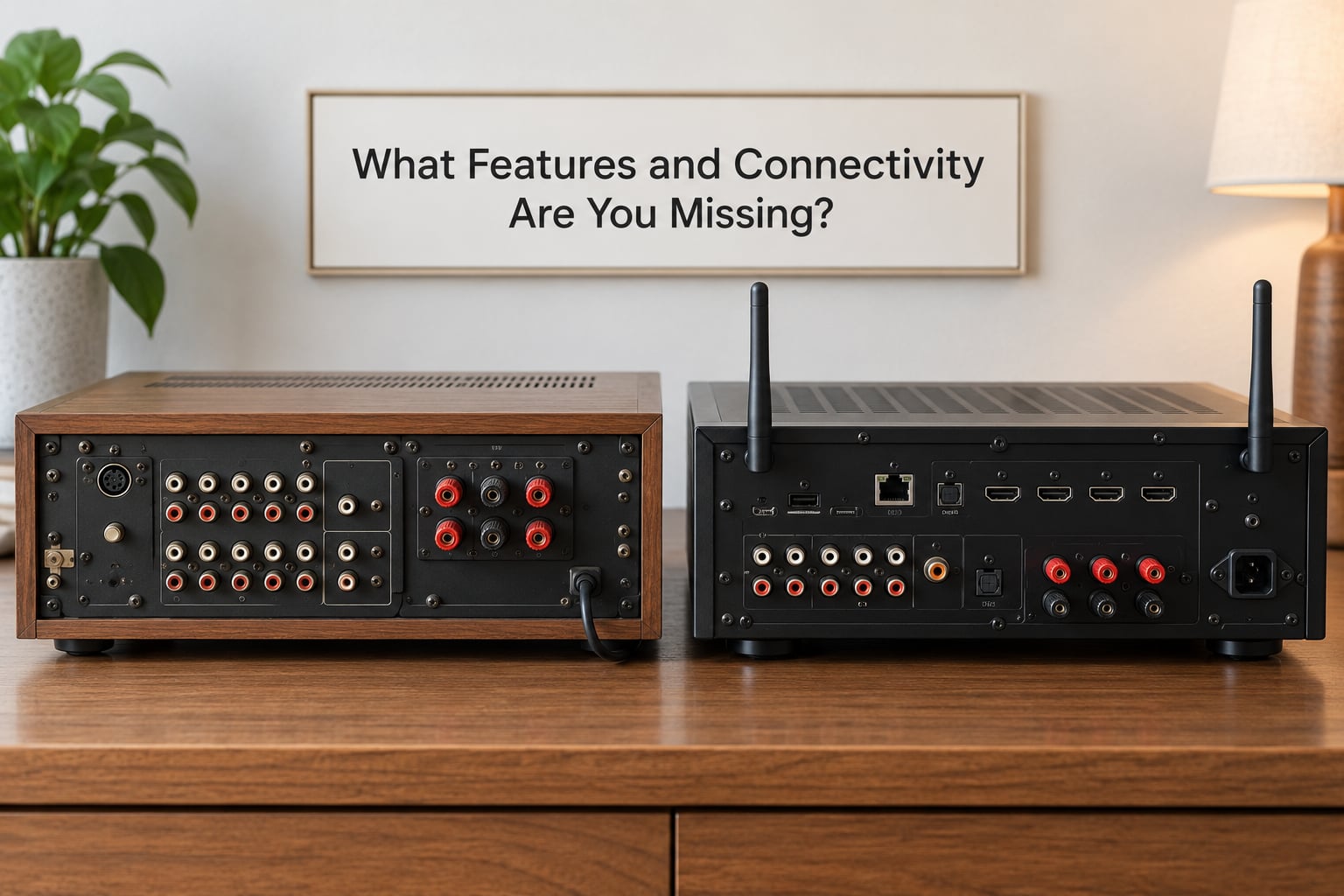
On features, the gap is not close, and pretending otherwise does a disservice to anyone shopping. A vintage receiver gives you a good FM tuner, a tape loop for recording and dubbing, an aux input, a headphone jack, a phono stage, and switches that move under your fingers with a satisfying mechanical detent. Some flagship models add a graphic equaliser with dozens of bands you will never touch and a quadraphonic mode for the appropriately obsessed.
A new receiver gives you HDMI with eARC, Bluetooth, USB, network streaming, multi-zone output, Dolby Atmos and DTS decoding, and automatic room correction from Audyssey, YPAO or MCACC. It can calibrate itself to your speakers and your room in ten minutes. None of that is available on a 1978 receiver in any form.
None of it makes the sound better by itself. It makes the box more convenient, and it is a completely different answer to whether the gear is right for you. Treating newer connectivity as better sound quality is the most common reasoning error in this debate, and it usually traces back to comparing a processed new receiver against a bypassed vintage amplifier. Switch the new one to Direct or Pure Analog mode and the comparison changes completely.
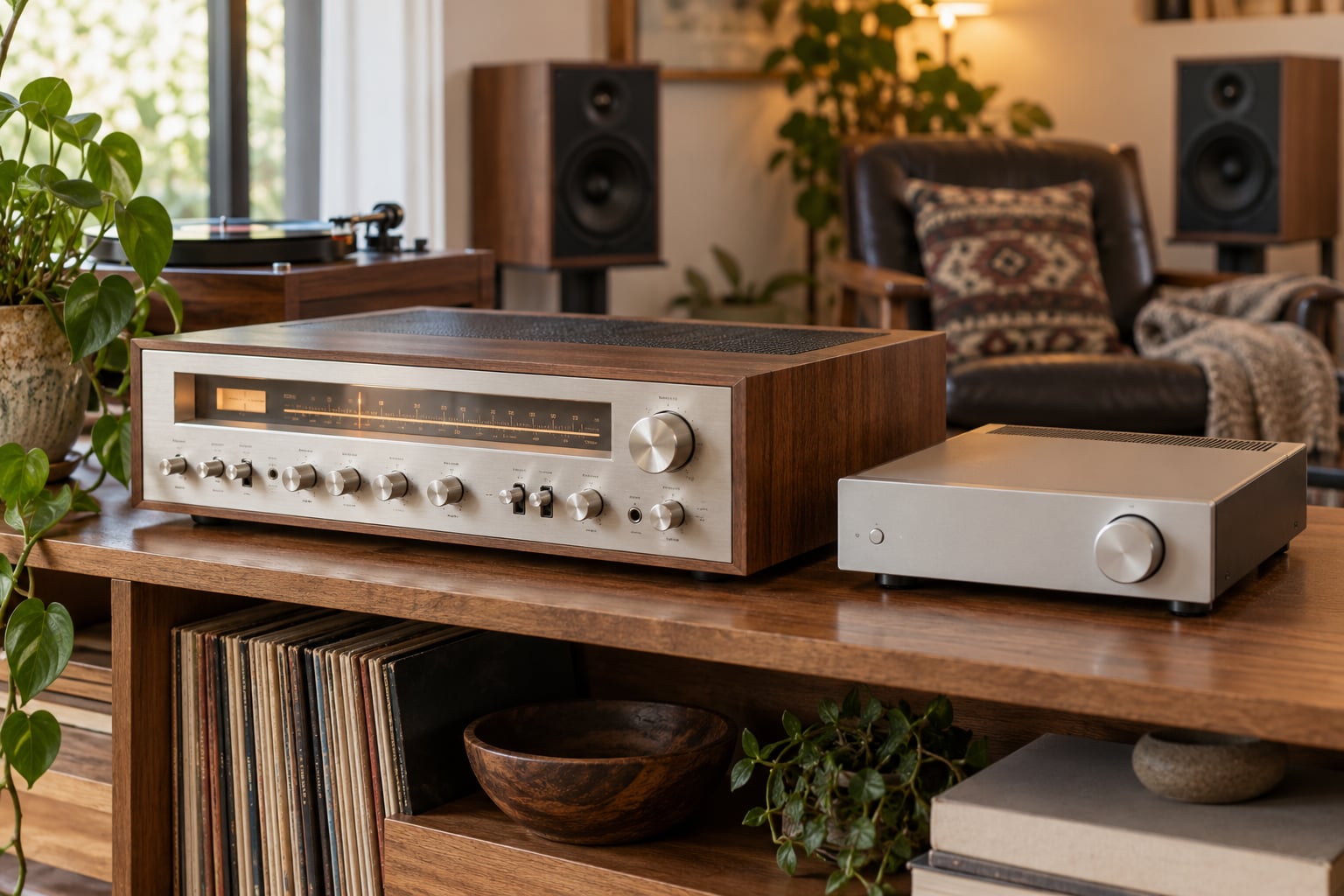
The third option is the one most guides skip: a vintage receiver or integrated amp with a modern streamer and an external DAC feeding it. You get the analogue front end and the phono stage you actually want, plus streaming, Bluetooth if the streamer has it, and a digital connection that removes the question entirely. For a lot of people it is the best answer on this page.
How Much Maintenance Does a Vintage Receiver Need?
More than a new one, and the difference is one-off rather than constant if you buy carefully. Here is the sensible order of operations before a unit ever gets plugged in.
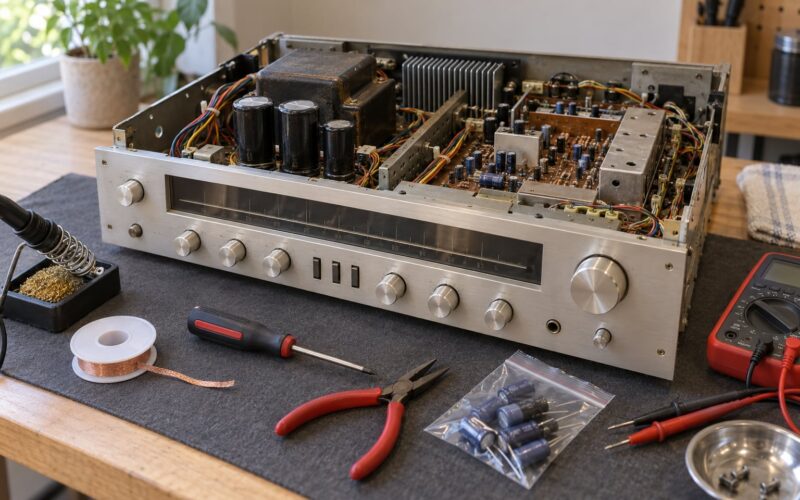
- Inspect before power. Open the case with the unit unplugged and look for bulging or leaking capacitors, burnt resistors, cold or cracked solder joints, corrosion, and rodent nesting. A burnt smell means stop, not try.
- Find and read the service manual. hifiengine.com and audio-database.com both index manuals by model, and the manual tells you the correct fuse rating, the expected idle current, and the test points a technician will use.
- Check the fuse. Never fit a higher-rated fuse because the original looked tired.
- Exercise the controls first, unpowered. Turn every knob through its full travel and work every switch. Stiff pots, dead switches and a dead selector are cheap fixes and a useful negotiating point.
- Power up cautiously. A variac or dim-bulb tester slows the ramp and reveals shorted capacitors and leaky parts. A momentary flicker of the dial lamp is normal. Popcorn-smelling smoke is not — power off immediately.
- Listen before touching anything. Low volume and high volume, buzz, hiss, crackle, dropouts, relay chatter, one channel missing, and both channels balanced.
- Decide on the recap. If the recap is needed, do it properly with modern parts and correct polarity and voltage ratings, and expect the work to take most of a day once the case is open.
- Use a qualified technician for anything touching mains voltage. Rectifier replacement, power-supply rebuilds and board-level rework are not beginner jobs, and a receiver holds a charged reservoir capacitor after it is unplugged.
Cheap fixes cluster around pots, switches, dial cords, lamps and fuses. Money-pit fixes are board-level rework, sourcing obsolete semiconductors, and chasing a fault that turns out to be three things at once. Ask the seller which one you are looking at before you commit, and treat “it works” from a seller who has not had it open as weak evidence.
On tube versus solid-state: tube gear is often the cheaper restoration, because there are fewer electrolytic capacitors in the signal path and the parts that do fail (tubes themselves) are replaceable and documented. The bill arrives later in the form of frequent tube replacement and a technician who knows valves.
What Is the Better Value Over Time?
Value is where vintage gear makes its strongest case, and the arithmetic is simple enough to do in your head.
| Cost over ten years | Vintage receiver | New receiver |
|---|---|---|
| Upfront | Low, often a small fraction of a new equivalent | Moderate, with a warranty attached |
| Expected service | One substantial visit for a recap, clean and alignment, plus parts over the decade | Covered, then out-of-warranty repair or replacement |
| Failure risk | Front-loaded in year one if the unit was stored badly | Low early, rising as the unit ages |
| Energy use | Class B and tube designs idle high; older units run warm | Class D and efficient analogue stages use less |
| Repairability | Discrete parts, published manuals, sockets and modules | Surface-mount boards, adhesives, paired parts |
| Resale | Collector interest in the right brand and condition, then a long flat tail | Resale value that falls off fast once the warranty ends |
The break-even point most owners describe is simple: buy a bargain unit, accept that it needs a couple of hundred in cleaning, recap and alignment, and compare that total against a new machine in the same tier. A thrift-store receiver that needs a board-level repair is not a bargain at any price, and one owner on a BudgetAudiophile thread recommended walking away from a unit priced such that the work erased the saving. That arithmetic is the single most useful filter in this article.
Watch the badge tax
Marantz and Pioneer command a collector premium over units from Sanyo, Onkyo, Kenwood, Sherwood and Sansui that often perform equivalently. One long-time owner of around a hundred 1970s receivers on Audiogon argues none of the big-name models compares to what is made today and recommends the less famous names instead. Whether or not you agree on sound, the pricing gap is real and it is the lever that decides which brand fits your budget.
- Collector favourites — Pioneer SX-1050, SX-1250 and SX-1980, Marantz 2230, 2270 and 2285, Sansui 9090 and the AU-series, Onkyo TX-8500 and SV-717PRO, Kenwood KR-8300, Yamaha CR-2020, Technics SA-616, McIntosh MR-78, Sherwood 9910, Sanyo JCX-2900.
- Approach carefully — quadraphonic-only models, console stereos with built-in changers, jukebox-derived units, anything proprietary, and anything with no available service manual.
- Parts and manuals availability matters more than badge — Marantz, Pioneer, Sansui and Technics are the practical picks.
Which Should You Choose?
Choose a vintage receiver if you play vinyl with a turntable that has no built-in preamp, you like real tone controls and a loudness button, you want something that can be repaired rather than replaced, you are willing to have it serviced once properly, and you enjoy the tactile side of analogue gear. Choose it if you have the time to shop, compare condition seriously, and walk away from a bad unit without regret.
Choose a new receiver if you need HDMI, surround decoding, streaming, Bluetooth, room correction or multi-room, if your listening is at low volume in a small room where those DSP features genuinely help, if you want a warranty and no tools, or if you would rather spend the same money on speakers. A new machine with more of your budget in the speakers beats a vintage flagship with a cheap pair of boxes every time.
On speakers, match impedance and headroom. Vintage receivers are usually 8 ohm with a 4 ohm tap, and they are generous with current, so moderately efficient bookshelf speakers are ideal. Modern receivers can struggle with very low-impedance loads, and a 200 watt channel is not twice as loud as 100 watts: perceived loudness follows the cube root of power, so doubling power is roughly a 3 dB gain, which is subtle.
And if you cannot decide, the hybrid path — vintage amplifier, modern streamer, external DAC — gives you most of the vintage character with none of the connectivity compromise.
Frequently Asked Questions
Is a vintage receiver better for playing vinyl records?
Usually yes, and this is the clearest win for older gear. Receivers from the 1970s and 1980s were built with moving-magnet phono stages as standard, often with selectable loading and a moving-coil option. Many modern all-in-one receivers have no phono input at all, or a fixed-load stage that suits only one cartridge type. Check impedance and loading options before buying.
What should I check before buying a used receiver?
Look inside for bulging or leaking capacitors, burnt resistors, cold solder joints and corrosion, all with the unit unplugged. Power up cautiously and listen at low and high volume for buzz, hiss, crackle, dropouts and relay chatter. Exercise every knob and switch, confirm both channels are balanced, and ask whether the seller has a service manual and any service history for the model.
Do vintage receivers need to be recapped?
Not always. A unit that was stored in a climate-controlled room and powered occasionally may be fine for years, and a needless recap is wasted money. Units that sat unused for decades usually are not. Signs point to a recap: hum that changes with volume, crackling controls, a bulging or leaking capacitor, or a power supply that will not come up cleanly. Have it assessed, not assumed.
Can a vintage receiver work with modern speakers and Bluetooth?
Speakers, yes, as long as you respect impedance and leave headroom. Bluetooth, no: there is no Bluetooth receiver in a 1970s machine. A small streamer or a Bluetooth transmitter with an analogue output solves it and feeds the vintage receiver’s aux or tape input, which is how most people build a hybrid system today.
Are tube receivers better than solid-state receivers?
Neither is better in the abstract. Tube designs are often described as warmer and are frequently cheaper to restore, because fewer electrolytic capacitors sit in the signal path and the parts that fail are documented and replaceable. They need more frequent tube replacement and a technician who knows valves. Solid-state designs are more efficient, lighter on mains power, and usually easier to find parts for.
How much does it cost to restore a vintage audio receiver?
A routine restoration on a common solid-state model usually runs into the low hundreds once cleaning, a recap, contact treatment and alignment are included, and rises sharply for board-level rework or obsolete parts. Diagnosis is often the biggest variable. A dealer who has already restored a unit and can supply a replaced-parts list plus measured output into 4 and 8 ohms is worth paying a premium over.
Conclusion
So are vintage receivers better than new ones? New hardware is measurably cleaner, more connected and far easier to live with. Vintage hardware gives you a phono stage worth having, tone controls you can actually use, a chassis that can be repaired, and more character per pound spent. The question only has a good answer once you look at the specific unit in front of you.
Before you buy anything, do three things. Verify the condition and the serviceability of that exact receiver, including its storage history and whether a service manual exists. Confirm the phono stage and speaker impedance match your turntable and your speakers. Then listen to it, at low volume and high, with a new unit set to Direct mode as your reference. Buy on what you hear and what you can afford to service, not on the year stamped on the dial.