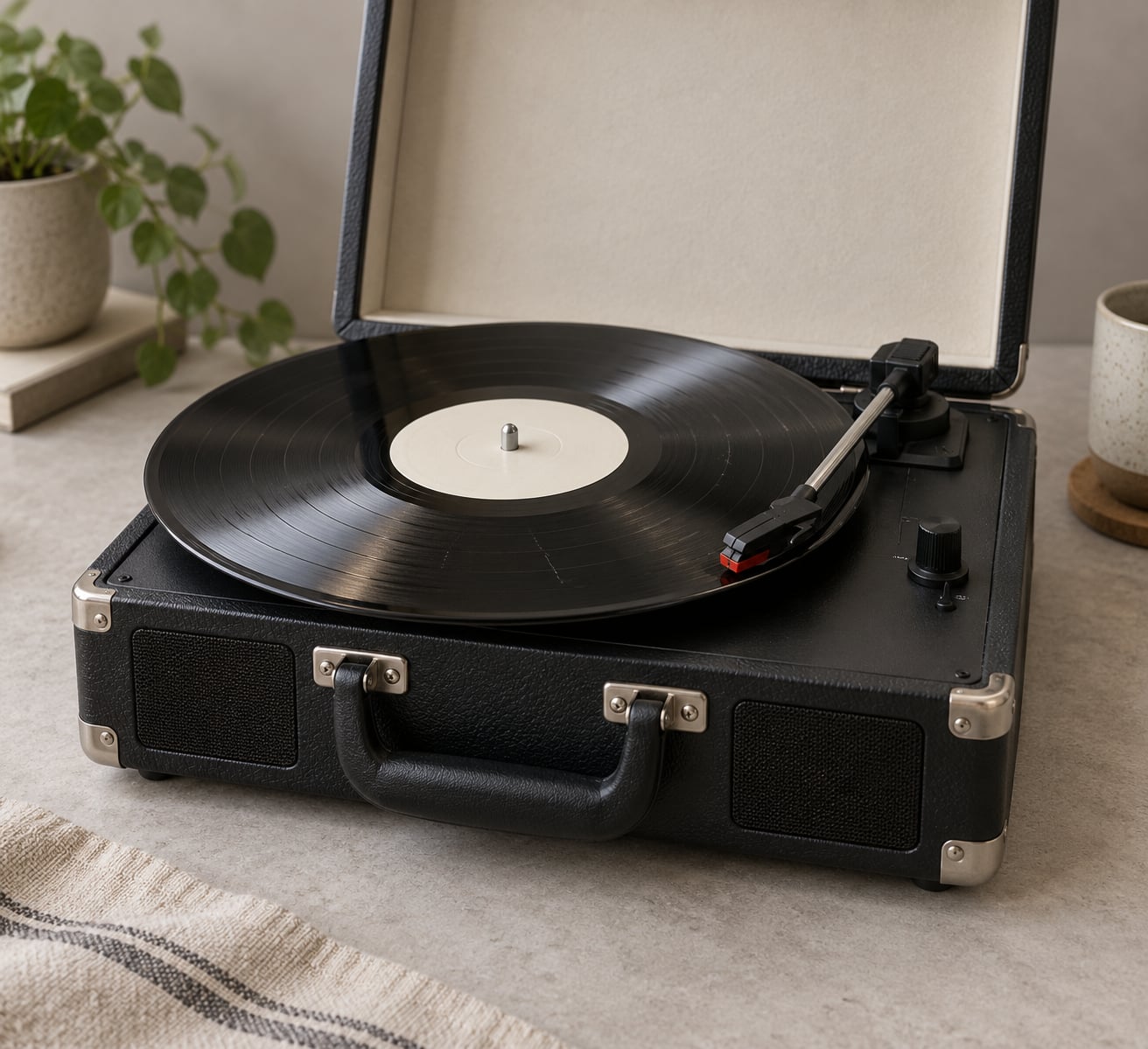
Portable suitcase record players damage records because the stylus is pressed into the grooves far harder than vinyl tolerates, usually by a cartridge that cannot be adjusted and a tonearm that is never properly balanced. Add a platter that is often smaller than the disc, and the record ends up carrying more load and more vibration than it was ever designed to take. None of that is inevitable, though: a well-built portable player handles vinyl fine, and the same cheap player can play a thrift-store copy without a care in the world.
The word damage covers a lot of ground, from a hairline scratch you will never hear to a disc that skips at the same track every time. Sorting those outcomes apart is most of the work, because the fix is completely different in each case.
Table of Contents
- How Portable Suitcase Record Players Put Records at Risk
- Why Portable Suitcase Record Players Damage Records
- The Main Ways Record Damage Happens
- Undersized Platters and Off-Center Records
- How an Undersized Platter Causes Scratches and Warping
- Why Tonearm Alignment and Tracking Matter
- How Excess Stylus Pressure Damages Vinyl
- Why Resonance and Feedback Can Make Damage Worse
- Can a Portable Player Warp a Record?
- Which Records Are Most Vulnerable?
- How to Tell When a Portable Player Is Damaging a Record
- How to Use a Suitcase Record Player More Safely
- Frequently Asked Questions
- Do all portable suitcase record players damage vinyl?
- Can a record player fix scratches or remove them?
- Is it safe to play a warped vinyl record on a portable player?
- Are old records more vulnerable to damage than new ones?
- How can I tell if a record player is damaging my vinyl?
- Is it better to use a larger platter or a separate slipmat with a portable player?
- What Collectors Should Do First
How Portable Suitcase Record Players Put Records at Risk
Portable players put records at risk through rough starting motion, platters smaller than the record, unstable tonearm tracking, stylus pressure set well above the safe range, cabinet resonance, and handling that assumes records are tougher than they are. Damage is not automatic. It depends on the specific player, the specific record, and how carefully you set things up before the needle drops.
That last point matters, because the cheapest players and the most expensive all-in-ones share the same basic weaknesses. The gap between them is mostly in how much of the risk you can remove before you start the motor.
Why Portable Suitcase Record Players Damage Records
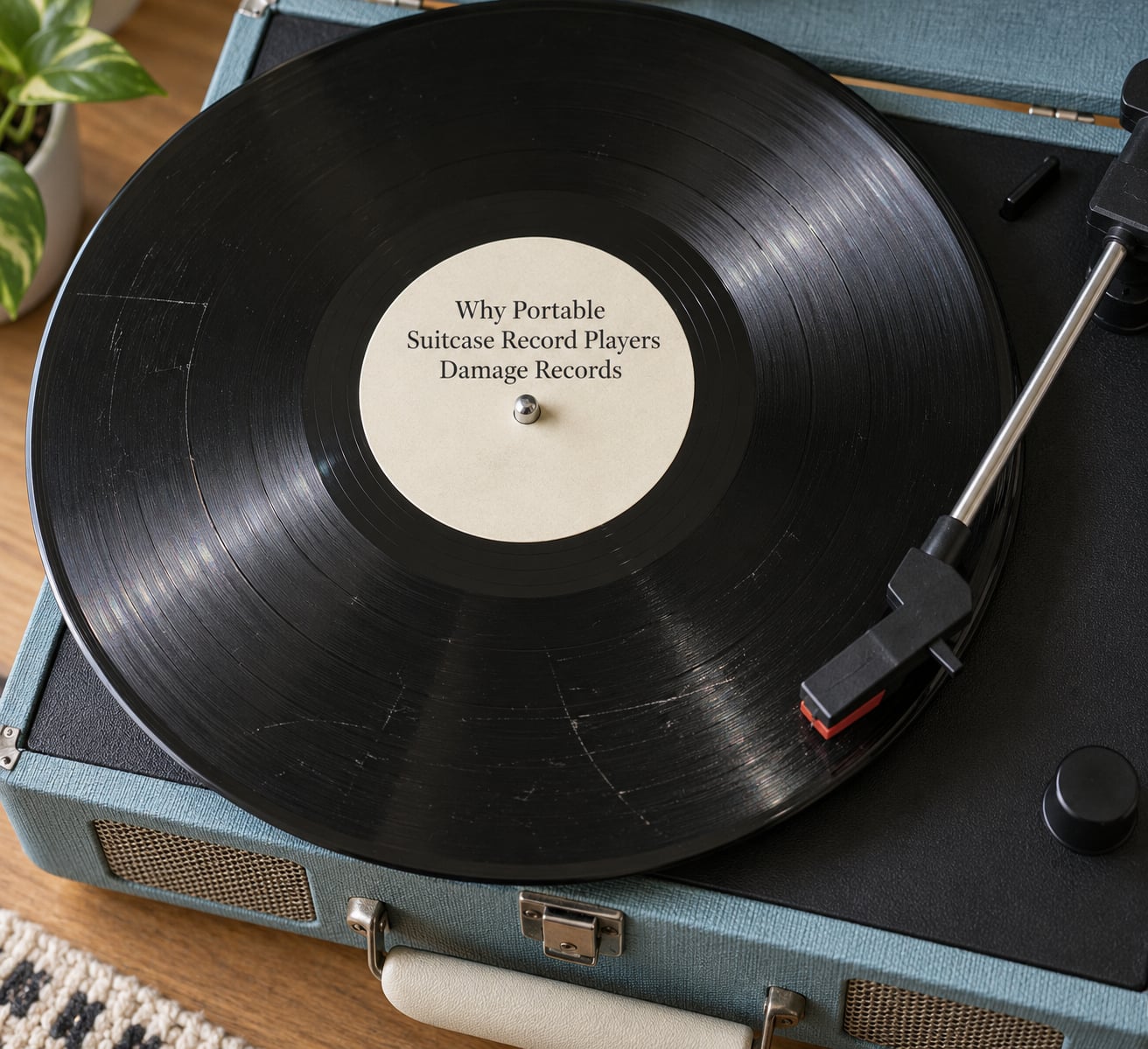
Every player shares the same handful of failure modes. What changes between models is whether the design gives you any way to correct them.
| Failure mechanism | Damage it causes | Most exposed area | Warning signs |
|---|---|---|---|
| Tracking force above the safe range | Groove wear, visible scuffing on the groove walls | The first ten minutes of each side, then the whole track | Dull top end, loss of detail between loud passages |
| Platter smaller than the record | Edge slip, wobble, unstable rotation | Outer edge and lead-in groove | Record rocks visibly, sound warbles |
| Record mounted off the spindle | Rotational wobble and sideward stress | Whole disc, worst at the rim | Uneven tone, occasional skip |
| Unbalanced tonearm | Side pressure on the inner groove wall | Inner grooves in the run-out | Inner tracks sound worse than outer tracks |
| Weak or absent anti-skate | Stylus drifts inward, digs into one wall | Second half of each side | Gritty, splattery quality late in the side |
| Short arm geometry | Stylus sits too far in, inner-groove distortion | Last few tracks | Sudden loss of clarity near the label |
| Resonance and speaker feedback | Chatter, repeated groove contact, skipping | Whichever track shakes the cabinet most | Skip on bass-heavy passages, rattling sound |
| Abrupt start and stop | Scratches and scuffs at start and stop points | Second or third track, wherever you cue | New marks that match your cueing habits |
| Dust and debris in the groove | Amplified wear, audible clicks | Random, follows handling | Popping that gets worse as the side progresses |
Read down the warning-signs column and you will notice something useful: nearly every problem announces itself audibly before it does permanent harm. That is your window to stop and fix something.
The Main Ways Record Damage Happens
Four things get called record damage, and they are not interchangeable.
Scratching is a mechanical gouge across the vinyl. A dirty stylus, a chipped tip, grit dragged by the cleaning cloth, or a record landing off-centre on the spindle will all do it. Scratches skip when crossed and hiss constantly.
Warping is a shape change, usually from heat, pressure or a cracked disc. The record touches the platter unevenly or binds partway through and stops the music.
Groove wear is the slow version nobody sees happening. The groove walls get polished and thinned by too much downward force. Nothing looks wrong. The record just sounds quieter, duller and less detailed than it should, and no cleaning will bring the top end back.
Tracking error is not damage to the record at all. It is the stylus losing its seat in the groove, which produces distortion on playback. It often accompanies a player that will cause real damage later, so treat it as a warning rather than a diagnosis.
A worn stylus cuts both ways. A cheap player measuring around seven grams of tracking force is exactly what collectors mean when they call a setup a record reamer, and every bit of the resulting wear is permanent.
Undersized Platters and Off-Center Records
A platter that is smaller than the record cannot hold the disc flat. The overhang past the platter edge wobbles through every rotation, and the record sits at a slight angle the whole time it plays.
Mounting mistakes do the same thing. If the disc is pushed too far onto the spindle or is not seated flat against the platter centre, you get wobble even on an adequately sized deck.
How an Undersized Platter Causes Scratches and Warping
The sequence runs slip, drag, vibration, groove damage. At the moment the motor catches, the overhang section of the record momentarily slips against the platter surface rather than turning with it. That slip is a scuff across the vinyl right where the stylus is about to land.
Once rotation settles, the wobbling edge keeps lifting and dropping the disc. Each drop is a small shock to the grooves, and a record that is already slightly cupped or thin will amplify every one of them. Vertical tracking force stays uneven too, which means the stylus digs harder on the way down into the wobble and eases off on the way up.
Startup and shutdown are the worst moments because speed is changing and friction peaks. It is also why cueing a portable player is the single most common moment a collector scratches a record by accident.
Why Tonearm Alignment and Tracking Matter
An aligned tonearm does one job: keep the stylus moving in a straight line at a constant, gentle sideways pressure as the record turns underneath it. Most portable players break several parts of that.
A floating arm that has no proper pivot bearing will not stay in one plane, so tracking force changes as the arm swings outward. An improvised bearing also has play, which lets the arm drift sideways across the grooves.
Overhang is the other half. If the stylus reaches past the spindle at the outer edge but barely covers the inner grooves, the arm geometry is wrong. Manufacturers instead blame the record for distorting at the end of the side, which is not what is happening.
Anti-skate deserves its own paragraph. Without it, the tonearm is pulled inward by the groove walls themselves, and the stylus presses against one wall for the whole second half. The result is a slow, steady grind on a single wall of the groove rather than even contact across it.
Damping is the other half of that fix. A tonearm that is too free bounces over warps and dirt, and every bounce is another impact. Too much friction and the stylus cannot climb over the same bump, so it stalls and drops again. Damper settings that cannot be changed leave you with one of those two problems.
How Excess Stylus Pressure Damages Vinyl
Groove wear is a function of force multiplied by distance. More tracking force over the same track wears the same groove faster, and the effect accumulates on every play.
The mechanisms behind excess pressure are specific and fixable in principle. A heavy stylus, a counterweight set too far back, an anti-skate dial wound up when nobody knew what it did, or a tonearm left resting on the disc while you queue something all add downward or sideways force.
Ceramic cartridges are the usual culprit. They generate their signal by flexing a piezoelectric element, which means they need more tracking force than a magnetic cartridge to stay seated in the groove. That is often quoted at three to six grams, against roughly one and a half to two and a half grams for a typical moving magnet cartridge.
Two to four times the recommended load is the whole problem in a single phrase. A player nobody can adjust means nobody can bring that number back down.
Why Resonance and Feedback Can Make Damage Worse
An all-in-one player puts the speakers a few centimetres from the stylus. Speaker vibration travels straight up the chassis and into the tonearm, and the stylus can chatter against the groove wall in response.
Chatter is rapid, repeated contact. It is not one impact but dozens per second, and it turns a track that has low inherent resonance into the most damaging spot on the whole side. That is why skipping tends to land on the same track every time rather than spreading randomly.
Other vibration sources add to it. A platter that is loose in its own bearing, a spindle with no isolation, a tonearm with an improvised pivot, and playing on a soft or springy surface all feed energy back into the record. Put the same player on a solid, level cabinet and a good number of skips disappear without touching a single setting.
Speakers housed in the same cabinet as the platter are the core of the design problem. There is no isolation between them by construction, which is why separating the two is the single biggest improvement available to a portable player owner.
Can a Portable Player Warp a Record?
Rarely through heat alone. Vinyl does soften in a hot car or a hot attic, but ordinary playback does not generate enough energy to bend a flat disc. The temperature rise from a stylus moving through a groove is negligible.
What does bend and stress a record during playback is mechanical. Pressure concentrated on a small contact area, off-centre rotation that loads one section of the rim, and binding against a warp the record already had all create bending forces while the disc is spinning.
So a slightly warped disc is the cause, not the effect, in most cases. Once a disc is bent, it never sits flat again, and a player with any wobble at the rim will keep pushing it further out of shape. A cracked disc is a different matter entirely, and one that should never be played.
Which Records Are Most Vulnerable?
The ranking runs from damaged media at one end to fragile media at the other.
Already warped or cracked records sit at the top. A cracked disc can break completely under the stylus. A warped one binds, jumps, and often drops out while playing.
Thin, inexpensive pressings are next. They have less material to distribute force, so they deflect and wear sooner than a heavy audiophile pressing.
Heavily scratched records present a different hazard: the damage already present catches the stylus and drags it sideways. Adding a heavy tracking force to a scarred groove is how a previously playable disc becomes unplayable.
Rigid editions — picture discs, coloured vinyl, clear pressings — deserve extra care because their material properties differ from standard black vinyl.
Finally, the mismatch cases: a record that only fits with an adapter, or a disc forced onto a platter that is too small for it. Neither should be forced. Put a thicker record on a smaller platter and you have built the slip condition described earlier.
How to Tell When a Portable Player Is Damaging a Record
Most of the time you can hear it before you can see it.
Repeated clicks in the same place on every play mean the groove has been physically gouged and the stylus is now jumping the same defect. A sudden speed change, or warble that comes and goes with the music, points at rotational instability from wobble or off-centre mounting.
Dragging is harder to identify because it sounds like ordinary grit. Wobbling during playback, or a platter that visibly rocks when you flick the disc with a fingertip, is a mechanical fault and nothing else.
New scratches that match your cueing habits are the clearest evidence of all. Check under a light before you start and again when you finish. A stylus that jumps, skates across the surface, or leaves the groove and lands further in is telling you the setup is wrong.
Stop playback when the disc rocks, when the arm drags sideways, when skating repeats, or when you hear clicks that were not there before. None of those is worth pushing through.
How to Use a Suitcase Record Player More Safely
Check the record before it goes on. Inspect the surface, look for cracks near the label or the run-out groove, and hold it up to the light to spot a bow.
Check the platter next. Compare it against the disc. If the platter is smaller than the record, or only barely equal to it, the setup is not safe no matter how carefully you handle things.
Seat the record properly on the spindle so it sits centred and flat before you start anything. Start the motor first and let the platter reach speed, then lower the stylus. Starting and stopping are the highest-risk moments in the entire process.
Use whatever tracking controls the player actually has, and resist turning anything you cannot identify. Never push the tonearm to stop skating, and never touch the stylus to reposition the arm. Moving the arm by hand sends it across the record at an angle no counterweight can compensate for.
Keep the surface underneath the player solid and level, and give the speakers room. If the player has RCA outputs, running it into a separate amplifier and speakers removes the feedback loop entirely and is the best improvement you can make for record safety.
Cleaning helps, but only in one direction. A brush and a proper fluid remove dust and reduce friction, which cuts tracking problems and removes the loose debris that acts like sandpaper under the stylus. Neither reverses a scratch, restores worn grooves, or repairs a warp.
Frequently Asked Questions
Do all portable suitcase record players damage vinyl?
No. The design of an all-in-one player raises the risk, but many portable models ship with an adjustable tonearm, a counterweight, and a replaceable magnetic cartridge that track within the safe range. The ones to worry about are the fixed-pressure models with a bonded ceramic cartridge and no way to change it. Check the specifications before you buy, not the price.
Can a record player fix scratches or remove them?
No turntable removes a scratch, and no cleaning product reverses one. A stylus crossing a scratch produces a click every time, because the physical groove deformation is still there. What cleaning does is remove dust and reduce the friction that turns a light scratch into a skipping problem, which makes damaged records easier to play but never restores them.
Is it safe to play a warped vinyl record on a portable player?
Warping usually means heat, pressure, or an already-bent disc, not anything the player caused during playback. Light warping often plays fine, but it can bind or skip, and a disc with a crack can break completely under the stylus. On a player with a small or wobbly platter the risk climbs. Check for cracks first, and skip any disc that rocks on the platter.
Are old records more vulnerable to damage than new ones?
Not automatically. Age alone does not make vinyl fragile, and an unplayed pressing stored flat can be in better shape than a new record that has been through a heavy-tracking-force player fifty times. Old sleeves, warping from storage, and brittle labels raise the risk, but the deciding factor is groove condition and where the record has already been played.
How can I tell if a record player is damaging my vinyl?
Listen for repeated clicks at the same point, warble that follows the music, and a sound that gets gritty near the run-out. Look for new scratches that match your cueing habits, and check whether the platter visibly rocks the disc. If the arm skates or the stylus jumps and lands further in, stop the record and correct the setup before playing it again.
Is it better to use a larger platter or a separate slipmat with a portable player?
A platter that is at least as large as the record beats any slipmat, because it supports the whole disc and keeps the rim from wobbling. A slipmat cannot fix a platter that is too small or mounted off-centre, and a thick one can make a low-friction bearing slip further. Solve the size and seating problem first, then worry about mats.
What Collectors Should Do First
Stop the record and look at it. Any wobble, sideways dragging, or repeated skating means the disc and the platter need checking before another side goes on.
That pause is the entire answer to why portable suitcase record players damage records. The players themselves rarely ruin a disc in a single play; they apply more force, more wobble, and more vibration than the vinyl can absorb over time, and none of those three things can be corrected on a model without adjustable controls. Confirm the platter is at least as large as the record, that the disc sits centred on the spindle, and that the stylus drops after the platter is already at speed. Everything else on this page is detail hanging off that one habit.