Can you play 78s with a regular stylus? Not safely. A standard LP needle is roughly a third of the width a 78 groove needs, so it drops to the bottom of the groove, ruins the sound and slowly chews the record up. A 78 wants a stylus tip of about 2.5 to 3.5 mil, and everything else in your chain has to agree with it.
I have watched people drop a valued shellac 78 onto an LP cartridge to see what happened. You do not need to be an expert to hear the difference: it skips on the first loud passage, sounds thin and fizzy, and leaves a flat patch that never recovers.
This guide covers what regular needles do to 78 rpm records, which styluses are safe, how to set a turntable up for them, and how to digitise a 78 before you risk it.
Table of Contents
- Can You Play 78s With a Regular Stylus?
- Why 78s Need a Different Stylus
- What Stylus Is Safe for 78s?
- Can a Turntable Play 78s?
- How to Set Up a Turntable for 78s
- Can You Convert an Old 78-Rpm Record?
- Common Problems When Playing 78s
- Frequently Asked Questions
- What size stylus do I need for 78 rpm records?
- Can I play a 78 on a regular record player?
- Do I need a mono cartridge to play 78s?
- How do I clean shellac 78 records?
- Conclusion: Start With the Right 78-Rpm Setup
Can You Play 78s With a Regular Stylus?
The short answer is that you can put almost any cartridge on almost any turntable, but you should not put an ordinary microgroove stylus on a wide-groove 78. The stylus is matched to the groove, and the two are not interchangeable.
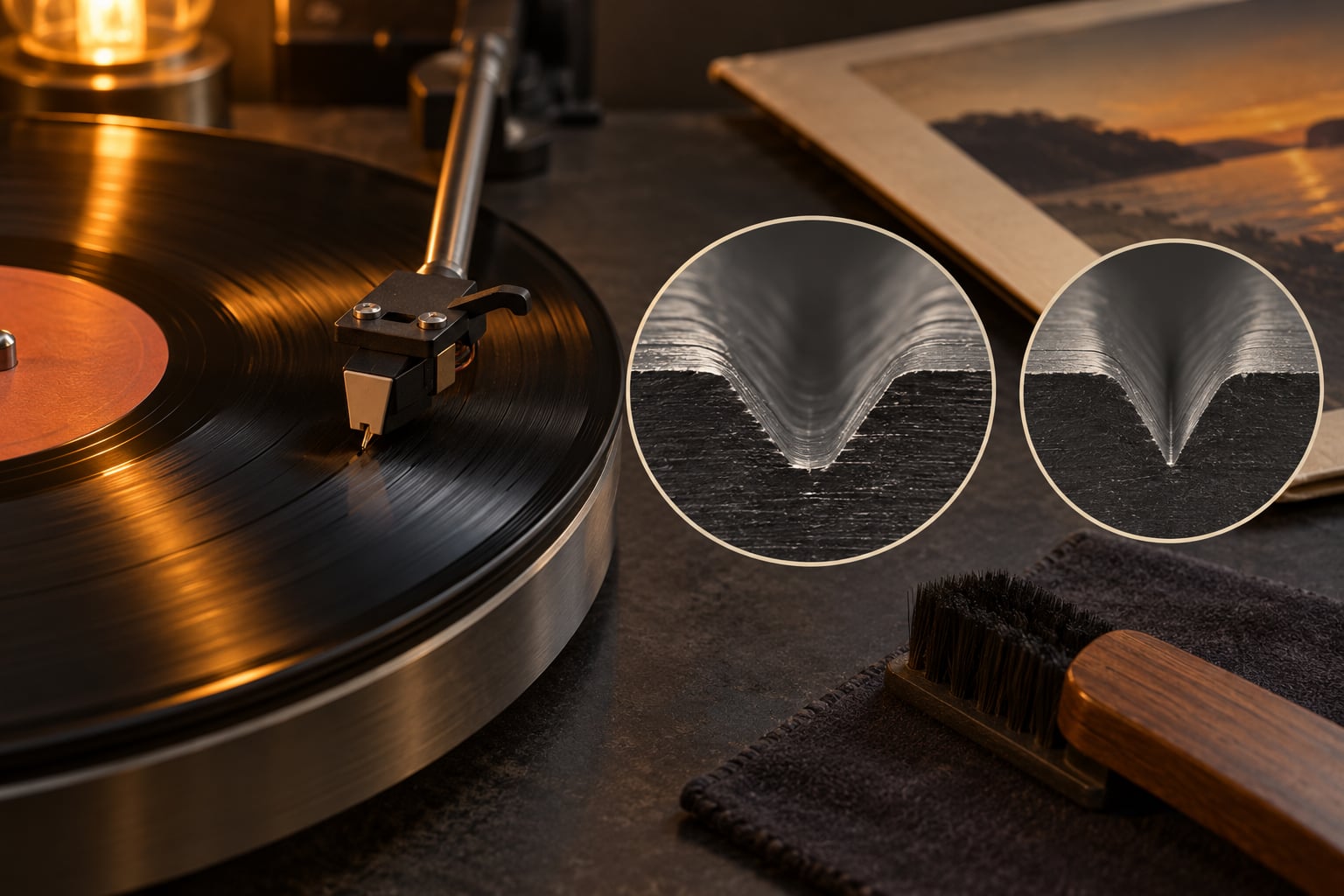
A typical LP cartridge carries a 0.7 mil conical tip, with elliptical models running up to around 1 mil. A wide-groove 78 needs something in the 2.5 to 3.5 mil range. That is three to five times wider, and the difference is not subtle at all.
Two situations make an exception. If your “78” is actually a microgroove disc cut at 33 or 45 rpm and labelled as such, a normal stylus is correct. And if your turntable has a removable headshell or an interchangeable cartridge already rated for 78s, swapping in the right stylus is a five-minute job rather than a gamble.
Anything else is a test you only get to run once on a given record. Treat an unknown cartridge as not 78-compatible.
Why 78s Need a Different Stylus
A stylus rides on the walls of a V-shaped groove, suspended just above the base. Groove geometry sets the size of the ball that can float in there without touching anything.
Put a 1 mil tip into a 78 groove and there is no position where it sits correctly. It sinks until the groove floor stops it. That collision is what collectors call bottoming out, and it happens on every rotation.
The consequences stack up quickly. First the signal drops out, so the music loses bass and thins out. Then the groove floor gets scraped and flattened, which permanently lowers the signal-to-noise ratio of the disc. Crackle that was once a faint background turns into a roar on every play. On shellac, which is brittle and often filled with filler, the record can chip at the edge of the groove outright.
There is a second difference worth knowing. Many 78s were cut laterally, which makes them sensitive to the vertical tracking angle of the cartridge. A misaligned stylus on a vertical cut will hammer the groove wall hard, even at the right tip size.
What Stylus Is Safe for 78s?
The safest general-purpose choice is a truncated conical stylus around 2.5 mil, or a full radius tip of 3 mil or more for older and well-worn records. Both are blunt by design: the point is to avoid damaging the record more than to squeeze out detail.
| Tip size | Best suited to | Notes |
|---|---|---|
| 0.7 to 1.0 mil | LPs and microgroove discs | Too small for a wide-groove 78 |
| 1.5 to 2.0 mil | Microgroove mono discs, some narrow-groove 78s | Use only if the maker rates the cartridge for it |
| 2.0 to 2.5 mil | Standard wide-groove 78s | The common starting point |
| 2.8 to 3.5 mil | Most mid-century 78s | Forgiving, widely recommended |
| 4.0 mil and above | Very old acoustic-era, short-play discs | Specialist supply only |
Elliptical tips are not the answer here. A fine elliptical profile rides near the bottom of the groove wall, so it suits microgroove and thin-walled vinyl 78s. On shellac it does more damage than a blunt conical does.
There is no single play-everything 78 stylus, because labels varied groove width for decades. The specialist suppliers collectors trust are Expert Stylus Company in the UK and KAB Electro-Acoustics in the US, both of which publish their recommendations by label and era. Audio-Technica’s AT-VM95SP is the most commonly recommended starting cartridge on the forums, and Ortofon makes a 78 stylus for people who prefer that brand.
Can a Turntable Play 78s?
Most decent turntables can, but the model name matters less than three things: whether it spins at a stable 78 rpm, whether the cartridge can be changed, and whether the tracking force range suits a wider, heavier tip.
Dedicated 78 players do the job properly and are simple to live with, since there is nothing to set wrong. Dual-speed decks usually run 33 and 45, sometimes 78 instead of one of those, so read the speed markings before you buy.
Standard three-speed belt-drive decks with a removable headshell handle 78s well once the cartridge is right. Quartz-lock or servo-speed decks are a bonus, because older 78s vary in diameter and a fixed-speed deck will drift on them.
Three-speed decks usually lack anything meaningful for 78 work, though they may still turn at 78. Speed without a suitable cartridge and adjustable tracking gives you the worst version of the problem: it spins, and it damages the record while doing it.
How to Set Up a Turntable for 78s
Work through these in order and stop if anything sounds wrong. The sequence takes about fifteen minutes.
- Confirm the format. Read the label and check the groove width. A 78 cut for a small-diameter disc can be very short, and it needs a larger tip than a full-size one.
- Fit the correct cartridge or stylus. Match the cartridge model to the headshell mounting, confirm the tracking force range covers the maker’s specification, and set the vertical tracking angle if your deck allows it.
- Set the tracking force. Use the cartridge maker’s figure, not a guess. A 78 stylus is heavier at the tip, so a setting tuned for an LP can sit far too low in the groove.
- Align the tonearm. Set the arm rest and cueing height for the new cartridge, then check alignment with whatever gauge your turntable recommends.
- Set the speed and start at low volume. Select 78 rpm, lower the volume before you cue the arm, and never lower the arm before the stylus is seated in the groove.
Never override a cartridge’s stated tracking range. That range is not a marketing figure, it is the mechanical limit before the cantilever starts to bend.
One more decision: mono or stereo. A true mono 78 has no information in the vertical channel, so a stereo cartridge plays it with a needle that wobbles from side to side, which is both pointless and harder on the groove. If your phono stage or preamp has a mono switch, use it. If your cartridge is rated for mono wide-groove playback, that is better still.
Can You Convert an Old 78-Rpm Record?
Yes, and for an inherited collection it is often the safer play, because the same stylus rules apply whether you are listening or recording.
The chain runs turntable to phono preamp to recording device. The turntable needs the 78-rated cartridge and a stable 78 rpm speed. The preamp needs a 78 playback curve rather than the RIAA curve used for LPs, because 78 equalisation is not a fixed standard across labels.
Software such as Audacity or a dedicated 78 transfer package can capture the audio and apply de-clicking. Work on a copy, keep the original file untouched, and never use destructive noise reduction if you want to keep the archival master honest.
There is a real case for a specialist service too. An experienced operator can drop the needle into the groove the right way every time, adjust for the vertical tracking angle, and avoid the one bad pass that permanently marks a record.
Common Problems When Playing 78s
Some faults come from the record, and some come from your equipment. Telling them apart saves you from buying parts you do not need.
Skipping or jumping at one spot is usually a worn groove or a damaged section, and occasionally a bump in a shellac pressing. If it skips on every track at the same place, suspect the stylus or tracking force instead.
Constant crackle and hiss across the whole side is normal for a record of this age, but it worsens fast if the wrong stylus has been flattening the groove floor. A scraping sound that comes and goes is the stylus riding the groove wall, which means the tip is too narrow.
Thin, distorted or unstable sound points at the cartridge or the phono stage rather than the disc. Check the tracking force first, then make sure the preamp is set for mono and the correct loading.
Speed that wobbles or runs slow usually means the motor or the belt, not the record. Old shellac discs shrink unevenly over decades, so they can also slip on the platter. Never correct this by gripping the disc harder.
Stop playback if the stylus is dragging, jumping or scraping. Those sounds mean contact you do not want, and one more side is not worth it.
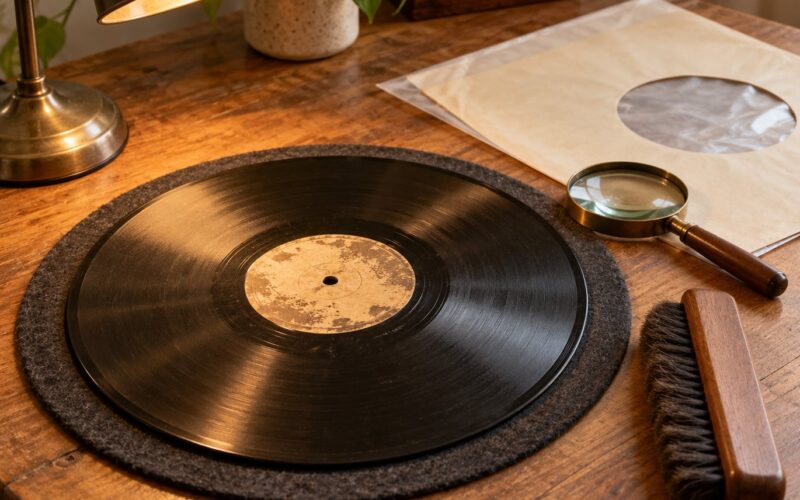
Cleaning matters too. Shellac dissolves in alcohol and in most household cleaners, so keep both away from it. Use a dedicated record cleaning fluid, work gently, and store shellac records vertically in inner sleeves.
Frequently Asked Questions
What size stylus do I need for 78 rpm records?
Most wide-groove 78s want a stylus tip of 2.5 to 3.5 mil. A 2.5 mil truncated conical handles standard mid-century pressings, while a 3 mil or larger full radius tip suits older acoustic-era records with deeper grooves. A standard 0.7 to 1 mil LP stylus is far too small and will bottom out in the groove.
Can I play a 78 on a regular record player?
Only if your player can reach a stable 78 rpm and you fit a cartridge rated for wide-groove records. Many three-speed belt-drive decks have no 78 speed setting and a fixed cartridge, so they can spin a record but not play it properly. If the stylus is not 78-rated, the record suffers damage rather than just sounding poor.
Do I need a mono cartridge to play 78s?
Not always, but it helps. A stereo needle wiggles vertically through a mono groove, which adds wear and produces no useful signal. A mono switch on your phono stage or preamp gets you most of the way there, and a cartridge rated for mono wide-groove playback is the cleaner option if your system allows it.
How do I clean shellac 78 records?
Never use alcohol, household cleaners or anything water-based on shellac, because they dissolve the binder and can permanently cloud or warp the surface. Use a dedicated record cleaning fluid with a soft cloth or brush, work gently from the label outwards, and let the record dry fully before sleeving it. Store shellac vertically in inner sleeves.
Conclusion: Start With the Right 78-Rpm Setup
Start by identifying what you actually own. Check the groove width, check whether it is shellac or vinyl, and only then pick a stylus: a truncated conical around 2.5 mil for most discs, larger for old acoustic-era pressings.
Then match the cartridge to the turntable, set the tracking force to the maker’s figure, select 78 rpm, and start at low volume. Do not lower the arm until the stylus is seated, and if the record is inherited or irreplaceable, transfer it before you experiment.