Learning how to collect 78 rpm records comes down to three habits: pick a narrow musical focus, learn to identify format and pressing, and judge condition before you pay. A 78 collection can be built on any budget, because most common copies are cheap — but the wrong cartridge, or ignoring a hairline crack, will cost you more than the record ever did.
The biggest surprise for newcomers is how fragile these discs are. Many are not vinyl at all but shellac, a natural resin that turns to powder in a humid room and dissolves if you clean it with alcohol. Treat them as archival objects rather than as playing surfaces, and most beginner disasters disappear.
Table of Contents
- What You Need
- Step-by-Step
- 1. Decide What You Want to Collect
- 2. Learn the Basic 78 rpm Formats
- 3. Inspect the Grooves, Label, and Center Area
- 4. Check the Label and Runout Information
- 5. Test Play Before Buying
- 6. Compare Price With Condition and Rarity
- 7. Store and Care for the Collection
- Common Mistakes
- Frequently Asked Questions
- Are pre-1925 78 rpm records really played at 78 RPM?
- What turntable and cartridge do I need to play 78 rpm records?
- How do I tell whether a record is shellac or vinyl?
- Are old 78 rpm records worth money?
- How do I clean 78 rpm shellac records safely?
- Conclusion
What You Need
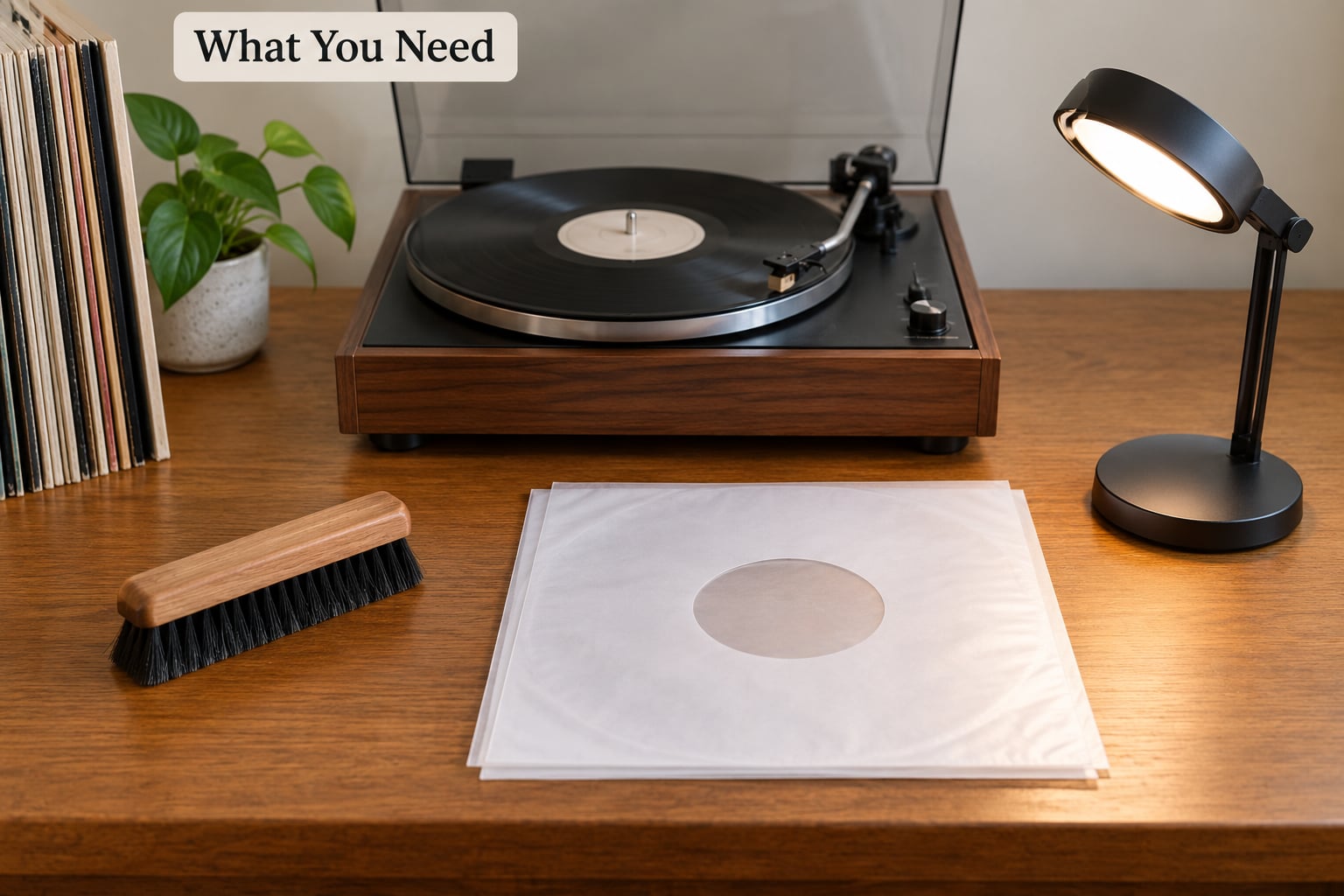
You need far less than a collector guide suggests. Four things matter: something to play them on, the right stylus, a way to see cracks, and a way to store them upright.
A turntable that plays 78s at a variable pitch. Almost any manual belt-drive or idler-drive deck from the 1950s and earlier does this, and so do a handful of modern decks sold specifically for 78s. The pitch control matters because plenty of acoustic-era discs were cut somewhere between 76 and 82 rpm. A deck with only a 33 and 45 setting will play them, but at the wrong speed and with the wrong pitch.
A cartridge with a 3-mil stylus. This is the number people get wrong most often. A 3-mil (0.003 inch) tip is small enough to sit at the bottom of a wide-groove shellac groove. A modern elliptical or microline stylus is physically too wide, sits on the groove walls, and can shave a playable disc down to nothing in one pass. Start with a 3-mil conical tip; move to a truncated diamond only once your records are playing cleanly and you want a firmer contact patch.
A phono preamp with the subsonic filter off. Low-frequency rumble sits below the audible signal on 78s, and a subsonic filter treats it as noise and rolls it off, which thins out the sound. If your preamp has a rumble filter, switch it off for these records.
Cleaning kit without alcohol. A soft carbon fiber brush, a bottle of distilled water, and a weak solution of mild dish detergent and distilled water do the job. Alcohol strips the resin from shellac and dulls vinylite, and household sprays leave residues that attract dust.
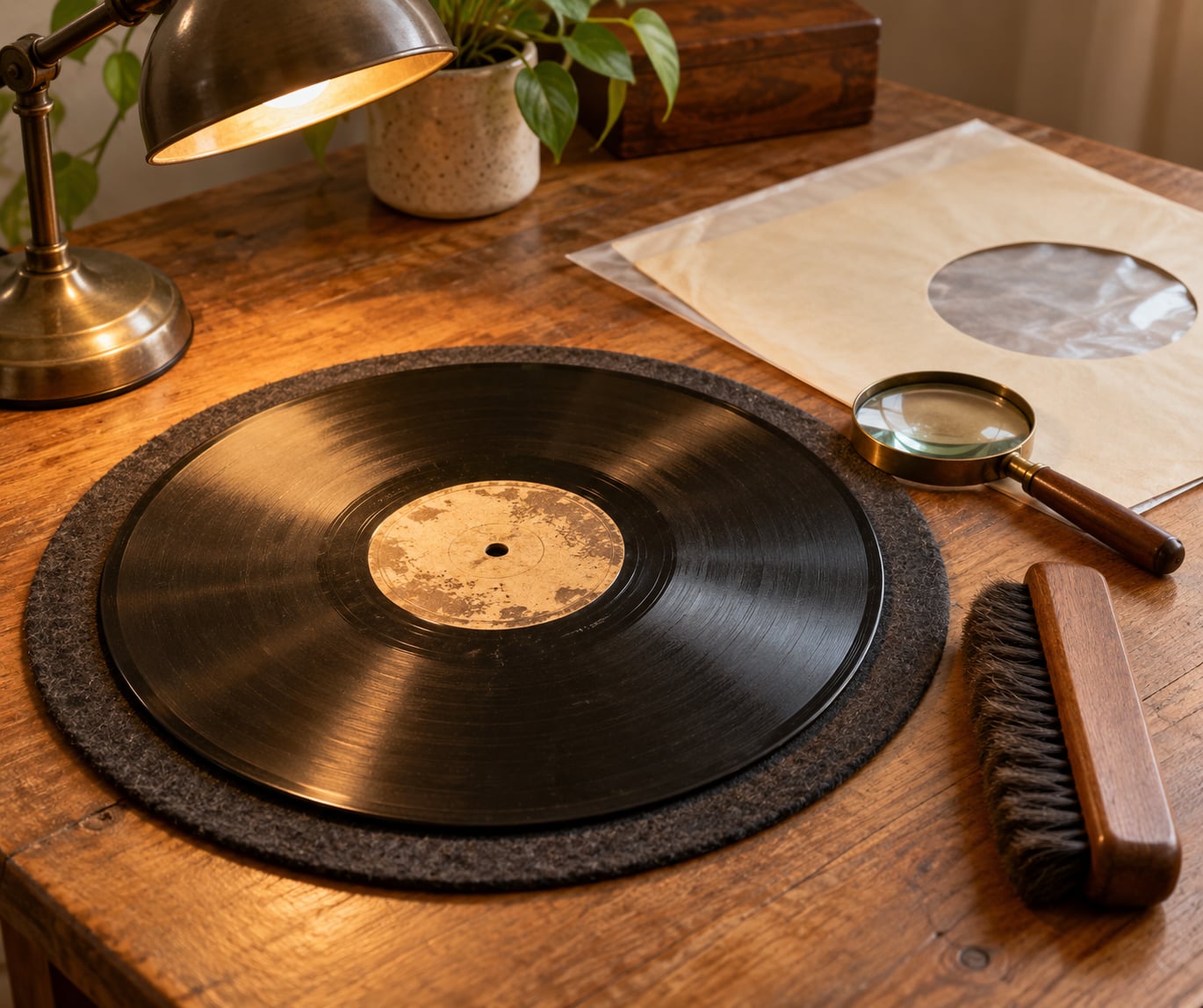
Add poly-lined inner sleeves, a shelf that holds records upright, an angled lamp for reading labels and runouts, and a notebook or spreadsheet. The logbook sounds fussy until you find the same record listed three times in two different sleeves.
Step-by-Step
1. Decide What You Want to Collect
Collectors who enjoy collecting usually last longer than collectors who are hunting for money. Both are valid, but the shopping rules differ completely, and mixing them is how people end up with 400 records they never play.
Pick one axis and stay with it: a genre (blues, jazz, country, gospel), an artist, a label, a decade, or a format quirk. Blues and race records carry the deepest collector interest, jazz from the 1920s and 30s runs close behind, and pre-war country and hillbilly material has a very dedicated following. Common big band and mainstream pop 78s are plentiful and inexpensive, which makes them a good practice collection for learning grading and cleaning without risk.
Write the focus down in the logbook, including what you will not collect. The exclusion list matters more than the inclusion list on day one.
2. Learn the Basic 78 rpm Formats
Not everything called a 78 is shellac, and not everything cut before 1930 is played at 78 rpm. Get these categories straight and you will never overpay for the wrong thing.
- 10-inch shellac, roughly 1898 to 1948. The standard commercial 78 for half a century. Typically one song or one movement per side.
- 12-inch shellac and early vinyl. Larger discs, often album-length, appearing from the mid-1930s onward.
- Vinylite, Plasticine, and other trade materials. Early plastic compositions that imitate shellac. Brittle in their own way, and sometimes cleaned with alcohol without damage — a per-disc judgement, not a blanket rule.
- Later vinyl 78s, into the 1950s. These play more predictably and matter less as rarities, though the music is often excellent.
How to tell if a record is vinyl or shellac: color is a hint but not a verdict, since shellac ranges from clear amber to near-black and black shellac exists. Turn the disc over. Shellac shows a fine brown swirl pattern throughout the body and usually looks slightly translucent at the edge. Weight is not a reliable test either. The most dependable method is a fingernail scrape on a non-recorded area near the label or the runout: shellac gouges and powdery flakes, vinyl dents and leaves a dark mark. Test an edge you never intend to play.
For pre-1925 material, note that acoustic recordings were cut to horn and bell without electrical amplification, so they need more volume and speed accuracy, and they sometimes carry surface noise that electrical-era pressing methods removed. These play at whatever speed suits the recording, which is why variable pitch matters.
3. Inspect the Grooves, Label, and Center Area
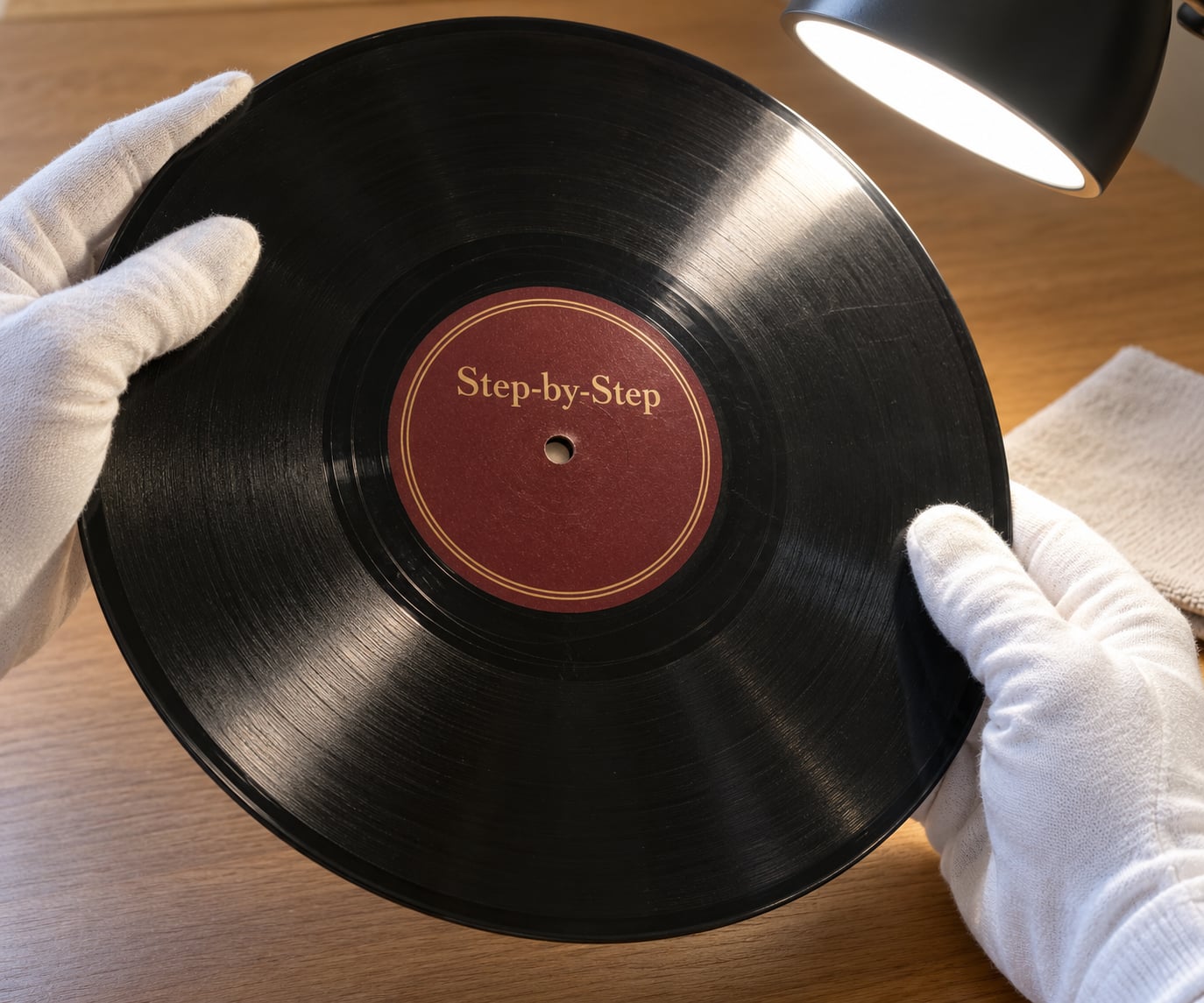
Hold the disc by the edges, under a bright light, and look through it. What you are looking for, in order of severity:
- Cracks and chips. A crack that reaches the label or the center hole splits the disc into pieces during one spin. A short crack in the outer grooves may be playable but will grow. Chips on the edge matter less than chips near the label.
- Warps. A disc that will not lie flat, or that rocks visibly, may not clear the cartridge on a warped disc. Severe warps also mean the pressing was poor and the sound usually matches.
- Skips and deep scratches. Look across the grooves under raking light. A scratch you can catch a fingernail in is a problem; a hairline surface scratch mostly adds noise.
- Groove wear. On heavily played commercial 78s the bottom of the groove is worn flat and the audio gets thin and muffled no matter how well the surface looks.
- Label condition. Torn labels, peeled corners, pen writing, tape residue, and seam splits all reduce value, because the label carries the catalog number and often the only evidence of the pressing.
- Center area. Enlarged or elongated center holes mean a hard plug or adapter was forced in. The record will play but it is a defect worth pricing in.
Grade against the Goldmine scale, adapted for shellac: Mint, Near Mint, Very Good Plus, Very Good, Good Plus, Good, Fair, Poor. Two adjustments matter for 78s. Surface noise is normal on acoustic-era pressings and should not be graded as damage the way it would be on an LP. And crack-free, unwarped, unskipped playback matters more than cosmetic perfection — for listening collections, a noisy clean copy beats a beautiful unplayable one.
4. Check the Label and Runout Information
This is where a cheap record becomes an original pressing, and where a reissue pretending to be one gets caught. Read three things: the label, the catalog number, and the runout.
The label tells you the company, the series, and often the recording date or session. Artwork variants matter — different colors, different label designs, and different wording can each signal a different period of a label’s life. A plain generic label on an otherwise fancy record is a reason to look twice.
The catalog number, usually printed on the label and sometimes with a suffix, identifies the specific release. Suffixes often indicate a later issue: different takes or a different coupling of the two sides. Compare the catalog number against a database entry, not against memory.
The runout, etched into the two small areas between the last groove and the label, carries the matrix numbers plus the mastering and pressing plant codes. A master plate etched by an engineer is not the same as a copy pressed from a working plate by a plant. For a beginner, the practical rule is simple: record the runout exactly as you see it, letters, numbers, and symbols, for every record you consider buying. Typed or stamped runouts and labels suggest a later issue; hand-etched marks suggest closer to the original session.
Other categories to recognize by name: dubbed copies (genuine but made from a worn or damaged master), reissues and later pressings, pirate or bootleg dubs (usually on unbranded or plain labels, sometimes under a different company name), and foreign pressings. The Jazz Crazy channel and the Talking Machine Forum both go deep on distinguishing these, and the Steve Hoffman forums stay the sharpest place to get a second opinion on a specific disc.
5. Test Play Before Buying
Test play is the only inspection that reveals what the grooves actually hold, and it is where most of your learning happens. Play a side at low volume first, then judge.
Check that the first revolution is silent or nearly silent — a bump there means a warp or a bad spot. Listen through a full side without your hand hovering over the lever; note every skip and how often it repeats. If the same spot skips three times, it will not get better.
Listen for surface noise level, which tells you a lot about groove wear, and for distortion on loud passages, which usually means the groove walls are damaged or the cartridge is aligned badly rather than the disc being bad. Follow the needle through to the runout and confirm both sides play through to the end.
Walk away when a skip repeats, when a crack reaches the label or center, when the warp will not clear, or when the noise floor means you are playing a record that has been used as furniture. On a focused collection, also walk away when the price assumes a better copy than the one in your hands.
6. Compare Price With Condition and Rarity
Price follows three variables: how many copies exist, how good this copy is, and how much the music matters to the people who want it. Anyone still learning how to collect 78 rpm records tends to assume age equals value, and that assumption gets expensive fast. Most 78s were pressed in enormous quantities, so the default assumption should be that a record is common until evidence says otherwise.
Before paying, check sold prices rather than asking prices. Popsike is the reference for auction history on collectible 78s, Discogs shows marketplace listings and community notes, and general record price sites cover mainstream titles. Cross-check at least two sources, because each covers different material well and none covers everything.
Price the condition you actually hold. A worn copy of a common pressing is a play-and-file record. A clean copy of a scarce pressing on a label collectors prize is a different purchase entirely, and the same catalog number can vary hugely between the two. When a seller describes a record as an original pressing, confirm the runout supports it. When a seller cannot produce the runout, treat the claim as unverified.
One more collector rule worth learning early: preserve access to the music. A collection nobody else can hear or borrow is worth less to the culture that produced it than a well-cataloged one shared with libraries, archives, and other collectors.
7. Store and Care for the Collection
Store records upright, never flat. Flat storage puts stress on the outer grooves and, on shellac, slowly deforms the disc. Vertical storage with the weight distributed down the spine is what these formats were designed for.
Use poly-lined inner sleeves for anything with a bare or delicate shellac surface, and outer sleeves that fit without stretching. Keep the collection away from direct sunlight, from radiators, and from any room that swings between damp and dry. Cool, stable, moderate humidity is the goal; a basement that floods and an attic that bakes are the two places to avoid.
Clean before you play and after handling. Use the dry brush first, then a barely damp cloth with the distilled water and mild detergent solution, working in the direction of the grooves. Dry with a clean microfiber cloth and let the disc air dry fully before sleeving it. Skip the wet cleaners and never put alcohol on shellac.
Play shellac sparingly and handle it minimally. Each spin wears a groove, and most collectors set a side a few times a year for the good copies. If you want to hear a record often, consider digitizing it once and playing the file. Ship discs like eggs if you ever sell or trade: double boxing, stiffeners, no pressure on the record, and padding on all sides so nothing moves inside the parcel.
Catalog as you go. Record artist, title, label, catalog number, matrix and runout, diameter, material, condition notes, and what you paid. Discogs handles 78-specific data entry well once you know which fields matter, and a spreadsheet works fine if you are not ready for that.
Common Mistakes
Getting good at how to collect 78 rpm records is mostly about the handful of habits below. Each one shows up in nearly every beginner’s first year.
Assuming every old record is valuable. Default to common. Most 78s were mass pressings, and treating age as value is how beginners end up paying three figures for a clean copy of something pressed 200,000 times. Check sold prices before you get excited.
Ignoring condition. A crack, a skip, a warped edge, or a worn groove costs more than most individual 78s ever will. Grade before you negotiate.
Using a modern elliptical or microline stylus. These are sized for microgroove LP records. On 78s they sit on the groove walls and destroy the groove. Fit a 3-mil conical or truncated diamond stylus.
Playing acoustic-era discs at exactly 78 rpm. Pre-1925 recordings were cut at varying speeds, sometimes as low as 76 or as high as 82. Use the variable pitch control and listen for the clearest playback rather than trusting the dial.
Cleaning with alcohol or commercial sprays. Alcohol dissolves shellac and dulls vinylite. Use distilled water with a small amount of mild detergent, and nothing sprayed directly onto the disc.
Storing records flat. Flat storage stresses the outer grooves permanently. Keep them upright in poly-lined sleeves.
Skipping the runout check. The runout is where original pressings, dubs, and reissues give themselves away. Read it and write it down before you buy.
Frequently Asked Questions
Are pre-1925 78 rpm records really played at 78 RPM?
Often not. Acoustic-era recordings were cut directly to a horn and bell without electrical amplification, and many discs were cut at speeds between roughly 76 and 82 rpm. This is why a turntable with variable pitch matters: listen for the clearest playback instead of trusting the dial. Playing an acoustic disc at exactly 78 often leaves it slightly flat in pitch.
What turntable and cartridge do I need to play 78 rpm records?
Any deck with variable pitch control and 78 rpm capability works, including most manual belt-drive and idler-drive machines from the 1950s and earlier and several modern decks sold for 78s. Pair it with a cartridge carrying a 3-mil conical or truncated diamond stylus, and turn the subsonic filter off on your phono preamp. Avoid elliptical and microline styli, which are sized for LP grooves.
How do I tell whether a record is shellac or vinyl?
Scrape an unplayed area near the label or in the runout with a fingernail. Shellac gouges and sheds powdery brown flakes, while vinyl dents and leaves a dark mark. Turn the disc over and look through it: shellac shows a fine brown swirl pattern and often looks slightly translucent at the edge. Color alone is unreliable, because shellac ranges from clear amber to near-black.
Are old 78 rpm records worth money?
Most are not, because most were pressed in large quantities. Value comes from scarcity, label interest, genre, and condition together. Blues and race records lead collector interest, jazz from the 1920s and 30s follows, and common big band and pop 78s are plentiful and inexpensive. Check sold prices on Popsike and Discogs before deciding what a record is worth to you.
How do I clean 78 rpm shellac records safely?
Brush the surface dry with a soft carbon fiber brush first, then wipe with a cloth barely dampened with distilled water and a small amount of mild detergent, always moving in the direction of the grooves. Dry with a clean microfiber cloth and let the disc air dry fully before sleeving it. Never use alcohol or sprayed cleaners, since alcohol dissolves shellac and dulls vinylite.
Conclusion
Start with three things and the rest follows. Choose one narrow musical focus and write down what you will not collect. Spend a week learning the formats, the labels, and how to read a runout, so you can tell an original from a dub in seconds. Then make condition the deciding factor every single time, because on these fragile discs a cheap copy in good shape beats an expensive copy you cannot play.
Everything else — cleaning, storage, cataloging, playing carefully — is habit rather than technique. Pick it up from there.