Last updated: October 2026
Short answer: read the matrix number in the run-out groove, the smooth band of vinyl between the last track and the centre label, then check that code against documented pressings of the same release. That single line of etching settles the question more often than anything else on the disc. The label, the sleeve and the barcode only confirm what the dead wax already told you.
A reissue is a record pressed again after the original run, usually years later, often from a digital source. An original pressing, or first pressing, was made from the metal parts used in the first production run of that album. Because labels and cover art get reused across decades of pressings, the outside of the record can lie to you. The run-out groove rarely does.
This is the order I work in every time a record arrives without a clear pressing description: dead wax first, everything else second. Ten minutes with the record out of its sleeve will tell you more than an hour of guessing from the artwork. What follows is the same seven checks, in the same order, with a verdict at the end of each one.
One word of housekeeping first, because it trips up almost everyone. A reissue is a new issue of the album, usually years after the original, often with revised artwork and audio from a digital master. A repress is a further pressing of an edition that already existed, made when the original run sold out, using the same plates and sometimes the same labels. Both are later pressings. Only the first run is an original pressing. Sellers mix these up constantly, and the wording on a listing tells you much more about the seller than about the record.
Table of Contents
- What You Need
- Step-by-Step: How to Tell If a Record Is a Reissue or Original
- 1. Check the Album, Artist, and Release Details
- 2. Identify the Label and Catalog Number
- 3. Compare the Label Design and Printing
- 4. Read the Runout, Etchings, and Matrix Numbers
- 5. Examine the Sleeve, Jacket, and Inserts
- 6. Look for Evidence of an Earlier or Later Pressing
- 7. Compare Against Known Examples and Estimate Confidence
- Common Mistakes
- Judging by the cover and the label alone
- Treating a barcode as the whole answer
- Assuming a high catalog number means a reissue
- Trusting shrink-wrap, hype stickers or sealed packaging
- Assuming heavier vinyl means a better or earlier pressing
- Ignoring regional issues
- Frequently Asked Questions
- What is a reissue vinyl record?
- What is a repress?
- How do I know if a vinyl is a first edition?
- How do I find the matrix number on a vinyl record?
- Do first pressings sound better than reissues?
- How do I tell if a record is a bootleg?
What You Need
You need very little, but the light matters more than anything else. Nothing about this process requires expensive equipment.
- A bright directional light. A desk lamp or clamp lamp at an angle. A run-out groove is a shallow scratch that is invisible under flat ceiling light and obvious when light rakes across it.
- A jeweller’s loupe or a decent magnifier. Hand-etched matrix numbers are cut with a scribe and are irregular. Machine-stamped numbers are crisp and perfectly even, and the difference only shows up under magnification.
- A clean record and a soft brush. Dust in the dead wax is the main reason people cannot read their own records. Clean before you look, not after.
- A discography reference. Discogs is the broadest database and has a pressing notes field that collectors fill in carefully. 45cat covers seven-inch singles, MusicBrainz covers catalog numbers across formats, and the Internet Archive Wayback Machine recovers label catalogs from labels that no longer exist.
- Comparison images of known pressings. A photograph of a confirmed first pressing of the same album, label and territory beats a hundred descriptions.
- A notebook. Write down the full matrix line exactly as it reads, including hand-etched details. Half the time you will need it again.
Two handling notes. Hold the disc by the edges under the label and the outer rim, never across a flat surface, and keep heat and direct sunlight off it while you inspect, because warping from a hot car or a window ledge is the fastest way to destroy a copy you were trying to appraise. Stack the sleeve and any inserts nearby in the order they came out, because the order of the paperwork tells you things too.
Step-by-Step: How to Tell If a Record Is a Reissue or Original
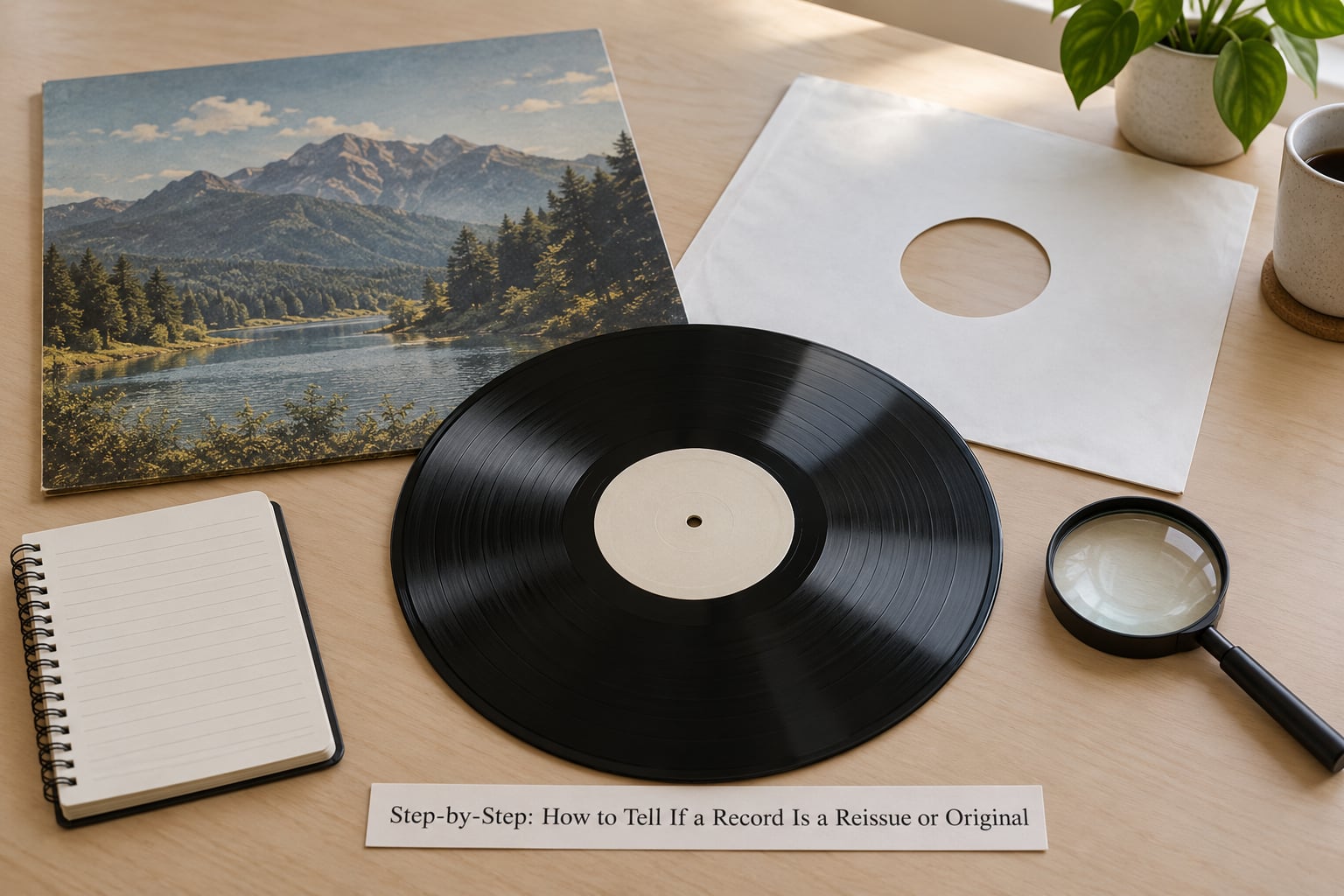
Work top to bottom. Steps 1 to 3 are fast and mostly free, step 4 is the one that decides it, steps 5 to 7 confirm and quantify. By the end you will end up in one of three states: confirmed original, confirmed reissue, or unresolved. Unresolved is a perfectly good outcome and far better than a confident wrong answer.
1. Check the Album, Artist, and Release Details
Start with what you can read before you touch the vinyl: title, artist name, track listing, running time, and credits. Alternate editions carry different track lists, and that alone identifies them.
A reissue that adds two bonus tracks or replaces one single with a 12-inch remix is not the first pressing, whatever the catalogue number on the label says. Revised liner notes, an updated producer credit, a remastered sound credit or a changed running time all point the same way. Compilation status matters too: if the tracks were drawn from several earlier singles or a previous album, you are looking at a compilation pressing, not an original issue of the record the sleeve names.
Format tells you the era before anything else does. A 78 rpm disc has a noticeably different speed feel and usually a much wider groove; most surviving 78s date from before 1958. A 10-inch LP is a 33 rpm format that largely existed in the early 1950s before the 12-inch LP displaced it. A 7-inch single is normally 45 rpm, and a 12-inch single of the same song can be either. Check the label for a speed marking, and if there is none, judge it by size and by whether the tonearm can reach the inner tracks without trouble. If a 12-inch disc has a small hole in the centre, that is a strong clue it was cut for jukebox use and pressed at 45 rpm.
Verdict: bonus tracks, a different track list, compilation credits or a changed running time mean this is not the first issue. Move on.
2. Identify the Label and Catalog Number
The catalog number is the commercial fingerprint of the release, and it sits on the label, the sleeve, the back cover or the spine. Read it exactly, including the suffix, because the suffix is where the pressing history lives.
Suffix conventions differ by label but follow a general logic. A plain number usually means the first issue. A letter suffix such as -1, -2 or -A often indicates a second or later issue in the same series. Some labels appended a year, so a number ending in a four-digit year is almost always a later issue. Columbia’s own practice ran through multiple labeled generations, with the six-eye label marking pre-1962 issues and the later 12-eye format carrying different suffix conventions entirely.
Regional editions matter here. The same catalog number can exist as a US issue, a UK issue and a Japanese issue with different sleeves, different labels and different mastering, so a catalog number narrows the field rather than settling the question. Series numbers matter in the same way: a number in the middle of a numbered series tells you the edition, and later positions in the series are later issues.
Verdict: a dated suffix or a high series position points away from a first pressing. Confirm against the label’s own numbering history before you rely on it.
3. Compare the Label Design and Printing
Original labels were commonly printed with matte or slightly rough finishes, while many later issues were produced with glossier or digital-printed labels. That difference is a real signal, and it is not a proof on its own.
Look at more than finish. Letter spacing shifts between printing runs, fonts get redrawn, colours drift, and legal text changes from one era to the next. Trademark symbols are a useful marker: older pressings carry a small TM, later ones a registered R symbol, and some labels moved from one to the other partway through a catalog’s life. Manufacturing statements appear on some territories and not others, and distributor names change with corporate mergers, so a distribution line naming a different company than the one you expected usually means a later issue.
Named examples help more than general rules. Columbia’s six-eye label marks the mono era before 1962. Blue Note original pressings from the late 1940s and early 1950s carry a distinctive ear-shaped pressing plant mark that was dropped on later issues. Capitol’s coloured label variations through the 1950s and early 1960s are well documented, and collectors argue about which of them sounds best. The trap is assuming a look you recognise as vintage guarantees a first issue. Labels were re-used for decades, and a well-made reissue can carry a period-correct label design exactly.
Verdict: a matte label with old-style typography and a TM symbol is consistent with an early pressing. Consistent with is not the same as confirmed.
4. Read the Runout, Etchings, and Matrix Numbers
This is the check that decides most cases. The run-out groove, also called the dead wax or lead-out area, is the unrecorded band between the final track and the label. Hold the disc under the light at an angle so it rakes across the surface, and rotate it slowly. Machine-stamped numbers appear as bright raised or etched characters; hand-etched entries catch the light as thin, irregular scratches with no consistent letter shape.
A matrix line usually contains several pieces of information. The catalog number identifies the release and must match the label. A side letter, either A and B or 1 and 2, tells you which side you are looking at. A trailing stamper code tells you which set of metal parts made your copy. Mastering engineer initials give the cut, and a separate symbol identifies the pressing plant.
The stamper suffix is the part people misread most often. A bare suffix indicates the first set of metal parts. A second set of parts produces a lettered pair, conventionally -1A and -1B for the first stamper of each side, then -2A and -2B, and later -1A-1, -1A-2 and -1B-1, -1B-2 for subsequent platings of the same stamper set. Numbers inside the suffix represent later platings of the same plate, while letters represent a different stamper entirely. A trailing -1 or -A often signals the first metal parts, which is why a single suffix is suggestive rather than decisive.
Mastering initials carry real weight because named engineers are treated as provenance by collectors. Common ones include RL for Robert Ludwig, Porky for George Peckham, RVG for Rudy Van Gelder, HTM for Harry T. Moss, and mark-outs such as STERLING for the Sterling operation and PORKY for Peckham’s own cutting work. A different cut from the one documented for the first issue tells you this is a later plating even when the label looks original.
Pressing plant symbols are the last piece. Marks such as the Plastylite ear, the GCM triangle, BST, PRS or RCA marks each identify the plant that pressed the record, and a plant that only opened in 1974 cannot appear on a 1971 pressing. Check the plant’s opening and closing dates whenever you see one you do not recognise.
A worked example. A UK Pink Floyd record from 1973 carries a matrix in the SHVL 804 series with side letters and a stamper pair such as A-2 and B-2, plus an HTM credit on many pressings. That reads as the second stamper set on the second plating, made at the Pye operation. Compare that line with the documented first issues for the same catalog number, and you know within a minute whether the copy in your hand is early or late, regardless of how convincing the sleeve looks.
Verdict: if the catalog number matches the label, the stamper suffix is early, and the cut and plant fit the claimed date, call it an original pressing pending confirmation. If the suffix is high or the plant postdates the claimed year, call it a later pressing.
5. Examine the Sleeve, Jacket, and Inserts
The packaging is confirmation, not proof. Artwork gets reused, so a sleeve cannot make a copy an original, but it can contradict a pressing you thought was first.
Check the barcode. A barcode on the back or on the sleeve is one of the most reliable later-issue signals, because barcodes on records became routine decades after the first issues. Its position matters: on many UK issues it sits on the back cover, on some later issues on a small sticker on the front, and the difference between a printed barcode and an applied sticker often distinguishes the issue. Printed copyright and phonographic copyright dates are the next check, and a copyright date later than the release is a clear giveaway.
Then look at construction. Original gatefolds tend to have seam allowances, spine text and paper stock that later issues lack, while some later issues are a plain single sleeve with no gatefold at all. Inner sleeves tell their own story: a plain white inner with die-cuts suggests the record came from a factory pack, while a printed inner is usually part of the original package. Inserts, obi strips on Japanese issues, hype stickers and bonus track listings are all later-issue or anniversary-edition signals.
The sticker language deserves scepticism. Phrases like remastered from original tapes or newly remastered for this edition describe a marketing intention, not a verifiable process, and plenty of them come from a digital master that nobody traced. An anniversary edition sticker with a year on it tells you the year the reissue came out, nothing about the copy underneath.
Verdict: a barcode, a later copyright date, a hype sticker or revised artwork confirms a reissue. None of these should ever be the reason you bought a copy.
6. Look for Evidence of an Earlier or Later Pressing
Run through a short checklist of contradictions before you decide. Each of these on its own weakens a first-pressing claim.
- A track list that differs from the documented first issue, in either direction.
- Liner notes or credits naming a mastering engineer whose work on that title began after the claimed issue year.
- A new distributor or manufacturing company on the label or sleeve, often the result of a corporate rename or acquisition.
- Updated mastering information on the sleeve, such as a credit to a facility or engineer not involved in the original sessions.
- Cover art that has been redrawn, recoloured or re-typeset compared with the first edition.
- A catalog reference in the sleeve that disagrees with the number on the label.
- Shrink wrap still on the package. Sealed copies exist, but they are also the easiest thing in the world to fake, and a sealed reissue presented as an original is a routine scam.
Where the label and the matrix number disagree, trust the matrix. A sleeve and label can be swapped or reproduced; the run-out groove is cut into the record itself at the pressing plant.
Verdict: two or more contradictions on this list and you are looking at a later pressing even if nothing about it looks obviously wrong.
7. Compare Against Known Examples and Estimate Confidence

Now go to Discogs and search the artist and title. Filter the versions by country of origin, year of release and pressing plant rather than taking the first result, and open the Notes and Credits fields, which are where collectors record exactly which matrix belongs to which stamper. The version listed at the top is frequently the one most people buy, not the first issue, and that mismatch is the single most common way collectors end up paying an original’s money for a reissue.
Use 45cat for singles and the Wayback Machine for labels whose catalogs predate the internet. Cross-check against at least two independent sources before you state a conclusion, and if the sources disagree, record the disagreement rather than picking the answer you prefer.
Then grade your own confidence honestly, in three buckets.
- Confirmed original: catalog number and stamper suffix match a documented first issue, and nothing on the label, sleeve or packaging contradicts it.
- Confirmed reissue: barcode, later copyright line, a stamper suffix beyond the first set, or a documented plant date that postdates the claimed issue.
- Unresolved: the evidence is missing, the run-out is worn or the copy has been unverified by anyone. Say so plainly rather than guessing. An unresolved identification is a normal outcome in a collection, not a failure.
Here is the same evidence, tell by tell, in the form that is most useful when you are standing in a shop with a record in one hand and your phone in the other.
- Run-out matrix. Points to an original when the catalog number matches the label and the stamper suffix sits at the first set or the second stamping. Points to a reissue or repress when the stamper count is high or the lettered suffix is well past the first set.
- Mastering initials. Points to an original when the cut matches the one documented for the first issue. Points to a reissue when it names an engineer or facility whose involvement began later.
- Pressing plant mark. Points to an original when the plant was operating during the original release years. Points to a reissue when the plant opened after the claimed issue year.
- Label finish. Points to an original when the print is matte or textured with period typography. Points to a reissue when it is glossy or digital, with redrawn fonts or changed spacing.
- Trademark symbol. A small TM on label and sleeve points to an original. A registered R symbol, or no symbol at all, points to a reissue.
- Barcode. Absent from sleeve and back cover points to an original. A printed barcode, or a sticker added later, points to a reissue.
- Copyright line. Dates that match or predate the release point to an original. A copyright date later than the release year points to a reissue.
- Sleeve and inserts. A gatefold with a factory inner and matching artwork points to an original. Revised artwork, an obi strip, a hype sticker or bonus tracks point to a reissue.
Common Mistakes
Almost every wrong identification I have seen came down to one of five errors. Each has a straight fix.
Judging by the cover and the label alone
Artwork and labels are reproduced, re-used and re-tooled across decades. A sleeve can be from 1971 wrapped around a disc pressed in 2015. Fix: always read the run-out before you form an opinion, and if you cannot read the run-out, treat the pressing as unverified.
Treating a barcode as the whole answer
The absence of a barcode proves nothing. Plenty of first issues have one, plenty of later issues were made before barcodes were common, and some barcodes sit inside the sleeve rather than on the back. Fix: use the barcode as one line in a list, never as the verdict.
Assuming a high catalog number means a reissue
Catalog numbers increase because a label issued more records, not because a specific copy was pressed later. Some labels simply skipped numbers for reasons that have nothing to do with reissuing. Fix: check that label’s numbering history before drawing a conclusion from a number’s size.
Trusting shrink-wrap, hype stickers or sealed packaging
Shrink is trivially replaced with heat film, and sticker language is marketing copy. Fix: discount every sticker that does not come with a verifiable matrix line, and treat sealed status as a description of the packaging rather than of the record.
Assuming heavier vinyl means a better or earlier pressing
Weight varies by plant, by era and by supplier for reasons unrelated to pressing date. Fix: use weight as a curiosity, never as evidence, and spend your attention on the matrix instead.
Ignoring regional issues
Japanese, UK and European issues of the same catalog number can carry different artwork, different inserts and different cuts, and a collector who only checks the US pressing will misread all of them. Fix: identify the territory from the label, the sleeve text and the plant mark before comparing against any reference.
Two pieces of collector advice I would keep. The first is that collectors routinely discover their supposed original is a later pressing only by comparing the matrix against the notes field of a database entry, which is why step 4 exists and why it comes before everything else. The second is that condition routinely beats pressing year: a clean, well-kept reissue will beat a scratched original every time, and beginners chasing first pressings at the expense of condition usually end up disappointed. If you simply want to listen to the music, most reissues are perfectly fine records, and a well-cut reissue from a plant known for good work can be a better buy than a battered copy from a famous year. Decide which side of that fence you are on before you pay for the hunt.
Frequently Asked Questions
What is a reissue vinyl record?
A reissue is a record pressed again after the original production run, usually years later and often with audio taken from a digital master. The sleeve art, catalog number and track list may also change. A reissue is easy to spot from packaging clues such as a barcode on the back cover, a later copyright date or revised artwork, and the run-out groove shows a stamper suffix beyond the first set.
What is a repress?
A repress is a further pressing of an edition that already existed, made after the original run sold out, usually using the same plates and sometimes the same labels and artwork. It differs from a reissue in that the edition itself is not new. Sellers use the two words interchangeably, so read the matrix number rather than the listing wording to know which one you have.
How do I know if a vinyl is a first edition?
Read the matrix number in the run-out groove and check it against documented pressings of that release. The catalog number on the etching must match the label, the stamper suffix should be at the first set, and the mastering initials and pressing plant should fit the claimed date. Packaging clues such as a barcode or a later copyright line confirm a reissue but can never establish a first pressing on their own.
How do I find the matrix number on a vinyl record?
Turn the disc over and hold it under a bright light at an angle, so the light rakes across the smooth band between the final track and the centre label. That area is the run-out groove or dead wax. The characters there may be machine-stamped, which looks crisp and even, or hand-etched, which looks thin and irregular. Clean the record first and use a loupe, since dust hides the etching entirely.
Do first pressings sound better than reissues?
Often, though not always, and the honest answer is that condition matters more than pressing year. A first cutting from a good tape with a respected mastering engineer usually sounds better than a reissue cut from a digital file, but plenty of later pressings from plants known for quality hold up very well. A scratched first pressing will lose to a clean later one every time, so judge the copy in front of you.
How do I tell if a record is a bootleg?
Bootlegs and counterfeits rarely copy the dead wax accurately, so a matrix line that no database entry matches for that catalog number is a strong warning sign. Other tells include labels with spelling errors, a run-out that is blank, misaligned or crudely etched, sleeves copied from low-resolution scans, missing credits and barcodes of the wrong format. Ask for a clear photo of the run-out before buying.
So if you want to know how to tell if a record is a reissue or an original, start with one thing: clean it, hold it under raking light, and read the run-out groove. Write down the catalog number, the side letter, the stamper suffix, the mastering initials and any plant symbol. Check that line against a database entry, then let the label, the sleeve and the barcode confirm or contradict it. When the evidence does not line up, say unresolved and move on. No single mark is decisive, and the collectors who get this right are the ones who treat it as a weight of evidence rather than a single clue.