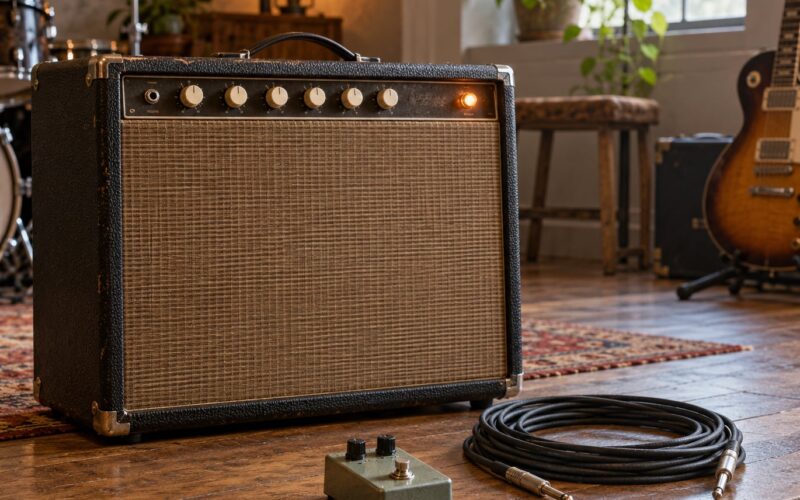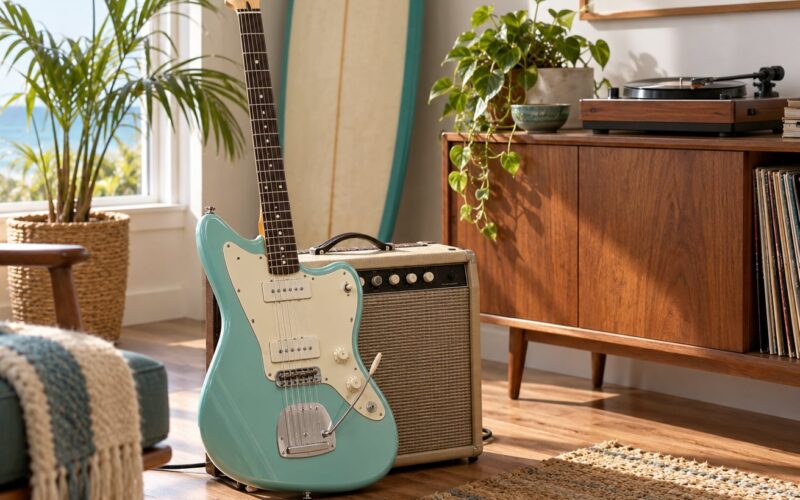
Neo rockabilly is the late-1970s British revival and modernisation of 1950s rockabilly: the twangy hollow-body guitar, the percussive slap upright bass and the shuffle backbeat, played faster, louder and straighter, with the speed and attitude of punk and new wave. It is an evolution of rockabilly, not a separate genre.
That distinction matters more than it sounds. Collectors who ask what is neo rockabilly are usually trying to work out why a record they found in a rock and roll section sounds nothing like Elvis, or why two records filed under the same name feel like different bands entirely. The answer sits in lineage and emphasis rather than in a rulebook.
I have spent enough years in record shops to know the confusion is real. Genre tags on streaming platforms are noisy, the term gets applied loosely in reviews, and Wikipedia quietly redirects “neo-rockabilly” into its much longer rockabilly article. So this guide starts from the sound itself, works through the history, and ends with what to actually listen for when you pull a record out of the bin.
Table of Contents
- What Is Neo Rockabilly?
- How Did Neo Rockabilly Develop?
- The legacy rockabilly carries
- What Musical Features Define Neo Rockabilly?
- How Is Neo Rockabilly Different From Classic Rockabilly?
- Which Artists and Bands Are Important to Neo Rockabilly?
- Restless
- Matchbox
- The Polecats
- The Blue Cats
- Shakin’ Stevens and the Rockats
- The Stray Cats
- The Cramps, The Blasters and Jason and the Scorchers
- The modern generation
- What Should Collectors Look for in Neo Rockabilly Records?
- Is Neo Rockabilly Related to Punk, Garage, and Psychobilly?
- Frequently Asked Questions
- What are some popular neo-rockabilly bands?
- When did neo rockabilly start?
- Is neo rockabilly the same as the rockabilly revival?
- What is the difference between psychobilly and neo rockabilly?
- Are the Stray Cats considered rockabilly?
- How do I start listening to neo rockabilly?
- Conclusion
What Is Neo Rockabilly?
Neo rockabilly is rockabilly played by bands who came after the originals and who borrowed from punk. The 1950s blueprint stays intact, but the shuffle gets straighter, the songs get shorter, the recordings get drier and brighter, and the attitude turns insolent. Think of it as the same car with a rebuilt engine and no chrome.
Here is how to recognise it in about thirty seconds:
- A hollow-body electric guitar, usually a Gretsch or Fender-style archtop, with quick double-stops and a short slapback or tape echo tail.
- An upright double bass played with slap and pull-off technique, sitting right in the front of the mix.
- A snare-forward shuffle backbeat, often with rimshots, rather than a big fat 1950s drum kit sound.
- Vocals with hiccup phrasing and quick vibrato, more conversational than the smooth crooning of early rock and roll.
- Songs that run two to three minutes and get to the last chorus fast.
- Almost no guitar distortion, and lyrics that treat a dance hall, a broken heart or a hot rod with equal seriousness.
Three terms trip people up, so a quick glossary. Slap bass means the strings are pulled away from the fingerboard and snapped back against the frets, percussive and rhythmic rather than melodic. Slapback echo is a short echo of the vocal or guitar, usually a fraction of a second, that imitates the sound of a singer and guitarist sharing one microphone in a small room. Shuffle feel is a swung rhythm where the off-beat is late and uneven, inherited directly from 1950s swing and R&B.
And the word “neo” itself is softer than most listeners assume. Clint Bradley of The Blue Cats has said the term came from journalists using it in the ordinary sense, meaning a new form of the music rather than a codified genre with entry requirements. That is worth sitting with, because a lot of arguments online are people treating a marketing word like a law.
How Did Neo Rockabilly Develop?
The story starts with collectors. Through the 1970s, British and European rock and roll fans dug out original 1950s rockabilly singles that had never been reissued, played them at packed club nights, and drove the demand. Independent labels answered, and the revival scene built itself on small vinyl runs that sold out at the counter.
The 1978 documentary Born Too Late: The Rockabilly Boom put the scene on film, and British music papers started covering it properly. Matchbox had “Rockabilly Rebel” in 1979, which pushed the sound toward a broader audience, and by the time the Stray Cats reached British audiences in the summer of 1980 the scene had a chart presence. Punk arrived on the same dance floor.
That overlap is the whole engine. Rockers and punks shared venues, sound systems and the same contrarian mood, and they disliked each other at least as much as they influenced each other. The Teddy Boy drape jacket and the Oi! boiler suit sat in the same room and rarely mixed. A lot of neo-rockabilly’s identity comes from that friction rather than from a musical rule.
Small labels did most of the work. Nervous Records, Rockhouse, Northwood and Fury released much of the British 1980s output on cheap, quickly pressed, sometimes hand-stamped 7-inch singles. The sound was rough, sleeves were photocopied, and pressing variants turned up years later in boxes that had been mislabelled for decades.
Through the 1990s the sound bled into garage rock, punk and alt-country in the US, where cowpunk and roots rock bands picked up the shuffle and dropped the vintage dress code. Since the 2000s, club nights, festivals and a steady vinyl market have kept the format alive, and contemporary bands play it without dressing up at all. Wikipedia’s coverage of the neo period largely stops around the 1990s, which is why the modern scene gets so little written about it.
The legacy rockabilly carries
“Is rockabilly racist?” is a live search on this topic, so it deserves a straight answer. Rockabilly grew out of white country and R&B traditions and largely excluded Black American musicians at a time when Black artists were reshaping popular music. Fans wearing 1950s fashion were also reproducing a look built on racial caricature in its earliest stages. Collectors who engage with the genre honestly have to hold both the music’s influence and its blind spots in the same hand.
What Musical Features Define Neo Rockabilly?
The rhythm section is the giveaway, and it starts with the bass. An upright double bass, played with the left hand on the neck and the right hand slapping and pulling strings, has a percussive attack that sits up front in the mix. Very few genres use a full-sized acoustic instrument this exposed at the centre of the sound.
The guitar is usually a hollow-body archtop with single-coil or Filter’Tron-style pickups, played with palm-muted eighths, ascending double-stops and quick chord fragments rather than sustained lead lines. No distortion, no effects pedals beyond maybe a vibrato unit. Rhythm guitar often cuts with a sharp transient on the snare beat.
Drums are snare-forward. A shuffle or half-time backbeat with rimshots and fills borrowed from 1950s R&B, often driven hard enough that the kit sounds like a live room rather than a studio.
Vocals sit closer to speech than to crooning. Hiccups, clipped phrasing, a fast vibrato on held notes, and verses that sound conversational are all common. The classic vocalists usually had bigger, smoother voices; the neo revival often trades polish for character.
Sonically, the neo approach is usually more linear and less swung than the 1950s. Song forms lean on 12-bar blues and I-IV-V progressions, but verse structures get shorter and choruses arrive sooner.
One honest caveat: neo-rockabilly is broad, and no single feature is mandatory. A band can file under it while using a drum machine, a distortion pedal or a fully digital bass, and still work for a rockabilly dance floor.
Here is the quick reference for the numbers collectors quote:
| Marker | Typical Range |
|---|---|
| Tempo | Around 140 to 190 BPM |
| Song length | Roughly 2 to 3 minutes |
| Common keys | A, E, G and C, usually guitar tuned down or played in open position |
| Signature sound | Slap upright bass, hollow-body guitar, short slapback echo |
| Form | 12-bar blues and short I-IV-V rock and roll structures |
How Is Neo Rockabilly Different From Classic Rockabilly?
The difference is one of lineage and emphasis. Classic rockabilly is the 1950s original, recorded in small rooms with one or two microphones. Neo rockabilly is that music read by bands who grew up after it and who were listening to punk at the same time.
Neither is more authentic than the other. Rockabilly has been continuously performed and reinterpreted since the mid-1950s, and a great deal of the music marketed as “neo” simply continues an unbroken live tradition rather than reviving a dead one. The table below compares the four styles that get tangled together most often.
| Factor | Classic rockabilly | Neo-rockabilly | Psychobilly | Cowpunk |
|---|---|---|---|---|
| Peak era | Mid 1950s to early 1960s | Late 1970s onward, still active | Early 1980s onward | 1980s alt-country scene |
| Main origin | US, Memphis and Nashville | UK, then US and Europe | UK, East Anglia and London | US, California, Austin and Los Angeles |
| Tempo | Fast shuffle | Fast and straighter | Very fast, hammering | Moderate, rootsy |
| Bass | Upright slap | Upright slap, sometimes electric | Upright slap, heavy and driving | Upright, bass guitar or both |
| Vocals | Smooth crooning | Hiccup phrasing, quick vibrato | Snarl, sneer, shouted gang vocals | Dry, rootsy, conversational |
| Typical imagery | 1950s youth culture | Teddy Boy, rockers and hot rod | Horror B-movies, psychobilly art | Cowboy and honky-tonk imagery |
| Notable bands | Elvis Presley, Carl Perkins, Jerry Lee Lewis | Restless, Matchbox, The Polecats, Stray Cats | The Meteors, Guana Batz, Demented | Jason and the Scorchers, The Blasters |
Which Artists and Bands Are Important to Neo Rockabilly?
There is no canonical ranked list, and anyone who hands you one is telling you about their own taste. These acts are the ones that come up constantly in collector talk, in roughly the order they shaped things.
Restless
A British band that has played neo-rockabilly since the early 1980s and never fit neatly into a trend. Their approach is often described as taking any popular song and running it through a rockabilly set-up: drums, slap bass and guitar, with the original melody kept intact.
Matchbox
Formed around singer Lincoln Chase and guitarist Terry Sylvester, Matchbox had “Rockabilly Rebel” in 1979 and “Twistin’ the Night Away” in 1980. They are the bridge between the club scene and the singles chart, and they had a genuine influence on the new wave adjacent to them.
The Polecats
Formed in 1977 and led by Brian Vincent, the Polecats came out of the British scene as a live band with a punk edge and a serious back catalogue. Guitarists pass them as a reference point, and Boz Boorer has stayed a visible figure in the scene for decades.
The Blue Cats
A foundational British group whose members have been described in interviews as the closest thing the scene has to a house band. They are also the source of the useful line about the word “neo” being a journalist’s coinage rather than a genre rulebook.
Shakin’ Stevens and the Rockats
Shakin’ Stevens took the shuffle into a Welsh-language and pop-friendly chart career, and The Rockats, a multinational London band, pushed rockabilly back toward punk audiences. Both are sometimes treated as pop and crossover rather than scene bands, and both are worth hearing precisely because they are hybrids.
The Stray Cats
Formed by Brian Setzer, Lee Rocker and Slim Jim Phantom, the Stray Cats were American but arrived in Britain, and that matters. They used upright bass, twangy guitars and a rock and roll songbook, and they made rockabilly look like a contemporary band rather than a costume. Whether you call them classic revival or neo depends on who you ask, and the argument has never settled.
The Cramps, The Blasters and Jason and the Scorchers
These US acts sit on the edges. The Cramps played 1950s-informed psychobilly-adjacent rockabilly decades before the label existed. The Blasters and Jason and the Scorchers mixed the shuffle into roots rock and alt-country, which is where cowpunk comes from.
The modern generation
Reverend Horton Heat took rockabilly into a Tex-Mex and country direction. Imelda May built a large international audience on a rockabilly set-up, and bands like The Quakes and a long tail of European groups keep the clubs busy today.
What Should Collectors Look for in Neo Rockabilly Records?
Neo-rockabilly was released mostly by small independent labels, so buying it means reading the label rather than just the sleeve. The music on a second pressing is usually identical to the first, but the label design, matrix number and paper quality vary, and those variants are what make one copy interesting and another ordinary.
Start with the sound. Play a track and ask whether you are hearing a hollow-body guitar, an upright bass in the front of the mix and a shuffle that leans on the snare. If yes, you are in the right part of the shop regardless of the genre tag on the sleeve.
Then compare track listings, because compilations of this music are notoriously inconsistent. The same album title can appear with different running orders on a 1982 UK pressing and a 1990s European reissue, and some compilations use different mastering entirely.
Check pressing and country information. British 7-inch singles from this scene were often released in both mono and stereo, and the sleeves sometimes show hand-stamped or photocopied artwork that was never reused. Catalogue numbers from Nervous Records, Rockhouse and Fury turn up in inconsistent forms, so a label that looks like a misprint is sometimes the documented version.
Look at the sleeve and label honestly. Cheap sleeves ringworm, laminate lifts and spine splits are normal on this music, and they cost more than the record. A small scuff on a mono 7-inch matters less than a split spine, and the vinyl itself is usually the least fragile part.
Sourcing takes a bit of work. Many of the essential records were small pressings that sold out on release, so Bandcamp tags, Discogs pressing lists, a Rate Your Music entry and the local specialist shops become more useful than general searches. Expect to track down records across several sources rather than in one afternoon.
| Factor | What to Check | Why It Matters |
|---|---|---|
| Pressing | First pressing, reissue or reissue of a reissue | Small indie runs make early pressings scarcer and reissues inconsistent |
| Mono or stereo | Format listed on the label | Both existed in this scene and collectors treat them as different records |
| Sleeve | Spine splits, ringworm, laminate | Cheap printed sleeves fail faster than the vinyl does |
| Matrix numbers | Stamped runout on the disc | Confirms the pressing when the label is vague |
| Track listing | Running order against another copy | Compilations were re-ordered between editions |
| Label and catalogue | Hand-stamped artwork, catalogue format | Evidence of an independent pressing rather than a standard issue |
Is Neo Rockabilly Related to Punk, Garage, and Psychobilly?
Related, yes, and often played on the same bill, but they are not the same thing and the differences show up in the records themselves.
Psychobilly is the faster, louder descendant. It keeps the upright bass and shuffle but pushes the tempo up, brings in a stand-up or thrashing backbeat, and leans into snarl, sneer and gang vocals with horror B-movie imagery. The Meteors are the reference point. As The AV Club puts it, psychobilly has stayed staunchly anti-political, where neo-rockabilly is looser and more eclectic. A psychobilly band playing a rockabilly club night is borrowing the dance floor, not joining a genre.
Garage rock and punk share the independent infrastructure more than the sound: small labels, hand-stamped sleeves, cheap records, a DIY attitude to playing. Some punk bands borrow the shuffle and the imagery, which produced the punkabilly nickname, but they rarely keep the upright bass discipline for long.
Cowpunk comes at it from American country and roots music, taking the shuffle into honky-tonk and B-movie territory with looser vocal delivery and less interest in 1950s dress. Rockabilly and cowpunk share a tempo and a dance feel without sharing much else.
What genuinely overlaps is the audience and the scene: the same clubs, the same record shops, the same dancers, and musicians who move between styles over a career rather than picking one at seventeen. If you like the rhythm section and the attitude, the label matters far less than whether you want to dance or want to grin.
Frequently Asked Questions
What are some popular neo-rockabilly bands?
The most cited are the Stray Cats, Matchbox, The Polecats, Restless, The Blue Cats and The Shakin’ Pyramids from the UK scene, plus US acts like The Rockats and Reverend Horton Heat. Bands move between neo-rockabilly, psychobilly and roots rock, so a name can appear under several tags depending on the record.
When did neo rockabilly start?
The revival that led to neo rockabilly began in the UK in the mid to late 1970s, driven by collectors rediscovering original 1950s singles. It broke into the mainstream from 1979 to 1981 through records like Matchbox’s Rockabilly Rebel and the arrival of the Stray Cats in Britain. The style has continued since without a formal starting date.
Is neo rockabilly the same as the rockabilly revival?
They overlap heavily but are often framed differently. The revival, roughly 1970 to 1990, was about rediscovering and reproducing 1950s rockabilly as it was originally performed. Neo-rockabilly is the looser modern continuation, mixing in punk, garage and new wave energy and staying open to bands with no interest in vintage dress. Many listeners treat the terms as interchangeable.
What is the difference between psychobilly and neo rockabilly?
Psychobilly is faster and heavier, with a harder backbeat, snarlier vocals, gang chants and horror B-movie imagery, as played by bands like The Meteors. Neo rockabilly stays closer to the 1950s shuffle, croons more, and leans on roots and punk attitude. Bass, tempo and lyrical theme are the three quickest ways to tell them apart in a shop.
Are the Stray Cats considered rockabilly?
They are described as rockabilly more often than not, and they play a classic set-up of hollow-body guitars and upright bass on a rock and roll songbook. Because they arrived as a modern band rather than a revival act, they get slotted into neo-rockabilly by some fans and treated as straightforward rockabilly by others. Both readings are defensible.
How do I start listening to neo rockabilly?
Put on one classic 1950s record so you know the original reference point, then follow it with Stray Cats, Matchbox and Restless so the difference in production and tempo is obvious. Search Bandcamp and Discogs tags, or a streaming playlist, once a band pulls you in. Buying the vinyl of one era you love is a better follow-up than buying ten at random.
Conclusion
Neo rockabilly is 1950s rockabilly taken forward by bands who grew up after it and who were listening to punk at the same time. Hollow-body guitar, upright slap bass and a shuffle that leans on the snare, played straighter, faster and drier than the originals, with a shorter song and a looser attitude.
Start with a classic record so the contrast lands, then put on the Stray Cats, Matchbox or Restless straight after it and listen for what changed. When you start buying, follow the era you enjoyed rather than the tag, because the label is fuzzy and the pressing details matter more than the genre name on the sleeve.